


With the 'airdrop season' of leading projects like zkSync and Starknet settling down, zero-knowledge (ZK) technology has ignited community fervor and controversy like never before. Millions of users' wallet addresses have for the first time been tangibly linked to this esoteric cryptographic technology. However, amidst the clamor surrounding valuation, transaction volume, and airdrop rules, are we falling into a kind of 'winner's myopia'? Are we locking the imagination of ZK merely into the single dimension of 'making Ethereum faster and cheaper'?
While the market's attention is focused on the fierce competition in the Layer 2 track, another grand wave—the integration of AI and Crypto—is quietly rising. And ZK is the key technological bridge connecting these two super narratives. This article aims to penetrate the haze of current ZK-Rollups' popularity and put forth a core viewpoint: the ultimate battlefield of ZK technology is not to win the L2 war, but to build a credible, permissionless digital reality that defends personal sovereignty for the upcoming AI era.
(Photo from: @ayyyeandy)
ZK-Rollups: A great starting point, not an endpoint
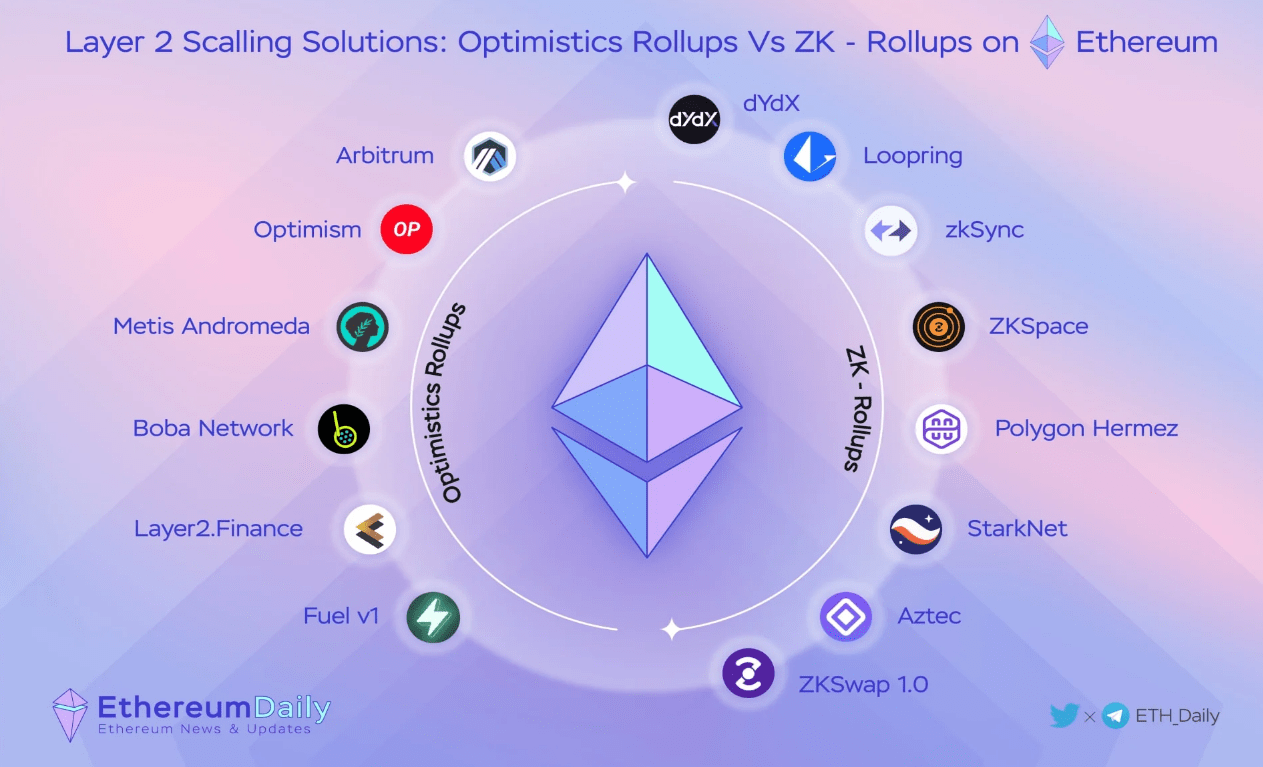
Undoubtedly, ZK-Rollups are the most successful commercial implementation of zero-knowledge proof technology to date. It solves the scalability problem in the 'impossible triangle' that has plagued the blockchain world for years with an almost perfect cryptographic technique. By bundling hundreds or thousands of transactions off-chain (Layer 2), generating a concise validity proof, and then submitting it to the main chain (Layer 1) for verification, ZK-Rollups significantly increase Ethereum's transaction processing capacity without sacrificing security.
From StarkWare's StarkNet to Matter Labs' zkSync, to Scroll and Polygon zkEVM, the technical competition among major teams has almost entirely revolved around 'EVM compatibility' and 'transaction costs (Gas Fees)'. The market has reacted enthusiastically, and capital has invested its preferences with real money. This has created a prosperity but also brought about a kind of 'tunnel vision'—we seem to assume that ZK's mission is solely to make on-chain transaction experiences faster and cheaper.
However, if we widen our perspective, we will find that limiting ZK technology solely within the framework of scalability is an underestimation of its revolutionary potential. Scalability is a necessary road, the foundation for the future; but it is not the future itself. It paves the way for us, but what truly captivates is the scenery that this path leads to.
Breaking out of the scalability siege: Three high-potential battlefields for ZK
When we no longer see ZK merely as a 'compression tool', its essence as a 'trust tool' emerges. This reveals three areas that are ripe for explosion and more in line with the spirit of Crypto fundamentalism:
1. Verifiable Computation: Reshaping the trust foundation of data and computation
Imagine a scenario: a complex machine learning model or a sophisticated financial risk model running on a cloud server, how does it prove to you that its computation process is accurate and has not been maliciously tampered with? In the traditional Web2 architecture, we can only choose to 'trust' the service provider.
ZK technology fundamentally changes the rules of the game. Through zero-knowledge proofs, the party executing the calculation task can generate a proof that certifies it has executed the computation entirely according to the preset program and returned the results honestly. The verifier does not need to re-execute the entire time-consuming calculation process; it only needs to verify this lightweight proof to establish a mathematically level trust in the results.
This is not just a technical showcase. It will unlock decentralized physical infrastructure networks (DePIN), decentralized science (DeSci), and a fairer digital advertising market. For example, in the field of ZKML (zero-knowledge machine learning) that Modulus Labs is exploring, the reasoning process of AI models can be verified, allowing users to be confident that the AI-generated results they receive have not been censored or manipulated. Projects like RISC Zero, by building a universal ZK virtual machine (zkVM), enable any type of computation to generate ZK proofs, opening the door to decentralized and verifiable cloud computing. When the computation process itself becomes trustworthy and verifiable, we no longer need to rely on centralized brands or institutions as trust intermediaries, making a truly peer-to-peer, permissionless computing market possible.
2. Decentralized Identity (DID) and On-chain Reputation: Building your Web3 native passport
In the current Web3 world, our 'identity' has been brutally simplified to a wallet address. This address records our assets and transaction history, but it cannot carry our complex social relationships, professional achievements, or credit scores.
ZK-DID allows users to selectively prove their attributes without disclosing specific personal information. For example:
Proving to DeFi protocols that your credit score is above a certain threshold to obtain better borrowing rates without exposing your entire asset status.
Proving you are a real, independent user in DAO governance voting without disclosing your identity.
Proving to a gaming platform that you are over 18 years old without showing your ID number.
This ability of 'selective disclosure' is key to building a Web3 ecosystem that can protect user privacy while establishing complex social cooperation. This is not a fantasy; Polygon ID has already built a complete open-source framework for this purpose, allowing developers to easily integrate ZK identity verification functions. Projects like zkMe focus on providing decentralized KYC solutions, where users only need to verify once to anonymously prove their compliant identity across the entire Web3 world. Even large-scale social experiments like Worldcoin utilize ZK technology to ensure that users' 'identity proofs' are separated from their on-chain behavior, protecting personal privacy. It will give rise to a native on-chain reputation system, making our digital identity no longer just a cold address, but a full, three-dimensional 'soul' governed by our own sovereignty.
3. True on-chain privacy: From transparency to 'controllable transparency'
The transparency of Ethereum is a double-edged sword. It guarantees the fairness and auditability of the system, but also exposes all users' financial situations to the sunlight. Privacy coins (like Zcash) have long showcased the power of ZK in transaction privacy, but their ecosystems are relatively isolated.
The future trend is to seamlessly integrate privacy features into mainstream smart contract platforms as 'optional' or 'default'. Imagine companies conducting confidential supply chain financial settlements on-chain; DAO organizations making anonymous salary distributions; individual users transferring assets privately.
In this arena, Aztec Network is a pioneer, aiming to bring a native privacy layer to Ethereum by building an encrypted ZK-Rollup, allowing users to conduct confidential transactions within familiar DeFi applications. Moreover, Layer 1 public chains like Aleo are designed for privacy from the ground up, aiming to create a smart contract platform that is private by default. This requires us to shift our mindset from pursuing 'complete transparency' to pursuing 'controllable transparency'—where data is private by default, but owners can grant viewing permissions to specific parties (like auditing bodies) as needed and generate corresponding ZK proofs to verify compliance. This represents the most profound change that ZK technology can bring to finance and even social governance.
The success of ZK-Rollups is a tremendous victory for ZK technology at the level of 'instrumental rationality'. It effectively addresses the industry's most pressing pain points. However, the vast universe of Crypto ultimately needs to return to the exploration of 'value rationality'—what kind of world do we really want to build with these powerful tools?
I firmly believe that the ultimate mission of ZK technology is to empower individuals with unprecedented digital sovereignty. It enables us to participate in the digital economy without sacrificing privacy, to verify the authenticity of the information we rely on, and to build a trust-based internet defined not by centralized giants, but by mathematics and consensus.
Therefore, when we evaluate a ZK project next time, we might ask higher-dimensional questions: Besides making transactions faster and cheaper, does it make our digital world more trustworthy? Does it enhance our control over our identity and data? Is it contributing to a future that is fairer and more protective of individuals?
Betting on ZK is not just betting on a technology; it is betting on a future. And that future is far grander than the TPS and Gas fees we are discussing today.