


If you ask ten spot traders, nine will tell you not to touch contracts; many have died from contracts and leverage...
Contracts are indeed frightening, leading many to be unwilling to seriously understand them and form numerous misconceptions about contract trading.
This article is suitable for those who are already trading contracts but are constantly suffering losses or have just started trading contracts. I will help you re-understand contracts, avoid the pitfalls you may encounter in the future, and bring you back from erroneous reasoning, finding the correct posture and mindset suitable for ordinary people to trade contracts.
For those eager to enter contracts, I suggest:
Try not to participate; you lack professional skills and cannot overcome human nature. The probability of you becoming the chosen one is equivalent to winning 5 million in a 2-dollar lottery. Even if you are lucky enough to come out in the end, the process is akin to the arduous journey of seeking scriptures.
First, define the ordinary traders mentioned in this article: amateur players, limited time, incomplete technical knowledge, average fundamental research capability, lack of advanced resources, average information collection capabilities, and small capital size.
Cognitive misconception: Spot trading carries little risk, while contract trading is highly risky.
Is the risk of spot trading necessarily lower than that of contracts?
Not necessarily! The coldest joke in this round of the cryptocurrency market cycle—the phrase 'spot trading is not afraid' is mocked cruelly by the majority of spot retail traders.
In fact, most people in this round died in spots—altcoins, while most industry OGs lost in spots—ETH. Altcoins can drop by 90% and then drop another 90%; bottom cuts are common.
Spot trading requires high demands on market background and the assets held, suitable for unidirectional upward movements or bullish market backgrounds, maintaining a long-term bullish outlook on high-quality value assets. Without a bullish background in this round, one may be trapped for a long time, with accounts continuously shrinking, and some altcoins may even go to zero.
Most of the time, spot trading is indeed relatively lower risk than contracts; this low risk comes more from leverage rather than from the contracts themselves.
In other words, as long as your contract leverage is low enough or you do not use leverage, its risk is not necessarily much higher than that of spot trading. Of course, it also depends on the underlying asset; if it is a low market cap altcoin, even very low leverage could still carry liquidation risks.
Contracts can operate in both long and short directions, making them more flexible, while spot trading can only be bullish. The lack of a bull market in this cycle has instead highlighted the advantages of contracts.
If you cannot be dissuaded from deciding to engage in contracts, then please participate after fully understanding and preparing!
As an ordinary player, what preparations should you make before entering?
The first lesson of contract trading, often overlooked by most players: Establish contract risk awareness and have reverence for the market and leverage!
Understanding the trading market: The market itself is in a chaotic state, with no certainty. So-called certainty is only relative. No matter how many trading skills you have learned, you cannot fully control the market. At its core, it is a probability game!
Know your opponent: Contracts are different from spot trading; they are a zero-sum game. Your profits come from the losses of the opposing traders, and your losses are the profits of the other party. In the cryptocurrency circle, your opponents may not just be ordinary traders like you; they could also be market makers, promoters, or exchanges.
Cognition of leverage risk: Ordinary players in the cryptocurrency circle are accustomed to high leverage, with 10 times being normal and 50 times not uncommon. Leverage is a 'double-edged sword'; if the market trend goes against expectations, losses will be magnified multiple times, even leading to liquidation. The characteristics of the cryptocurrency market are severe fluctuations, with altcoins commonly experiencing 20% volatility in a short time, and extreme conditions occasionally occur. High leverage means you cannot bear such volatility; sometimes your direction is correct, but you cannot escape being stopped out or liquidated...
The evil cognition of trading platforms: The lack of regulation in cryptocurrency exchanges leads to a complete disregard for ethics. Lack of transparency, manipulation, pinning, malicious liquidation, targeted liquidations of large accounts, and cutting off connections at critical times... the list goes on!
Now it has converged a lot. Since 2018, many have lost their fortunes due to the dark operations of exchanges regarding perpetual contracts. Early on, I went to a certain exchange in Shanghai to unfurl banners while drinking pesticide...
The cognitive understanding of altcoins being highly manipulated: market makers and promoters manipulate altcoins everywhere, just to what extent. As long as the profits are large enough, they will manipulate price trends ruthlessly.
The above is just a simple summary; it is recommended to systematically study each point before entering the market.
The main functions of futures contracts are hedging and price discovery. In the early days of cryptocurrency, they were used for miners to hedge, but now perpetual contracts have completely evolved into a casino.
When you face it with a casino's mindset and operational methods, it becomes a casino!
Gambling for a long time will lead to losses!
The correct way for ordinary people to engage with contracts: Treat them with a spot trading mindset, treating them as spot trades!
The advantage of contracts is to amplify the utilization of capital. Most people treat it as a path to getting rich through gambling, which is a fundamentally wrong mindset.
If you treat contracts with a mindset of spot trading, it will be completely different.
What does it mean to have a mindset and operational philosophy of spot trading?
1. Focus on a long mindset; only go long and avoid going short as much as possible, because entering the market to buy based on optimism is valid, but a bearish outlook is not a reason to enter.
(In this round, some contract players achieved great results by shorting altcoins with ultra-low leverage. Ordinary players are not advised to adopt a shorting mindset. Historically, making big money in the cryptocurrency market is primarily based on a long mindset.)
2. Mindset, not pursuing get-rich-quick schemes but seeking stability and longevity;
3. Only use low-leverage; leverage is used to improve capital utilization, not as a tool for getting rich quickly;
4. Only engage in large cycles and high levels; higher levels have greater certainty and better risk-reward ratios, while also indirectly reducing your operational frequency.
5. Refuse to engage in frequent trading and short-term operations, reducing operational frequency. Frequent operations are a major taboo; this is the biggest flaw of contract traders; control your hands and trade less.
6. Try to focus on fundamentally sound mainstream assets; small altcoins should only be participated in with small amounts. Although their gains are slow, they have high certainty and limited declines, and human manipulation and gaming are relatively less intense than small altcoins, making analytical tools more effective and liquidity better.
7. Going long brings better returns than going short. Long positions theoretically have unlimited upward potential, while downward potential is limited (in practice, this also distinguishes between USDT-based and coin-based; USDT-based is suitable for long positions, while coin-based longs may face the dilemma of dual losses).
8. Only engage in trend-following trading; in spot trading, everyone understands this principle, but in the contract market, ordinary players almost ignore the principle of 'trend is king' and 'go with the flow,' fantasizing about eating both long and short.
9. 'Slow' thinking; slow is fast, trading time for space, the long-term accumulation and compounding mindset of spot trading.
10. Be patient and wait. In spot trading, people often say 'hold coins and observe' or 'wait for the market to change.' Contract traders are eager to enter when they see volatility; not opening a position for a day feels uncomfortable. Recently, I've seen many examples of those who hurriedly entered high positions in altcoins and faced liquidation.
If you look at contracts with a spot trading mindset, the advantages of contracts become apparent:
1. Improvement in capital utilization efficiency;
2. Achieving high returns with low risk;
3. Flexible, can respond better in downtrends;
4. In uncertain markets, hedge risks without selling the spot.
(In reality, if it were spot trading, once you decide to sell, it is highly likely you won't buy back in the short term. It is difficult for a person to overcome their psychological barriers, and the market may reverse and rise right after you sell. Hedging in contracts locks in profits while leaving the spot unchanged, so your mindset won't be affected during real declines, allowing for flexible entry and exit!)
5. At specific times, it is possible to earn funding rate benefits without risk.
If you look at contracts with a spot trading mindset, the advantages of contracts become apparent:
1. Improvement in capital utilization efficiency;
2. Achieving high returns with low risk;
3. Flexible, can respond better in downtrends;
4. In uncertain markets, hedge risks without selling the spot.
(In reality, if it were spot trading, once you decide to sell, it is highly likely you won't buy back in the short term. It is difficult for a person to overcome their psychological barriers, and the market may reverse and rise right after you sell. Hedging in contracts locks in profits while leaving the spot unchanged, so your mindset won't be affected during real declines, allowing for flexible entry and exit!)
5. At specific times, it is possible to earn funding rate benefits without risk.
If you want to short, you can also treat it with a spot trading mindset.
In spot trading, you know to wait for low points and try to buy low. So in contracts, you should also wait to short at high reversal points, where the risk-reward ratio is extremely high. If done well, a single trade can yield profits equivalent to several months of operations, like the recent altcoin OM.
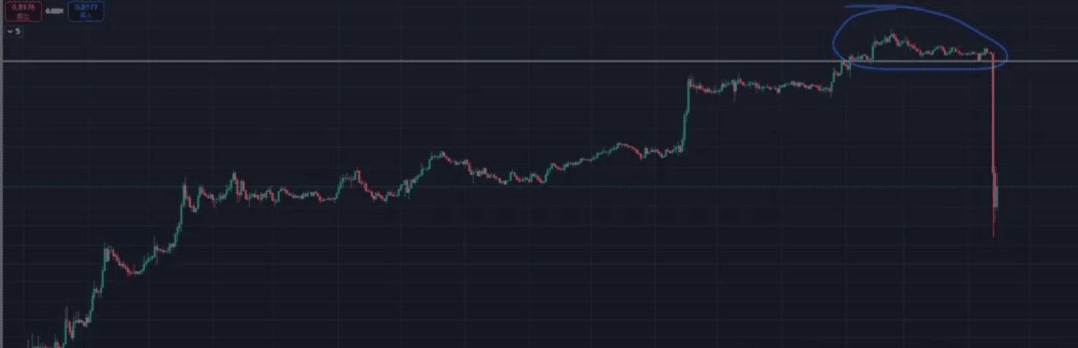
In practice, one will also learn other operational strategies and gameplay. In short, treating contracts with a spot mindset is more suitable for ordinary players.
Let’s talk about the common cognitive and operational misconceptions of ordinary people in daily contract trading:
1. Obsessed with subjective analysis and prediction.
The biggest cognitive misconception of novice retail traders is that actual analysis and prediction are two different things!
Relying on analysis and predictions will not get you anywhere; almost all successful real traders oppose analysis and predictions. The essence of trading is to respond and follow! A friend told me years ago that it took me a long time to truly understand the meaning of this sentence.
Prediction is subjective; going with the trend is objective! Analysis and prediction will only bring you biases and obsessions. While you may be wrong, you are unwilling to admit it, and when you are right, you feel self-satisfied, laying the groundwork for future major losses.
Because the essence of the market is uncertainty, and because of uncertainty, there is the possibility of market existence. The winners in practical combat are those who understand and accept this uncertainty, find relative certainty, and develop a system that matches their personality.
Why is the technical analysis camp often despised? Because analysis and prediction are the favorites of the technical analysis camp. As long as you spend three to five years, you can learn the mainstream technical analysis knowledge on the market, but it does not guarantee you will make money. On the contrary, most people start losing money after learning and eventually turn into analysts or course sellers. Traders and analysts are two different professions.
I have talked enough about this misconception; if you stay in the market for a few years and take enough hits, you will naturally understand.
Two, not loving stop losses and being accustomed to 'holding positions.'
The Bybit 2023 research report shows that in a downtrend, 83% of retail traders choose to average down rather than stop loss, among which 76% ultimately face liquidation due to continued price declines.
Not loving stop losses and being accustomed to 'holding positions' is almost a universal behavior. Heavy positions in the wrong direction lead to being liquidated once they are exposed.
Years ago, I watched a financial program on Central TV 2 interviewing Soros; the host asked him what his greatest wisdom was. Soros immediately replied—stop loss.
The second cognitive lesson discusses that the psychology of not stopping losses stems from 'loss aversion': people would rather take a chance than actively admit mistakes and face facts objectively. Psychological studies show that the pain of loss is 2-3 times more than the pleasure of equivalent gains.
Dare not face mistakes; it's suggested to take a trading cognition class—probability thinking. Trading itself is a probability game; when you're wrong, you must admit it; when you take a hit, stand straight. Stop loss is also part of the trading system.
Not only should you stop losses, but you should also exchange very small losses for maximum gains; getting rich from minimal investments is the essence of contracts!
I have read many classic books, watched interviews with masters, and learned from the trading wisdom of well-known investors in A-shares throughout history. The most impressive commonality among all masters, both ancient and modern, is the importance of stop losses.
The topic of stop losses is too broad; we will discuss it separately in the future.
Three, overly pursuing win rates.
One of the misconceptions of newbies is blindly pursuing high win rates. A high win rate does not equal stable profits; in trading, the risk-reward ratio is actually the most important.
Several great gods have emerged in the cryptocurrency contract market, profiting over A9, and have achieved financial freedom and exited the market. I saw their data earlier; their win rates are not high. The most famous 'fat man' had a win rate of 28%, while others I remember had win rates around 40%, which did not prevent them from making a lot of money.
Soros's famous quote perfectly explains the truth: What matters is not whether you are right or wrong, but how much you earn when you're right and how much you lose when you're wrong!
Additionally, I remind those who copy trades from others to be particularly wary of those with excessively high win rates. To make the data look good, they may use extremely wide stop losses or mindless martingale strategies to achieve high win rates, a common strategy among signal providers.
The following image is provided by a fan whose copy trading was ultimately exposed; the win rate is 93.8%, and all of it is from not stopping losses and 'holding on.' This account has historically had over 1,500 people copying.
Four, hold on when wrong, run away when you earn a little.
This is the biggest taboo; it is even less likely to make big money. The direct result of this operation is—small profits and large losses, which is exactly the opposite. Why is this so? Human nature determines that almost every ordinary trader will make this mistake in the first few years after entering the market, especially those who like short-term trading, often end up not being able to hold onto profits the more they watch. In short, losses should be as decisive as a lizard shedding its tail, while profits should be held onto like an alligator that won't let go.
Using the words of the trading god Livermore: Cut losses and let profits run!
Five, lacking a trading system/mode of thought.
In the end, stable profits in contract trading rely on systems and models. In reality, most people open positions randomly and emotionally, without logic, relying on a so-called illusory 'market feeling' that sometimes works and sometimes doesn't. There is no established model or systematic thinking.
Loss is a necessary path to growth; unclear and aimless losses are meaningless real losses. Meaningful losses should be justifiable, and each loss should yield lessons learned. Early losses should serve to explore and establish a suitable system and model for oneself.
Six, regarding demo accounts?
I particularly do not recommend using demo accounts!
Using small amounts of capital to trade directly in the real market, you can divide 1000 USDT into 10 parts, using 100 USDT each time to participate, and transfer in another 100 USDT after losing.
Practice suggestion: Start with a low-leverage gradual position model. In the early stages, avoid considering position management and try to open fixed amounts, and it is not recommended to hold more than two assets simultaneously.
Real trading and simulation are completely different; in simulation, the mindset is like a game, while real trading is influenced by the trader's mindset and emotions, causing behavior and operations to distort. The virtual funds in simulation cannot trigger the natural fear of loss in human nature. In simulation, even losing a million feels indifferent, but in real trading, losing ten thousand can trigger emotional breakdown, leading to frequent strategy changes, revenge trading, and other irrational behaviors.
Seven, considerations when selecting trading assets.
On social media, I often see posts analyzing small altcoins using wave theory, ignoring the fundamental applicability of the method. Wave theory is more suitable for large market indices, while small altcoins may exhibit distortion. The same issue arises when applying technical analysis to small altcoins, which can become apparent after trading in real markets for a long time.
When trading contracts, if you use analytical tools, which altcoins should you choose?
Large market capitalization, large circulation, sufficient gaming, good liquidity, large trading volume, active trading, with sufficient market participants, the more participants, the more effective, which can fully reflect the emotions of greed and fear of each participant.
Such assets have higher certainty and are relatively less likely to be manipulated, making analytical tools more effective.
When trading obscure small altcoins, there is a feeling that when you sell, it rallies, and when you hold onto it, it keeps dropping. It feels like the market is working against you. Your feelings are correct; all your buys and sells are clearly visible to market makers in the back end. If your position is small, it’s fine, but if your position is large, the competition will be more intense and targeted.
Contract trading is very challenging and requires high levels of professional skills and mindset. Ordinary players lack both conditions. Even traders who master professional skills ultimately cannot overcome their psychological barriers and human nature.
The path you have walked has been traveled by countless failures; stop losses in time, and turning back is the shore!
I am Ah Yue, focusing on analysis and teaching, a mentor and friend on your investment journey! May every investor in the market sail smoothly. As an analyst, the most fundamental thing is to help everyone make money. I will help you resolve confusion, deal with positions, and provide operational advice, speaking with strength. When you lose your direction and don't know what to do, follow Ah Yue to find the way out.