


Take profit and stop loss are one of the important strategies in cryptocurrency trading. Through take profit and stop loss, you can not only ensure profits or avoid losing your principal but also evaluate whether your trading strategy is feasible.
This article will introduce what take profit and stop loss mean, and why we need take profit and stop loss. I will use actual figures to introduce related concepts and techniques, and demonstrate how to use take profit and stop loss on Binance!
Enjoy a 20% discount on spot trading fees
Table of contents (clickable)
What does take profit and stop loss mean?
Why do we need take profit and stop loss?
Risk management
Stabilize trading mindset and find strategies
Mastering the profit and loss ratio
The operation process of take profit and stop loss
What does trailing take profit and stop loss mean?
How to use Binance Take Profit and Stop Loss?
Binance Spot Take Profit and Stop Loss Tutorial
Binance contract take profit and stop loss tutorial
Common questions about take profit and stop loss
Summary of the article's main points
What does take profit and stop loss mean?
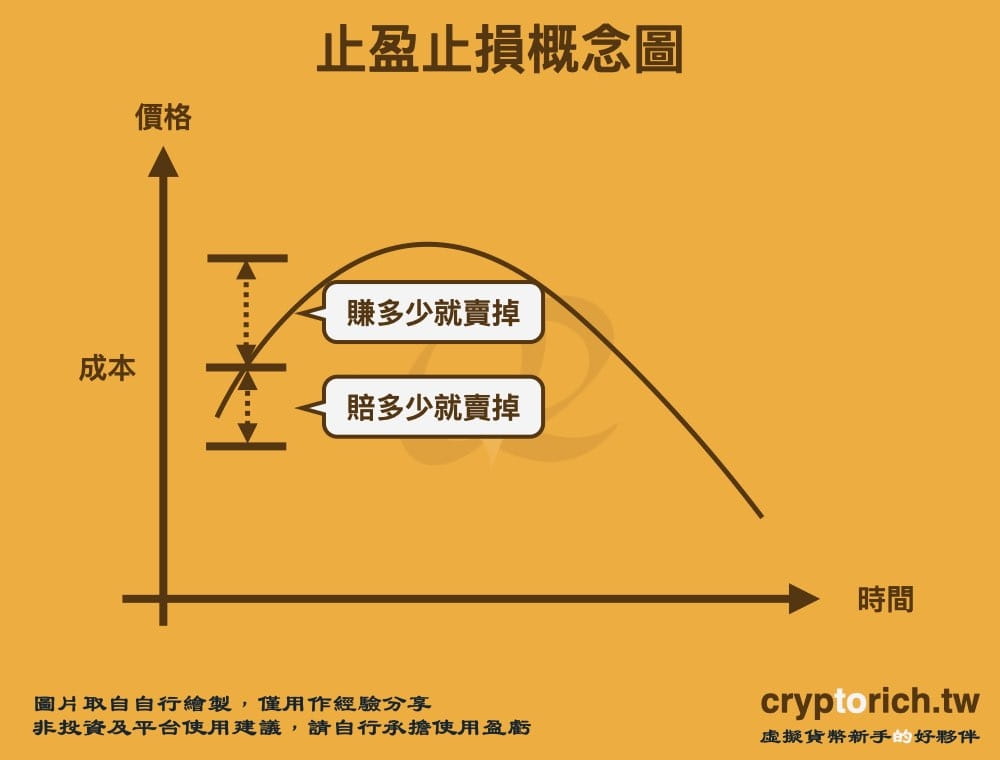
Take profit (Take Profit, abbreviated as TP) means to pocket the profits. In a situation where you already have profits, you choose to sell and no longer hold, ensuring that you actually made money.
Conversely, stop loss (Stop Loss, abbreviated as SL) means to cut losses. Despite being in a losing position, you choose to sell early to avoid further losses.
Usually, take profit and stop loss will be accompanied by specific conditions, for example, take profit only when the price exceeds a certain level, or stop loss when it drops below a certain level. This specific condition is called the "trigger price."
As for how to set the trigger price? It depends on each investor's habits. For example, some people consider support and resistance levels to be good reference points, while others think moving averages are better.
Major trading platforms usually also provide take profit and stop loss functions, allowing investors to set related prices when placing orders, so they can automatically complete buy and sell transactions without spending time watching the market.
Why do we need take profit and stop loss?
Risk management
The main purpose of take profit and stop loss is to control risk, avoiding the situation of seeing cryptocurrencies rise and then fall back, or losing the principal and being unable to stay in the market.
I don't know if you have had this experience; when you see the price rise, you think it will rise even more, so you hold on and don't sell, only to find that it later drops all the way, turning your original profit into a loss.
If there was a take profit at that time, although it might be possible that the price rises more later without benefiting, at least you made money!
Or when the price drops, unwilling to lose money, you continue to hold on, but unexpectedly it keeps dropping, and even your principal is lost!
If there was a stop loss at that time, although it would hurt, at least you would still have recouped some principal and have a chance to stay in the market to look for the next investment opportunity.
Stabilize trading mindset and find strategies
Take profit and stop loss can also effectively avoid psychological factors affecting trading operations, thereby leading to wrong decisions.
Because take profit and stop loss are clear numbers, once set, as long as the price hits, the system will automatically help you trade, completely eliminating human operation.
Therefore, you will no longer be tempted by continuously rising prices, thinking you can earn more money, or be afraid to cut losses when prices drop.
In addition, only after practicing take profit and stop loss can you clearly know whether your strategy is effective. If it turns out to be losing money over the long term, you need to consider adjusting your strategy!
Mastering the profit and loss ratio
Experienced investors also use take profit and stop loss to master the profit and loss ratio, evaluating the take profit and stop loss prices before entering the market to determine whether it is suitable to enter.
For example, if there is an 80% chance of taking profit and earning 10% when entering at a certain price, and a 20% chance of stopping loss and losing 30%, since 80×10 > 20×30, it is worth entering.
After understanding the basic concepts of take profit and stop loss, let me give you an example.
The operation process of take profit and stop loss
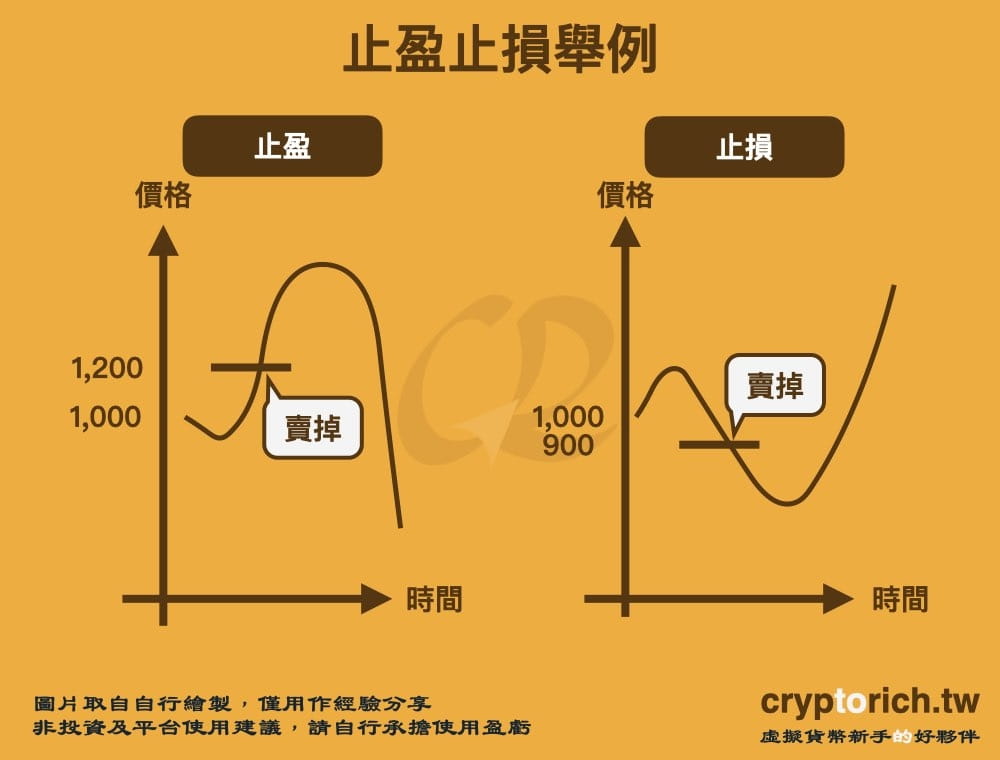
Assuming you buy a coin at a price of 1,000 and hope to make 200, then the take profit price should be set at 1,200. This is quite understandable; you can even manually create a sell order at 1,200 without placing a take profit order.
If you believe you can only afford a loss of 100, it means you need to sell when the price drops to 900. However, if you place a sell order at 900, it will be executed immediately because the current market price is 1,000!
At this time, the 900 must be placed on "stop loss," and even needs to be set through the "trigger price."
For example, if you set the trigger price to 900 and the stop-loss price to 890, the system will only automatically create a sell order at 890 when the price reaches 900, which means you won't be executed immediately at the price of 1,000!
However, if a trigger price is set, it does not guarantee that the take profit and stop loss will be executed smoothly, because if the price does not hit the take profit or stop-loss price after the trigger, it still will not execute unless you choose to trade at market price.
What does trailing take profit and stop loss mean?
Trailing take profit and stop loss refer to not using a specific price as the take profit and stop loss price, but rather deciding based on a relative price or ratio.
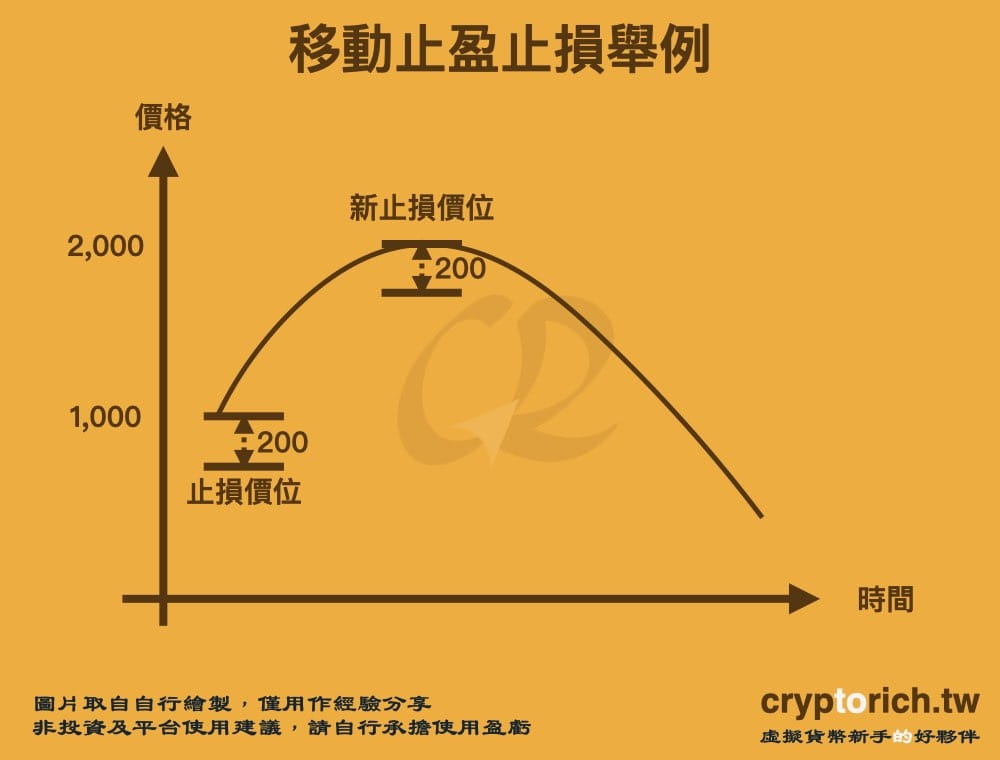
For example, when a coin's price is 1,000, if you set a trailing stop loss at -200, the following two situations will cause differences in the stop-loss price:
The coin price rises to 2,000 first: the stop-loss price changes to 1,800, and when the price subsequently drops to 1,800, the stop loss will be triggered. Although this is a stop loss, you still made a profit of 800.
The coin price directly drops to 800: triggering stop loss.
That is, when the price moves in a favorable direction, the stop-loss price will also move accordingly, giving you the opportunity to earn more money and avoid being affected by rigid numbers on profits and losses.
This concept is somewhat like hedging, using flexible settings to protect existing profits. For more details, please read: What does hedging mean? How to hedge?
How to use Binance Take Profit and Stop Loss?
The Binance order page offers take profit and stop loss functions, and both spot and contract trading have them, so as long as you have a Binance account, you can trade using take profit and stop loss.
Enjoy a 20% discount on spot trading fees
Binance Spot Take Profit and Stop Loss Tutorial
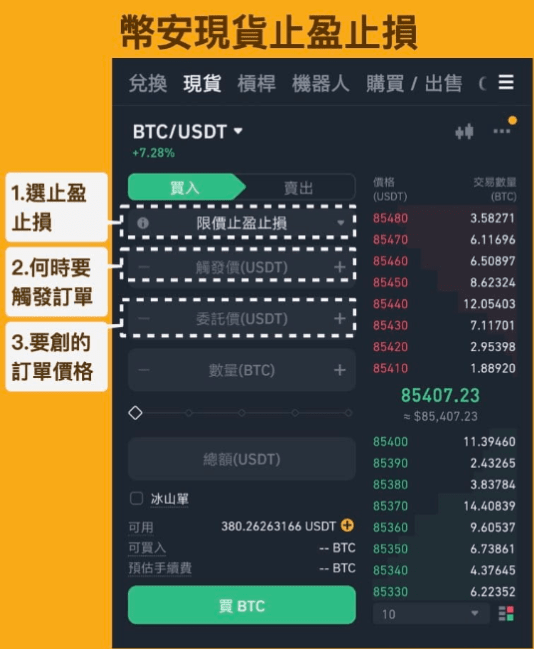
Binance Spot Take Profit and Stop Loss is similar to regular ordering, just with an additional trigger price, and is divided into market take profit and stop loss and limit take profit and stop loss.
The meaning of Binance trigger price is that when the market reaches this price, it will trigger your set market or limit order, similar to the concept of a switch.
The market price is executed immediately at the market price, while the limit price is executed only after reaching the specified price.
Further reading:
Binance buying tutorial, a step-by-step guide to buying your first cryptocurrency
What are market and limit prices? What's the difference? How to choose?
Binance contract take profit and stop loss tutorial
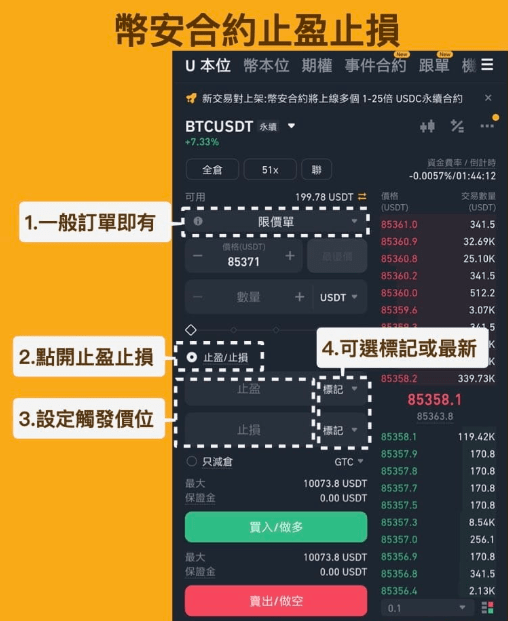
Binance contract take profit and stop loss can be set when creating a position, meaning you can set all trading conditions at once, and once the price hits, it automatically buys and sells, saving time waiting for the transaction to be manually taken profit or stopped loss.
However, be careful, the take profit and stop loss prices set here refer to the "trigger price." After reaching the set price, an order will be placed at the market price.
In addition, you will also see options for marked price and latest price. This means which price to look at for the trigger price:
Marked price: the price derived from combining the same underlying assets from major exchanges and calculating them.
Latest price: the latest transaction price in the Binance contract market.
Generally speaking, if the position risk is well controlled and does not easily lead to liquidation, it is recommended to use marked prices to avoid accidentally being triggered by a spike.
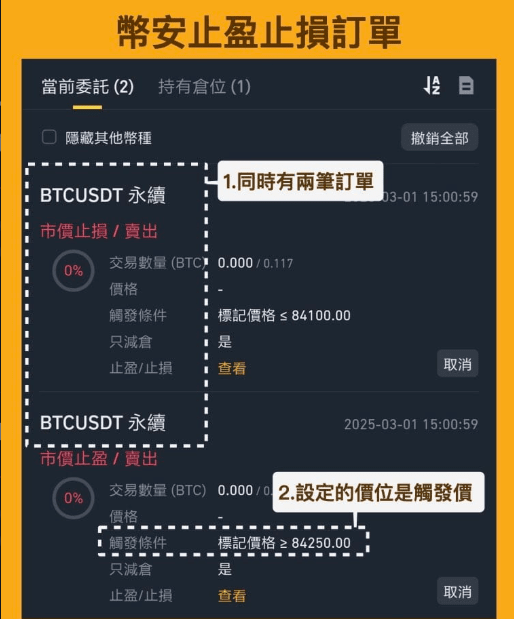
If the created order has been executed, the system will simultaneously create orders at the take profit and stop loss prices, so you will see two orders in the "Current Orders." Once one is triggered, the other will automatically close!
Further reading: What are cryptocurrency contracts? Taking Binance contracts as an example
If you want to further clarify how take profit and stop loss work, you can also practice with simulated trading. Through simulated trading, you can place orders at no cost to see what happens:
Binance simulated trading tutorial! Zero risk can open contracts
Common questions about take profit and stop loss
Is the trigger price for take profit and stop loss the same as the transaction price?
No, the trigger price means triggering the take profit and stop loss orders, at which point these orders will appear in the market. The trading price of these orders may differ from the trigger price, and even at market price, there may be a difference due to market fluctuations.
How to set the take profit and stop loss ratio better?
Many people use support and resistance levels, Bollinger Bands, etc., as related references, but everyone has different tolerances for profits and losses. Therefore, it is suggested to set take profit at "the amount you feel satisfied with earning," and stop loss at "the amount you will feel pain losing."
Summary of the article's main points
Finally, the key points of take profit and stop loss are summarized as follows:
Take profit means to realize profits at a specified price, even if it later rises more, it doesn't matter.
Stop loss means to sell at a loss, ensuring that you recover a certain amount of principal.
Through take profit and stop loss, you can manage capital risk and stabilize trading mindset.
Moving take profit and stop loss can track market fluctuations and flexibly adjust trading strategies.