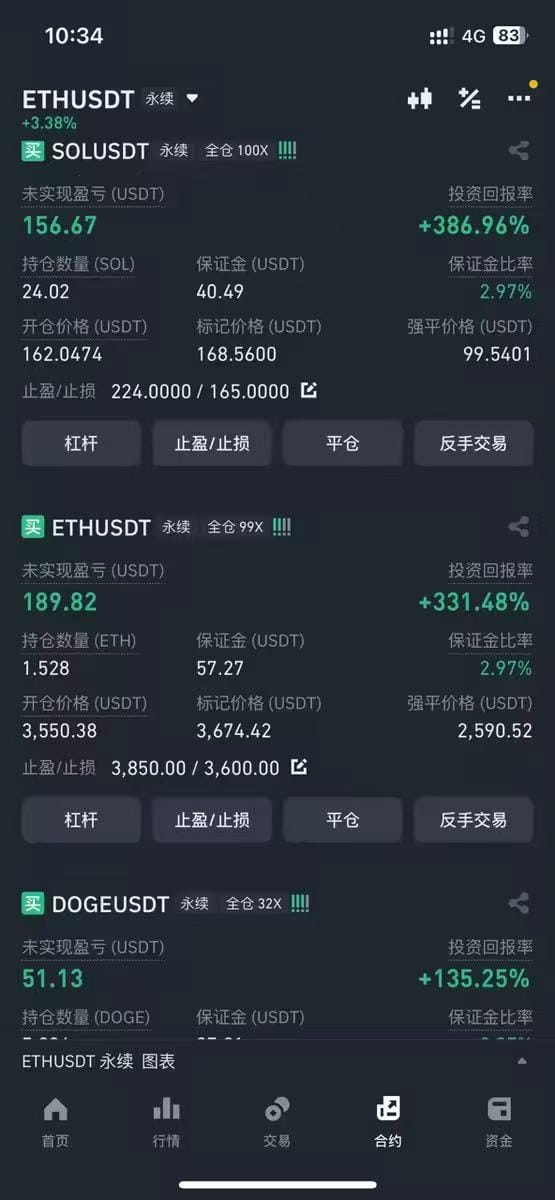
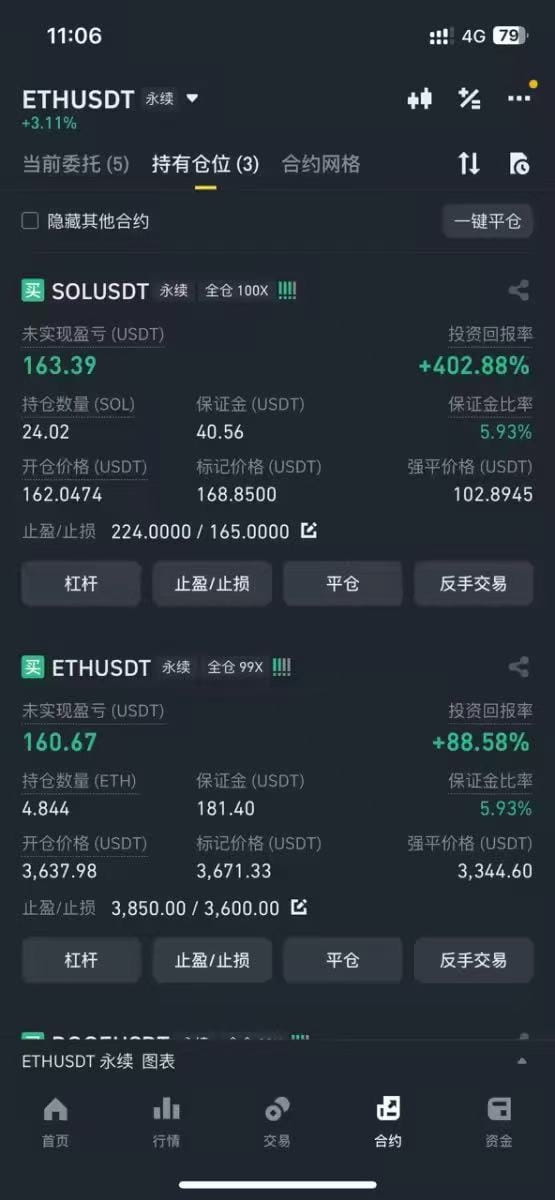
1. Many people lose money in the crypto space mainly because their expectations are too high, like wanting 10x or 100x in a year, which inherently carries great risks. However, people are often easily swept away by emotions and forget the risks, putting everything on the line, ultimately cutting losses to exit. Repeated losses lead to diminished capital, and ultimately a significant loss. If you want to recover your principal, you end up playing contracts or engaging in PVP, only to lose even more in the end.
You might see others playing contracts and PVP, but their model is different. They probably started with no money, maybe 1000 or 500 yuan, and grew it big. Meanwhile, you are directly using larger assets to play, which can lead to a collapsing mindset the more you play. Building a stable mindset can take one to two years of accumulation, but it can be destroyed in just five minutes with a sudden market crash.
Next, I'll talk about a method where even a fool can make two 50% gains in a year. One is dollar-cost averaging into quality US stocks, like Tesla or Nvidia. Insisting on dollar-cost averaging for a year, you can likely achieve such returns. Another is to dollar-cost average into Bitcoin; during a bear market, sticking to it will likely yield a doubling by the second year. If you dollar-cost average when the bull market starts, investing for half a year to a year, making a 50% profit is also achievable. When in a crypto bull market, if you dollar-cost average into mainstream meme coins, sticking to it for six months to a year, making a 50% profit is also no problem. Each time you make a 50% profit, consider selling; what happens afterward is not your concern. The money driven by emotions isn't something you can earn, and you can stop in time.
So by this method, completing two 50% gains in a year—can anyone do it? It seems simple, but it's not easy because it requires extreme patience and confidence. During the investment process, whenever there's a drop, you'll involuntarily think about what if it goes to zero, what if it doesn't rise, etc. Various distracting thoughts will interfere with you. If there's no one providing psychological support, about 60% of people will exit the market; if there is psychological support, that number might drop to 20%. If this period is extended to two years, the number of people exiting could reach an astonishing 80%. This illustrates the difference in people's patience; the time process and the targets are actually the same.
I rarely see people who profit from dollar-cost averaging because many actually look down on such returns and have an inflated self-view. They think they need to showcase their skills and strategies. However, over time, the market will teach them humility. If someone were to charge for a dollar-cost averaging group, they would likely be harshly criticized. After all, who can't dollar-cost average?
Playing contracts or PVP without any information advantage or engaging in swing trading can lead to instability in accumulating compound returns. This is because you might make two profitable trades only to lose one, and that loss can negate your profits, ultimately leading to no accumulation. This is the fundamental reason why this model cannot accumulate significant capital. If you have information advantages, then naturally you can make money, and it can be extremely quick. For instance, I made a 50% profit within six days of shorting a small coin.
Earning 50% in a year is not difficult at all; that would be 5 times in four years. The challenge lies in having the steadfast execution to resist distractions and temptations. Is earning two 50% gains difficult? There is a bit of difficulty in grasping the cycle rhythm, but it’s not too hard. In four years, that could mean 25 times; excluding the difficult parts, I would estimate about 10 times in four years. This is a logical return. If you take your principal and do a one-time all-in bet, focusing on what you want to buy, that is the worst money-making strategy. It generally leads to losses as the market is filled with traps; what you see as a good investment is exactly what others want to sell.
So when choosing targets, you need to respect the market and not act based on your own ideas. People often ask me how this coin is, or that one is. I usually take a quick look and say there are exaggerations involved. If the other party disagrees, I won't argue; I respect their opinion. Because I already have the best money-making strategy suited for me, and I won't make too little money this way. I can't compare with others making millions on a single contract because I don't have that mentality or capability. I can't accept a total loss of funds; I know myself, so I firmly refuse to play.
Many people can't profit from dollar-cost averaging due to three core reasons: they don't dare to buy when prices fall, they continue to hesitate while prices drop, and eventually sell at a loss or just give up. Then when prices soar, they complain they invested too little and want to increase their investment significantly, only to see the price drop afterward, and then they don't have funds to average down, buying at the highest point. Also, when they've made over 50%, many are reluctant to sell, wanting 100%. You need to understand that making 100% once and making 50% twice are completely different levels of difficulty.
It's definitely disrespectful to the objective reality of the market to expect to make 100% profit; people want to eat from start to finish. Because with dollar-cost averaging, you can't buy at the highest point, nor at the lowest. Even if a coin eventually rises by 5 times, you might only make 50%. At this point, don't complain about it being small; most people are losing money. If you make 50%, you've already outperformed the vast majority of those who bought this coin; you've made a lot.
For those coins with the potential to rise 3-5 times, I aim for a 50% profit. I achieve my goals through multiple 50% gains, making it quite easy. Investing isn't an exam where you must score 90 to be excellent; investing is a marathon. If you earn 50% once, and 50% ten times, that's 25 times! If you do well for four years, achieving 25 times is entirely possible.
In this process, the only thing you truly need is patience. If there is too little money in dollar-cost averaging, I wouldn't recommend playing it; I'd suggest having at least 100,000, preferably 300,000. If you have a few million, that's even better; it makes it a lot more enjoyable. You don’t need to make wild predictions about the market but rather respect its trends. By dollar-cost averaging repeatedly, you can calculate how much you can earn.
At this moment, you will feel that you are really amazing.
If you want to seize this round of bull market, it's definitely too late to learn on the fly; it's best to have someone guide you in quickly getting started.
We are mainly a blogger focused on freshness.
It’s better to teach someone to fish than to give them a fish.