
Project Overview
Treehouse is a decentralized fixed income protocol aimed at creating a 'decentralized fixed income layer' through tAssets (on-chain yield certificates) and decentralized quoted interest rates (DOR), unifying the on-chain interest rate market to provide standardized benchmark interest rates and fixed income product infrastructure for DeFi.
Core Advantage Analysis
1. Filling Market Gaps: Building on-chain interest rate benchmarks
DOR Mechanism: Through multiple Panelists submitting interest rate suggestions, combined with Delegator staking votes, an on-chain benchmark interest rate is formed (e.g., TESR, Treehouse Ethereum Staking Rate), solving the fragmentation problem of DeFi interest rates.
LIBOR-like Benchmark: DOR provides reliable pricing references for fixed income products such as bonds and swaps, promoting the development of on-chain interest rate derivatives market (e.g., FRA).
2. Yield Stacking and Liquidity Enhancement
tAssets Design:
Users deposit ETH or LST (such as stETH, rETH) to obtain tETH, automatically arbitraging across DeFi protocols to aggregate yields.
Yield sources include base staking yields, interest rate arbitrage (such as Aave and Lido interest rate differences), MEV distributions, etc., with annualized yields 0.5%-1.5% higher than base staking.
Strong Liquidity: tETH can be used as collateral (LTV up to 92%), supporting lending and reinvestment.
LST 2.0 Upgrade: Enhancing yield stacking and security through re-staking points (Nuts) and additional token incentives.
3. Security and Ecosystem Scalability
Multiple Audits: Audited by top institutions such as Trail of Bits, Sigma Prime, Fuzzland, and has insurance funds and bug bounty programs.
Ecosystem Cooperation: Integrates multiple LST protocols (Lido, Rocket Pool, etc.) and plans to expand to multiple chains (such as BNB Chain, Avalanche).
Governance Mechanism: TREE token holders participate in protocol parameter voting, directly deciding on ecosystem incentives, product upgrades, etc.
4. Institutional Endorsement and Market Recognition
Financing Background: Cumulative financing of $18 million, investors include MassMutual Ventures, Binance Labs, Lightspeed, etc.
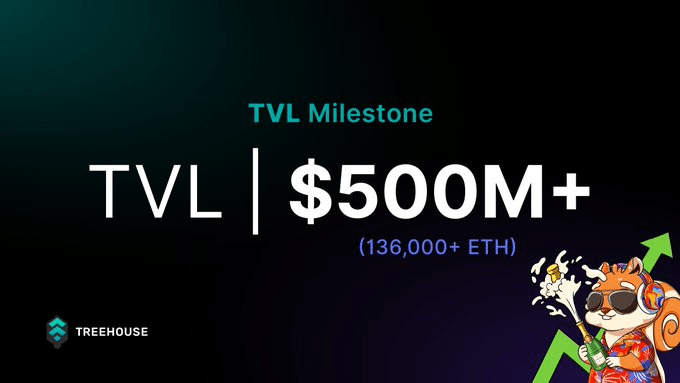
TVL and User Base: Total Locked Value (TVL) reached $573 million, nearly 50,000 users, showing market recognition.
Token Model (TREE)
1. Token Basic Information
Token Name: Treehouse (TREE)
Total Supply: 1 billion coins
Blockchain: Ethereum (ERC-20)
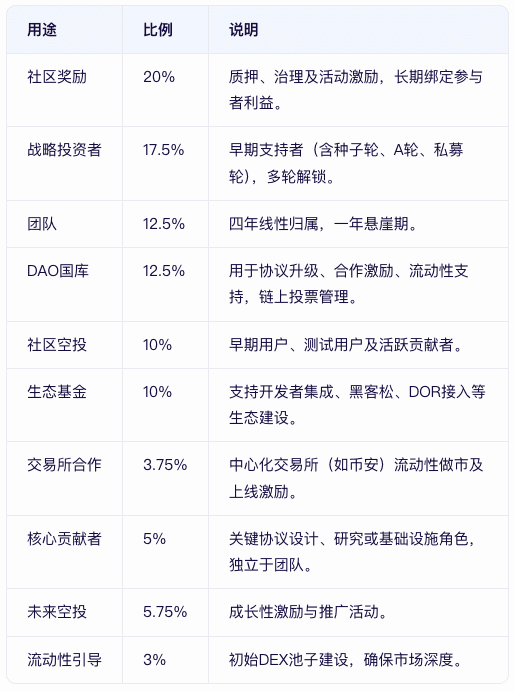
2. Token Distribution
3. Token Utility
Payment Fees: On-chain querying of DOR data requires paying TREE, with about 25% of protocol income used for buyback and destruction, forming a deflationary model.
Staking and Governance: Panelists must stake TREE to participate in interest rate submissions, holders have governance rights in the protocol, voting to decide on DOR parameters, ecosystem incentives, etc.
Consensus Rewards: Accurate quote nodes and delegated stakers can share the TREE incentive pool, driving quality on-chain behavior.
Ecosystem Support: DAO allocates TREE funds to promote cooperation protocol integration, RWA data on-chain, structured product design, etc.
4. Market Performance and Strategy
Launch Data: After listing on Binance, circulation is about 156 million coins, FDV is affected by market speculation, with short-term strategies for both shorting and longing.
Staking Incentives: Binance Wallet launched the Booster activity, where users stake ETH into the Treehouse pool to share TREE rewards, with a total reward pool equivalent to $7.5 million in TREE.
Register on Binance with the invitation code: DBQAREOK
Follow me for periodic updates on various project information!
https://www.binance.com/en/join?ref=DBQAREOK