

In a rare live exchange on X (formerly Twitter), personal finance influencer Andrei Jikh posed a series of profound questions about the long-term viability of XRP, prompting Ripple's CTO David Schwartz to provide in-depth responses.
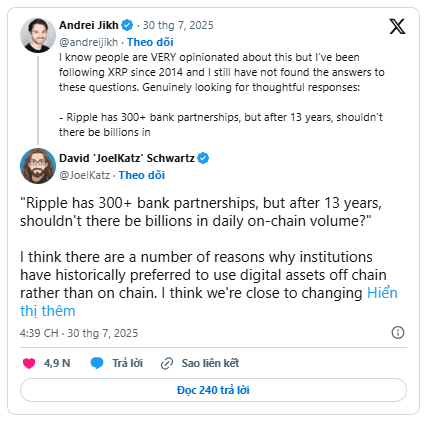
Jikh, who stated that he has been following XRP since 2014, expressed skepticism about key issues, from the use and volatility of XRP in practice to its role as a bridge currency and its appeal to institutions. The post quickly garnered attention, sparking a broader discussion within the cryptocurrency community.
Key Questions Surrounding The Adoption And Use Of XRP
Jikh opened his post with a question about why, despite Ripple having over 300 partnerships with banks and more than a decade of development, XRP has not yet achieved daily trading volumes in the billions of dollars.
Schwartz acknowledged the slow adoption rate but emphasized that organizations previously preferred to use off-chain digital assets due to concerns about compliance and regulation.
He added, "Even Ripple has not been able to use XRPL DEX for payments because we are not sure if a terrorist would provide liquidity for payments." He pointed to upcoming features, such as licensed domains, as a potential solution.
Volatility: Responsibility Or Strategic Advantage?
Another pressing concern raised by Jikh was the volatility of XRP, questioning why it is used instead of stablecoins for transferring money.
Schwartz responded that volatility is not always a disadvantage. "There are use cases where volatility is not a downside, but even an upside," he said, adding that many in the digital asset space view the potential for price appreciation as worth the risk, especially for those who are not overly risk-averse.
Regarding holding XRP, Schwartz noted that bridge currencies still require holders to maintain liquidity. "If you are unsure what asset you will need to hold next, you might hold the dominant bridge currency," he explained, arguing that it could minimize conversion friction between different digital assets.
Are Bridge Currencies Becoming Obsolete?
Jikh also questioned whether bridge currencies like XRP would be necessary in the future as stablecoins dominate. Schwartz suggested that the likelihood is low.
"A stablecoin can only be stable against a specific fiat currency and will always have legal constraints," he said. In a multi-stablecoin world, XRP or similar assets could still serve as a neutral bridge, especially when trading with less frequently traded tokenized assets like loan portfolios or securities.
Why Should One Use XRPL Instead of Building A Proprietary Blockchain?
Citing examples like Robinhood using Arbitrum and plans to develop its own blockchain, Jikh asked why major companies like BlackRock chose XRPL for tokenization.
Schwartz responded by comparing it to Circle, the company behind USDC. "Why haven't they deployed USDC on their own blockchain? You might find that ridiculous," he said, arguing that the interoperability and mobility of assets are more important than platform ownership in the tokenization space.
Addressing Geopolitical Concerns And Trust
The final point Jikh raised relates to geopolitical risks: why should foreign countries trust a private company based in the United States like Ripple?
Schwartz distinguishes Ripple as a company and XRP Ledger (XRPL) as a decentralized protocol. He stated, "XRPL has never discriminated against any participant."
Regarding Ripple's enterprise solutions, Schwartz emphasized that the company operates through separately licensed entities worldwide. However, he acknowledged that Ripple's headquarters in the United States could create disagreements in certain geopolitical contexts.
Community Reactions And What's Next
The deep exchange between Jikh and Schwartz highlighted the ongoing tension between the ideals of cryptocurrency and its implementation in the real world. While XRP supporters praise its potential as a global liquidity solution, critics remain cautious about its adoption speed, legal barriers, and competitive positioning.
However, Schwartz's candid responses suggest that Ripple remains committed to developing its technology and making arguments for organizations and the cryptocurrency community at large.