


The crypto market is witnessing a showdown between two incredibly fast blockchain giants: Sui and Solana. Both offer superior features such as fast transaction speeds, low fees, and strong security. Although there are many similarities, can only one of these blockchains claim the crown in this cycle?
Solana, a veteran candidate, has made a strong impression since the 2021 boom, while Sui, an ambitious newcomer, is proving its strength in the blockchain world. So which one has greater growth potential? Let's analyze further.
Solana (SOL): A muscular veteran
Solana has proven itself to be one of the strongest competitors in the blockchain world. Launched in 2020, it made a strong impression from the very beginning. From a price of just $1.5, Solana skyrocketed to $260 in a short time, achieving a 173x increase in less than a year. An absolutely crazy figure!
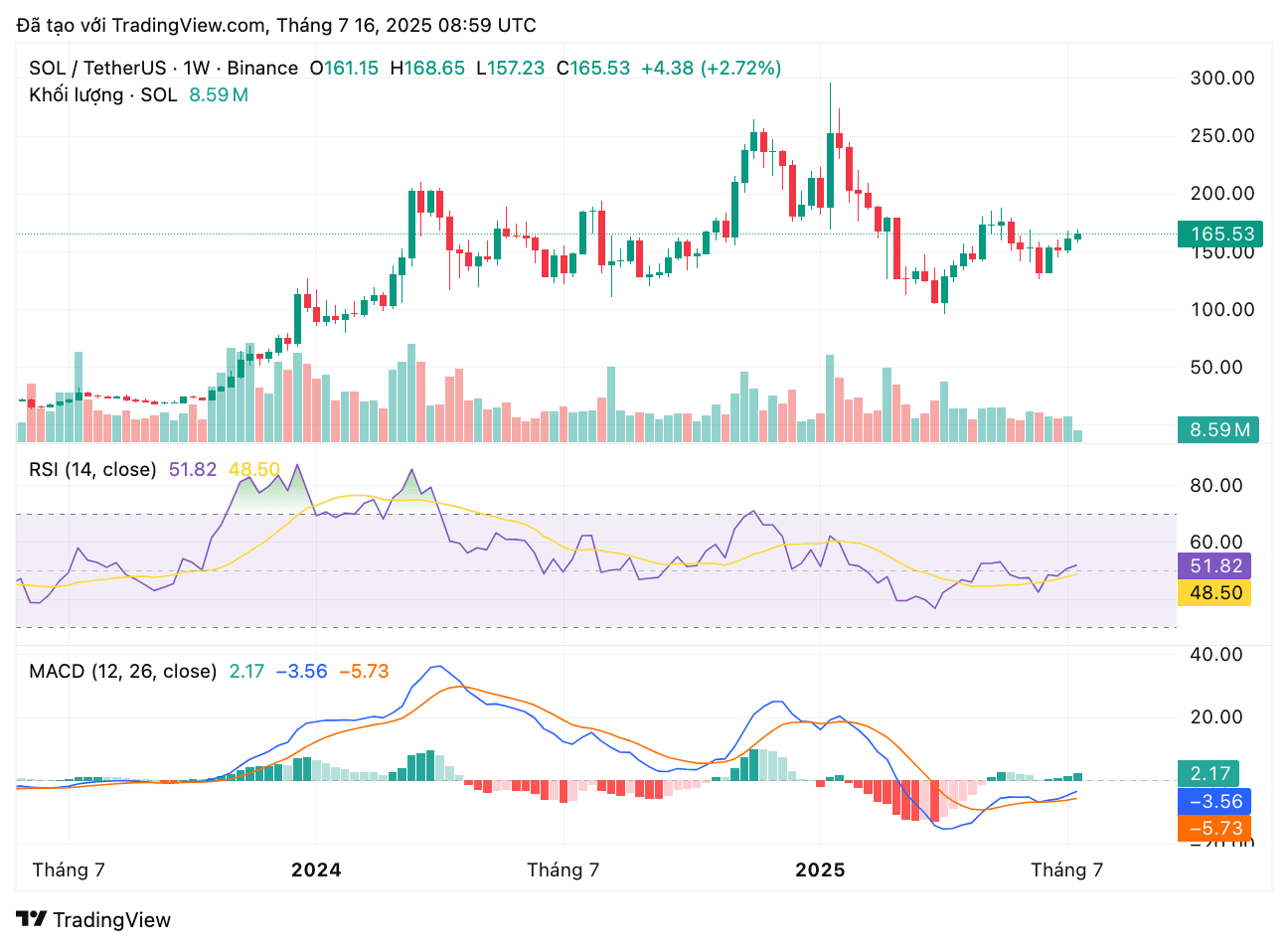
Despite strong growth, Solana continues to improve and develop. Its blockchain is now much more stable, with almost no issues since the end of 2022. This stability has attracted attention from major institutions, with the launch of the SOL staking ETF and a series of other ETFs being deployed. This indicates that Solana is not only of interest to retail investors but also to large investment funds.
Solana is also thriving in the traditional finance space. It doesn't just stop at supporting cryptocurrency transactions but also expands into tokenized physical assets, such as stocks and treasury bonds. In particular, collectible platforms and real-world assets (RWA) are becoming an important part of Solana's ecosystem.
It can be said that Solana is not just a trend – it is exploding like a tsunami as, in just one year, the number of daily active wallets on Solana has surged from under 1 million to over 16.3 million—a leap that cannot be overlooked. This is not a small step – but a jump of 17 times.
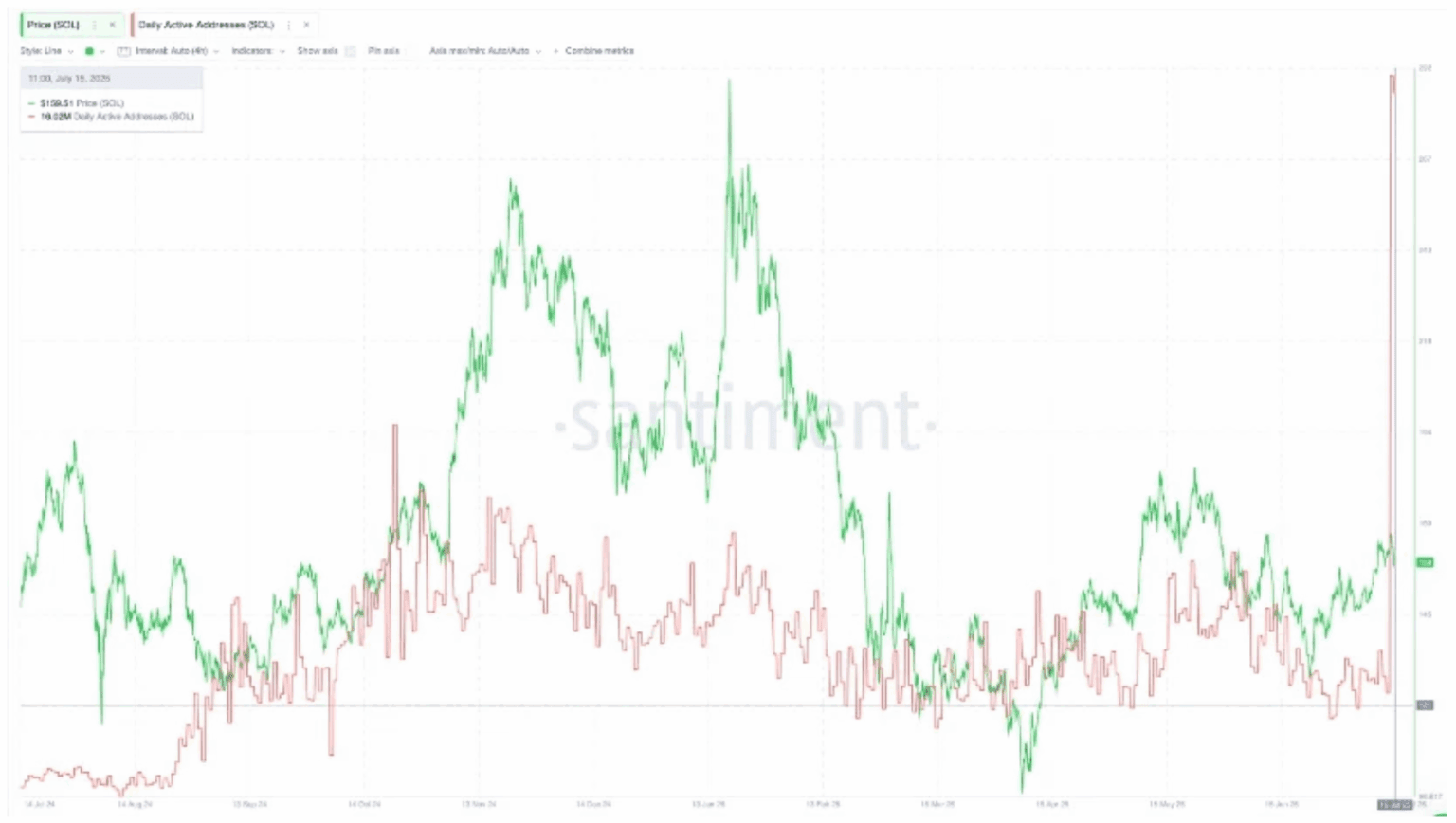
Since October 2024 alone, the number of wallets has doubled. At that time, the number was only 8.8 million. Since then, on-chain activity has skyrocketed, and prices have followed suit: from $130 at the end of 2024 to over $200.
This is the kind of déjà vu in the crypto market: a sharp increase in users and rising prices. History tends to repeat itself – and this time, the scale seems even larger.
Moreover, in just one week, Solana attracted $78 million through ETP products – surpassing both Ethereum and Bitcoin. This is not FOMO from retail investors. This is investment funds, financial institutions, and Wall Street sharks seriously betting on the future of Solana. ETPs are the gateway for them to enter crypto legally and safely. And when they invest, it is not gambling – it is a long-term strategy.
In fact, Solana has been leading all Layer 1 and Layer 2 blockchains in network revenue for 16 consecutive weeks. A blockchain generating more fees than Ethereum, yet still valued much lower? This is an asymmetry that investors cannot ignore.
After a period of capital withdrawal, net inflows on Solana are now stabilizing. No one is rushing to sell anymore. And this speaks to an important point: the market is accumulating.
Decreasing supply + increasing demand = the classic formula for a parabolic price surge. This is no longer theory – it is happening, day by day, hour by hour.
Famous analyst Ali Martinez has used Fibonacci tools to sketch a potential path to $2,000. Everything could start from a key point: prices surpassing $172. If that happens, the domino effect could spread rapidly.
Price milestones to watch:
172 dollars – the first short-term resistance
198.25 dollars – a clear breakout signal
217.89 dollars – a strong psychological barrier
274.61 dollars and 366.39 dollars – expansion targets
2,000 dollars – the long-term goal.
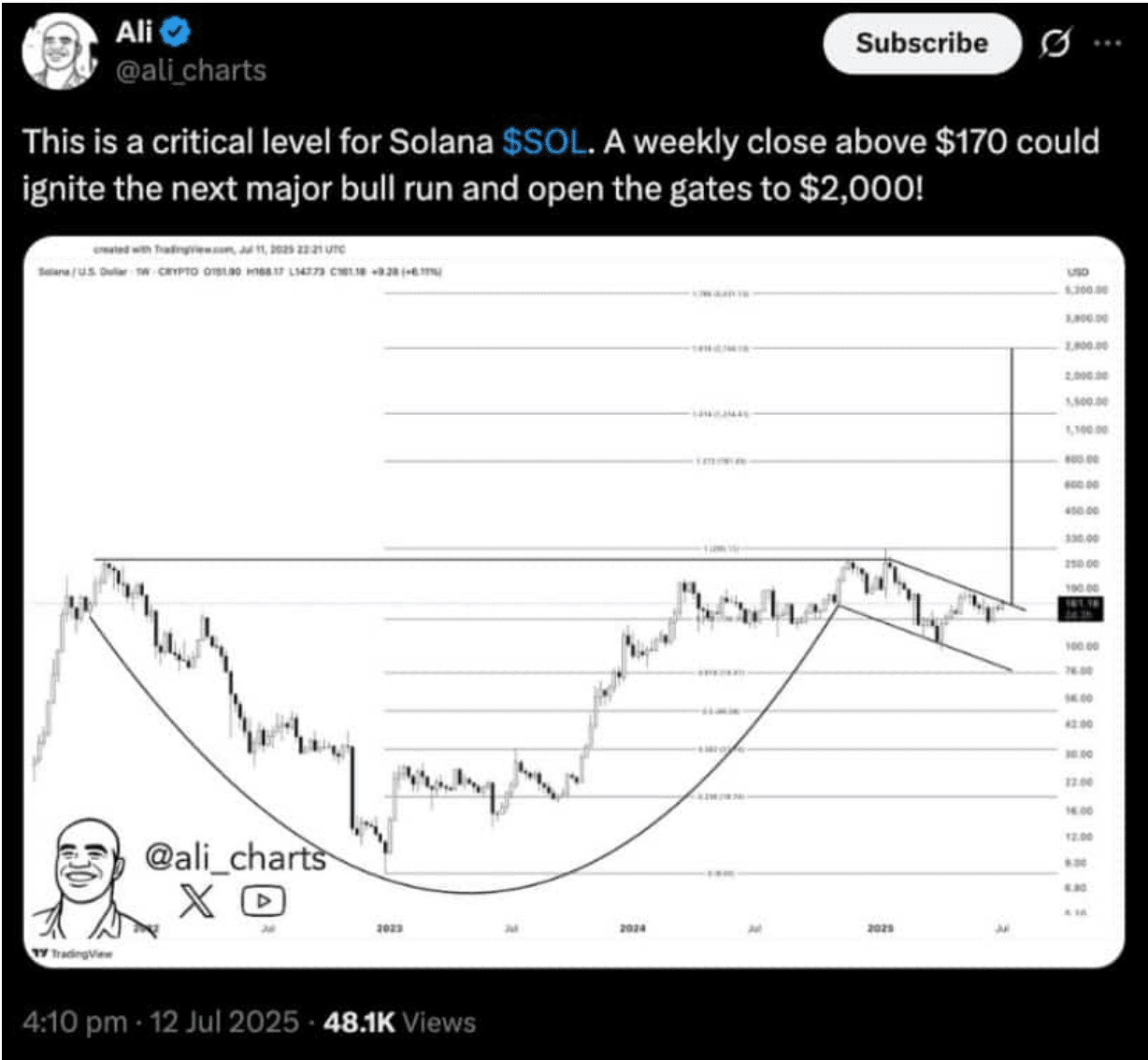
Everything revolves around closing weekly above $170. If maintained, a strong bullish trend could be triggered – similar to what happened in early 2025.
Even AI models like ChatGPT agree: with on-chain growth, abundant institutional inflows, and vibrant retail activity, the $200 mark is just the next stop – and $2,000 is entirely possible, if the factors continue to converge.
SUI: An ambitious newcomer rewriting the rules
Unlike Solana – a “veteran” making a spectacular breakout – Sui is a newly emerging name, having just launched in mid-2023. Yet, in a short time, this blockchain has caused real tremors: soaring straight into the top 10 by total value locked (TVL) in the DeFi space, surpassing many veteran predecessors.
Part of the reason comes from the explosion of practical applications on the Sui platform. For example:
Bluefin – a DEX platform attracting a huge number of users with a smooth experience and low costs.
BTCFi – opens the door to bring Bitcoin into the DeFi world, making this traditional asset more flexible than ever.
One of the standout features of Sui is the Walrus Protocol – a decentralized storage solution that is up to 80% cheaper than current competitors. This is not just a technical advancement but also a strategic lever helping Sui scale rapidly.
That also explains why not only retail investors but also giants like Grayscale have begun to closely monitor every move of this blockchain.
In 2024, Sui has reached an incredible milestone: over 230 million user accounts – a figure that even veteran blockchains must be wary of.
Not only that, but the growth rate of Sui has also outpaced Bitcoin, gold, the S&P 500, and Coinbase stocks during the same period. It doesn't take much time to realize that: this is not a name to underestimate.
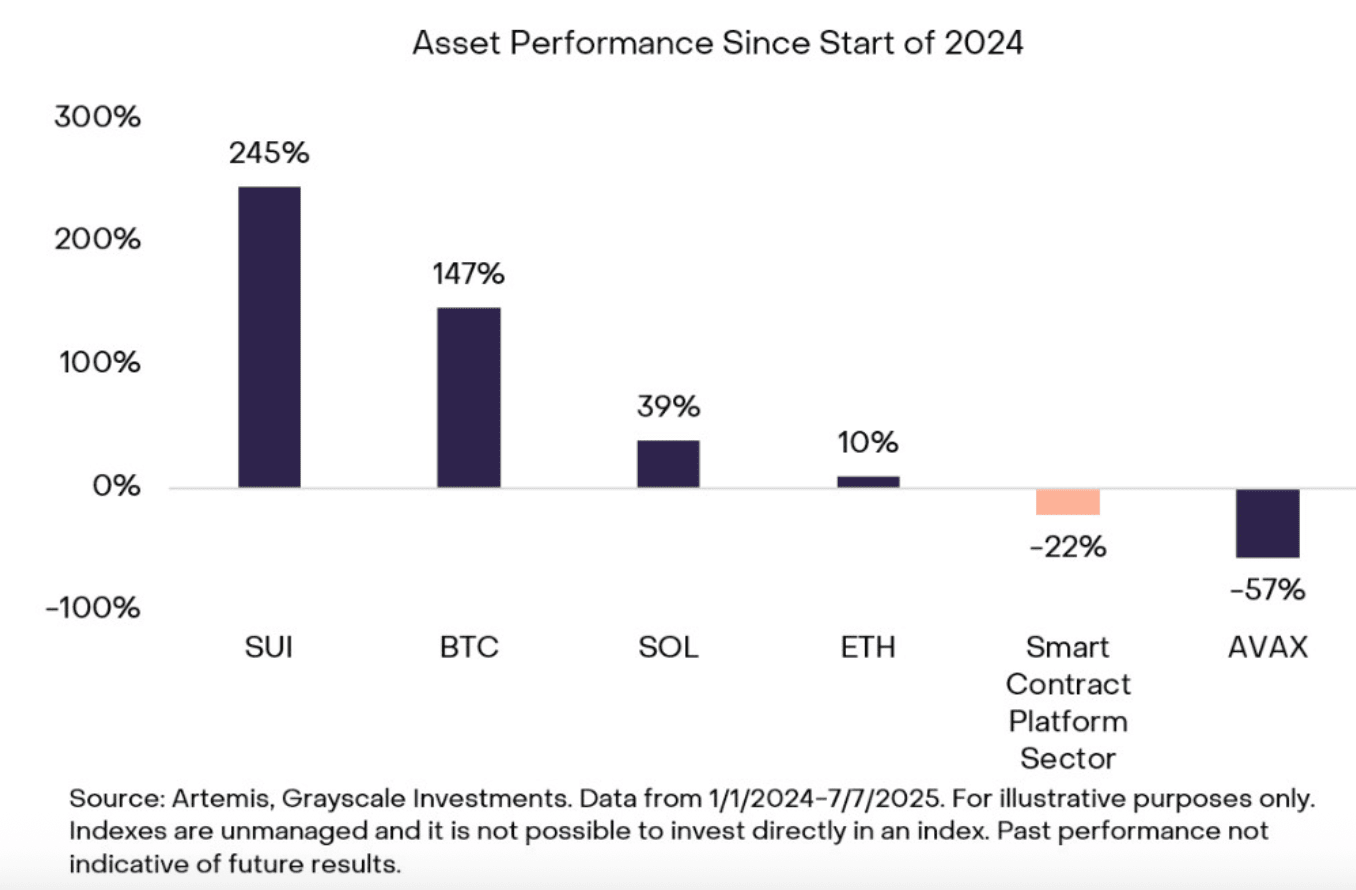
From a newcomer, Sui is gradually reshaping its position on the global blockchain map. With a rapidly developing ecosystem, optimized technology, and growing interest from financial institutions, Sui is not just a new wave – it could be the next wave.
Who will win this battle?
Solana is one of the few blockchains that can confidently stand firm in a volatile market. Dubbed a “beast” of the Web3 world, Solana boasts high stability, abundant liquidity, and a rich ecosystem spanning from DeFi, NFT, to RWA. With a solid position among leading blockchains, Solana is the top choice for long-term investors seeking safety and efficiency.
However, the current scale of Solana makes exponential price increases more challenging. Although analysis models expect SOL to reach $600 to $800 in the next cycle, a 100x value increase like in the early days is nearly impossible in a more mature and competitive market.
In contrast to Solana, Sui is a youthful newcomer, but not inexperienced. The blockchain architecture centered around the user of Sui is not only different but also allows for optimization of speed, scalability, and user experience. Although it has only been around since mid-2023, Sui has risen to the top 10 blockchains by TVL – an impressive feat for any project.
With the current price at around $4, a rise of SUI to $15 is a completely reasonable target – equivalent to a 4x increase. And if it continues to maintain its current growth rate, Sui could easily exceed expectations, becoming one of the fastest-growing blockchains in the market.
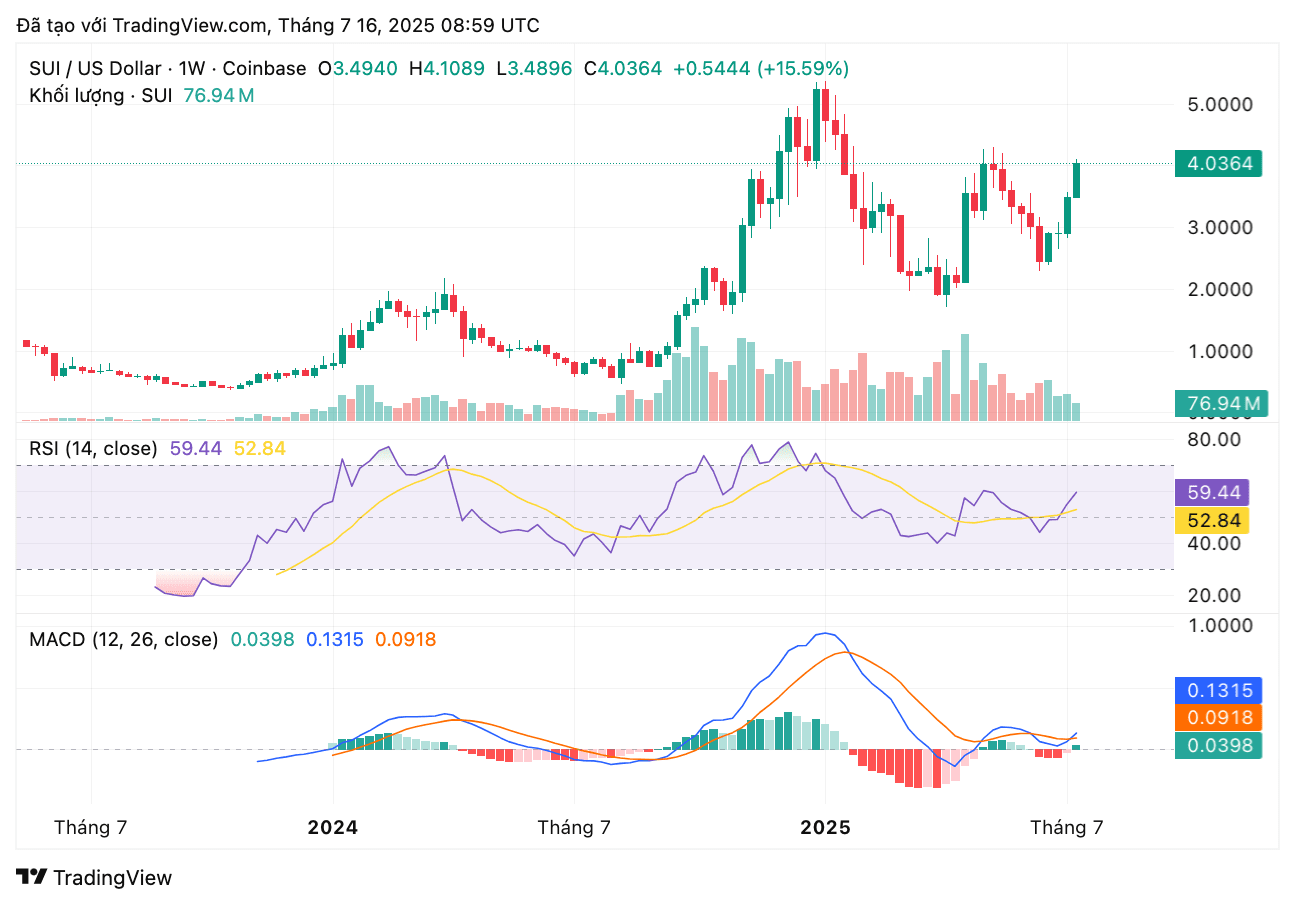
In the short term, Solana is clearly the more stable and less risky option – a familiar path for many institutional investors seeking capital preservation and clear profitability. But if you are willing to take risks for the chance of a breakthrough, then Sui is the dark horse worth betting on.
The race between Solana and Sui is not just a story about transaction speed or user numbers. It’s a competition between a mature giant and an ambitious newcomer. Solana brings peace of mind. Sui offers opportunity. And no matter who you choose, one thing is certain: both are shaping the future of the blockchain industry – and the game has just begun.

