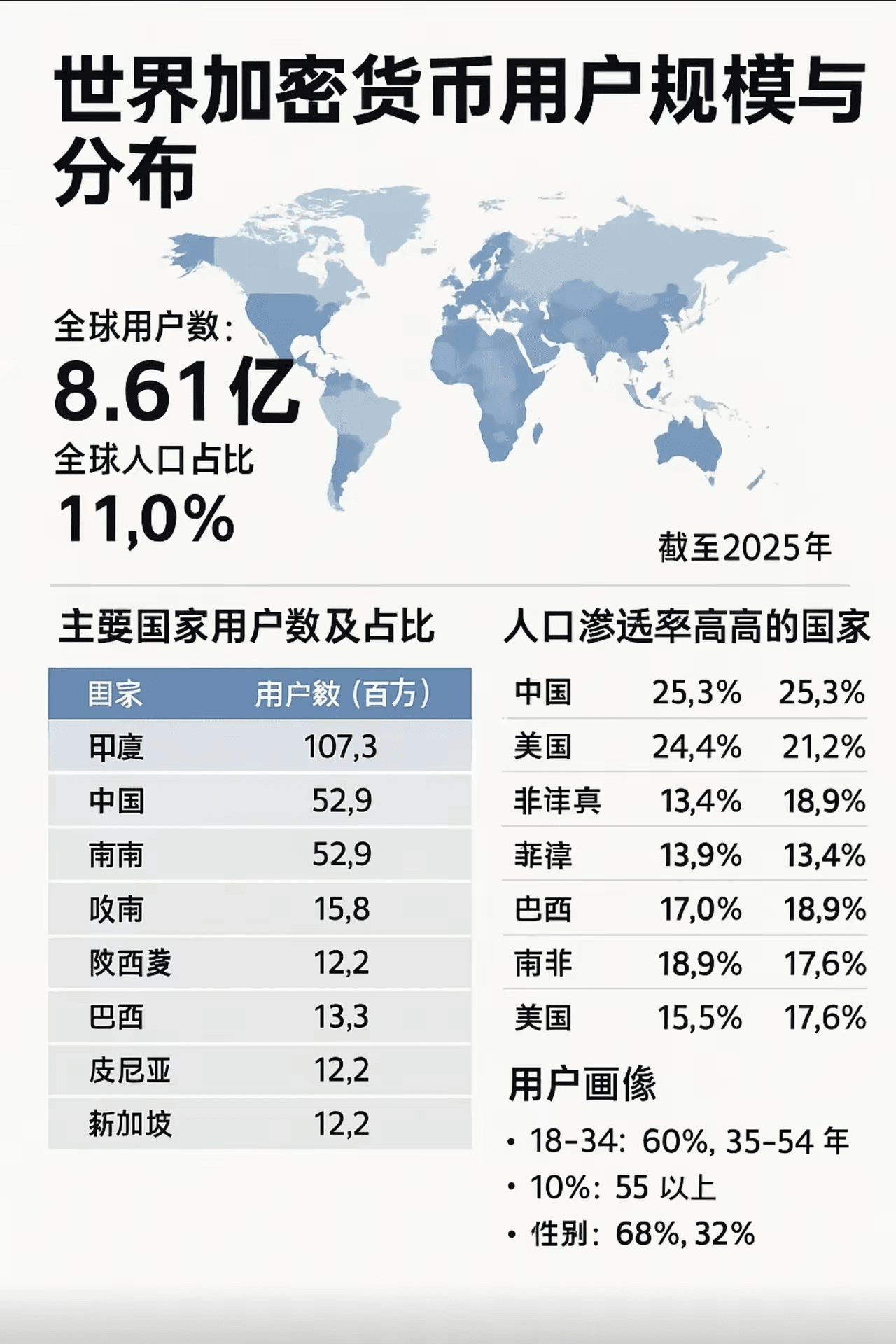
According to the latest data from 2025, there are currently about 861 million people in the world who own or use cryptocurrency, accounting for about 11.0% of the global population.
Global user distribution (as of 2025)
Total user number: approximately 861 million (11.0%)
By region:
Asia: Approximately 326.8 million → Dominating the global market
North America: Approximately 72.2 million
Other regions are growing rapidly, especially Latin America and Africa
📌 Major countries user numbers and proportions
Country User number (million) Proportion (%) Description
India 107.3 7.35% Largest user base
China 59.1 4.15% Diverse user demand is strong
United States 52.9-55 15.6% Most active globally in institutions
Vietnam 20.9-21 21.2% One of the highest population penetration rates
Pakistan ~15.9 6.6% Active in P2P and mining industries
Philippines 15.8 13.4% Remittance-driven adoption
Brazil 26 12.0% Rapid growth in emerging markets
Nigeria 13.3 5.9% High adoption affected by inflation
Indonesia 12.2 4.4% Leveraging digital currency to enhance financial inclusion
📊 Countries with the highest population penetration rates (by proportion)
UAE: 25.3%
Singapore: 24.4%
Turkey: 19.3%
Argentina: 18.9%
Thailand: 17.6%
United States: 15.5%
🧑🎓 User profile
Age: 18–34 years account for about 60% of total users, 35–54 years about 30%, and 55 years and older about 10%
Gender: Male 68%, Female 32%, Female participation is rising fastest in Asia and Africa
🧾 Summary points
Nearly 900 million cryptocurrency holders globally, entering the era of over 100 million users
Asia shows strong penetration of cryptocurrency, with a quarter of countries having a penetration rate exceeding 20%
Emerging markets (such as India, Vietnam, Nigeria, etc.) have become leaders due to inflation, remittances, and financial inclusion
Developed countries (such as the United States and Europe) have slightly lower penetration rates, but the trading volume is enormous, primarily driven by institutions