


Spark Protocol is a decentralized lending market launched by MakerDAO, integrating direct lending functions within MakerDAO. Through Spark, users can obtain DAI loans using assets like ETH, stETH, and sDAI.
Core advantages of Spark
Deep integration of stablecoins and RWA
Spark relies on the USDS and USDC from the Sky ecosystem as core liquidity support, combining RWA (such as tokenized government bonds) to provide users with low-volatility, high-efficiency yield products. Through the Spark Liquidity Layer (SLL), Spark seamlessly deploys stablecoin liquidity into traditional financial assets, attracting institutional capital into DeFi.
Efficient capital allocation
Spark optimizes the allocation of capital between DeFi, CeFi, and RWA through an algorithm-driven dynamic risk engine and cross-chain asset routing, reducing liquidity fragmentation and enhancing capital efficiency. Its capital efficiency far exceeds that of traditional DeFi protocols, ensuring users receive stable and predictable returns.
User and ecosystem friendly
Spark offers a user-friendly interface that supports mainstream DeFi wallets, allowing users to earn returns through SparkLend for lending or Spark Savings for savings. Its smart contracts support developer integration and are applicable to various scenarios such as lending, liquidity mining, and on-chain asset management.

Spark's performance in the industry
Market position
Spark, as a pioneer in the integration of DeFi and RWA, holds a leading position in the DeFi space with the strong backing of the Sky ecosystem and a total locked value (TVL) of $6 billion. Its application scenarios cover on-chain lending, savings, RWA investments, and institutional asset management, attracting widespread attention from both the community and traditional financial participants.
Technical Innovation
Spark's core innovation lies in its LaaS model, which optimizes capital flows through algorithms, reducing idle funds and market risks. The dynamic risk engine adjusts risk exposure in real-time to ensure stable returns. In the future, Spark plans to deeply integrate with Layer 2 solutions (such as Optimism, Unichain) to improve cross-chain efficiency and user experience.
Core competitiveness
By combining RWA with stablecoins, Spark addresses the pain point of high yield volatility in traditional DeFi. Its modular architecture is compatible with EVM environments, adapting to DeFi protocols, on-chain payments, and RWA investment scenarios. Community-driven incentive mechanisms (such as airdrop events) further enhance user participation, creating a bottom-up growth momentum.
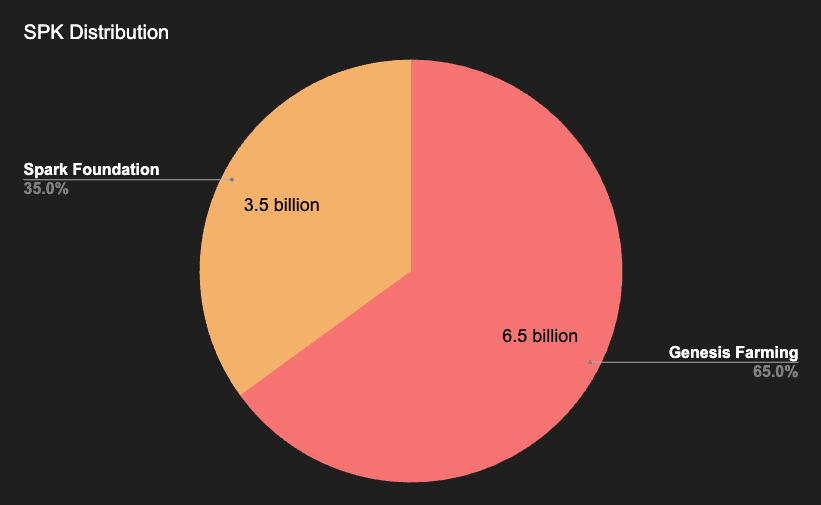
Token details and allocation
Token Name: Spark ($SPK)
Genesis Token Total Supply: 10,000,000,000 $SPK
Maximum Token Supply: 10,000,000,000 $SPK
TGE unlock amount: 391,000,000 $SPK (accounting for 3.91% of maximum token supply)
Airdrop allocation: 300,000,000 $SPK (including Binance 200,000,000 $SPK, accounting for 3% of total)
Current circulating supply: Approximately 1,700,000,000 $SPK (accounting for 17% of maximum token supply)
Market Cap: Approximately $87,100,000
Summary
Through its innovative LaaS model, deep integration of RWA and DeFi, and stablecoin support from the Sky ecosystem, Spark provides efficient and stable yield solutions for the Web3 ecosystem. Its algorithm-optimized capital allocation and community-driven growth model address liquidity fragmentation and yield volatility issues in traditional DeFi. With a $6 billion TVL, $355 million annual revenue, and user-friendly design, Spark shows tremendous potential in DeFi lending, RWA investments, and institutional-level scenarios. As an important part of the Sky ecosystem, Spark is poised to become a bridge connecting traditional finance and blockchain, promoting the global adoption of Web3 finance. Whether for DeFi enthusiasts or traditional investors, Spark offers a transparent and trustworthy yield engine that is worthy of long-term attention.