

We know that retail investors face significant challenges in volume brushing: the score threshold is constantly rising, quickly increasing from 100 to 120, 150, or even 160 points, and our volume brushing speed often cannot keep up, resulting in points being mostly taken by studios.
The operations of these studios have the following characteristics:
The instructions are simple and clear: the boss requires employees to conduct 5 instant buy-sell transactions daily with USDT in the Binance Alpha BSC zone, targeting the number one coin.
Avoid complexity: Trading is limited to within the exchange, without involving wallet operations, to ensure efficient execution.
What impact does this have on market trends?
The coin ranked number one in the BSC zone fluctuates frequently due to buying and selling, with prices oscillating like an ECG.
Tokens from other chains show ordinary altcoin trends, and after being listed in the Alpha zone, they rarely see significant increases.
For Binance, although the Alpha points rule is controversial, it has indeed effectively boosted trading volume. In the past, Binance wallet trading volume only surged during events, then dropped afterward; now, trading volume continues to oscillate at high levels.
Moreover, Binance attracts project parties to 'supply' through the Alpha zone, requiring them to airdrop to Alpha zone users, effectively extracting airdrop rewards from the entire crypto circle.
So, what certain opportunities can we seize?
The coin ranked number one in the BSC zone will continue to fluctuate, and its liquidity pool is based on DEX construction.
Therefore, retail investors can earn substantial transaction fees by forming liquidity pools (LP). Binance guides studios and retail investors to engage in simple repetitive trading through Alpha activities, creating predictable trends that we can profit from.
How to operate?
1. Find the volume brushing target
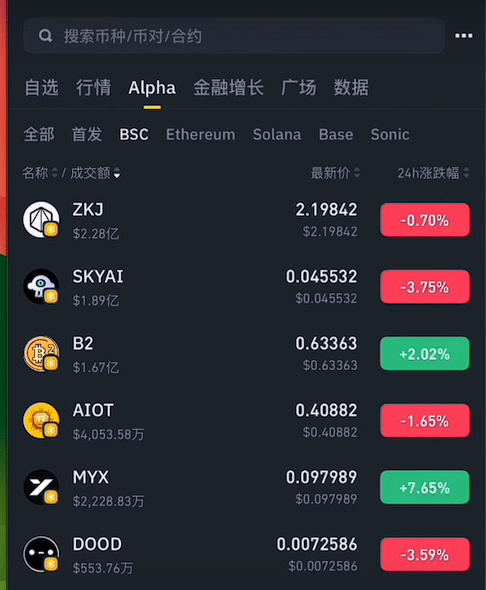
Check Binance Alpha Zone: Click on Market, switch to Alpha, sort by trading volume in descending order, filter for BSC sector, the current number one is ZKJ.
2. Positioning the Liquidity Pool
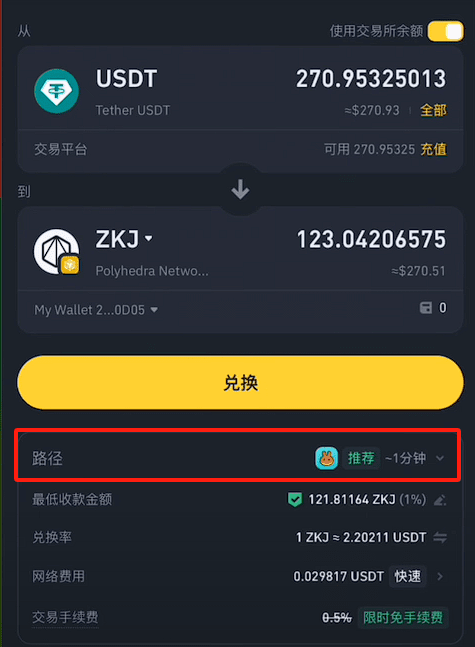
In the Binance wallet, click 'Trade', simulate exchanging ZKJ with any asset, and check that the path shows PCS Hub (i.e., PancakeSwap), confirming that ZKJ's liquidity pool comes from PancakeSwap.
3. Choose trading pairs
The main force in score brushing often uses USDT for trading, so choose ZKJ against USDT as the target for the liquidity pool.
4. Add liquidity
Connect to PancakeSwap: Search for PancakeSwap V3 on the Binance wallet 'Discover' page, and switch to Simplified Chinese after connecting.
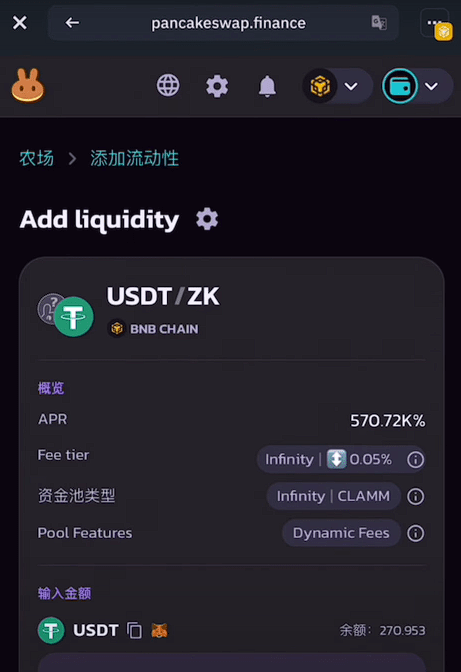
Find ZKJ: Since ZKJ cannot be searched directly, you need to copy the ZKJ contract address from the Binance wallet BSC zone and paste it into the PancakeSwap search bar to confirm the token (displayed as ZK, consistent with ZKJ).
5. Exchange and Add: Use half of the BNB to exchange for ZKJ, then select USDT and ZKJ in 'Earn - Farm Liquidity', set the price range, input the amount, and add liquidity after authorizing USDT and ZKJ.
Estimated Yield: The annualized return depends on the selected range. Generally between 500-2000.
6. Dynamic Adjustment and Risk
Monitor rankings: If ZKJ is no longer the number one in the BSC zone for two consecutive days, the motivation to brush points weakens, and liquidity needs to be withdrawn.
Withdrawal method: In PancakeSwap's 'Earn - Farm Liquidity - My Holdings', click on LP pair, select 'Remove', split ZKJ and USDT, and then exchange ZKJ for USDT.
7. Price Range: If the price of ZKJ against USDT exceeds the set range, it will not be possible to earn transaction fees.
Risk Warning: Since ZKJ needs to be purchased first, if its price continues to fall, it may lead to losses. It is recommended to monitor daily; this is not a guaranteed profit strategy.