


Cetus Protocol – the largest DeFi protocol in the Sui ecosystem – has just become the victim of a serious attack, causing estimated damages of hundreds of millions of USD to related projects and users.
Currently, the community is closely watching how Cetus handles the aftermath and compensates for the damages. However, alongside this, a new wave of interest is also rising: the true level of decentralization of the Sui Network is being heavily questioned.
This incident is not only a wake-up call regarding smart contract security but also a test for the architecture and governance model of the entire Sui network, especially in the context where many expect it to be one of the breakthrough next-generation blockchains.
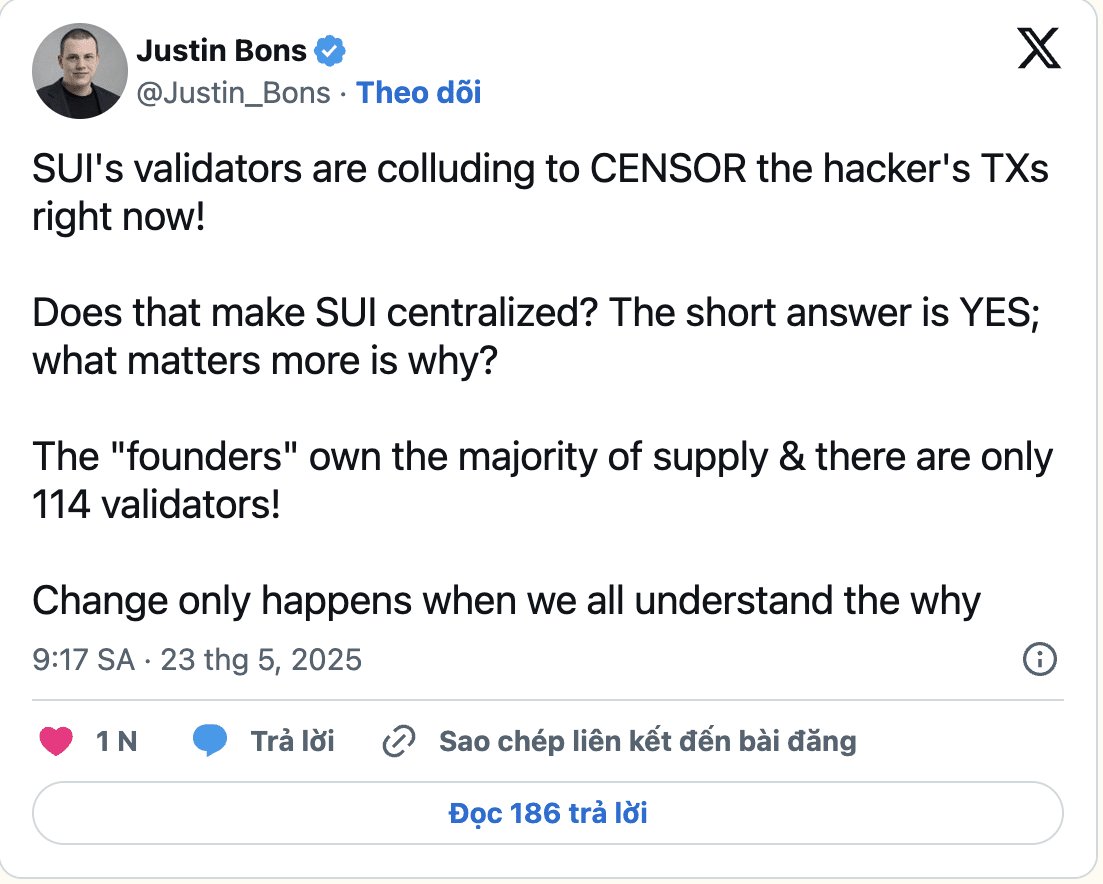
Prominent among the criticisms is Justin Bons, founder of Cyber Capital, who argues that:
"The validators of SUI are colluding to censor the hacker's transactions! Does this make SUI a centralized network? The short answer is YES – the important issue is why."
He emphasized that control in the Sui ecosystem is overly centralized, with only 114 validators and the majority of the token supply belonging to the founding group. According to Bons, “the ability of validators to quickly coordinate to halt transactions is the root issue, not the consensus model or governance through staking.”
Bons also rejected misleading comparisons with precedents on Ethereum, arguing that the OFAC 2023 regulation did not lead to the censorship of any transactions on Ethereum because this network is more decentralized and cannot achieve consensus on censorship. He continued:
"Even the DAO hack in 2016 on Ethereum did not lead to transaction censorship. The assets at that time were locked in a smart contract, and any changes underwent a transparent voting process, with no transactions being blocked."
These arguments raise concerns that Sui – despite being labeled as a public blockchain – is operating in a manner reminiscent of a centralized system, where power is held by a minority.
Returning to the tokenomics of the Sui Network
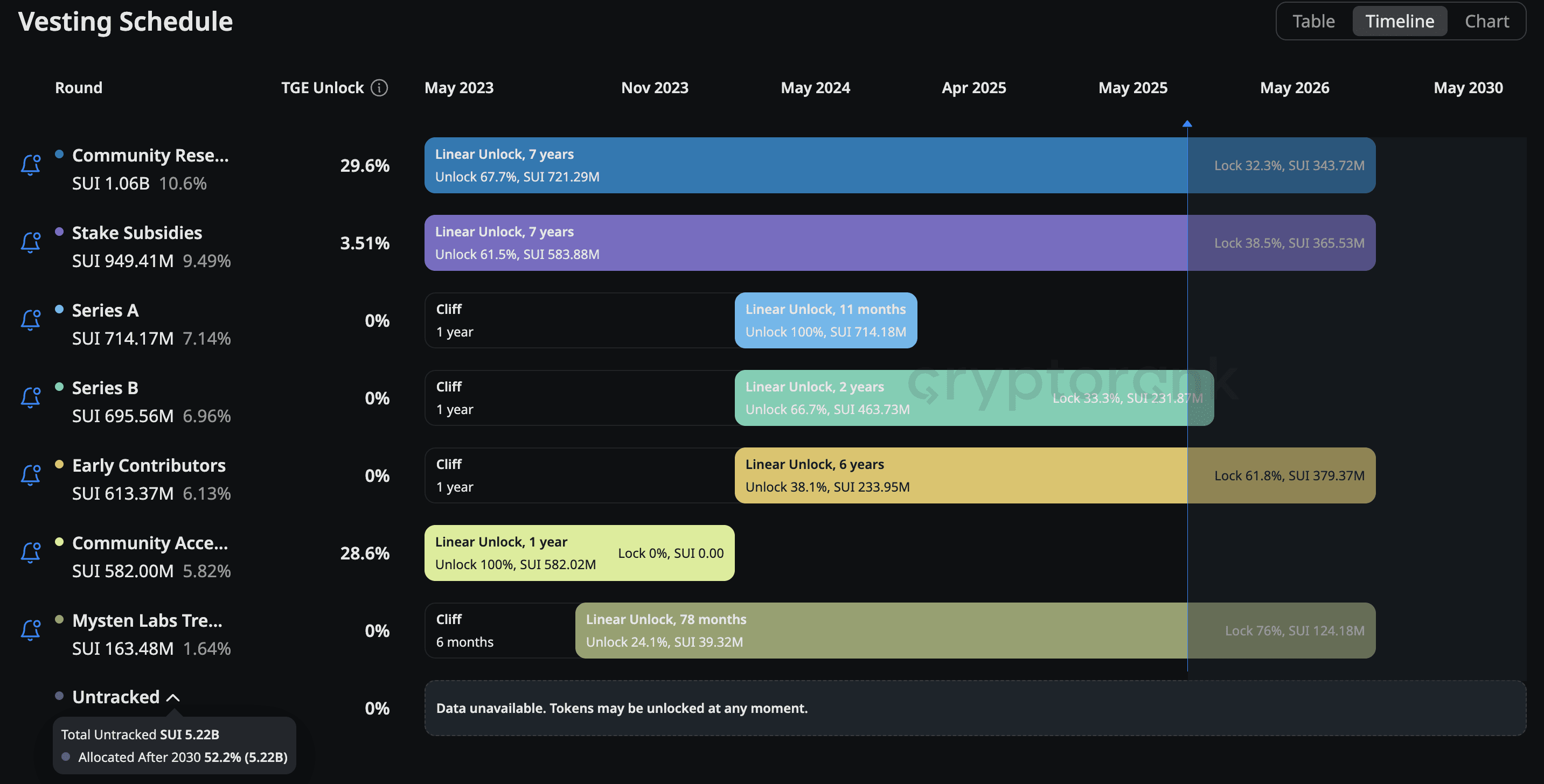
According to information from tokenomics, currently only about 3.34 billion SUI tokens have been unlocked and circulated in the market. However, when checking directly on Sui Explorer, it can be seen that over 7.6 billion SUI tokens are being staked by validators on the network. So what does this imply?

The asymmetry between the amount of unlocked SUI tokens (about 3.34 billion) and the amount of tokens being staked (over 7.6 billion) indicates a concerning reality: the majority of SUI participating in staking comes from tokens that have not been unlocked — which, according to tokenomics, should still be locked and not usable.
This raises questions about the transparency and commitment to adhere to the tokenomics roadmap from the project team and strategic partners. If the observations are correct, then:
SUI is being manipulated in a sophisticated manner: allowing staking of unlocked tokens enables the team and stakeholders to control the majority of the network (through validator rights) while monopolizing most of the staking rewards — which should be fairly distributed to the community participating in the network.
The Sui network is losing its core decentralization: staking from internal addresses and non-tradable tokens makes the network appear 'secure' technically, but concentrates power in the hands of a small group – contrary to the principles of a public blockchain.
Price increases do not reflect intrinsic value: the strong rise in SUI token prices recently may not come from actual market demand, but from activities controlling the circulating supply and manipulating liquidity.
Therefore, retail investors need to be extremely cautious. With such an ownership structure controlled by insiders, any time in the future could lead to mass sell-off behavior. In a worst-case scenario, new investors could become "Exit Liquidity" for earlier investment rounds or for the development team itself.