


Focus|Web3 Payment Track Landing Application - Africa's Stablecoin Market
Web3 Payment White Paper: Stablecoins in Africa in 2025
Reprinted from Teacher WILL, WILL Awang

Foreword
The world is flat.
Our world has shifted from isolated local economies to a tightly interconnected global system, prompting Thomas L. Friedman to state, 'The world is flat.' While the internet has made the flow of information free and global, the infrastructure supporting the flow of funds still largely relies on frameworks established before the internet era, making the movement of money/value still so difficult and costly.
Although some regional financial innovations can accelerate the flow of funds, the financial rails supporting Africa have not been synchronized. The traditional financial system has failed to provide stability, accessibility, and efficiency, exposing people to inflation and financial uncertainty risks, with limited control over savings and difficulty entering global markets. But just as the region leaped from desktop computers directly to mobile, Africa is now ready to move beyond outdated banking infrastructure and actively embrace stablecoins.
We can no longer limit our vision to the trading use cases of stablecoins in native crypto markets. We should view stablecoins from a fresh perspective, considering their real-world use cases in non-crypto native scenarios. Stablecoins have become a crucial part of the crypto narrative in sub-Saharan Africa, serving as a popular hedging tool against prolonged inflation and currency depreciation.
“Blockchain-based stablecoins are the answer. Stablecoins represent our first real opportunity to change currency in the same way email changed communication: making it open, instant, and borderless. This is a currency/value WhatsApp moment, with a global network built through blockchain and stablecoins that can benefit everyone.” — Chris Dixon, a16z

I. The Quiet Revolution of Stablecoins in Africa
The adoption of mobile money in Africa is the highest in the world and deeply ingrained, demonstrating a demand for alternative financial solutions. Thus, the emergence of stablecoins is a logical development, providing a way to seamlessly access financial services with just a mobile phone. Stablecoins can further evolve on this foundation, expanding financial inclusion and enabling more efficient borderless transactions.
According to Chainalysis data, Africa is the fastest-growing region for cryptocurrency adoption, with year-on-year growth rates from 2022-2023 to 2023-2024 at 45%, surpassing 42.5% in other emerging markets like Latin America. This rapid growth highlights the immense potential for stablecoin applications, especially in African regions where banking penetration remains at the lowest levels globally.
“Stablecoins have already become a reality in cross-border payments in Africa... Other parts of the world are just catching up.” —Zekarias Amsalu, Co-Founder of Africa Fintech Summit

One of the main drivers of stablecoin adoption in Africa is the foreign exchange (FX) crisis faced by many countries. Approximately 70% of African countries are experiencing foreign exchange shortages, making it difficult for businesses to secure the dollars needed for operations. In countries like Nigeria, where the local currency Naira (NGN) has depreciated significantly, stablecoins offer a much-needed alternative. 'Banks have no dollars, the government has no dollars, and even if they do, they won't give you any.' — Chris Maurice, CEO & Co-founder of Yellow Card
Over the past three years, stablecoins have become an integral part of Africa's financial system, providing a reliable means of value storage, cross-border remittances, and trade without relying on highly volatile and unstable local currencies. Dollar-backed stablecoins like USDT and USDC are filling the gaps left by traditional finance, allowing people in economies where dollars are scarce to access stable value storage.
From remittances and retail savings to B2B trade and cross-border payments, stablecoins are addressing issues like Dollar Access, Instant Settlement, and FX Inefficiencies across the African continent, particularly in markets where traditional payment channels are lacking.
Africa is the world's most vibrant growth market, with the fastest population growth, the youngest median age, and nine of the twenty fastest-growing economies. Africa has 400 million mobile payment users, and the scale of digital finance is already substantial. Stablecoins are the next leap, transforming smartphones into globally connected dollar accounts. Looking ahead, in a decade, more Africans will own crypto wallets and use stablecoins for everyday transactions rather than traditional bank accounts.
“You don't have to educate users; life will force them to use it.” —Sky, Co-founder of ROZO

II. Projects Driving Future Adoption of Stablecoins
Chuk from Paxos has drawn a map covering payment channels, use cases, and the ecosystem of companies affected by this transformation. While many market maps showcase the global stablecoin ecosystem, few focus on Africa's role in shaping its financial future. Thus, we created this map to highlight the builders and use cases that are redefining the financial infrastructure of the African continent.

(Mobile Money to Global Money: Africa’s Stablecoin Revolution, Chuk @ Paxos)
In the past three years of investment in the African market, we have seen an increasing number of companies building around stablecoins, each playing a critical role in driving the adoption and innovation of stablecoins. Here are some of the most noteworthy participants, along with key growth and funding data highlighting the rapid expansion of the industry.
Yellow Card: One of Africa's leading cryptocurrency exchanges, operating in 20 countries across the continent. The largest and first licensed stablecoin deposit platform in Africa. Yellow Card allows users to seamlessly exchange fiat currency for cryptocurrency and vice versa. In 2024, the platform's annual trading volume doubled from $1.5 billion in 2023 to $3 billion.
Conduit: Providing stablecoin payment services for import and export businesses in Africa and Latin America. Annualized TPV is expected to soar from $5 billion in 2023 to $10 billion in 2024.
Juicyway: A Lagos-based startup facilitating cross-border payments using stablecoins. Since 2021, Juicyway has processed a total of $1.3 billion in payments.
Bridge: Founded in 2022, Bridge was acquired by Stripe for $1.1 billion just two years later. Bridge has enhanced the global stablecoin payment infrastructure. It serves most African payment companies and facilitates stablecoin payments in Europe, the US, and Asia.
Jia: A blockchain-based fintech company providing loans to small and micro enterprises in emerging markets. In 2024, Jia's cumulative loan issuance exceeded $10 million, up from $2 million the previous year, with an internal rate of return (IRR) of 24% and a default rate of 0.14%.
Onboard: A global P2P trading protocol that allows anyone to access on-chain finance anywhere. Nestcoin raised $1.9 million in its last funding round to drive product growth.
KotaniPay: Providing stablecoin settlement solutions for businesses and users. KotaniPay is developing an API product that connects blockchain and local payment channels. In 2023, KotaniPay secured $2 million in seed funding.
Accrue: Building a USD stablecoin agency network to expand cross-border payment infrastructure. Secured $1.58 million in seed funding to scale operations.
Convexity: Developed Nigeria's first regulated stablecoin, cNGN. The company has been collaborating with the Central Bank of Nigeria since 2021 and received a temporary license from the Nigerian Securities and Exchange Commission (SEC) in 2024.
Honeycoin: A platform for cross-border remittances, bill payments, purchasing airtime, and online consumption. GTV surged from $40 million in the previous quarter to $500 million in Q4 2024.
Paycrest: A decentralized liquidity protocol that supports instant, low-cost payments backed by stablecoins. They also developed Zap, a DApp for seamless payments between cryptocurrencies and fiat currencies, and won the Base 2024 Global Onchain Summer Buildathon competition. Zap is now ready to launch as Noblocks, the first interface supported by a distributed liquidity node network for instant decentralized payments with any bank or mobile wallet.
Haraka: A stablecoin-driven micro-lending protocol aimed at underserved entrepreneurs in emerging markets. Haraka utilizes a reputation-based credit scoring system and has partnered with Grameen Bank and Mercy Corps to showcase early commercial validation.
Many of these companies have seen significant growth over the past two years and are at the forefront of stablecoin innovation in Africa.
For the global fintech community, the question is not whether stablecoins will go mainstream. The question is what we can learn from places where stablecoins are already prevalent—Africa.
III. Stablecoins are Solving Everyday Problems in Africa
“In Africa, this is not a choice between stablecoins and other financial tools. It is stablecoins, or nothing.” —Samora Kariuki, Frontier Fintech
Across Africa, stablecoins are addressing real problems. From asset preservation to trade facilitation, the adoption of stablecoins is driven by necessity, rather than speculation and trading. Below are the most critical use cases based on real demand, along with the companies building to support these use cases.
3.1 Everyday Tools: Savings, Consumption, and Credit
In many African countries, inflation, currency depreciation, and limited access to banking services make establishing financial security exceptionally challenging. Stablecoins offer a more reliable path, becoming a dollar-denominated tool for savings, transactions, and credit.
A. Asset Preservation
In regions where access to dollar-based banking services is limited, inflation rates are high, and the costs of fiat payment networks are excessive or unreliable, stablecoins are increasingly favored. The situation in Africa reflects these dynamics, making stablecoins a critical tool for protecting savings and maintaining purchasing power, especially in economies where local currencies are persistently depreciating.
Currency depreciation is one of the biggest financial challenges facing African markets. Take the Kenyan shilling as an example: although Kenya's GDP has doubled from 2008 to 2024, its exchange rate against the dollar has depreciated by 50% since 2021. The contradiction is evident: economic growth is rising, but confidence in the local currency has not strengthened. Similarly, over the past 18 months, inflation and the naira's depreciation have been key drivers of stablecoin adoption in Nigeria. The naira hit an all-time low in February 2024 and has struggled ever since, further highlighting the demand for stable alternatives.

(Stablecoins: Leapfrogging Africa’s Financial System, Ayush Ghiya and Uchenna Edeoga)
As local currencies continue to depreciate, stablecoins are becoming the preferred hedging tool, offering a more reliable means of wealth trading and storage. Unlike cash or gold, stablecoins provide a fully digital and widely available payment channel without relying on banks, payment networks, or central banks. They not only hedge against currency volatility but also offer higher yields than traditional savings accounts, making them an attractive option for Africans looking to preserve and grow their wealth. Traditional bank interest rates are low, while stablecoin savings platforms leverage decentralized finance (DeFi) and cryptocurrency lending models to create higher returns for users.
Currently, dollar-based stablecoins are the preferred choice for users in emerging markets. In much of Africa, USDT (based on Tron) has become the de facto digital dollar. Most users access stablecoins through centralized custodial applications like Binance, prioritizing speed and liquidity over Western concerns about reserves or transparency.
For users facing foreign exchange rationing and 30% inflation, the most important factor is whether it works. Stablecoins help users preserve assets in marginalized areas and save in stable currencies. According to World Bank data, as of 2021, only 49% of Africans had bank accounts, yet 400 million people used mobile payments, illustrating how stablecoins can meet user needs where banks are unable.
Platforms like Fonbnk can achieve instant top-ups to USDT on basic mobile phones, while Accrue provides a local community agent network for cashing in and out of stablecoins. The Nigerian cryptocurrency platform Busha Earn allows users to save stablecoins at an annual yield of up to 7.5% (far exceeding most Nigerian banks' yields). Sub-Saharan Africa leads the world in DeFi applications, likely due to the region's growing demand for convenient financial services. This indicates that stablecoins are not just an alternative; they are essential for financial stability in areas where traditional systems have failed.
This makes stablecoin savings an attractive option—not only because of higher interest rates but also because users can gain value through hedging against currency depreciation and earn returns. These factors combine to make stablecoins a powerful tool for wealth preservation and appreciation.
“By converting everyday prepaid payments—mobile data, bank transfers, and mobile payments—into USDT, Fonbnk acts as a stablecoin settlement layer, providing 400 million unbanked and underbanked Africans with a means to hedge against currency depreciation and opening up new savings and credit pathways beyond traditional banking.” —Chris Duffus, Founder & CEO, Fonbnk
B. Expanding Access to Credit
Africa's micro, small, and medium enterprises (MSMEs) face a $330 billion credit gap, with a lack of banking services leading to an underdeveloped credit system for small and micro businesses, leaving millions of individuals and small enterprises shut out by banks. In these markets, small enterprises are often overlooked by traditional financial institutions due to high collateral requirements, lengthy documentation processes, and a lack of credit history. Difficulty accessing affordable upfront capital has led many MSMEs to turn to informal lenders for financing, and the lack of affordable credit limits their ability to maintain daily operations and promote economic growth.
In the Web3 space, stablecoin lending protocols have shown significant potential for addressing this issue over the past three years. However, most such solutions still require excessively high collateral rates, needing about 150% in crypto assets as collateral, effectively excluding small and micro enterprises in emerging markets. Although low-collateral lending protocols like Goldfinch have emerged, they primarily serve as alternative debt providers for fintech lenders rather than directly serving small enterprises.
Recently, two companies, Jia (utilizing decentralized finance for factoring, supply chain financing, and other loans) and Haraka (using an innovative social credit system), have been actively disrupting the space and seizing market opportunities in Africa. These companies provide blockchain-based loans to small businesses and empower responsible borrowers with ownership, allowing them to accumulate wealth and drive economic development in their communities.
Bringing this real-world economic activity on-chain benefits both investors and borrowers. Investors can democratically access real returns, while borrowers can gain blockchain liquidity, treating ownership as a way to create long-term wealth for themselves and their communities. The use of blockchain also reduces the high transaction costs commonly seen in private credit markets (often passed on to the final borrower) and enables borrowers to create on-chain credit histories, building reputations over time.
These tools give users more control over their funds and unlock previously inaccessible financial options.
3.2 Cross-Border Flow: Trade, Capital Management, and Remittances
As Stripe CEO Patrick Collison stated, stablecoins are 'the room-temperature superconductor of financial services.' They will enable businesses to seek new opportunities that previously could not bear the burden of existing payment channels or the friction of traditional gatekeepers. This is especially evident in the cross-border payments space, where traditional systems are slow, costly, and reliant on multiple intermediaries. High fees and long delays complicate transactions—especially in Africa, where the average remittance rate is around 8%, and financial infrastructure is often limited or absent.
Cross-border payments are the backbone of Africa's everyday economy, from importing goods and sending remittances to repatriating profits and paying freelancers. However, the payment channels supporting these flows remain fragile: 3-5 days delays, 5-10% fees, and subjected to foreign exchange rationing. Stablecoins change this reality, offering a solution that supports real-time, low-cost transfers without requiring significant capital reserves or bank intermediaries.

(Stablecoins: Leapfrogging Africa’s Financial System, Ayush Ghiya and Uchenna Edeoga)
For the scenario where a user in Uganda wants to transfer funds to a user in Nigeria. If remitted via the SWIFT network, the user may have to go through intermediary banks in the US since there is no direct banking network between the two countries. However, once a stablecoin payment network is adopted, users can exchange local currency for stablecoins and send them directly to the Nigerian user, who can then convert it into Nigerian Naira and access the funds locally.
This process eliminates the inefficiencies of SWIFT and net settlement models, as transfers are made directly through exchanges or blockchain wallets connected to currency acceptance and withdrawal service providers. These providers integrate with local payment systems, enabling seamless conversion between stablecoins and local currencies.
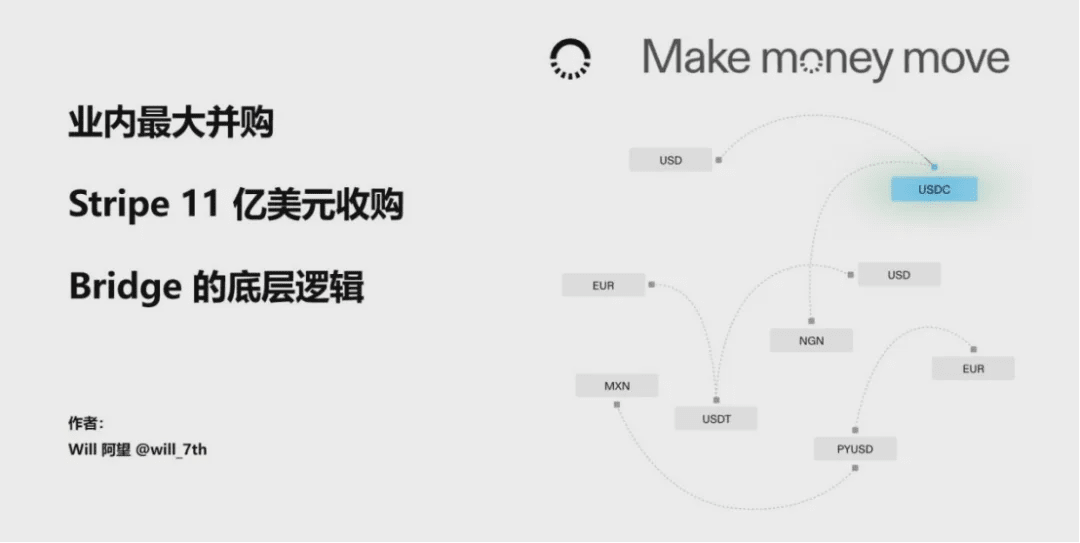
Recently, Stripe acquired Bridge, a stablecoin API provider, for $1.1 billion, just two years after Bridge was founded in 2022, aiming to enhance its global stablecoin payment network. Africa is a key market for Bridge, providing stablecoin payment services for most African payment companies operating in Europe, the US, and Asia. This underscores the growing demand for stablecoin infrastructure in the market and the rapid expansion of major players in this space.
While Bridge laid the groundwork for the orchestration and issuance of stablecoins, there remains considerable work to be done in this subfield. Cross-border payments remain a massive opportunity, but there are also key issues that need to be addressed.
A. Trade and B2B Payments
China is Africa's largest trading partner, with imports from China reaching $176 billion in 2023, resulting in a trade deficit of $66.6 billion. This creates a sustained demand for dollar payments, which stablecoins meet efficiently and with high liquidity. Due to its deep liquidity and wide exchange support, USDT (based on Tron) has become the preferred channel for many commercial payments.
“Stablecoins are the new cornerstone of cross-border payments in Africa. Businesses using Conduit can settle payments almost instantly, reducing working capital, maintaining liquidity, and avoiding currency fluctuations.” —Eric Wainaina, General Manager, Africa at Conduit
“Stablecoins have completely changed the situation for importers who cannot access dollars through banks—now their businesses are thriving.” —Suleiman Murunga, Director, MUDA
Intra-African Trade Payments: Intra-African trade accounts for only 15% of total African imports and exports, far below 54% in North America, 60% in Asia, and 70% in the EU. The main reason for this imbalance is the lack of direct currency exchange infrastructure—most transactions require converting local currencies into dollars, pounds, or euros before being exchanged for other African currencies. This inefficiency adds $5 billion in unnecessary costs to intra-African transactions each year. Addressing this issue is crucial for achieving smooth trade across the continent.
Capital Repatriation: Some large multinationals selling goods and services in Africa can use stablecoins to repatriate funds. With stablecoin infrastructure, funds can settle in under 30 minutes, while traditional payment methods take 2-3 days.
B. Remittances and Global Payments
Just as stablecoins can facilitate outward payments, they can also bring funds into the African continent. This includes remittances, salary payments, and income for freelancers.
Remittances are one of the most common cross-border payment needs, but traditional remittance methods make it costly. In 2023, global remittance flows reached $883 billion, with fees particularly impacting low-income users. Today, sending $200 from the US to Nigeria using stablecoins costs less than $0.01, whereas traditional methods require $7.60. Massively reducing these costs remains a top priority.
“Sub-Saharan Africa remains the region with the highest remittance costs globally, with an average cost of 8.37% in 2024. However, many overseas Africans are unaware that they can now use stablecoins to send money home faster and at a lower cost.” —Xino Zee, Lead at Send Africa
Payments: For freelancers in the gig economy, cross-border micro-payments remain costly and inefficient. In places like Kenya, some even opt to 'rent' PayPal accounts because opening accounts themselves is too difficult—highlighting how access barriers exacerbate the already high costs of small international payments. The emergence of stablecoins can simplify payment processes, significantly benefiting these workers. Additionally, multinational companies can use stablecoins to efficiently manage cash flow and seamlessly pay global employees, customers, or suppliers.
Global Aid: Currently, only about 40 cents of every dollar donated to global aid organizations actually reaches the beneficiaries, with the remaining funds going to various intermediaries. We clearly need a more efficient, low-cost system to deliver global assistance in a transparent and seamless manner.
A new wave of companies is rebuilding Africa's cross-border payment infrastructure around stablecoins. As exchanges, Yellow Card, Busha, VALR, and Luno provide liquidity for local currency acceptance. Conduit, Honeycoin, Shiga Digital, and Juicyway support commercial trade, collections, and payments, while Sling and Send drive consumer P2P payments.
These builders have quietly transferred billions of dollars cumulatively. Many companies do not directly sell 'stablecoins,' but rather offer cheaper remittances, operational capital efficiency, and currency stability.
IV. Opportunities for African Builders
“In Africa, if you kick a tree, three fintech companies using stablecoins will fall out... The strongest teams we support now have single-channel or industry liquidity—stablecoins are hidden behind fintech companies.” —Brenton Naicker, Principal & Head of Growth (Africa) at CV VC
4.1 Four Levers for Creating Value
The first wave of stablecoin growth focused on infrastructure: deposits, channel liquidity, and basic wallet functions. This level is rapidly becoming crowded. The next stage is differentiation: who owns the users, who defines the standards, and how to profit from real use cases. Here are the four levers shaping value creation across the African continent:
A. Distribution: Winning Users
Control over the user interface and customer relationships determines the flow of transaction volume. The strongest companies are not those leading with stablecoin infrastructure but rather those solving payment, lending, or capital management issues, keeping stablecoins hidden behind the scenes.
B. Liquidity: Controlling the Two Ends of the Channel
Local foreign exchange liquidity is uneven and difficult to replicate. Teams capable of managing flows at the starting and ending points can offer better pricing, internal net trading, and lower costs. Liquidity accumulates, forming a defensive moat.
C. Regulation: Shaping Rules Where They Have Yet to Form
In competitive markets like Nigeria and Kenya, perfect execution is critical. But in less developed markets like Malawi or Cape Verde, first movers face less competition and can work with regulators to define the rules of the game. Builders who invest in trust early on may win long-term policy consistency.
“Dollar liquidity has already been on-chain in much of Africa through stablecoins. Policymakers should prioritize the large-scale on-chain migration of local currencies to accelerate economic sovereignty and trade.” —Wale Ayeni, Managing Partner of Helios Digital Ventures
D. Vertical Fields: Tailoring for Specific Workflows
Whether in agriculture (e.g., Agridex), logistics, education, or global aid, each industry has its own workflows, user expectations, compliance requirements, and payment rhythms. Specialized builders can use jargon, integrate with existing tools, and solve problems that generalists cannot. Once trust is established, they can add additional financial services such as credit, capital management, or insurance. Focus brings user stickiness and profits.
4.2 Major Crypto Economies in Africa

(State of Crypto Report 2024: New data on swing states, stablecoins, AI, builder energy, and more)
A. Nigeria—The Hub of African Crypto Activity
Driven by a booming fintech sector and severe economic challenges, Nigeria, Africa's most populous country, is leading in the adoption of stablecoins. In recent years, Nigeria's economy has faced a series of shocks. Low oil prices (a key driver of its export economy), coupled with the impacts of the COVID-19 pandemic and supply chain disruptions, have led to prolonged financial uncertainty. Nigeria's inflation rate is among the highest in Africa, even surpassing that of the entire Francophone region. As the Naira continues to depreciate, stablecoins have become an important tool for Nigerians seeking to preserve wealth and engage in global transactions.
According to the Chainalysis team's Crypto Global Adoption Index, Nigeria ranks second overall. Between July 2023 and June 2024, the country received approximately $59 billion worth of cryptocurrency. Nigeria is also one of the leading markets for mobile crypto wallet adoption, second only to the United States. The country is actively working towards regulatory clarity, including through incubation programs, and the use of stablecoins in everyday transactions (such as bill payments and retail purchases) is growing significantly.

(Sub-Saharan Africa: Nigeria Takes #2 Spot in Global Adoption, South Africa Grows Crypto-TradFi Nexus, Chainalysis)
Like Ethiopia, Ghana, and South Africa, stablecoins are also a significant part of Nigeria's crypto economy, accounting for about 40% of all stablecoin inflows in the region—the highest in sub-Saharan Africa. Nigerian users report higher transaction frequencies and a deeper understanding that stablecoins are a financial tool, not just an asset class.
Cryptocurrency activity in Nigeria is primarily driven by small retail and professionally scaled transactions, with about 85% of the transfer value being below $1 million. Due to the inefficiencies and high costs of traditional remittance channels, many Nigerians rely on stablecoins for cross-border remittances. Sodipo noted, “Cross-border remittances are the main use case for stablecoins in Nigeria. They are faster and more affordable.”
“Everyday activities like bill payments, mobile top-ups, and retail shopping are increasingly being driven by cryptocurrencies. People are beginning to see the practicality of cryptocurrencies in the real world, especially in daily transactions, which contrasts with the earlier view of crypto as a fast track to wealth.” —Moyo Sodipo, CEO & Co-founder of Busha, Nigerian cryptocurrency exchange
In addition to traditional financial systems, DeFi platforms are providing Nigerians with new opportunities to earn interest, borrow, and engage in decentralized trading. Sodipo states, “DeFi is a key growth area as users explore ways to maximize returns and obtain financial services they might not otherwise have access to.”
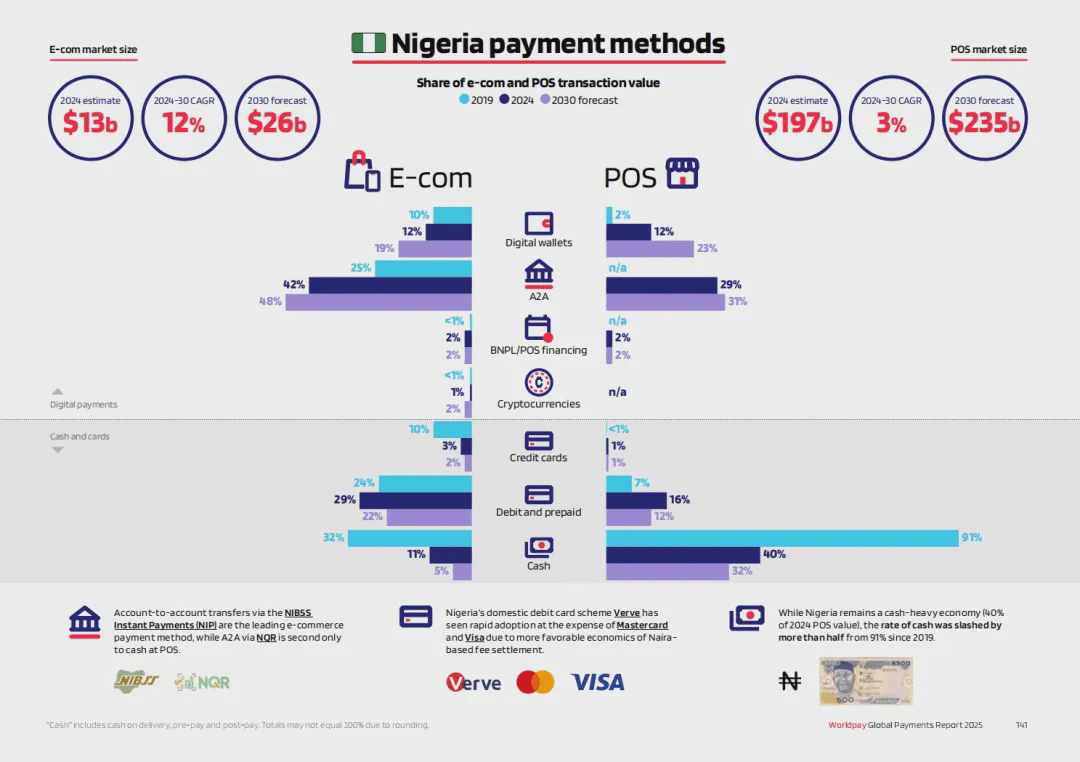
(GPR 2025: the past, present and future of payments, WorldPay)
We can see from the above diagram that cryptocurrency as a payment method has already accounted for 1% of online e-commerce and offline point-of-sale (POS) in Nigeria, classified under Digital Payments. Similar countries in the WorldPay report include: Argentina, Brazil, India, Nigeria, Philippines, Singapore, Turkey.
Against the backdrop of inflation, remittances, and financial channels driving stablecoin applications, it is believed that the adoption of stablecoins will be reflected across various scenarios. Nigeria has become an ideal testing ground for stablecoins in Africa. The role the country plays in the construction of stablecoin infrastructure will determine the direction of this technology's development across the continent.
In December 2023, the Central Bank of Nigeria lifted the ban on banks providing services to cryptocurrency companies, which has also played a crucial role in the popularization of cryptocurrency. “Since the bank ban was lifted, it has opened up many possibilities for collaboration and smoother transactions,” Sodipo explained. Building on this, in June 2024, the Nigerian Securities and Exchange Commission (SEC) launched the Accelerated Regulatory Incubation Program (ARIP), requiring all virtual asset service providers (VASPs) to register and undergo evaluation before obtaining full approval. “The industry is optimistic about ARIP; it marks a shift away from uncertainty and is a positive step towards regulatory clarity,” said Sodipo.
These policy initiatives will enable companies across various sectors to consider transitioning from traditional payment channels to stablecoin infrastructure. While compliant solutions are not without flaws, every business adopting stablecoins can demonstrate to existing enterprises that stablecoins are a reliable, safe, compliant, and superior solution to traditional payment issues.
B. South Africa—TradFi Institutional Adoption Drives Market Development
As Africa's largest economy, South Africa has positioned itself as one of the continent's most advanced Web3 markets, with a sophisticated regulatory framework and strong institutional investor interest. The country has become one of Africa's largest cryptocurrency markets, with a trading volume of $26 billion over the past year. Unlike many African nations where cryptocurrency adoption is largely driven by retail investors, South African institutional participation is steadily increasing, with licensed companies and traditional financial institutions entering the space.
Since the end of 2023, stablecoins have seen sustained growth on local exchanges in South Africa—over 50% month-over-month growth in October 2023. Stablecoins have outpaced Bitcoin as the most popular cryptocurrency in recent months.

(Sub-Saharan Africa: Nigeria Takes #2 Spot in Global Adoption, South Africa Grows Crypto-TradFi Nexus, Chainalysis)
The key driver of cryptocurrency growth in South Africa lies in its clear regulatory stance. The country has classified cryptocurrencies as financial products, creating a structured legal environment that provides clarity for businesses and investors. In March 2024, South Africa approved 59 cryptocurrency operating licenses, paving the way for broader adoption of stablecoins. By setting regulatory guardrails, the government aims to attract investment, protect users from cybercrime, and expand low-cost digital asset trading channels.
The South African government's fintech taskforce is actively refining its approach to stablecoin regulation and plans to officially categorize stablecoins as a unique subset of crypto assets. This move aligns with the country's broader financial modernization and digital payment initiatives and aims to ensure stablecoins are appropriately integrated into the financial ecosystem. The 2024 budget review further emphasizes the government's commitment to structural reforms, improving public financial management, and developing new policies focused on stablecoins and blockchain-based digital payments.
The growing interest from institutional investors has also sparked discussions around banks issuing stablecoins. As traditional financial institutions explore stablecoin models, South Africa may soon see the emergence of regulated, bank-supported digital assets, further driving the mainstream adoption of stablecoins. Led by startups like VALR, Luno, and Altify, South Africans have already begun using stablecoins for diversification, payments, and more efficient access to financial services.
With a developed financial sector, clear regulations, and the growing integration of cryptocurrency with traditional finance, South Africa is becoming a leader in stablecoin applications on the continent. As the government refines its policy framework and institutions become more deeply involved, South Africa is laying the groundwork for stablecoins to play a core role in its evolving digital economy.
C. Kenya—Becoming the Stablecoin Hub of East Africa
Kenya has long been at the forefront of financial innovation in Africa. From being the first to launch mobile money to early adoption of Web3, the country continues to transcend traditional banking systems in favor of more efficient digital solutions. Today, Kenya is positioning itself as a key player in the stablecoin revolution, backed by its robust fintech infrastructure, open regulatory environment, and growing demand for alternative financial services.
One of Kenya's biggest advantages is its deeply rooted mobile money culture. M-Pesa, launched by Safaricom in 2007, has become a pillar of Kenya's financial system, processing about 60% of the country's GDP and covering over 90% of the adult population. Its success lies in providing banking services without requiring physical banks, allowing millions of Kenyans to deposit, withdraw, transfer, and even obtain credit via mobile devices. Stablecoins complement this ecosystem, enabling users to hold value in stable currencies and conduct frictionless transactions on a global scale.
Beyond mobile money, Kenya's regulatory environment has been a significant driver of fintech and Web3 development. Unlike many countries that take a restrictive stance on digital assets, Kenya's Capital Markets Authority (CMA) actively promotes innovation through regulatory sandboxes, allowing blockchain-based companies to test and refine their products.
Kenya's demand for stablecoins stems from its lack of formal financial services. SMEs face significant barriers to credit, with Kenyan businesses seeking about $1.1 billion in loans in 2021 alone. Stablecoin-driven lending solutions can fill this gap, providing businesses and individuals with cheaper, faster, and more convenient credit options.
Kenya has also become a global leader in the tokenization of private credit. According to data from RWA.xyz, Kenya ranks first globally in the tokenized real-world asset lending space, with loan amounts reaching $73.8 million, surpassing larger economies like India and Brazil. This not only reflects the strong demand in Kenya for alternative financing solutions but also demonstrates the country's capability to integrate blockchain-based credit models into its financial ecosystem.
With a mature mobile currency landscape, advanced regulatory bodies, and increasingly popular stablecoin applications, Kenya is rapidly becoming an important stablecoin hub in East Africa. As more fintech companies build stablecoin-based solutions, Kenya's role in shaping the region's financial future will continue to grow.

(Nika, photographed in downtown Kenya, May 2025)
V. Barriers to Adoption That Need to Be Overcome
Although we can see numerous builders making strong progress in Africa's ideal testing ground, stablecoin infrastructure still faces structural challenges. To further scale, builders must navigate tough barriers, some technical and others political.
5.1 Policy Risks and Regulatory Ambiguity
Although the largest countries have made regulatory progress, most others remain in a regulatory gray area. Stablecoins are neither banned nor fully legalized, which slows the pace of enterprise adoption and hinders institutional capital entry.
As transaction volumes increase, enforcement may tighten regarding capital controls, taxation, anti-money laundering, and reporting. Progress in this area will come from active interaction with regulators. Founders, industry associations, and regional sandboxes can help shape the rules.
“Busha is proud to be the first licensed exchange in this market, leading the charge to provide the necessary liquidity, trust, and infrastructure to drive a stablecoin-powered economy. This is not the future; it is already here.” —Michael Adeyeri, Co-Founder & CEO of Busha
5.2 Currency Sovereignty
Governments are increasingly concerned that stablecoin wallets are creating a 'shadow dollar economy.' Some countries are exploring local alternatives, such as ZARP (Zimbabwe Digital Asset Reserve Platform) and cNGN (Naira-backed stablecoin), or piloting central bank digital currencies (CBDCs) to maintain monetary control.
“The dominance of dollar stablecoins reflects a trust crisis... Without decisive policy innovation and encouragement for regulated, competitive Naira-backed stablecoins like cNGN, African countries may hand over their financial control to offshore stablecoin issuers.” —Adedeji Owonibi, Founder & COO of Convexity (cNGN Issuer)
5.3 Liquidity Gap
Fast cross-border payments require capital to be available in the right time, place, and currency. Providers like Wise and Thunes address this through pre-deposited funding accounts, but as stablecoin liquidity flows, this responsibility shifts to market makers, OTC desks, and other liquidity providers. As transaction volumes grow, capital remains a limiting factor in each channel.
Payment finance companies like MANSA and Arf are filling this gap. By using stablecoins as a transmission layer, they provide real-time liquidity to fintech companies, coordinators, and SMEs.
“Real-time, low-cost liquidity not only makes payments faster but also unlocks new models like just-in-time supplier financing. For founders who have built around settlement risks, this is a game changer.
The next step is to embed this dollar liquidity directly into the applications and tools already used by emerging market businesses, so that value can flow as easily as a WhatsApp message.” —Mouloukou Sanoh, CEO & Co-Founder, MANSA
5.4 Fraud, Scams, and Consumer Trust
The adoption of cryptocurrencies brings new risks, from phishing scams to counterfeit wallets and poorly secured applications. These vulnerabilities undermine user trust, particularly among first-time users. The responsibility for security falls on consumer applications. Trustworthy design, risk tools, and education must be core components of the product.
“Users are the biggest victims of malicious actions. They will only continue to use and recommend platforms they perceive as safe.” —Zach Bijesse, CEO & Co-Founder at Archer
5.5 Awareness and Education
Outside of the cryptocurrency-native circles, many merchants and agents still find stablecoins difficult to understand. Ongoing 'last mile' adoption depends on usability, training, and demonstrating actual value.
“In many rural areas and even urban communities, awareness of cryptocurrencies remains low, as they seem too technical.” —Xino Zee, Lead at Send Africa
These barriers are real, but they are being gradually overcome every day. Successful teams do not wait for perfect conditions; instead, they build resilience, earn trust, and adapt across channels and communities as regulation improves.
VI. Stablecoins are Redefining Finance in Africa
Stablecoins are fundamentally changing the financial landscape in emerging markets by offering a convenient, efficient, and reliable alternative to traditional banking systems. Unlike the institution-driven adoption seen in Western economies, Africa has not waited for global consensus on stablecoins but is already building. Sub-Saharan Africa is experiencing grassroots growth driven by small transfers, remittances, P2P payments, and value storage involving retail users. At the same time, substantive applications are being developed in remittances, trade, credit, and savings, driven by fintech companies.
The past few years have proven that stablecoins are not just an alternative but an inevitable trend for the future of African currencies. They can bypass fractured financial rails, providing stable value and enabling instant, low-cost transactions, making them important tools for individuals, businesses, and institutions alike. As more infrastructure is built and regulatory transparency improves, stablecoins will undoubtedly become more deeply integrated into Africa's financial system.
Here lies the prototype of the future of programmable money. This is a region worth learning from, building in, and investing in.
We are producing a series of documentaries to tell these stories—the stories of people using stablecoins in the last mile—because to fully realize the opportunities of stablecoins, we need to better understand the conditions driving their development and continue to push for their adoption in markets where the technology has found product-market fit. —Justin Norman, Founder of The Flip
He noted that to understand stablecoin adoption in Africa, one must see the 'last mile' individuals, not just the technology.
Africa's demographics are in place, the demand is evident, and this momentum will only accelerate with the gradual improvement of global regulations. Stablecoins are no longer a buzzword in the crypto market; they represent a systemic transformation decoupling from traditional finance and reconstructing on-chain.
Everyone sees different facets, but they all point to the same future—a world where banks are not needed, but everyone can 'have a bank.'
Focus: The payment track has always been a market where Web3 occupies a place, with leading projects like XRP and TON continuously building. If full-scale adoption truly occurs, how do you think you can make money within it?
#payfi #payment #币安Alpha上新