


Futures contract rolling refers to using the profits from the existing position to open more positions after the original position is profitable, thereby increasing the position value. This process is called rolling, which can be understood as rolling a snowball that gets bigger.

This sounds simple, but in actual operations, novice users will encounter various problems, such as:
How is the margin and liquidation price calculated after increasing the position?
Why did my liquidation come faster after adding a position?
If a liquidation occurs, will it happen together or will the first opened position be liquidated first?
This tutorial article will explain the above confusion together with me!
Before understanding the rolling position, let's look at the specific calculation method of the liquidation price, as the calculation methods differ for different opening modes (the following calculations do not consider maintenance margin rates and transaction fees):
1. Isolated Margin Mode
In the isolated margin mode, positions will be allocated to a certain amount of margin, which is independent of the trader's account balance. This allows traders to control account risk, and the maximum loss to be borne when triggering liquidation is the corresponding position margin.
The calculation formula is as follows: (The case is a forward contract, USDT-based; all following cases only consider long scenarios; short scenarios can be calculated by everyone themselves.)
When the position loss > position margin, it triggers liquidation, that is,
(Opening price - liquidation price) * position size > initial margin + additional margin
Assume that a BTC forward contract has a face value of 0.01 BTC. User A buys 10 contracts to go long when the coin price is 20,000 USDT, with 20x leverage. If no additional margin is added, then
(Opening price: 20,000 USDT - liquidation price) * position size (0.01 BTC * 10 contracts) > initial margin (100 USDT)
Calculated: Liquidation price <19,000 USDT, which means that the price of the coin must drop to 19,000 USDT to be liquidated.
If user A adds an additional 500 USDT as margin after opening the position, then
(Opening price 20,000 USDT - liquidation price) * position size (0.01 BTC * 10 contracts) > initial margin (100 USDT) + additional margin (500 USDT)
Calculated: Liquidation price <14,000 USDT, which means that the price of the coin must drop to 14,000 USDT to be liquidated.
From the above calculations, we can also see that adding margin can delay the liquidation time.
In the isolated margin mode, unrealized gains cannot be used to increase positions; many novices will wonder why their unrealized gains cannot be used for rolling positions. This is because they are using isolated margin mode, only the unrealized gains in the full margin mode mentioned below can be used to increase positions.
2. Full Margin Mode
Compared to the isolated margin mode (fixed liquidation price), the liquidation prices in the full margin mode may change continuously because the available balance will be affected by other positions.
In the full margin mode, the initial margin occupied by each position is independent of the account balance, but the remaining balance is shared by all positions, and the available balance will be affected by the unrealized gains and losses of all existing positions.
Example 1
In the full margin mode, assume trader A wants to open a long position of 1 BTC at a price of 20,000 USDT with 50x leverage. The current available balance in the account is 2,000 USDT.
With a total sustainable loss of 2,000 USDT, the liquidation price of the position is 18,000 USDT.
Trader A accepts this risk level and opens a position. The system will occupy 400 USDT from their available balance as the initial margin for opening the position.
Available balance = 2,000 - 400 = 1,600 USDT
Example 2
After a period of time, the price rises to 22,000 USDT, and trader A's unrealized gains are 2,000 USDT.
Total sustainable loss = available balance + initial margin + unrealized gains
= 1,600 + 400 + 2,000
= 4,000 USDT
With a total sustainable loss of 4,000 USDT, the liquidation price of the position is 18,000 USDT.
Based on the above logic, we can derive the calculation formula for the liquidation price as follows (long scenario):
There are unrealized gains:
(Opening price - liquidation price) * position size = available balance + initial margin
There are unrealized losses:
(Current marking price - liquidation price) * position size = available balance + initial margin
The above two formulas reveal a principle: unrealized gains do not affect the liquidation price of the original position, but unrealized losses will bring the liquidation price closer to the marking price.
Having understood the calculation of the liquidation price in the full margin mode, let's see how different additions affect the liquidation price, including fully hedged scenarios, partially hedged scenarios, and positions of different contracts.
The following is an example of calculating the liquidation price in full margin mode (excluding transaction fees).
Example 1 (fully hedged)
In full margin mode, a complete hedge can only be performed when holding the same quantity of the same contract. For example, a trader holds a long position of 1 BTC in BTCUSDT and a short position of 1 BTC in BTCUSDT in full margin mode.
A fully hedged position will not be liquidated because the unrealized gains of one position will offset the unrealized losses of another position.
Example 2 (partial hedging)
Assume trader B holds the following two positions under 50x leverage, with the current available balance being 5,000 USDT. The current marking price is 20,000 USDT.

In this case, the short position will never be liquidated because the number of long positions is greater than the short positions. When the price rises, the unrealized gains of the long positions will always be greater than the unrealized losses of the short positions.
For long positions, when calculating the liquidation price, only the net risk exposure of the position needs to be considered: abs(long position - short position) = abs(2 BTC - 1 BTC) = 1 BTC.
Initial margin = (1 × 22,000) / 50 = 440 USDT
Available balance = 5,000 USDT
(Current marking price 20,000 USDT - liquidation price) * position size (1 BTC) = available balance (5,000 USDT) + initial margin (440 USDT)
Liquidation price = 14,560 USDT
Example 3 (positions of different contracts)
Trader C currently holds the following two positions, and the account available balance is 2,500 USDT.

For the BTCUSDT position,
(Current marking price: 19,500 USDT - liquidation price) * position size (1 BTC) = available balance (2,500 USDT) + initial margin (200 USDT)
Therefore, the liquidation price of the BTC position = 16,800 USDT.
For the ETHUSDT position,
(Liquidation price - current marking price: 2,000 USDT) * position size (10 ETH) = available balance (2,500 USDT) + initial margin (400 USDT)
Therefore, the liquidation price of the ETH position = 2,290 USDT.
Assume trader C has also opened a short position in ARBUSDT. The position details are as follows:
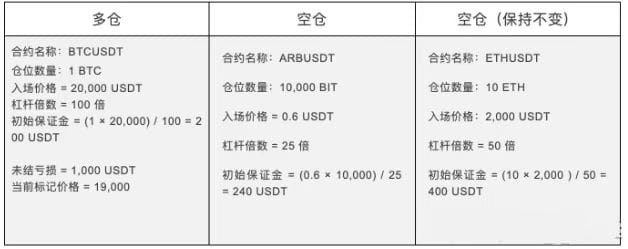
New available balance = 2,500 - 500 (additional unrealized loss of BTCUSDT long position) - 240 USDT (initial margin of ARBUSDT) = 1,760 USDT
The new liquidation price for each position will be calculated as follows:
For the BTCUSDT long position,
(Current marking price: 19,000 USDT - liquidation price) * position size (1 BTC) = available balance (1,760 USDT) + initial margin (200 USDT)
Therefore, the liquidation price of the BTC position = 17,040 USDT.
For the ARBUSDT position,
(Liquidation price - opening price: 0.6) * position size (10,000 ARB) = available balance (1,760 USDT) + initial margin (240 USDT)
Therefore, the liquidation price of the ARB position = 1.1 USDT.
For the ETHUSDT position,
(Liquidation price - opening price: 2,000 USDT) * position size (10 ETH) = available balance (1,760 USDT) + initial margin (400 USDT)
Therefore, the liquidation price of the ETH position = 2,200 USDT.
Let's compare the BTC and ETH liquidation prices before and after adding the position:

It can be seen that when multiple positions use the same asset (USDT) as margin in full margin mode, whenever the unrealized losses of the losing positions increase, the liquidation price of the positions will approach the marking price, which means that all positions are more likely to be liquidated.
The reason for this situation is that the shared available balance will be used to offset the unrealized losses of the losing positions, so the available balance will decrease.
When the available balance is 0, the liquidation prices of the two positions will no longer change because at this point, the maintenance of the position is the initial margin of the position, which will not be shared between positions.