

With less than a week until April 2, the day of the Trump administration's tariff implementation, there are doubts about the strength of the policy, which may not fully materialize as previously envisioned. The Trump team aims to use tariffs to protect domestic industries and generate revenue to fill the deficit, but faces the risk of economic pressure. The implementation of tariffs could follow two paths: either the opponent compromises or a tit-for-tat response, with the short-term tit-for-tat being more probable. The Federal Reserve's delayed response to tariffs has affected U.S. stocks, and the S&P 500 is at a critical position. The crypto market is also impacted, with doubts surrounding Bitcoin's rebound; the April 2 policy will become a turning point that influences the long-term direction.

This impending tariff policy is seen by the Trump administration as a key step in reshaping the U.S. trade landscape. However, as policy details emerge, the market questions its strength and impact. In this global game, both traditional markets and the crypto sector are affected; April 2 will reveal the future direction. This article is based on a piece by Luke from Mars Finance, reprinted by Foresight News.
(Background: JPMorgan: The risks of Trump's tariff war are becoming clearer; it's time to 'stop selling the highs' in U.S. stocks)
There is less than a week left until the highly anticipated 'April 2 Tariff Implementation Day.' This day is referred to as 'Liberation Day' by the Trump administration, carrying the ambition to reshape the U.S. trade landscape.
However, as media speculation rises, it seems that the script for this policy drama is not as radical as the outside world expects. Meanwhile, the crypto market — a sector particularly sensitive to macro winds — is also stirring under the shadow of tariffs.
A 'moderate shift' on Tariff Implementation Day?
Recent information indicates that the tariff policy on April 2 may not fully realize the grand vision previously outlined by Commerce Secretary Lutnik. He envisioned a 'three-tiered' tariff system: based on equivalent tariffs, supplemented by targeted taxes for specific industries and countries. However, recent rumors suggest that the latter two may be relaxed. This is akin to a carefully prepared feast, but what finally ends up on the table is a simple meal — missing some seasoning, but the main dish remains.
Why did this adjustment occur? The reason is not hard to speculate. The Trump team knows well that tariffs are a double-edged sword. Since taking office, its trade policy has caused severe turbulence in the global market: the U.S. stock market has evaporated trillions of dollars in value, supply chain pressures have driven up prices, and even eggs have become 'luxury goods.' If tariffs are pushed to the limit at this time, the U.S. economy may bear the brunt. Goldman Sachs economists warn that despite the calm on the surface, there is a risk of 'negative surprises' lurking behind this 'moderate stance.' The market expects the equivalent tariff rate to be around 9%, but Goldman estimates the actual figure could double to 18%. This gap is enough to make traders hold their breath and wait for the other shoe to drop.
Meanwhile, the upcoming April 1 (unfair trade behavior review report) will be a key barometer. This report will reveal the U.S. investigation tendencies towards its trade partners, directly affecting the rhythm and intensity of subsequent tariffs. If the report accuses certain countries of blatant 'shearing sheep' behavior, Trump may seize the opportunity to escalate; if the tone is softer, the market may welcome a brief respite. Regardless, this report will serve as a preview for interpreting the 'Liberation Day' plot.
Trump's Abacus —— Fairness, fairness, or TMD fairness?
To understand the logic behind the implementation of tariffs, it is worth listening to the statements of core members of the Trump team. Recently, Treasury Secretary Bessent and Commerce Secretary Lutnik candidly expressed their views on the All-in Podcast. Lutnik recalled history, pointing out that from 1880 to 1913, the U.S. relied entirely on tariffs to maintain its finances without needing to levy income tax. After World War II, to support global reconstruction, the U.S. actively reduced tariffs but allowed other countries to maintain high barriers, becoming the 'most open' and thus the biggest loser in trade. For example, U.S. car exports to a certain country are subject to a 20% tariff, while vehicles from that country entering the U.S. only face a 5% tariff. This inequality angered Trump, who exclaimed, 'Fairness, fairness, or damn fairness!'
Trump's intentions are clear: one is to protect domestic industries through tariffs, attracting manufacturing back; the other is to generate revenue to fill a $2 trillion deficit. Lutnik proposed the 'three-horse carriage' plan: increasing tariff revenue, sovereign fund investment, and the 'immigrant golden card' project — the latter reportedly can sell 1,000 cards a day, and Trump optimistically predicts it can attract 1 million buyers. As for the other half of the deficit, it relies on the 'Government Efficiency Department' to cut $1 trillion in wasted spending. This department aims to eliminate 25% of the 'fat' from the $6.5 trillion in annual fiscal spending, which sounds ambitious but undoubtedly daunting in execution.
Treasury Secretary Bessent analyzed the problem from a macro perspective, identifying three major pain points in the U.S. economy: high debt, uncontrollable inflation, and declining manufacturing. His prescription includes cutting spending, reshaping the trade system, and revitalizing the middle class. Unlike Lutnik's radical approach, Bessent emphasizes 'gradualism' to avoid triggering an economic recession with drastic measures. White House economic advisor Stephen Milan also added in a Bloomberg interview that as the world's largest consumer market, the U.S. holds the negotiating trump card and has the ability to force opponents to back down. This confidence stems from strength, but whether it can convert into victory depends on how the opponent responds.
The tariff implementation may take two paths:
One possibility is that the opponent compromises, reducing tariffs on the U.S., resulting in a victory for the U.S. and a rise in the stock market;
The other is a tit-for-tat response, forcing Trump to escalate, resulting in a short-term loss for both sides and pressuring the U.S. stock market.
In the short term, the latter is more likely, as few are willing to show weakness in the global game. But in the long term, with the leverage of the consumer market, the U.S. may gradually reverse the trade imbalance.
The Federal Reserve's sluggish response and the unresolved bottom of U.S. stocks
The uncertainty of tariff policy not only affects the trade landscape but also transmits through inflation and monetary policy to the capital market. Looking back at 2020, the surge in inflation triggered by the COVID-19 pandemic caught the U.S. Federal Reserve off guard. Initially, the Fed was confident that inflation was 'transitory,' but by the end of 2021, Chair Powell had to admit to Congress that it had misjudged and abandoned the term 'transitory,' subsequently embarking on a significant rate hike cycle. According to Bloomberg data (see Chart 1), the U.S. economic policy uncertainty index surged above 500 points at the onset of the pandemic, reaching a historical peak. Although it has since retreated, events such as the Russia-Ukraine conflict in 2022 and Trump's tariff policy in 2024 have once again raised uncertainty; the index still hovers at a high level of 200 points, far exceeding the average level from 1995 to 2019.
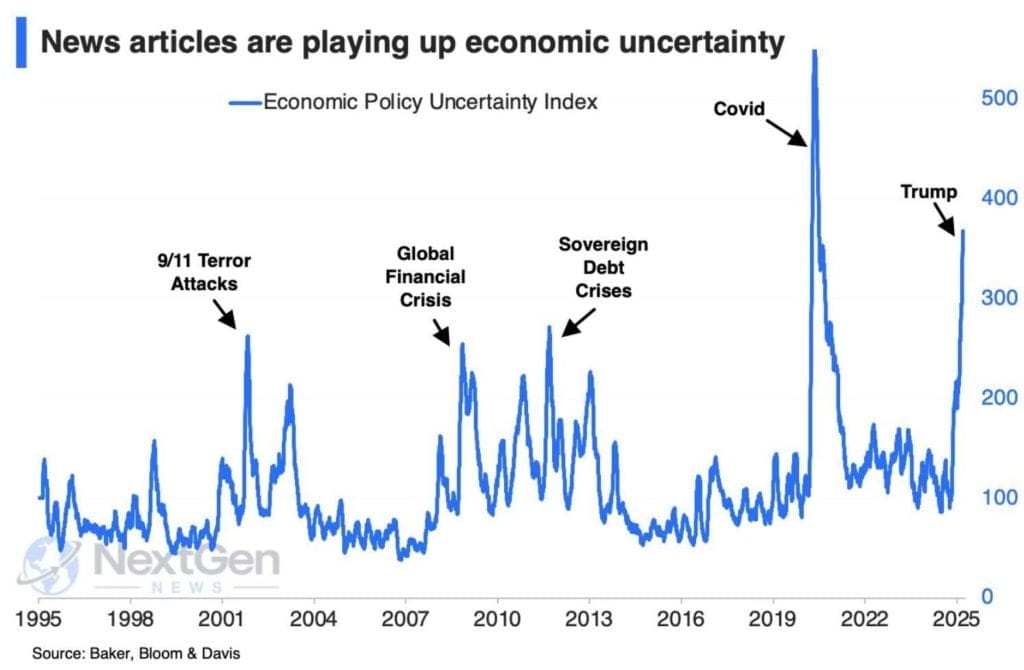
The Federal Reserve's response to tariff impacts has also been sluggish. Over the past few years, the supply chain pressures and rising prices caused by tariffs have significantly pushed up inflation expectations, but the Fed prefers to soothe the market through dovish statements. However, this soothing can only bring a brief rebound in U.S. stocks, not a trend reversal. The reason is that the market's greatest uncertainty — the direction and intensity of tariff policy — remains unresolved. As seen in Chart 1, the economic policy uncertainty index has been accompanied by significant adjustments in the stock market during historical nodes such as the '9/11 attacks,' 'global financial crisis,' and 'sovereign debt crisis,' while the current level of uncertainty suggests that the bottom of U.S. stocks may still not have arrived. The market may need to wait for tariff policies to clarify or for more severe macro shocks to trigger a complete reshuffle.
The recent performance of the S&P 500 further confirms this concern. According to Bloomberg and MacroBond data, the S&P 500 has fallen by 7.8% since its peak in February, with a drop of as much as 10% last week. Historical data shows that if the S&P 500 averages another drop of at least 5% in the next five months, the U.S. economy is very likely to fall into recession (the yellow line in Chart 2).
Conversely, if the S&P 500 can recover in the next 4 to 5 months, it may avoid an economic downturn (the black line in Chart 2). However, this data is merely an average; if the economy does enter recession, U.S. stocks could drop by at least 20%. Notably, market sentiment can sometimes amplify volatility, such as in 2022, when the S&P 500 fell by over 20%, yet an economic recession did not occur; at that time, the panic of 'expected recession' dominated the market's trajectory in the second half of the year.

Currently, the S&P 500 is at a critical crossroads. Chart 2 shows that if the economy avoids recession, the stock market should rebound quickly; but if recession risks worsen, selling pressure could persist. The ambiguity of tariff policy undoubtedly exacerbates this uncertainty, and if the policy on April 2 is unexpectedly hardline, market panic could further depress U.S. stocks.
The crypto market is in a state of alarm
How tariffs are oriented will directly impact the crypto market. Bitcoin recently climbed to $88,786, showing signs of recovery, but industry insiders are issuing frequent warnings. CoinPanel trading expert Kretov points out that this rebound looks more like a 'bull trap': trading volumes are shrinking, retail investors are on the sidelines, funding rates have turned negative, and even 'smart money' is sitting tight. The market is as fragile as thin ice, and any slight disturbance could cause it to crack. Aave's stablecoin lending rate has dropped to 4%, further confirming the spread of risk-averse sentiment.
What is even more worrying is the 'reluctance to sell' mentality of long-term Bitcoin holders. These 'veterans' expect higher exit prices, yet inadvertently become the 'dead weight' of market selling pressure. Kretov believes that only when these holders sell off and the market undergoes a thorough reshuffle can larger players re-enter. However, signs of a washout have not yet surfaced, and the sustainability of the rebound is questionable.
Historical data has sounded the alarm for the current situation. When Trump first initiated the tariff war in 2018, the global market experienced significant turbulence. As shown in Chart 3, since the announcement of tariffs in March 2018, the S&P 500 has cumulatively fallen by 12%, while Bitcoin has plummeted by 65%, far exceeding the performance of traditional assets. The nature of gains and losses is vividly reflected in the crypto market: high risk brings high returns, but also accompanies more severe downward pressure. In contrast, the Chinese index has performed relatively steadily during the same period, with a cumulative decline of less than 20%, indicating differences in sensitivity to tariff shocks between different markets.

CoinDesk's analysis has intensified this concern: Bitcoin has formed a 'double top' pattern near $87,000, and if this bearish signal breaks below the $86,000 'neckline,' it could dip to $75,000 in the short term. Altcoins will likely fare even worse. SignalPlus partner Augustine Fan predicts that the market's soft rebound may continue until the end of the month, but the April 2 tariff announcement will become a turning point. If the policy is moderate, Bitcoin may surge towards $90,000 due to the Fed's dovish stance; if it is unexpectedly hardline, tightening liquidity may trigger a collective plunge.
Speculation on the outcome
How will the tariffs of April 2 play out? Based on current information, Trump may choose a 'moderate start': setting the equivalent tariff at 10%-12%, delaying tariffs for specific industries and countries, preserving pressure space while avoiding an economic hard landing. If the April 1 report supports escalation, a second wave of attacks may arrive mid-year. In the short term, the market may fluctuate due to expectation gaps; in the long term, if the trade war reshapes the economic landscape, recovery dividends may benefit the crypto sector.
For crypto investors, Tariff Implementation Day is not only a barometer of policy but also a magnifying glass for sentiment. A moderate policy may ignite a short-term rebound, while a hardline escalation will test market resilience. Regardless of the outcome, this game reminds us: the interplay between macro policies and the crypto market is becoming increasingly close; in the midst of turmoil, only those who understand the trends can ride the waves.