


On February 25, 2025, the price of Bitcoin experienced a sharp flash crash. In the past 24 hours, Bitcoin fell by 5%, briefly dropping below the $91,000 mark, setting a new monthly low. This crash not only set a record for the largest single-day drop since the liquidation on February 3, but also triggered a chain reaction in the cryptocurrency market: nearly 300,000 people were liquidated, about $900 million in funds 'evaporated', and cryptocurrency concept stocks in the US stock market fell in tandem, with market panic spreading rapidly.
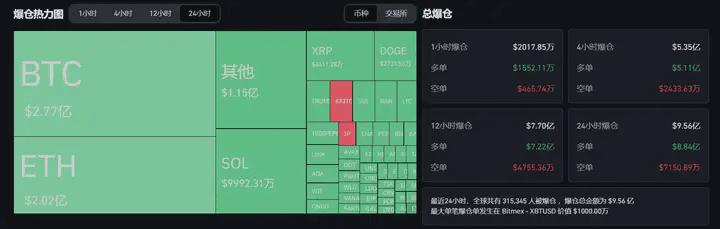
The overall market for altcoins is experiencing a waterfall-like washout, with significant declines seen in both AI and quality DEFI projects. Mainstream coins are all down simultaneously: Solana (SOL) has fallen over 16%, Ethereum and XRP have dropped 12%, BNB is relatively 'mild', down 6%, and over 90% of tokens in the top 100 by market cap are showing losses.
Trigger for the crash: multiple factors intertwining to affect the market.
1. Macroeconomic factors.
The recent 'hawkish' signals from the Federal Reserve have intensified uncertainty in the market, strengthening the US dollar index and suppressing the performance of risk assets. As expectations of interest rate hikes in the US increase, market interest in high-risk assets declines, and the Nasdaq and other US stocks experience significant corrections, which also impacts the cryptocurrency market. Meanwhile, the Federal Reserve's policy direction has made the outflow of funds from the cryptocurrency market increasingly obvious, and the reduction in risk appetite has led to downward pressure on the crypto market.
2. Fund flow and the weakness of the ETF market.
In 2024, the net inflow of Bitcoin ETFs in the US reached as high as $35.66 billion, but after entering 2025, the inflow of funds has significantly slowed down. Since February, the average weekly fund inflow of ETFs has decreased by 40% compared to January, and there have been two consecutive weeks of outflows. This also reflects the increasing wait-and-see sentiment among market investors, with market funds failing to effectively enter, further exacerbating the trend of market weakness. Especially when the ETF market is performing poorly, the cooling of market sentiment significantly affects the price trends of crypto assets.
3. Policy uncertainty: Trump's policies and regulatory changes.
Despite the signals of support for cryptocurrency released by the Trump administration in 2024, its promised 'Bitcoin Strategic Reserve' policy has yet to materialize, and concerns about policy execution are gradually increasing in the market. Meanwhile, the divergence in market expectations regarding regulatory policies has also intensified uncertainty. Especially in the context of changes in basis, this could trigger large-scale sell-offs, further depressing the prices of assets like Bitcoin.
There are various interpretations regarding this crash, but we are indeed in a period of volatility, and the ultimate direction is merely downward. This is also an opportunity, as the overall trend of the US dollar index remains downward, and BTC has achieved a price significantly higher than its token price. In simple terms, it looks bearish in the short term but bullish in the long term; we are just waiting for a deep squat.
The cryptocurrency market now resembles a pig slaughtering scheme; since Trump took office, there has been basically no good trend in the crypto market, just a brief period of revelry during the election and the initiation of his term, followed by a continuous decline.
This month has seen a series of negative news, from Trump's tax black swan, ETH dropping from 3000 to 2000 in a day, Argentina's total issuance of tokens, to the Bybit hacking incident. Trump's tax black swan contracts have all been liquidated, the Argentine chain's shitcoins have all collapsed, and Bybit's theft has scared institutions. The cryptocurrency market is riddled with wounds, and everything seems meaningless except starting over; no one is playing anymore, there's no money to play with, and without starting over, any rally is pointless.
Altcoin waterfall washout!
Compared to the gradually US stock-like BTC, retail investors are perhaps more concerned about the future performance of ETH and SOL, the two major altcoin leaders, but the current situation does not look optimistic.
ETH has recently suffered a major blow; the ETH Denver event was supposed to be an excellent opportunity for the entire Ethereum community to regain confidence, but the sudden $1.5 billion hacker incident at Bybit dealt a heavy blow to ETH.
A few days ago, ETH holders could still comfort themselves with 'Bybit will buy back' and 'the hacker sell-off may take years', but now Bybit has basically replenished the stolen ETH from off-exchange and lending channels, and potential buying pressure has been eliminated; meanwhile, the speed at which the hacker is laundering money has greatly exceeded market expectations, having laundered over 20% of the funds in just a few days.
The situation for SOL is even bleaker. On one hand, affected by negative events like LIBRA, the wealth effect of meme tokens is gradually disappearing, and SOL's 'golden shovel' attribute is diminishing; on the other hand, the large SOL auction unlocking on March 1 is causing some holders to choose to avoid the storm and wait-and-see.
As the market evolves to this stage, the eagerly awaited 'altcoins' seem to be truly fading away, and this bull market is increasingly resembling a solo dance of BTC.
As for the future trends of altcoins, there will no longer be a comprehensive bull market; more attention should be given to those protocols with real practical uses and sustainable economic models.
The entire cryptocurrency industry seems to be undergoing a massive 'deceptive elimination', and only after the bubble is squeezed clean will value discovery occur.