


In the cryptocurrency market, washout refers to the main force or dealer manipulating the price through a series of specific trading methods to achieve the purposes of cleaning floating chips and consolidating control.
The washout mainly aims to make ordinary players sell their chips at relatively low levels. Its method is to torture players' patience and confidence in holding coins through long-term sideways oscillations and sharp declines, obediently handing over their low-priced chips to the main force, laying the groundwork for starting a major upward wave.
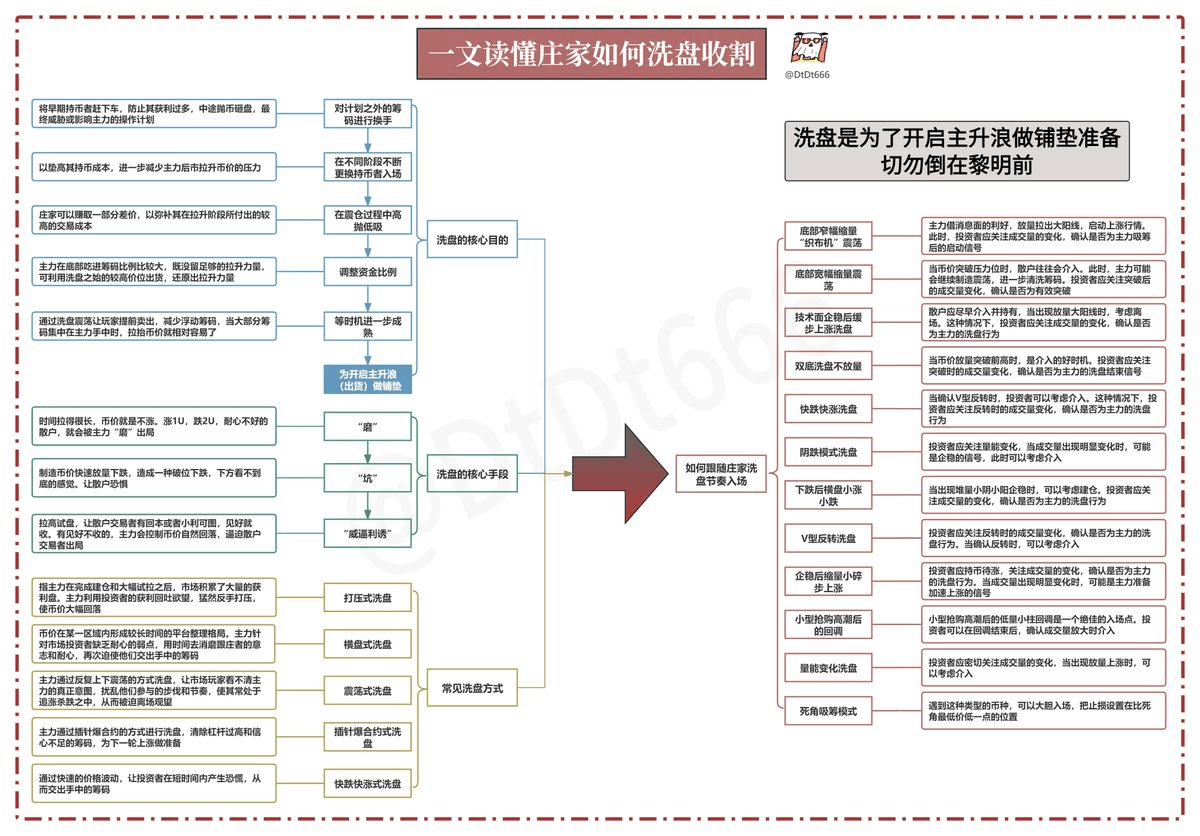
1️⃣ Core purpose of the dealer's washout
◽️ Hand over chips outside of plan: Driving early holders off the bus to prevent them from profiting too much, throwing coins midway to crash the market, ultimately threatening or affecting the main force's operational plans, avoiding excessive lifting costs or hindering smooth unloading.
◽️ Continuously replace holders at different stages: To raise their holding costs, further reduce the pressure on the main force to raise the price in the future. By repeatedly washing out, the average holding cost increases, which also helps the main force to unload at high points and prevents retail investors from being scared away as soon as the main force shows signs of selling, allowing for a calm distribution at high points later.
◽️ During the shakeout, sell high and buy low: The dealer can earn some price difference to offset the high trading costs incurred during the lifting phase. This not only increases their capital for lifting the price later but also boosts confidence, and keeps the market unclear about the main force's cost, making it difficult to discern where the main force will unload in the future.
◽️ Adjusting fund ratio: If the main force accumulates a large proportion of chips at the bottom, it has neither left enough upward momentum nor can it offload at the higher price at the beginning of the washout, restoring the upward momentum.
◽️ Wait for the timing to mature further: The main force uses washout oscillations to make players sell early, reducing floating chips. When most chips are concentrated in the hands of the main force, raising the price becomes relatively easier, the core is to lay the groundwork for starting a major upward wave (unloading).
2️⃣ Core means of the dealer's washout
It is almost impossible to wash out retail investors. As long as retail investors are still watching the market, the main force has a way to wash them out. Because if retail investors are not washed out to a certain extent, it will affect the main force's trading plans, which is not allowed by the main force.
The main force has many methods to clean out retail investors, and the three most uncomfortable ones for retail investors usually leave them with little chance of sitting still.
🟨 'Grinding', the main force often uses the 'grinding' tactic to wear down the bottom, prolonging the time without a price increase. Rising 1U and falling 2U, retail investors with little patience will be 'ground' out by the main force.
🟨 'Pit', after experiencing 'grinding', still many retail investors are not washed out, the main force will dig a pit to continue cleaning retail investors. The main force digging the 'pit' will create a rapid increase in volume and a drop in price, causing a sense of breakdown and no bottom in sight. This makes retail investors fearful, not knowing how long or how deeply the price will drop. Many retail investors have been trapped by the main force and will never have the chance to climb out.
🟨 'Coercion and inducement'. After the above two moves, if the washout has not reached the dealer's ideal value, the main force will use 'coercion and inducement' again to clean. 'Coercion and inducement' refers to the main force raising the price for testing, allowing retail traders to have a chance to break even or make a small profit, and then they will pull back the price naturally, forcing retail traders out.
Here are some common washout methods used by dealers and their characteristics:
🔻1/ Pressure-style washout
Pressure-style washout refers to the main force completing positions and significantly testing the lift after a market has accumulated a large number of profitable positions. The main force utilizes investors' desire to take profits and suddenly reverses to press down, causing a significant drop in price, enhancing market panic, shaking investors' confidence in holding coins, and forcing them to hand over their chips to achieve the goal of cleaning up floating chips. This washout method is characterized by 'speed' and 'ferocity', with a very rapid price drop and significant declines, employing fierce tactics. This method is usually carried out by a powerful main force with operational capabilities, mainly targeting highly speculative coins with fast capital entry and excessive short-term rises.
🔻2./ Sideways washout
Sideways washout, also known as platform washout, is characterized by the price forming a long-term platform consolidation pattern within a certain area. The main force exploits the lack of patience among market investors, using time to wear down the will and patience of those following the main force, forcing them once again to hand over their chips. During the sideways period, the chips held by retail investors are fully exchanged within the trading platform, and trading volume shows a gradually shrinking state. This method is usually adopted by weaker main forces, mainly using long-term dull movements to wear down retail investors' confidence in holding coins, trading time for space, making it the longest of all washout methods.
🔻3/ Oscillation-style washout
Oscillation-style washout combines multiple techniques such as lifting, sideways, and pressure, and is the most commonly used washout method by the main force. Its advantage lies in: compared to pressure-style washouts, it can avoid losses of low-priced chips; compared to sideways washouts, it can shorten the washout time. The main force washes out through repeated upward and downward oscillations, making market players unable to see the main force's true intentions, disrupting their participation pace and rhythm, causing them to often chase rises and kill falls, thus being forced to exit and watch. This washout method is quite confusing, with active trading volume, and the price maintains oscillation within a certain area. On daily candlestick charts, it combines both bullish and bearish patterns, often appearing in triangular, rectangular, flag shapes, etc.
🔻4/ Needle insertion explosion contract washout
If the recent cryptocurrency market enters a washout phase, price fluctuations will significantly increase. The main force conducts washouts through needle insertion and explosion contracts, clearing out chips with excessive leverage and insufficient confidence, preparing for the next round of rises. This washout method creates larger price fluctuations so that the main force can distribute at high points or accumulate at low points, thereby gaining larger profits. During this process, market sentiment fluctuates violently, leading to weakened spot pricing power, causing the market to experience violent price fluctuations, increasing trading risks for players.
🔻5/ Quick drop and quick rise washout
Quick drop and quick rise is also a washout method frequently used by the main force. This method generally washes out undecided chips and those based on technical analysis. The price quickly drops and then rapidly V-shaped reverses upwards, confirming that the previous decline was indeed a washout. This method creates rapid price fluctuations, causing investors to panic in a short time and thus hand over their chips.
To achieve the goal of getting most retail investors to exit without exposing any flaws, the dealer will adopt different washout methods according to the varying market holdings and changes among certain holders, as well as various objective conditions.
3️⃣ How to follow the dealer's washout rhythm for entry
🟢 Bottom narrow volume 'weaving machine' oscillation
Feature: The price undergoes narrow oscillations in the bottom area, with trading volume gradually shrinking and forming a 'weaving machine' pattern. The main force accumulates chips during this stage, waiting for the right moment to initiate a rise.
Operation: The main force takes advantage of positive news to bring out a large bullish line and initiate a rising market. At this time, investors should pay attention to changes in trading volume to confirm whether it is a signal for the main force's accumulation and subsequent initiation.
🟢 Bottom wide volume shrink oscillation
Feature: The price undergoes wide oscillations in the bottom area, with upward movement restricted, and trading volume remains at low levels. The main force cleans out undecided chips through this method.
Operation: When the price breaks through the resistance level, retail investors often intervene. At this time, the main force may continue to create oscillations to further clean the chips. Investors should pay attention to changes in trading volume after the breakthrough to confirm whether it is an effective breakthrough.
🟢 Technical stabilization followed by slow rise washout
Feature: The price starts to rise slowly after stabilizing technically, with trading volume gradually increasing. The main force gradually cleans out undecided chips through this method.
Operation: Retail investors should intervene and hold early, considering exit when a large bullish line appears. In this situation, investors should pay attention to changes in trading volume to confirm whether it is the main force's washout behavior.
🟢 Double bottom washout without volume
Feature: The price forms a double bottom pattern, alternating between left and right bottoms with slight decreases, while trading volume remains at low levels. The main force induces technical players to exit through this method.
Operation: When the price breaks out significantly above the previous high, it is a good time to intervene. Investors should pay attention to changes in trading volume during the breakout to confirm whether it signals the end of the main force's washout.
🟢 Quick drop and quick rise washout
Feature: The price quickly declines and then rapidly V-shaped reverses upwards, targeting undecided and technical chips.
Operation: When a V-shaped reversal is confirmed, investors can consider intervening. In this case, investors should focus on changes in trading volume during the reversal to confirm whether it is the main force's washout behavior.
🟢 Downward trend mode washout
Feature: The price continues to decline, with trading volume gradually shrinking. The main force creates market panic through this method, cleaning out undecided chips.
Operation: Investors should pay attention to changes in volume; when there is a significant change, it may signal stabilization, and at this point, they can consider intervening.
🟢 Small rises and falls after a decline
Feature: The price enters a sideways state after a decline, with small rises and small falls, and trading volume slightly increases. The main force further cleans the chips through this method.
Operation: When small bearish and bullish bars stabilize in a pile, consider building a position. Investors should pay attention to changes in trading volume to confirm whether it is the main force's washout behavior.
🟢 V-shaped reversal washout
Feature: The price forms a V-shaped reversal, similar to a double bottom but without a right shoulder pullback. The main force creates a strong 'head and shoulders bottom' pattern in this way to prevent retail investors from getting on board.
Operation: Investors should pay attention to trading volume changes when a reversal occurs to confirm whether it is the main force's washout behavior. When a reversal is confirmed, they can consider intervening.
🟢 Stabilizing after shrinking volume and small steps upward
Feature: After stabilizing, the price rises in small steps with reduced volume, while trading volume remains at low levels. The main force cleans out undecided chips through this method, creating a stable pattern.
Operation: Investors should hold coins for a rise, paying attention to changes in trading volume to confirm whether it is the main force's washout behavior. When there are significant changes in trading volume, it may signal that the main force is preparing to accelerate the rise.
🟢 Pullback after a small buying climax
Feature: After a small buying climax in the market, the main force may carry out a washout with the aim of cooling down the market and gathering energy for another rise.
Operation: A low-volume small bar pullback after a small buying climax is an excellent entry point. Investors can intervene once the pullback ends and trading volume increases.
🟢 Volume change washout
Feature: During the washout process, the trading volume usually gradually shrinks. When the price starts to rise, the trading volume will significantly increase. If the trading volume is shrinking during each upward movement, it can be concluded that it is still in the washout; however, if there is a sudden increase in volume on a certain day's rise, it may indicate a genuine breakout.
Operation: Investors should closely monitor changes in trading volume, and when there is a significant increase, consider intervening.
🟢 Dead angle accumulation mode
Feature: The main force quietly buys chips continuously during a downtrend, causing the extent of price decline to become progressively smaller, or directly leading to a quick drop that forms panic selling. As the chip accumulation nears the end, retail investors have exhausted their chips, forming a dead angle between the descending trend line and the trough of the price decline.
Operation: When encountering this type of currency, one can boldly enter, setting the stop loss slightly below the lowest price of the dead angle.
Waiting to buy: When the price rapidly declines, short-term investors can analyze comprehensively by combining moving averages, trading volume, support, and resistance levels, and if strong support is received during the session and positive buying occurs, they can seize the opportunity to buy.
Already bought at a high: Medium to long-term investors can ignore the temporary rise and fall of the price, and during the rise, do not rush to buy but continue holding for a rise.
Combine multiple indicators: Players can integrate moving averages (MA), relative strength index (RSI), MACD, volume-price, and other technical indicators to comprehensively judge market trends.
Always think from the main force's perspective to understand their operational intentions, so that you can follow the rhythm and share the gains!
The cryptocurrency market is always repeating yesterday's story. The speculative sectors change, prices change, and the buyers and sellers change, but human nature does not change.
Everyone please remember: The washout is to prepare for starting a major upward wave, do not fall before dawn.
Let’s encourage each other!