
What value does NFT have? This is likely the biggest question in the minds of many new users who have just come into contact with NFTs.
From a technical perspective, NFTs possess the scarcity and immutability endowed by blockchain technology. Scarcity means that each NFT is unique, and even the creator cannot replicate it; immutability ensures the authenticity and verifiability of NFT copyrights, allowing people to verify the authenticity of NFTs based on blockchain technology at any time.
Furthermore, NFTs serve as digital certificates of assets, ensuring that holders possess ownership of the assets corresponding to the NFTs.
To give a simple example, many people think of NFTs as just small images, and that they can simply screenshot or right-click to save them and make them their own, which is actually incorrect. For instance, if I own a BAYC, I can print this BAYC on company merchandise for advertising purposes. However, if you engage in commercial activities with this BAYC without my authorization, you may face the risk of infringement. This is the value of NFTs as digital certificates.
However, these concepts are not very obvious to ordinary users, which means it is difficult to explain why the 'small images' of NFTs, with their uniqueness, transparency, and immutability, can sell for such high prices. Therefore, we try to explain the value of NFTs from another perspective.
Consensus
If you are an ordinary person who has carefully created a painting, whether displayed as an NFT on OpenSea or on some traditional trading platforms, it is likely to go unnoticed; yet if it is a work created by Jeff Koons, even if it is just a random doodle, it can sell for a high price.
This is the issue of consensus. Where does consensus come from? It comes from factors such as the creator's reputation, the community's collective MEME, and the actual rights (empowerment) behind it, while the aesthetic appeal and design of the image itself are not decisive factors.
Let’s take another typical example, CryptoPunks, which are actually 10,000 randomly generated pixel images. From an artistic perspective, one could say they are rather ordinary, and it is very easy to copy or create a similar NFT series. But why can CryptoPunks achieve so-called 'consensus' and sell for millions of dollars each?
The most important reason is that CryptoPunks is a veteran project in the entire development history of NFTs. It represents an important milestone in the development of blockchain technology towards NFTs, and subsequent NFTs more or less carry the shadow of Punks. As the NFT trend continues to advance, new users often trace back to the pioneers of this industry, ultimately focusing naturally on CryptoPunks. Holding such a unique position, the value of Punks is naturally supported, and this can be summarized in two words—consensus.
Herd mentality
Currently, there are hundreds of thousands of NFT series on the market, and as an ordinary user, you might find that most of them are quite ordinary, not particularly beautiful, and nothing special. However, when someone comes along with an NFT and tells you that this series of NFTs is very beautiful and worth purchasing, and then pulls you into a 'family group', where you find everyone using the NFT image as their avatar and discussing how great this NFT is in all aspects, gradually, you will feel that this thing seems quite good and become increasingly accepting of it. This is actually a form of herd mentality.
If at this moment the floor price of the NFT happens to be continuously rising, your acceptance of it would grow exponentially, and the aesthetic value of the image will no longer matter. At this point, you begin to fear missing out on some opportunities, and you will try to buy it as much as possible. This is another form of herd mentality, namely the fear of missing out (FOMO), because at this moment you have lost your independent value judgment of this thing; you just feel that since others are buying it, you must also buy it.
GoblinTown is a classic case.
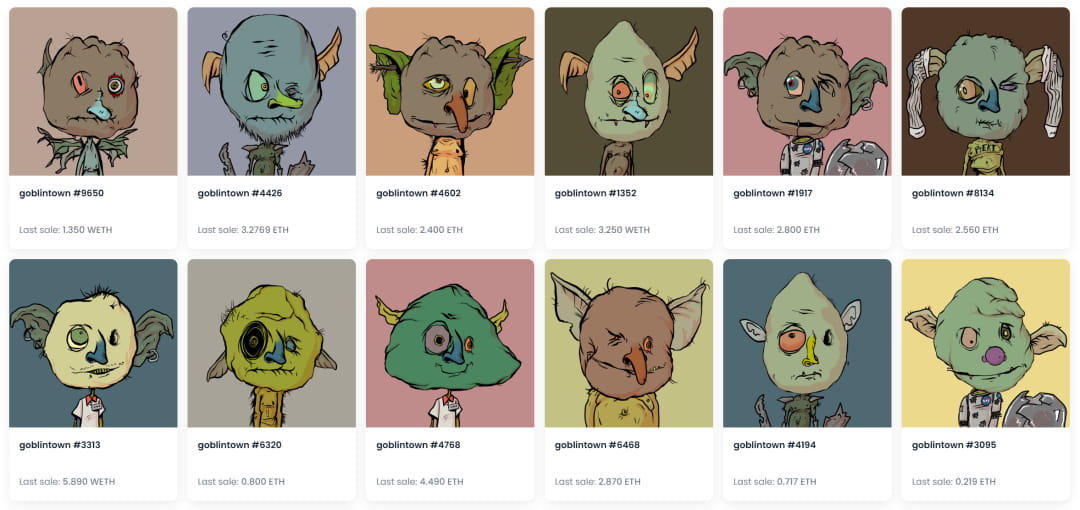
When you show this kind of image to 100 people, 99 of them will find it ugly. However, when it gradually rises from FreeMint (free) to a value of 1 ETH, many people start to change their views on it, with some even analyzing the artistic value behind these images. So, if you participated throughout this project, you might experience three stages: 'What an ugly thing this is', then feeling 'This ugly-cute thing is somewhat interesting', and finally 'This TM is a work of art'. But if you simply look at the image, you would likely be thinking 'Someone actually wants this thing'. This is the 'thought transformation' brought about by herd mentality.
Seeking recognition
Humans are social animals, and therefore, they are creatures that greatly need to obtain recognition from the outside world. This phenomenon is also common in the traditional collecting community. When an artwork is auctioned at a high price, does the buyer truly understand or recognize the emotions or values conveyed by this artwork? In fact, many times, this is not the case.
When a buyer purchases an artwork, they often do not genuinely recognize the emotions or values represented by the artwork. Instead, they wish to express to others that they have reached a certain aesthetic standard and attained a particular consumer class, showcasing their social status and gaining recognition from the outside world. Luxury cars, designer watches, and high-end handbags carry the same psychology.
If we reverse this psychology for the NFT industry, we can find that with the rapid development of the crypto industry, many new users entering this field hope to purchase an NFT that is highly recognized in the crypto community to signify that they have become a part of this community and to display their identity as 'trendsetters' at the forefront of technology. For users buying NFTs with this mindset, whether it is CryptoPunks or BAYC, what they actually look like is not important. What matters is that everyone knows they are expensive and valuable. Holding them is equivalent to having a ticket to enter the 'high-end circle', and that is already enough.
In summary, NFTs express value in a very similar way to traditional artworks, namely, they possess a high degree of subjectivity. Some people may have a particular 'favorite' and spend lavishly; but from the investment perspective of ordinary users, besides personal preferences, it is more important to observe whether the project has unique features, whether it has widespread attention, and whether it has established a healthy community. Only with these conditions can consensus form, and with consensus, the project can have lasting vitality.