Binance Square

candle

86,025 visualizações
119 a discutir
MKSL62
·
--
The Rickshaw Man's Warning: Navigating Chaos with the Long-Legged DojiIn the turbulent ocean of the cryptocurrency markets, there are days when the waves crash violently in both directions, tossing ships upward to the heavens and dragging them down to the abyssal depths, only to leave them drifting exactly where they started as the sun sets. It is a phenomenon of pure chaotic equilibrium. On a trading chart, this violent indecision leaves a scar—a specific candlestick formation that looks like a cross with elongated limbs. It stands as a monument to a battle where vast fortunes were wagered by bulls and bears, yet neither side could claim an inch of territory. This is the Long-Legged Doji, often whispered about by Japanese traders as the "Rickshaw Man." It is not merely a signal of pause; it is a scream of uncertainty, a sign that the market has lost its compass and is convulsing in a state of high-voltage confusion. Mastering this pattern does not just mean recognizing a shape; it means learning to read the tremors of a market on the verge of a massive breakout or a devastating collapse. The Anatomy of Chaos: Defining the Long-Legged Doji To understand the Long-Legged Doji is to understand the visual representation of volatility. Unlike the standard Doji, which implies a quiet moment of hesitation, the Long-Legged Doji implies a loud, aggressive struggle. The pattern is defined by a very specific and dramatic geometry. The central feature is the lack of a real body; the Opening Price and the Closing Price are virtually identical, appearing as a simple horizontal dash. However, what sets this pattern apart—and earns it the name "Long-Legged"—are the shadows. The candle possesses extremely long upper and lower wicks (or shadows). These wicks must be significantly longer than the average candle size of the preceding trend. The length of these shadows tells us that during the trading session—whether it be an hour or a day—the price traded at much higher levels and much lower levels than the open. The market explored extremes in both directions, testing the resolve of both buyers and sellers, but ultimately rejected both the highs and the lows to close in the middle. This creates a cross-like figure that dominates the immediate landscape of the chart. When you see it, it is impossible to miss. It signifies that the market has expended a massive amount of energy to go nowhere. The Psychology of the Rickshaw Man Why does this pattern form, and what are the traders thinking when it appears? The Long-Legged Doji is the ultimate manifestation of a market at a crossroads. Imagine a scenario where Bitcoin opens at $50,000. Early in the session, a wave of bullish news hits, driving the price up to $52,000. Greed spikes. But then, a regulatory rumor triggers a sell-off. The price crashes all the way down to $48,000. Panic ensues. Yet, as the session nears its close, value investors step in to buy the dip, pushing the price back up. The clock runs out, and the candle closes at $50,000. The psychological implication is one of deep disagreement. The bulls believe the asset is undervalued; the bears believe it is overvalued. Both sides have committed significant capital to prove their point (evidenced by the large price swing), but neither has enough strength to sustain a trend. The "Rickshaw Man" moniker comes from the visual resemblance to a person pulling a rickshaw, balancing the weight between two poles. In the market, the price is balancing precariously between two opposing forces. This state of equilibrium is unstable. The market cannot remain in this state of high-tension indecision for long. Usually, a Long-Legged Doji is the precursor to a violent move as one side finally gives up and the other takes control. Contextual Analysis: Interpreting the Signal A Long-Legged Doji is a chameleon; its meaning changes depending on the environment in which it appears. Trading it blindly is a recipe for losses. One must analyze the "trend context" to decipher the message. The Peak of Exhaustion When a Long-Legged Doji appears after a strong, parabolic uptrend, it is a significant warning sign. It suggests that the buyers are losing their unified conviction. They pushed the price to a new high (the top of the upper wick), but selling pressure was strong enough to force a close back at the open. The uncertainty indicated by the long lower wick shows that confidence is fracturing. While not an immediate "sell" signal, it screams that the uptrend is tired and a reversal or complex correction is imminent. The Bottom of Despair Conversely, finding a Long-Legged Doji at the end of a brutal downtrend can signal a "capitulation and recovery" event within a single candle. The long lower wick shows that sellers tried to push the price into the ground, but buyers were finally found at those depths. The market tested the bottom and rejected it. This indecision breaks the momentum of the downtrend and often sets the stage for a reversal or a relief rally. The Trap of the Sideways Market The most dangerous place to trade a Long-Legged Doji is in the middle of a consolidation range (a "choppy" market). In a sideways market, prices often swing wildly with no clear direction. Here, a Long-Legged Doji is merely noise. It confirms what we already know: the market is confused. Trading this pattern in a ranging market often leads to "whipsaws," where stop-losses are triggered on both sides without any profitable follow-through. Strategies for Trading the Long-Legged Doji Because the Long-Legged Doji represents indecision, we do not trade the candle itself. We trade the resolution of the indecision. The following strategy, known as the "Rickshaw Breakout Box," is designed to capture the move once the market picks a direction. Phase 1: The Box Setup Once the Long-Legged Doji has closed, draw a horizontal line at the very top of the upper wick (Resistance) and another horizontal line at the very bottom of the lower wick (Support). You have now created a "Box of Uncertainty." The price is trapped within this range. Phase 2: The Waiting Game Do not guess which way the market will break. The size of the wicks indicates that both bulls and bears are present and aggressive. Predicting the winner is gambling. Instead, wait for a subsequent candle to close outside of the box. Bullish Breakout: If a candle closes above the high of the upper wick, the bulls have won the tug-of-war. The indecision has resolved to the upside. Bearish Breakout: If a candle closes below the low of the lower wick, the bears have seized control. The indecision has resolved to the downside. Phase 3: The Entry Enter the trade in the direction of the breakout. Conservative Entry: Wait for the breakout candle to close, then enter on the open of the next candle. Retracement Entry: Often, after breaking out of such a volatile range, the price will return to "test" the breakout level. If the price breaks the top of the box, waits for it to come back down and touch that top line again. If it holds, enter there. This offers a better risk-to-reward ratio. Phase 4: Stop-Loss Placement The volatility of the Long-Legged Doji requires a wider stop-loss than usual. If you enter a Long (Buy) position, place your stop-loss at the midpoint (50% level) of the Long-Legged Doji's range. If the price falls back below the midpoint, the breakout was likely a fake-out. If you enter a Short (Sell) position, place your stop-loss at the midpoint of the Doji. Some aggressive traders use the opposite end of the Doji as the stop-loss, but because the wicks are so long, this can result in a risk that is too large for the potential reward. The midpoint is a mathematically sound invalidation level. Volume: The Truth Serum In crypto trading, price can be manipulated, but volume rarely lies. Volume analysis is the perfect partner for the Long-Legged Doji. A Long-Legged Doji formed on low volume is suspicious. It suggests that the price moved wildly simply because the order book was thin (lack of liquidity), not because there was a genuine battle. These patterns are prone to failure and should often be ignored. However, a Long-Legged Doji formed on ultra-high volume is the "Gold Standard." It confirms that a massive exchange of assets took place. The market churned through huge supply and demand and still ended up tied. When the price finally breaks out of a high-volume Long-Legged Doji range, the resulting trend is usually powerful and sustained because the losing side is trapped in massive positions and must exit, fueling the move. Indicators to Enhance Accuracy While the "Rickshaw Breakout Box" is a solid standalone strategy, combining it with indicators can filter out bad trades. Bollinger Bands The Long-Legged Doji often appears when volatility is expanding. If the upper and lower wicks pierce through the outer Bollinger Bands, it highlights the extreme nature of the price action. If the bands are wide, expect the volatility to continue. If the bands are narrow (a "Squeeze") and a Long-Legged Doji appears, it is a prelude to an explosive expansion. Average True Range (ATR) Since the Long-Legged Doji is a volatility pattern, checking the ATR is useful. If the ATR is rising, it confirms that the market is entering a high-volatility phase. This supports the thesis that a big move is coming. If the ATR is falling, the Long-Legged Doji might just be an isolated anomaly. Conclusion The Long-Legged Doji is the market's way of shouting, "I don't know!" It is a visual representation of a stalemate between aggressive buyers and aggressive sellers. While it creates confusion for the novice, it creates opportunity for the strategist. It defines a clear battlefield with a high boundary and a low boundary. By marking these boundaries and patiently waiting for the market to declare a winner through a breakout, you can hitch a ride on the new trend while the losing side scrambles to cover their losses. The "Rickshaw Man" is not a sign to trade immediately; it is a sign to prepare. It tells you that the energy in the market is coiling like a spring, and your job is to be ready when it snaps. Thank you for reading this comprehensive guide on the Long-Legged Doji. We hope it provides you with the clarity needed to navigate the chaotic waters of crypto volatility. We encourage you to continue your learning journey by exploring our other in-depth articles on candlestick psychology, breakout strategies, and technical indicators. Frequently Asked Questions (FAQ) Q: Is the Long-Legged Doji bullish or bearish? A: It is neither. It is a neutral pattern that signifies indecision and volatility. Its implication depends entirely on the breakout. If the price breaks above the Doji, it becomes bullish. If it breaks below, it becomes bearish. Q: How long should the wicks be to qualify as a "Long-Legged" Doji? A: There is no strict rule, but generally, the total range (High to Low) of the candle should be at least 2 to 3 times larger than the average range of the previous 10 candles. The visual prominence of the wicks is what matters most. Q: Can I trade this pattern on the 15-minute chart? A: Yes, but with caution. Long-Legged Dojis on lower timeframes like the 15-minute or 5-minute charts can be caused by minor news or temporary liquidity gaps. They are less significant than those found on the 4-Hour or Daily charts, which represent major shifts in market sentiment. Q: What is the difference between a Long-Legged Doji and a High Wave Candle? A: They are very similar. A Long-Legged Doji has virtually no body (Open = Close). A High Wave Candle has a small real body (Open and Close are slightly different) with long wicks. The psychology is the same: extreme confusion and volatility. The trading strategy for both is identical. Q: What if the open and close are not exactly the same price? A: In the volatile crypto market, a "perfect" Doji is rare. If the body is very small (negligible compared to the wicks), it is still treated as a Long-Legged Doji. The psychological message of the long shadows outweighs the tiny difference in open and close price. #LongLeggedDojiPattern #candlestick_patterns #candlestick #candle

The Rickshaw Man's Warning: Navigating Chaos with the Long-Legged Doji

In the turbulent ocean of the cryptocurrency markets, there are days when the waves crash violently in both directions, tossing ships upward to the heavens and dragging them down to the abyssal depths, only to leave them drifting exactly where they started as the sun sets. It is a phenomenon of pure chaotic equilibrium. On a trading chart, this violent indecision leaves a scar—a specific candlestick formation that looks like a cross with elongated limbs. It stands as a monument to a battle where vast fortunes were wagered by bulls and bears, yet neither side could claim an inch of territory. This is the Long-Legged Doji, often whispered about by Japanese traders as the "Rickshaw Man." It is not merely a signal of pause; it is a scream of uncertainty, a sign that the market has lost its compass and is convulsing in a state of high-voltage confusion. Mastering this pattern does not just mean recognizing a shape; it means learning to read the tremors of a market on the verge of a massive breakout or a devastating collapse.
The Anatomy of Chaos: Defining the Long-Legged Doji
To understand the Long-Legged Doji is to understand the visual representation of volatility. Unlike the standard Doji, which implies a quiet moment of hesitation, the Long-Legged Doji implies a loud, aggressive struggle.
The pattern is defined by a very specific and dramatic geometry. The central feature is the lack of a real body; the Opening Price and the Closing Price are virtually identical, appearing as a simple horizontal dash. However, what sets this pattern apart—and earns it the name "Long-Legged"—are the shadows.
The candle possesses extremely long upper and lower wicks (or shadows). These wicks must be significantly longer than the average candle size of the preceding trend. The length of these shadows tells us that during the trading session—whether it be an hour or a day—the price traded at much higher levels and much lower levels than the open. The market explored extremes in both directions, testing the resolve of both buyers and sellers, but ultimately rejected both the highs and the lows to close in the middle.
This creates a cross-like figure that dominates the immediate landscape of the chart. When you see it, it is impossible to miss. It signifies that the market has expended a massive amount of energy to go nowhere.
The Psychology of the Rickshaw Man
Why does this pattern form, and what are the traders thinking when it appears? The Long-Legged Doji is the ultimate manifestation of a market at a crossroads.
Imagine a scenario where Bitcoin opens at $50,000. Early in the session, a wave of bullish news hits, driving the price up to $52,000. Greed spikes. But then, a regulatory rumor triggers a sell-off. The price crashes all the way down to $48,000. Panic ensues. Yet, as the session nears its close, value investors step in to buy the dip, pushing the price back up. The clock runs out, and the candle closes at $50,000.
The psychological implication is one of deep disagreement. The bulls believe the asset is undervalued; the bears believe it is overvalued. Both sides have committed significant capital to prove their point (evidenced by the large price swing), but neither has enough strength to sustain a trend.
The "Rickshaw Man" moniker comes from the visual resemblance to a person pulling a rickshaw, balancing the weight between two poles. In the market, the price is balancing precariously between two opposing forces. This state of equilibrium is unstable. The market cannot remain in this state of high-tension indecision for long. Usually, a Long-Legged Doji is the precursor to a violent move as one side finally gives up and the other takes control.
Contextual Analysis: Interpreting the Signal
A Long-Legged Doji is a chameleon; its meaning changes depending on the environment in which it appears. Trading it blindly is a recipe for losses. One must analyze the "trend context" to decipher the message.
The Peak of Exhaustion
When a Long-Legged Doji appears after a strong, parabolic uptrend, it is a significant warning sign. It suggests that the buyers are losing their unified conviction. They pushed the price to a new high (the top of the upper wick), but selling pressure was strong enough to force a close back at the open. The uncertainty indicated by the long lower wick shows that confidence is fracturing. While not an immediate "sell" signal, it screams that the uptrend is tired and a reversal or complex correction is imminent.
The Bottom of Despair
Conversely, finding a Long-Legged Doji at the end of a brutal downtrend can signal a "capitulation and recovery" event within a single candle. The long lower wick shows that sellers tried to push the price into the ground, but buyers were finally found at those depths. The market tested the bottom and rejected it. This indecision breaks the momentum of the downtrend and often sets the stage for a reversal or a relief rally.
The Trap of the Sideways Market
The most dangerous place to trade a Long-Legged Doji is in the middle of a consolidation range (a "choppy" market). In a sideways market, prices often swing wildly with no clear direction. Here, a Long-Legged Doji is merely noise. It confirms what we already know: the market is confused. Trading this pattern in a ranging market often leads to "whipsaws," where stop-losses are triggered on both sides without any profitable follow-through.
Strategies for Trading the Long-Legged Doji
Because the Long-Legged Doji represents indecision, we do not trade the candle itself. We trade the resolution of the indecision. The following strategy, known as the "Rickshaw Breakout Box," is designed to capture the move once the market picks a direction.
Phase 1: The Box Setup
Once the Long-Legged Doji has closed, draw a horizontal line at the very top of the upper wick (Resistance) and another horizontal line at the very bottom of the lower wick (Support). You have now created a "Box of Uncertainty." The price is trapped within this range.
Phase 2: The Waiting Game
Do not guess which way the market will break. The size of the wicks indicates that both bulls and bears are present and aggressive. Predicting the winner is gambling. Instead, wait for a subsequent candle to close outside of the box.
Bullish Breakout: If a candle closes above the high of the upper wick, the bulls have won the tug-of-war. The indecision has resolved to the upside.
Bearish Breakout: If a candle closes below the low of the lower wick, the bears have seized control. The indecision has resolved to the downside.
Phase 3: The Entry
Enter the trade in the direction of the breakout.
Conservative Entry: Wait for the breakout candle to close, then enter on the open of the next candle.
Retracement Entry: Often, after breaking out of such a volatile range, the price will return to "test" the breakout level. If the price breaks the top of the box, waits for it to come back down and touch that top line again. If it holds, enter there. This offers a better risk-to-reward ratio.
Phase 4: Stop-Loss Placement
The volatility of the Long-Legged Doji requires a wider stop-loss than usual.
If you enter a Long (Buy) position, place your stop-loss at the midpoint (50% level) of the Long-Legged Doji's range. If the price falls back below the midpoint, the breakout was likely a fake-out.
If you enter a Short (Sell) position, place your stop-loss at the midpoint of the Doji.
Some aggressive traders use the opposite end of the Doji as the stop-loss, but because the wicks are so long, this can result in a risk that is too large for the potential reward. The midpoint is a mathematically sound invalidation level.
Volume: The Truth Serum
In crypto trading, price can be manipulated, but volume rarely lies. Volume analysis is the perfect partner for the Long-Legged Doji.
A Long-Legged Doji formed on low volume is suspicious. It suggests that the price moved wildly simply because the order book was thin (lack of liquidity), not because there was a genuine battle. These patterns are prone to failure and should often be ignored.
However, a Long-Legged Doji formed on ultra-high volume is the "Gold Standard." It confirms that a massive exchange of assets took place. The market churned through huge supply and demand and still ended up tied. When the price finally breaks out of a high-volume Long-Legged Doji range, the resulting trend is usually powerful and sustained because the losing side is trapped in massive positions and must exit, fueling the move.
Indicators to Enhance Accuracy
While the "Rickshaw Breakout Box" is a solid standalone strategy, combining it with indicators can filter out bad trades.
Bollinger Bands
The Long-Legged Doji often appears when volatility is expanding. If the upper and lower wicks pierce through the outer Bollinger Bands, it highlights the extreme nature of the price action. If the bands are wide, expect the volatility to continue. If the bands are narrow (a "Squeeze") and a Long-Legged Doji appears, it is a prelude to an explosive expansion.
Average True Range (ATR)
Since the Long-Legged Doji is a volatility pattern, checking the ATR is useful. If the ATR is rising, it confirms that the market is entering a high-volatility phase. This supports the thesis that a big move is coming. If the ATR is falling, the Long-Legged Doji might just be an isolated anomaly.
Conclusion
The Long-Legged Doji is the market's way of shouting, "I don't know!" It is a visual representation of a stalemate between aggressive buyers and aggressive sellers. While it creates confusion for the novice, it creates opportunity for the strategist. It defines a clear battlefield with a high boundary and a low boundary.
By marking these boundaries and patiently waiting for the market to declare a winner through a breakout, you can hitch a ride on the new trend while the losing side scrambles to cover their losses. The "Rickshaw Man" is not a sign to trade immediately; it is a sign to prepare. It tells you that the energy in the market is coiling like a spring, and your job is to be ready when it snaps.
Thank you for reading this comprehensive guide on the Long-Legged Doji. We hope it provides you with the clarity needed to navigate the chaotic waters of crypto volatility. We encourage you to continue your learning journey by exploring our other in-depth articles on candlestick psychology, breakout strategies, and technical indicators.
Frequently Asked Questions (FAQ)
Q: Is the Long-Legged Doji bullish or bearish?
A: It is neither. It is a neutral pattern that signifies indecision and volatility. Its implication depends entirely on the breakout. If the price breaks above the Doji, it becomes bullish. If it breaks below, it becomes bearish.
Q: How long should the wicks be to qualify as a "Long-Legged" Doji?
A: There is no strict rule, but generally, the total range (High to Low) of the candle should be at least 2 to 3 times larger than the average range of the previous 10 candles. The visual prominence of the wicks is what matters most.
Q: Can I trade this pattern on the 15-minute chart?
A: Yes, but with caution. Long-Legged Dojis on lower timeframes like the 15-minute or 5-minute charts can be caused by minor news or temporary liquidity gaps. They are less significant than those found on the 4-Hour or Daily charts, which represent major shifts in market sentiment.
Q: What is the difference between a Long-Legged Doji and a High Wave Candle?
A: They are very similar. A Long-Legged Doji has virtually no body (Open = Close). A High Wave Candle has a small real body (Open and Close are slightly different) with long wicks. The psychology is the same: extreme confusion and volatility. The trading strategy for both is identical.
Q: What if the open and close are not exactly the same price?
A: In the volatile crypto market, a "perfect" Doji is rare. If the body is very small (negligible compared to the wicks), it is still treated as a Long-Legged Doji. The psychological message of the long shadows outweighs the tiny difference in open and close price.
#LongLeggedDojiPattern #candlestick_patterns #candlestick #candle
#TON ATUALIZAÇÃO $DXY: #DXY deu um bom fechamento abaixo do suporte e teve um novo teste também. #candle foi forte o suficiente para fechar, então podemos esperar um mercado de alta. O único problema é que o fechamento semanal atual acima pode se transformar em um falso. #DOGSONBINANCE #TelegramCEO
#TON
ATUALIZAÇÃO $DXY:

#DXY deu um bom fechamento abaixo do suporte e teve um novo teste também. #candle foi forte o suficiente para fechar, então podemos esperar um mercado de alta. O único problema é que o fechamento semanal atual acima pode se transformar em um falso.
#DOGSONBINANCE #TelegramCEO
·
--
Em Alta
$ZEC entregou excelente volatilidade hoje com movimentos bruscos, recuos rápidos e forte momentum que criaram claras oportunidades de lucro. Consegui pegar algumas boas entradas e fechei no verde. Permanece na minha lista de observação porque esta moeda tem real potencial e merece atenção cuidadosa. #candle #zec
$ZEC entregou excelente volatilidade hoje com movimentos bruscos, recuos rápidos e forte momentum que criaram claras oportunidades de lucro.

Consegui pegar algumas boas entradas e fechei no verde.
Permanece na minha lista de observação porque esta moeda tem real potencial e merece atenção cuidadosa.

#candle #zec
Hoje $DOGE Moeda 1 Dia #candle Preço de Abertura 0.19534
Hoje $DOGE Moeda
1 Dia #candle Preço de Abertura 0.19534
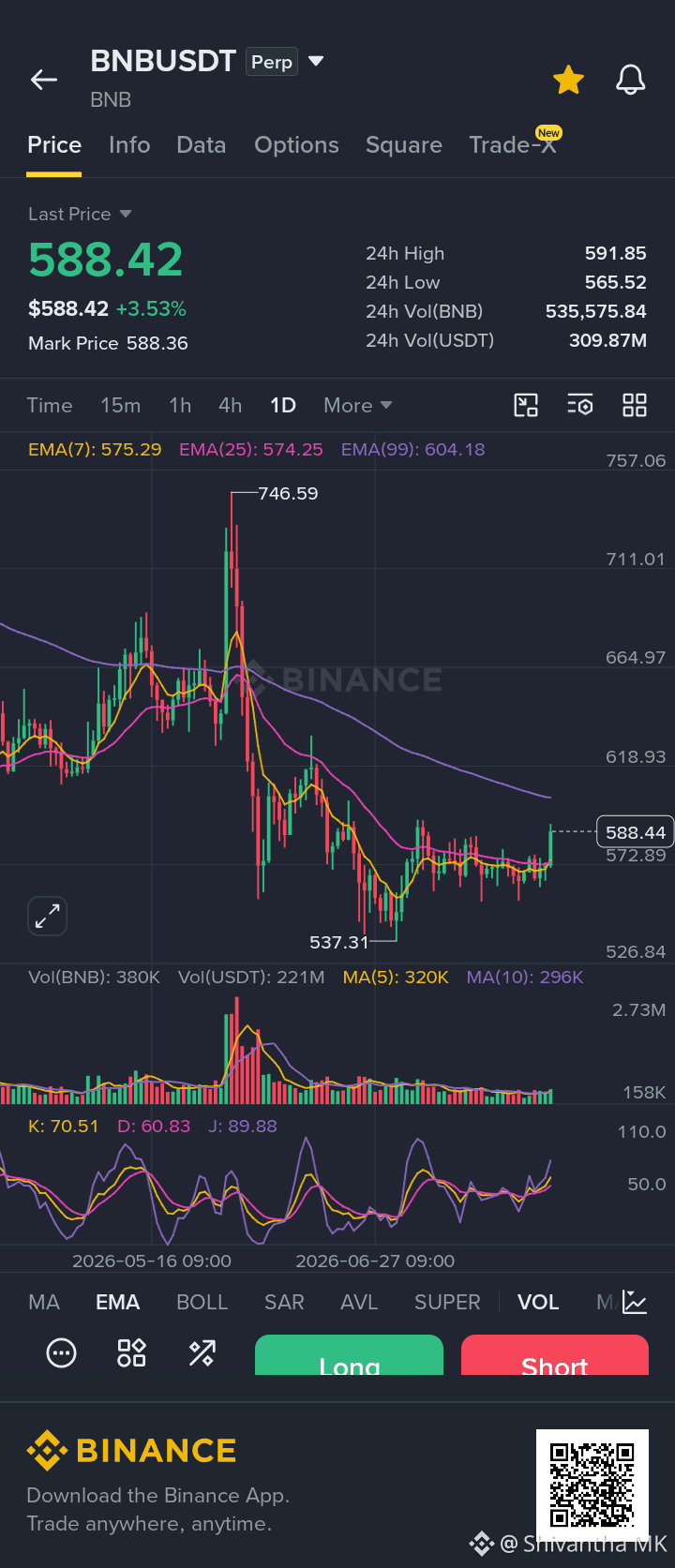
Hoje $BNB Coin 1 Dia #candle Preço de Abertura 1109,88
Hoje $BNB Coin
1 Dia #candle Preço de Abertura 1109,88
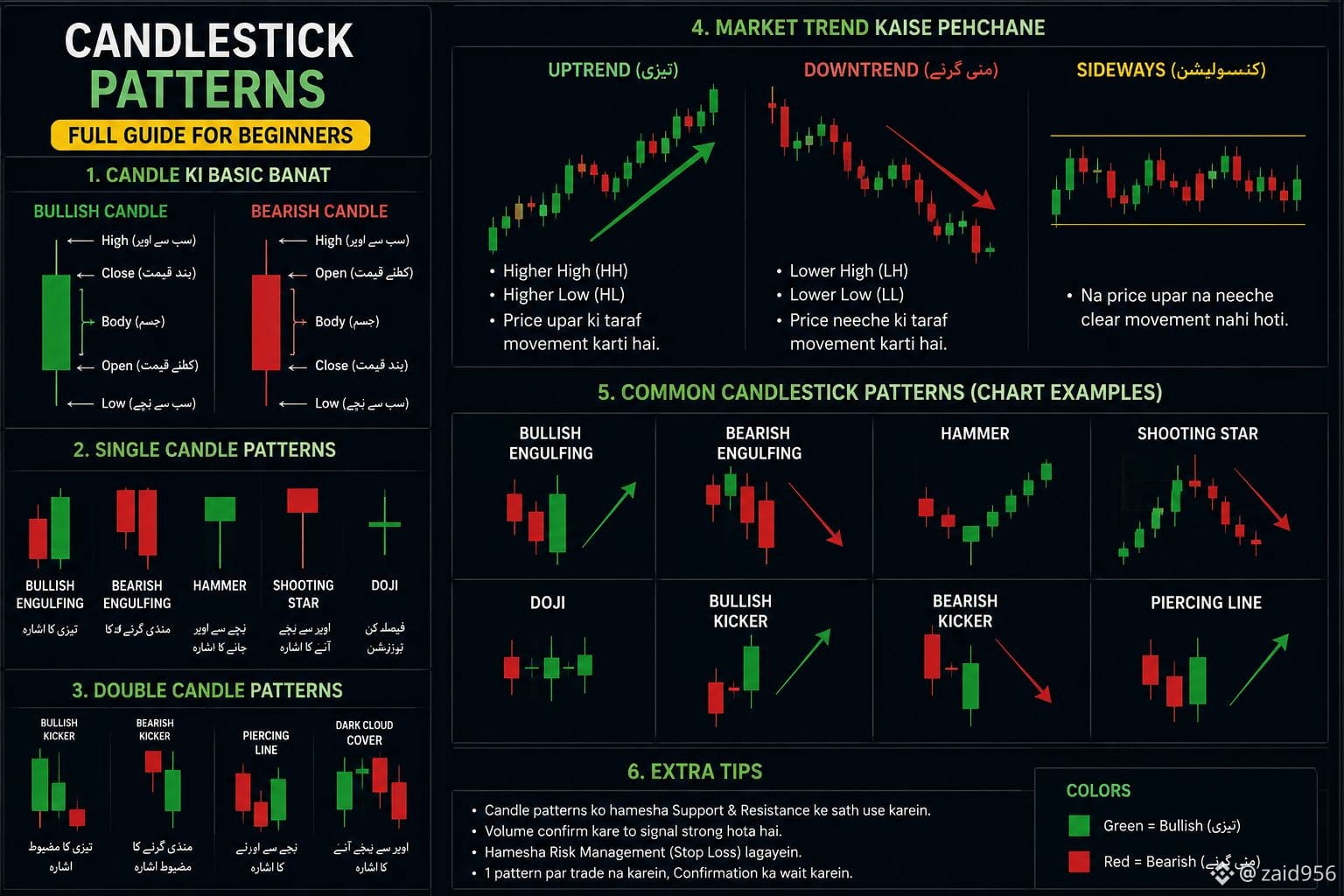
🚨Olá iniciantes🚨 Você sabe como ler esses padrões de velas—essas pequenas formações de gráficos que podem contar grandes histórias. Aqui está uma rápida, #análise dos padrões de alta, neutros e de baixa:  🟢 Padrões de Alta (O preço pode subir 🚀) • Martelo: Parece um martelo—corpo pequeno, longa sombra inferior. Aparece após uma tendência de baixa; sugere que os compradores estão entrando. • Engolfo de Alta: Uma pequena vela vermelha seguida por uma maior verde que a “engole”. Indica uma potencial reversão para cima.  • Estrela da Manhã: Três velas: uma longa vermelha, uma vela de corpo pequeno (pode ser vermelha ou verde), e uma longa verde. Sinaliza uma reversão de alta.  • Três Soldados Brancos: Três velas verdes longas consecutivas. Forte sinal de alta. ⚪ Padrões Neutros (Indecisão do mercado 🤔) • Doji: Os preços de abertura e fechamento são quase os mesmos. Indica indecisão; o mercado pode ir de qualquer maneira.  • Topo Giratório: Corpo pequeno com longas sombras superiores e inferiores. Sugere uma disputa entre compradores e vendedores.  🔴 Padrões de Baixa (O preço pode cair 📉) • Estrela Cadente: Corpo pequeno, longa sombra superior. Aparece após uma tendência de alta; sugere uma potencial reversão para baixo. • Engolfo de Baixa: Uma pequena vela verde seguida por uma maior vermelha que a “engole”. Indica uma potencial reversão para baixo.  • Estrela da Noite: Três velas: uma longa verde, uma vela de corpo pequeno, e uma longa vermelha. Sinaliza uma reversão de baixa. • Três Corvos Negros: Três velas vermelhas longas consecutivas. Forte sinal de baixa. Boas negociações! 💹📊 #candlestick_patterns #candle #Beginnersguide #tradingtechnique #CryptoTips
🚨Olá iniciantes🚨
Você sabe como ler esses padrões de velas—essas pequenas formações de gráficos que podem contar grandes histórias. Aqui está uma rápida, #análise dos padrões de alta, neutros e de baixa: 

🟢 Padrões de Alta (O preço pode subir 🚀)
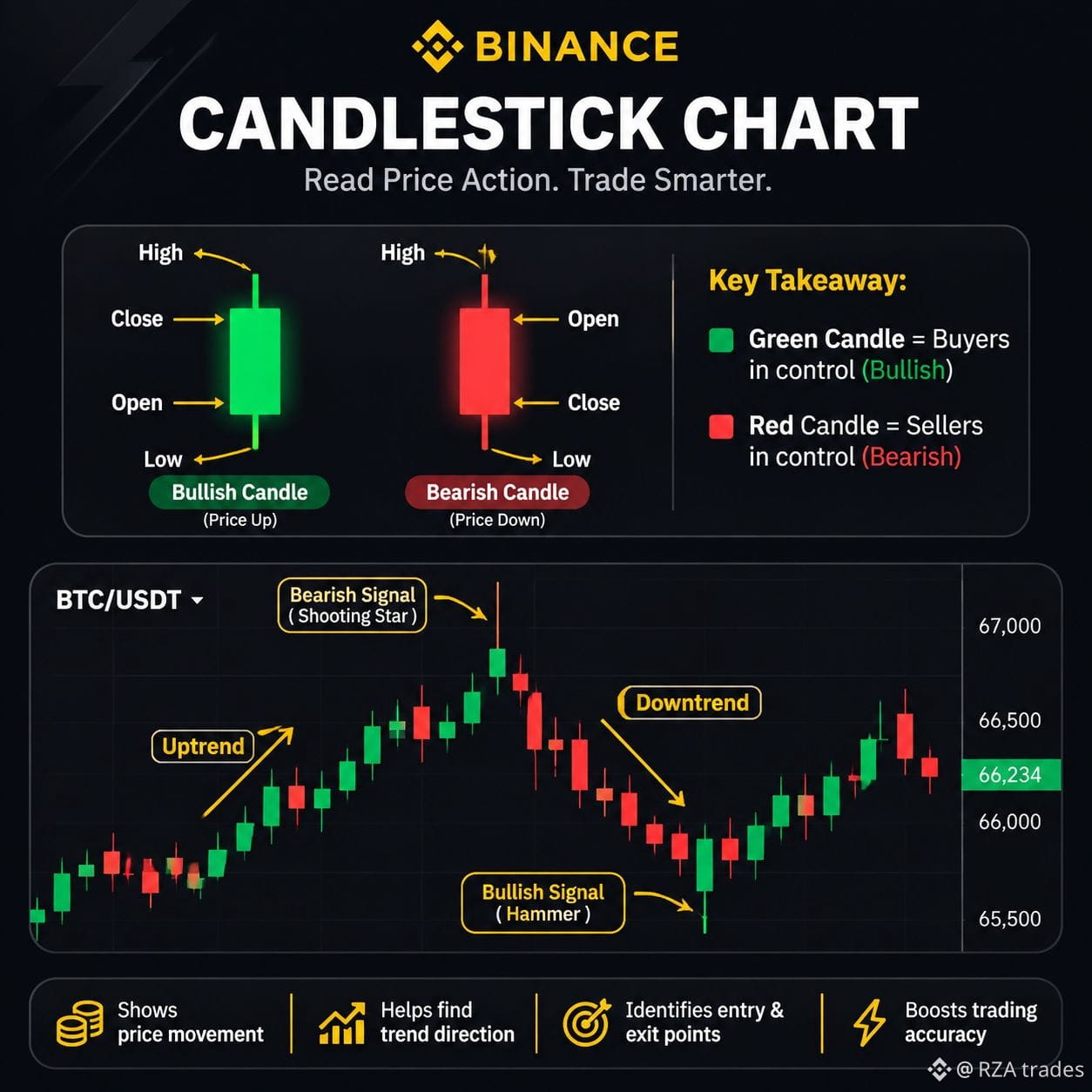
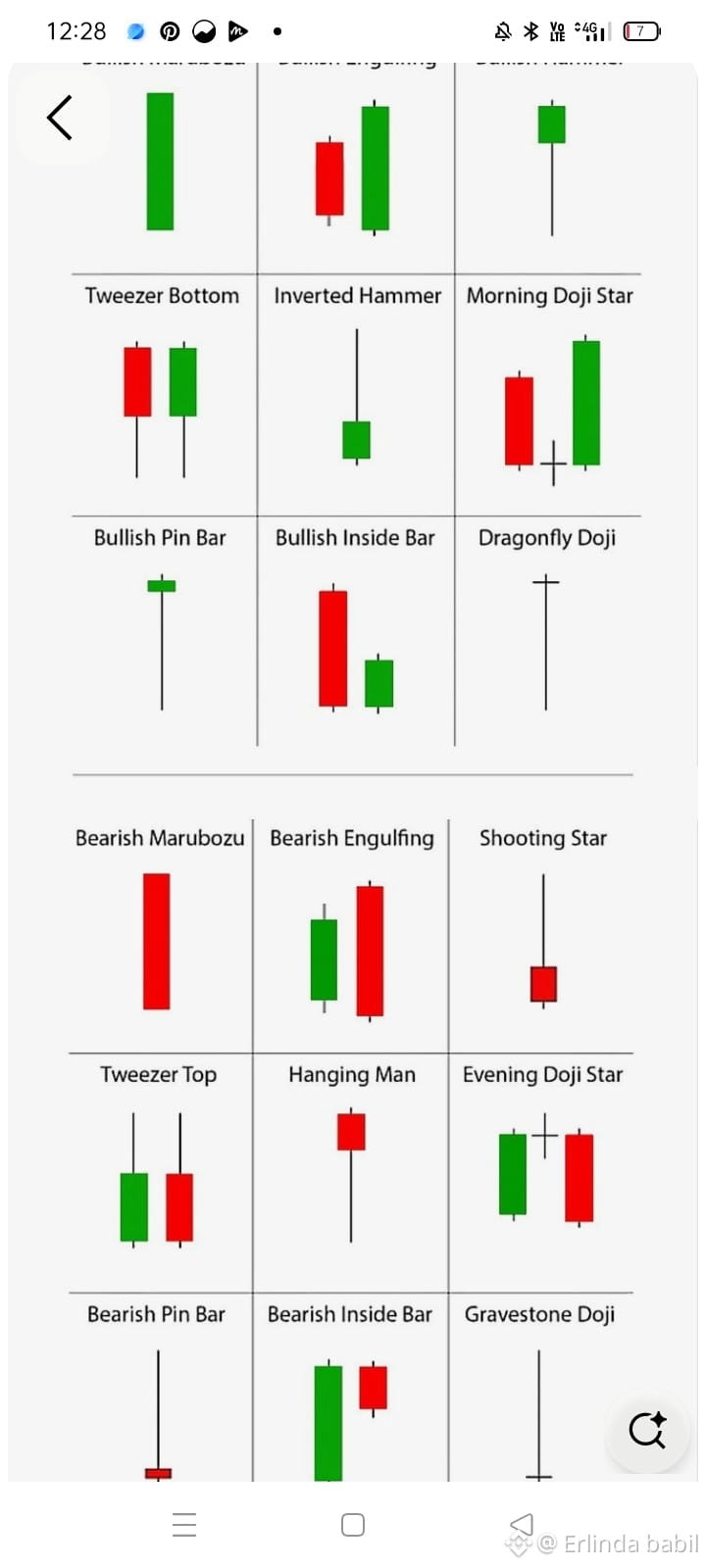
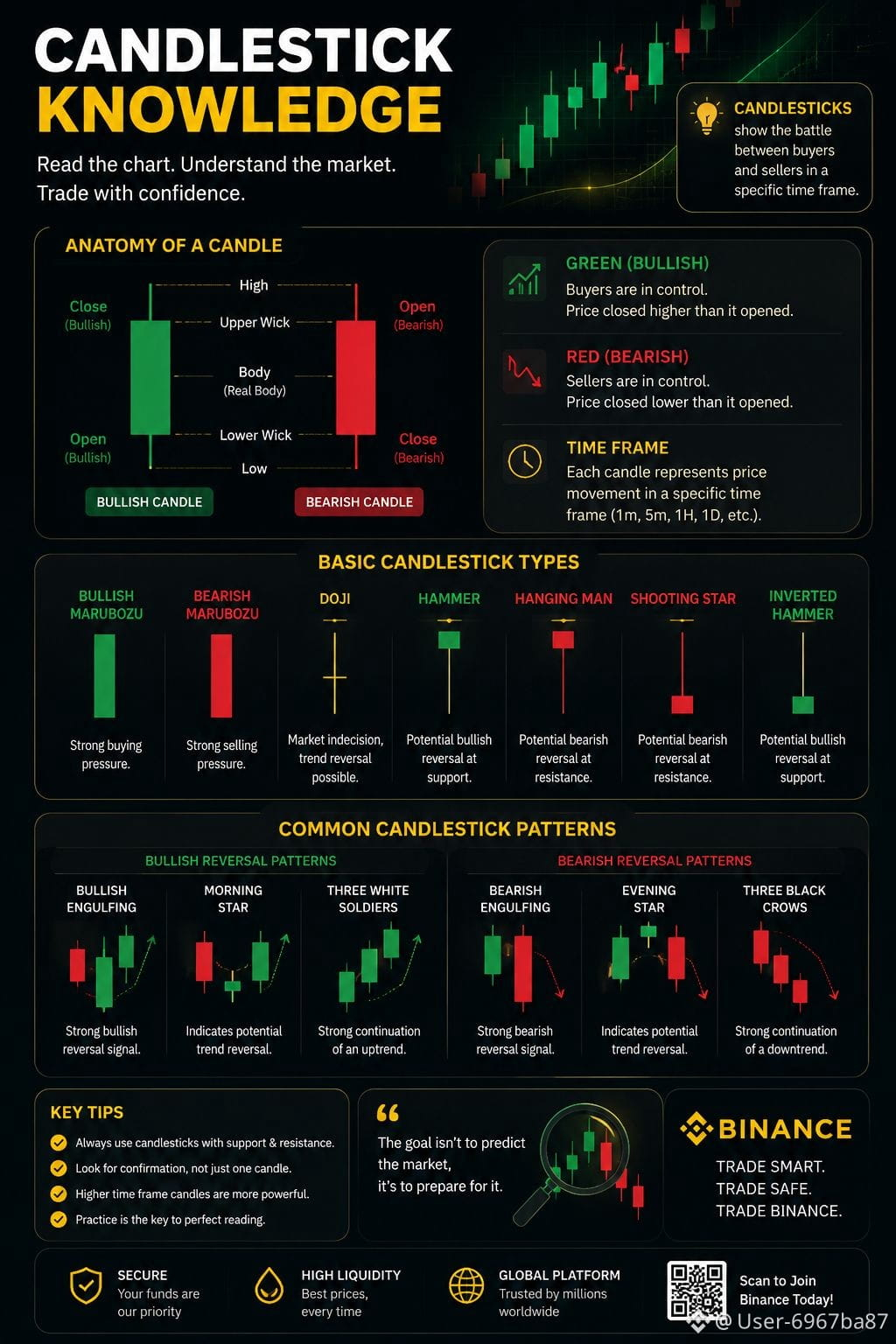
• Martelo: Parece um martelo—corpo pequeno, longa sombra inferior. Aparece após uma tendência de baixa; sugere que os compradores estão entrando.
• Engolfo de Alta: Uma pequena vela vermelha seguida por uma maior verde que a “engole”. Indica uma potencial reversão para cima. 
• Estrela da Manhã: Três velas: uma longa vermelha, uma vela de corpo pequeno (pode ser vermelha ou verde), e uma longa verde. Sinaliza uma reversão de alta. 
• Três Soldados Brancos: Três velas verdes longas consecutivas. Forte sinal de alta.

⚪ Padrões Neutros (Indecisão do mercado 🤔)
• Doji: Os preços de abertura e fechamento são quase os mesmos. Indica indecisão; o mercado pode ir de qualquer maneira. 
• Topo Giratório: Corpo pequeno com longas sombras superiores e inferiores. Sugere uma disputa entre compradores e vendedores. 

🔴 Padrões de Baixa (O preço pode cair 📉)
• Estrela Cadente: Corpo pequeno, longa sombra superior. Aparece após uma tendência de alta; sugere uma potencial reversão para baixo.
• Engolfo de Baixa: Uma pequena vela verde seguida por uma maior vermelha que a “engole”. Indica uma potencial reversão para baixo. 
• Estrela da Noite: Três velas: uma longa verde, uma vela de corpo pequeno, e uma longa vermelha. Sinaliza uma reversão de baixa.
• Três Corvos Negros: Três velas vermelhas longas consecutivas. Forte sinal de baixa.

Boas negociações! 💹📊
#candlestick_patterns #candle #Beginnersguide #tradingtechnique #CryptoTips
Transações recentes
0 transações
SIGN/USDT
🚀 DOMINE ESTES PADRÕES DE VELA & DIGA ADEUS A PERDAS ☑️👇✅ 1. Compradores em Controle Total 🟢 Candle Verde Forte 💡 Significado: Os touros dominam, elevando o preço. ✅ 2. Compradores Tomaram Conta Após o Empurrão dos Vendedores 🟢 Candle Verde com Longo Pavio Inferior 💡 Significado: Os ursos tentaram puxar o preço para baixo, mas os touros inverteram a movimentação. ❌ 3. Indecisão do Mercado ⚪ Doji / Corpo Pequeno 💡 Significado: Nenhum lado no controle → fique atento a uma possível reversão. ❌ 4. Compradores Rejeitados pelos Vendedores 🟢 Candle Verde com Longo Pavio Superior 💡 Significado: Os touros empurraram para cima, mas os ursos derrubaram novamente.

🚀 DOMINE ESTES PADRÕES DE VELA & DIGA ADEUS A PERDAS ☑️👇

✅ 1. Compradores em Controle Total
🟢 Candle Verde Forte
💡 Significado: Os touros dominam, elevando o preço.
✅ 2. Compradores Tomaram Conta Após o Empurrão dos Vendedores
🟢 Candle Verde com Longo Pavio Inferior
💡 Significado: Os ursos tentaram puxar o preço para baixo, mas os touros inverteram a movimentação.
❌ 3. Indecisão do Mercado
⚪ Doji / Corpo Pequeno
💡 Significado: Nenhum lado no controle → fique atento a uma possível reversão.
❌ 4. Compradores Rejeitados pelos Vendedores
🟢 Candle Verde com Longo Pavio Superior
💡 Significado: Os touros empurraram para cima, mas os ursos derrubaram novamente.
The key to success in trading: the 8 essential candlestick signalsThe key to success in trading: the 8 essential candlestick signals In the volatile world of crypto markets, correctly understanding Japanese candlestick patterns can make the difference between profit and loss. Here are the 8 most important signals to study: Bullish Engulfing – the green candle completely 'engulfs' the red one, a clear sign of buyers' return. Hammer & Inverted Hammer – long downward shadows, suggesting rejection of sellers and potential upward trend.

The key to success in trading: the 8 essential candlestick signals

The key to success in trading: the 8 essential candlestick signals
In the volatile world of crypto markets, correctly understanding Japanese candlestick patterns can make the difference between profit and loss. Here are the 8 most important signals to study:
Bullish Engulfing – the green candle completely 'engulfs' the red one, a clear sign of buyers' return.
Hammer & Inverted Hammer – long downward shadows, suggesting rejection of sellers and potential upward trend.
jantar à luz de velas...... Quando seu portfólio cai 90% e você está tendo um jantar à luz de velas... não por romance, mas porque você não pode mais pagar pela eletricidade." #candlestick #candle #BTCvsMarkets
jantar à luz de velas......

Quando seu portfólio cai 90% e você está tendo um jantar à luz de velas... não por romance, mas porque você não pode mais pagar pela eletricidade."
#candlestick #candle #BTCvsMarkets
$0G lançado a um grande preço $7 agora caiu para $3.606 Agora o gráfico mostra provavelmente uma pequena alta #candle pode ser #pump voltará a $7
$0G
lançado a um grande preço $7 agora caiu para $3.606
Agora o gráfico mostra provavelmente uma pequena alta #candle
pode ser #pump voltará a $7
O conteúdo citado foi removido
#candle padrões de stick estes são importantes para estudar e investir representa os movimentos de preços no mercado são pontos de dados em forma de vela onde as cores verde e vermelho representam tendências de alta e baixa
#candle padrões de stick estes são importantes para estudar e investir
representa os movimentos de preços no mercado são pontos de dados em forma de vela onde as cores verde e vermelho representam tendências de alta e baixa
·
--
Em Alta
$ARK Forte rompimento em movimento🚀 Um #Candle Mudança de jogo🔥. . . ALVO🎯 0.5000 Siga-me. . . #No1 . . Alerta🚨 Plataforma . . . $ARK {future}(ARKUSDT)
$ARK Forte rompimento em movimento🚀 Um #Candle Mudança de jogo🔥. . .
ALVO🎯
0.5000
Siga-me. . . #No1 . . Alerta🚨 Plataforma . . .
$ARK
DOMINE ESTES PADRÕES DE GRÁFICO & EVITE PERDAS PARA SEMPRE!🔥🔥DOMINE ESTES PADRÕES DE GRÁFICO & EVITE PERDAS PARA SEMPRE!🔥🔥 📌 Martelo O Martelo é um padrão de reversão bullish, geralmente encontrado no fundo de uma tendência de baixa. Tem um corpo pequeno com uma longa ponta inferior, indicando que os vendedores empurraram o preço para baixo, mas os compradores recuperaram o controle até o fechamento. É um símbolo de resiliência e um possível ponto de virada. --- confira meu post fixado 📌 para recompensas exclusivas 🎁 😉 📌 Martelo Invertido Aparecendo também após uma tendência de baixa, o Martelo Invertido tem um corpo pequeno com uma longa ponta superior. Embora reflita tentativas iniciais dos compradores de empurrar o preço para cima, seu verdadeiro potencial reside na confirmação que se segue. Ele sussurra a possibilidade de uma reversão bullish.

DOMINE ESTES PADRÕES DE GRÁFICO & EVITE PERDAS PARA SEMPRE!🔥🔥

DOMINE ESTES PADRÕES DE GRÁFICO & EVITE PERDAS PARA SEMPRE!🔥🔥
📌 Martelo
O Martelo é um padrão de reversão bullish, geralmente encontrado no fundo de uma tendência de baixa. Tem um corpo pequeno com uma longa ponta inferior, indicando que os vendedores empurraram o preço para baixo, mas os compradores recuperaram o controle até o fechamento. É um símbolo de resiliência e um possível ponto de virada.
--- confira meu post fixado 📌 para recompensas exclusivas 🎁 😉

📌 Martelo Invertido
Aparecendo também após uma tendência de baixa, o Martelo Invertido tem um corpo pequeno com uma longa ponta superior. Embora reflita tentativas iniciais dos compradores de empurrar o preço para cima, seu verdadeiro potencial reside na confirmação que se segue. Ele sussurra a possibilidade de uma reversão bullish.
·
--
Em Alta
🚀 $MAV forte💪 Entrada Silenciosa Grande Momento 🔥 Veja isso. . . Apenas Um #Candle Mudador de Jogo.
🚀 $MAV forte💪 Entrada Silenciosa Grande Momento 🔥 Veja isso. . .
Apenas Um #Candle Mudador de Jogo.
Inicia sessão para explorares mais conteúdos
Fica a saber as últimas notícias sobre criptomoedas
⚡️ Participa nas mais recentes discussões sobre criptomoedas
💬 Interage com os teus criadores preferidos
👍 Desfruta de conteúdos que sejam do teu interesse
E-mail/Número de telefone