
#blockchainanalysis
blockchainanalysis
102,417 visualizações
261 a discutir
Popular
Mais recente
·
--
$TAIKO ANÁLISE DE INCIDENTE DE SEGURANÇA E VISÃO GERAL DA VULNERABILIDADE DA PONTE ⚠️
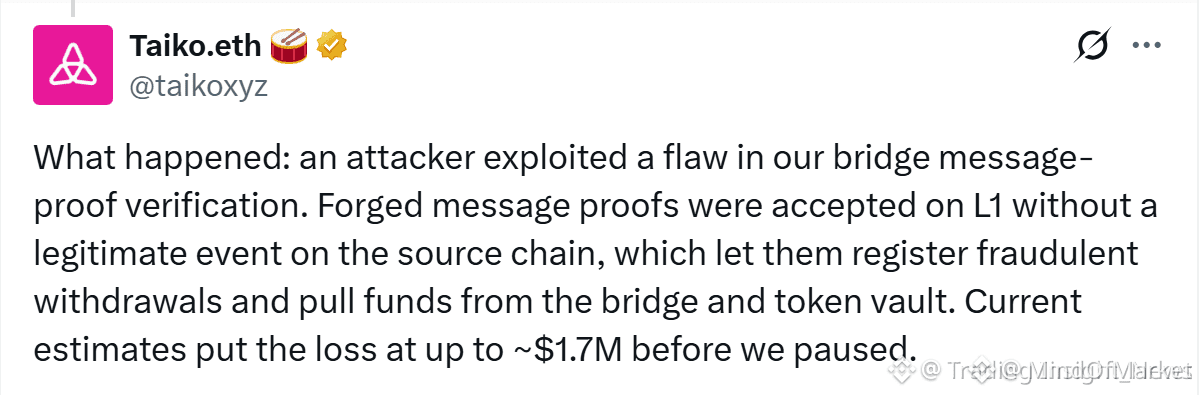
O recente ataque na ponte cross-chain $TAIKO resultou em uma perda de 1,7 milhão de dólares devido a uma prova de verificação de mensagens falsificada. Ao ignorar a geração de eventos da cadeia de origem, o atacante conseguiu executar saques fraudulentos, forçando a suspensão temporária da ponte e do cofre de tokens.
Este incidente evidencia a fragilidade sistêmica inerente aos atuais mecanismos de verificação cross-chain. Embora a contenção rápida da violação demonstre eficiência operacional, o incidente serve como um lembrete contundente dos riscos de segurança persistentes associados à infraestrutura de pontes. Você acha que soluções de ponte algum dia conseguirão alcançar segurança suficiente para evitar esse tipo de exploração?
Não é aconselhamento financeiro. Gerencie sempre o seu risco.
#TAIKO #CryptoSecurity #BridgeExploit #BlockchainAnalysis
🎯
$TAIKO ANÁLISE DE INCIDENTE DE SEGURANÇA E VISÃO GERAL DA VULNERABILIDADE DA PONTE ⚠️
O recente ataque na ponte cross-chain $TAIKO resultou em uma perda de 1,7 milhão de dólares devido a uma prova de verificação de mensagens falsificada. Ao ignorar a geração de eventos da cadeia de origem, o atacante conseguiu executar saques fraudulentos, forçando a suspensão temporária da ponte e do cofre de tokens.
Este incidente evidencia a fragilidade sistêmica inerente aos atuais mecanismos de verificação cross-chain. Embora a contenção rápida da violação demonstre eficiência operacional, o incidente serve como um lembrete contundente dos riscos de segurança persistentes associados à infraestrutura de pontes. Você acha que soluções de ponte algum dia conseguirão alcançar segurança suficiente para evitar esse tipo de exploração?
Não é aconselhamento financeiro. Gerencie sempre o seu risco.
#TAIKO #CryptoSecurity #BridgeExploit #BlockchainAnalysis
🎯
O recente ataque na ponte cross-chain $TAIKO resultou em uma perda de 1,7 milhão de dólares devido a uma prova de verificação de mensagens falsificada. Ao ignorar a geração de eventos da cadeia de origem, o atacante conseguiu executar saques fraudulentos, forçando a suspensão temporária da ponte e do cofre de tokens.
Este incidente evidencia a fragilidade sistêmica inerente aos atuais mecanismos de verificação cross-chain. Embora a contenção rápida da violação demonstre eficiência operacional, o incidente serve como um lembrete contundente dos riscos de segurança persistentes associados à infraestrutura de pontes. Você acha que soluções de ponte algum dia conseguirão alcançar segurança suficiente para evitar esse tipo de exploração?
Não é aconselhamento financeiro. Gerencie sempre o seu risco.
#TAIKO #CryptoSecurity #BridgeExploit #BlockchainAnalysis
🎯
82

·
--
Artigo
Pare de comprar pumps com zero dados on-chainA armadilha mais perigosa em cripto é comprar um token que subiu 20% em um dia enquanto sua saúde real on-chain está perto de zero.
Todos nós já passamos por isso: perseguir uma vela verde repentina por puro FOMO e, depois, ver o preço desabar horas mais tarde. Isso dói porque deixamos as emoções ditarem nossas entradas, em vez de olhar para os dados frios e concretos.
Dê uma olhada no $PIPPIN, que recentemente saltou mais de 21% em 24 horas para atingir uma capitalização de mercado de 21 milhões de dólares com US$ 8,5 milhões em volume. No papel, sua pontuação financeira parece incrivelmente forte em 86,6, o que naturalmente desperta nossa ganância e nos faz querer comprar. Depois de ter negociado através dos ciclos de 2017 e 2021, já vi esse filme se repetir muitas vezes.
Pare de comprar pumps com zero dados on-chain
A armadilha mais perigosa em cripto é comprar um token que subiu 20% em um dia enquanto sua saúde real on-chain está perto de zero.
Todos nós já passamos por isso: perseguir uma vela verde repentina por puro FOMO e, depois, ver o preço desabar horas mais tarde. Isso dói porque deixamos as emoções ditarem nossas entradas, em vez de olhar para os dados frios e concretos.
Dê uma olhada no $PIPPIN , que recentemente saltou mais de 21% em 24 horas para atingir uma capitalização de mercado de 21 milhões de dólares com US$ 8,5 milhões em volume. No papel, sua pontuação financeira parece incrivelmente forte em 86,6, o que naturalmente desperta nossa ganância e nos faz querer comprar. Depois de ter negociado através dos ciclos de 2017 e 2021, já vi esse filme se repetir muitas vezes.
Todos nós já passamos por isso: perseguir uma vela verde repentina por puro FOMO e, depois, ver o preço desabar horas mais tarde. Isso dói porque deixamos as emoções ditarem nossas entradas, em vez de olhar para os dados frios e concretos.
Dê uma olhada no $PIPPIN , que recentemente saltou mais de 21% em 24 horas para atingir uma capitalização de mercado de 21 milhões de dólares com US$ 8,5 milhões em volume. No papel, sua pontuação financeira parece incrivelmente forte em 86,6, o que naturalmente desperta nossa ganância e nos faz querer comprar. Depois de ter negociado através dos ciclos de 2017 e 2021, já vi esse filme se repetir muitas vezes.
289

·
--
Imagine isto: uma empresa anuncia uma grande integração com blockchain, mas quase nenhum valor comercial subjacente chega aos detentores do mercado secundário.
A maioria dos investidores de varejo entra em compras por impulso sempre que surgem manchetes de adoção corporativa, apenas para ficar preso(a) com “bolsos” quando a velocidade do token não se materializa. É uma armadilha recorrente que custa capital a cada ciclo, porque as pessoas confundem adoção corporativa com demanda por tokens.
A Blockforce recentemente implantou uma arquitetura pública de verificação para registros da cadeia de suprimentos de empresas, mantendo dados comerciais sensíveis em uma rede privada e, ao mesmo tempo, ancorando provas criptográficas em $ADA. A gigante da moda brasileira Azzas 2154 está atualmente usando este sistema para rastreabilidade de couro, mirando 100% de cobertura de sua origem de couro até 2030.
Embora essa arquitetura híbrida proteja a privacidade corporativa melhor do que protocolos totalmente transparentes em $ETH or $VET, ela expõe um risco gritante para investidores. Como transações pesadas de dados permanecem totalmente off-chain, o livro-razão público só processa âncoras mínimas de hash. A empresa obtém uma prova imutável quase gratuita, enquanto a atividade na mainnet e a queima orgânica de taxas de $ADA permanecem praticamente inalteradas.
Quando a adoção corporativa é explicitamente projetada para minimizar a presença on-chain, de onde você acha que vem a acumulação de valor de longo prazo para os detentores?
#Cardano #SupplyChain #BlockchainAnalysis
Imagine isto: uma empresa anuncia uma grande integração com blockchain, mas quase nenhum valor comercial subjacente chega aos detentores do mercado secundário.
A maioria dos investidores de varejo entra em compras por impulso sempre que surgem manchetes de adoção corporativa, apenas para ficar preso(a) com “bolsos” quando a velocidade do token não se materializa. É uma armadilha recorrente que custa capital a cada ciclo, porque as pessoas confundem adoção corporativa com demanda por tokens.
A Blockforce recentemente implantou uma arquitetura pública de verificação para registros da cadeia de suprimentos de empresas, mantendo dados comerciais sensíveis em uma rede privada e, ao mesmo tempo, ancorando provas criptográficas em $ADA . A gigante da moda brasileira Azzas 2154 está atualmente usando este sistema para rastreabilidade de couro, mirando 100% de cobertura de sua origem de couro até 2030.
Embora essa arquitetura híbrida proteja a privacidade corporativa melhor do que protocolos totalmente transparentes em $ETH or $VET , ela expõe um risco gritante para investidores. Como transações pesadas de dados permanecem totalmente off-chain, o livro-razão público só processa âncoras mínimas de hash. A empresa obtém uma prova imutável quase gratuita, enquanto a atividade na mainnet e a queima orgânica de taxas de $ADA permanecem praticamente inalteradas.
Quando a adoção corporativa é explicitamente projetada para minimizar a presença on-chain, de onde você acha que vem a acumulação de valor de longo prazo para os detentores?
#Cardano #SupplyChain #BlockchainAnalysis
A maioria dos investidores de varejo entra em compras por impulso sempre que surgem manchetes de adoção corporativa, apenas para ficar preso(a) com “bolsos” quando a velocidade do token não se materializa. É uma armadilha recorrente que custa capital a cada ciclo, porque as pessoas confundem adoção corporativa com demanda por tokens.
A Blockforce recentemente implantou uma arquitetura pública de verificação para registros da cadeia de suprimentos de empresas, mantendo dados comerciais sensíveis em uma rede privada e, ao mesmo tempo, ancorando provas criptográficas em $ADA . A gigante da moda brasileira Azzas 2154 está atualmente usando este sistema para rastreabilidade de couro, mirando 100% de cobertura de sua origem de couro até 2030.
Embora essa arquitetura híbrida proteja a privacidade corporativa melhor do que protocolos totalmente transparentes em $ETH or $VET , ela expõe um risco gritante para investidores. Como transações pesadas de dados permanecem totalmente off-chain, o livro-razão público só processa âncoras mínimas de hash. A empresa obtém uma prova imutável quase gratuita, enquanto a atividade na mainnet e a queima orgânica de taxas de $ADA permanecem praticamente inalteradas.
Quando a adoção corporativa é explicitamente projetada para minimizar a presença on-chain, de onde você acha que vem a acumulação de valor de longo prazo para os detentores?
#Cardano #SupplyChain #BlockchainAnalysis
33

·
--
Ravencoin em Modo de Crise: Rede sob Ameaça de ExploitUm grande problema está se formando no mundo do Ravencoin, uma moeda digital conhecida por suas capacidades de pagamento ponto a ponto e por seu código aberto.
As pools de mineração que controlam a maior parte da taxa de hash do Ravencoin estão secretamente construindo uma cadeia concorrente que poderia desencadear uma reorganização da rede de três dias. Este é um desenvolvimento extremamente preocupante, que pode ter consequências de longo alcance para a comunidade do Ravencoin, seus usuários e o ecossistema geral de blockchain.
Para entender esta questão complexa, vamos dividi-la: **Compreendendo a Reorganização da Rede e o Equilíbrio da Taxa de Hash** ( #blockchainsecurity, #cryptoeducation).
Ravencoin em Modo de Crise: Rede sob Ameaça de Exploit
Um grande problema está se formando no mundo do Ravencoin, uma moeda digital conhecida por suas capacidades de pagamento ponto a ponto e por seu código aberto.
As pools de mineração que controlam a maior parte da taxa de hash do Ravencoin estão secretamente construindo uma cadeia concorrente que poderia desencadear uma reorganização da rede de três dias. Este é um desenvolvimento extremamente preocupante, que pode ter consequências de longo alcance para a comunidade do Ravencoin, seus usuários e o ecossistema geral de blockchain.
Para entender esta questão complexa, vamos dividi-la: **Compreendendo a Reorganização da Rede e o Equilíbrio da Taxa de Hash** ( #blockchainsecurity, #cryptoeducation).
As pools de mineração que controlam a maior parte da taxa de hash do Ravencoin estão secretamente construindo uma cadeia concorrente que poderia desencadear uma reorganização da rede de três dias. Este é um desenvolvimento extremamente preocupante, que pode ter consequências de longo alcance para a comunidade do Ravencoin, seus usuários e o ecossistema geral de blockchain.
Para entender esta questão complexa, vamos dividi-la: **Compreendendo a Reorganização da Rede e o Equilíbrio da Taxa de Hash** ( #blockchainsecurity, #cryptoeducation).
85

·
--
Um número nos $NEAR dados de hoje se destaca: a relação de traders esperando um breakout em comparação com aqueles que já estão posicionados dentro da faixa atual. Esse sutil desequilíbrio sugere uma narrativa maior - a de um mercado prendendo a respiração enquanto se consolida. A posição atual dentro da faixa de 24 horas é particularmente notável, pois sugere que os traders estão hesitantes em se comprometer com uma direção, optando em vez disso por esperar e ver como a situação se desenrola.
Enquanto observamos $NEAR negociar próximo ao limite inferior de sua faixa recente, é essencial monitorar o volume e o fluxo de ordens, pois esses serão indicadores chave de se a atual consolidação é um precursor para um breakout ou uma continuação da ação dentro da faixa. O que você está observando em $NEAR agora?
Leitura atual: $NEAR, tape spot.
Estou marcando níveis em NEAR/USDT e esperando por um gatilho limpo.
#near
#cryptotrading
#blockchainanalysis
#estratégia de negociação
Um número nos $NEAR dados de hoje se destaca: a relação de traders esperando um breakout em comparação com aqueles que já estão posicionados dentro da faixa atual. Esse sutil desequilíbrio sugere uma narrativa maior - a de um mercado prendendo a respiração enquanto se consolida. A posição atual dentro da faixa de 24 horas é particularmente notável, pois sugere que os traders estão hesitantes em se comprometer com uma direção, optando em vez disso por esperar e ver como a situação se desenrola.
Enquanto observamos $NEAR negociar próximo ao limite inferior de sua faixa recente, é essencial monitorar o volume e o fluxo de ordens, pois esses serão indicadores chave de se a atual consolidação é um precursor para um breakout ou uma continuação da ação dentro da faixa. O que você está observando em $NEAR agora?
Leitura atual: $NEAR , tape spot.
Estou marcando níveis em NEAR/USDT e esperando por um gatilho limpo.
#near
#cryptotrading
#blockchainanalysis
#estratégia de negociação
Enquanto observamos $NEAR negociar próximo ao limite inferior de sua faixa recente, é essencial monitorar o volume e o fluxo de ordens, pois esses serão indicadores chave de se a atual consolidação é um precursor para um breakout ou uma continuação da ação dentro da faixa. O que você está observando em $NEAR agora?
Leitura atual: $NEAR , tape spot.
Estou marcando níveis em NEAR/USDT e esperando por um gatilho limpo.
#near
#cryptotrading
#blockchainanalysis
#estratégia de negociação
48
·
--
Artigo
Ravencoin em Modo de Crise: Rede Sob Ameaça de ExploraçãoUm grande problema está se formando no mundo do Ravencoin, uma moeda digital conhecida por suas capacidades de pagamentos ponto a ponto e por seu código aberto.
Os pools de mineração que controlam a maior parte da taxa de hash do Ravencoin estão, secretamente, construindo uma cadeia concorrente que poderia desencadear uma reorganização de três dias na rede. Este é um desenvolvimento extremamente preocupante que pode ter consequências de grande alcance para a comunidade do Ravencoin, seus usuários e para o ecossistema geral de blockchain.
Para compreender esse problema complexo, vamos dividi-lo: **Entendendo a reorganização da rede e o equilíbrio da taxa de hash** ( #blockchainsecurity, #cryptoeducation).
Ravencoin em Modo de Crise: Rede Sob Ameaça de Exploração
Um grande problema está se formando no mundo do Ravencoin, uma moeda digital conhecida por suas capacidades de pagamentos ponto a ponto e por seu código aberto.
Os pools de mineração que controlam a maior parte da taxa de hash do Ravencoin estão, secretamente, construindo uma cadeia concorrente que poderia desencadear uma reorganização de três dias na rede. Este é um desenvolvimento extremamente preocupante que pode ter consequências de grande alcance para a comunidade do Ravencoin, seus usuários e para o ecossistema geral de blockchain.
Para compreender esse problema complexo, vamos dividi-lo: **Entendendo a reorganização da rede e o equilíbrio da taxa de hash** ( #blockchainsecurity, #cryptoeducation).
Os pools de mineração que controlam a maior parte da taxa de hash do Ravencoin estão, secretamente, construindo uma cadeia concorrente que poderia desencadear uma reorganização de três dias na rede. Este é um desenvolvimento extremamente preocupante que pode ter consequências de grande alcance para a comunidade do Ravencoin, seus usuários e para o ecossistema geral de blockchain.
Para compreender esse problema complexo, vamos dividi-lo: **Entendendo a reorganização da rede e o equilíbrio da taxa de hash** ( #blockchainsecurity, #cryptoeducation).
127


O Rastreador de Volume Intradiário está captando uma pressão de compra consistente em $AIGENSYN e $SXT . Estou verificando por grandes negociações em bloco que possam indicar a participação de jogadores significativos. Minha abordagem é baseada em dados.
#BlockchainAnalysis #FluxoInstitucional
O Rastreador de Volume Intradiário está captando uma pressão de compra consistente em $AIGENSYN e $SXT . Estou verificando por grandes negociações em bloco que possam indicar a participação de jogadores significativos. Minha abordagem é baseada em dados.
#BlockchainAnalysis #FluxoInstitucional
#BlockchainAnalysis #FluxoInstitucional
308

Um número em <c>today's</c> $NEAR data se destaca: sua posição dentro da faixa de 24h. O fato de estar sendo negociado atualmente perto do meio dessa faixa sugere uma fase de consolidação, em que tanto os touros quanto os ursos aguardam um catalisador para definir o próximo movimento. Esse equilíbrio delicado se reflete na variação de 24h, que indica uma hesitação entre os traders em se comprometer com uma direção específica.
Enquanto acompanhamos $NEAR, é essencial observar os níveis que podem desencadear uma ruptura ou uma queda. A atual posição dentro da faixa indica que os traders estão cautelosos, e um movimento fora desse intervalo pode levar a um aumento da volatilidade. Com a variação de 24h relativamente estável, o próximo movimento significativo pode ser crucial para definir a tendência de curto prazo. O que você está observando agora em $NEAR ?
Leitura atual: $NEAR, fita do spot.
#near
#cryptotrading
#blockchainanalysis
#tradingrange
Um número em <c>today's</c> $NEAR data se destaca: sua posição dentro da faixa de 24h. O fato de estar sendo negociado atualmente perto do meio dessa faixa sugere uma fase de consolidação, em que tanto os touros quanto os ursos aguardam um catalisador para definir o próximo movimento. Esse equilíbrio delicado se reflete na variação de 24h, que indica uma hesitação entre os traders em se comprometer com uma direção específica.
Enquanto acompanhamos $NEAR , é essencial observar os níveis que podem desencadear uma ruptura ou uma queda. A atual posição dentro da faixa indica que os traders estão cautelosos, e um movimento fora desse intervalo pode levar a um aumento da volatilidade. Com a variação de 24h relativamente estável, o próximo movimento significativo pode ser crucial para definir a tendência de curto prazo. O que você está observando agora em $NEAR ?
Leitura atual: $NEAR , fita do spot.
#near
#cryptotrading
#blockchainanalysis
#tradingrange
Enquanto acompanhamos $NEAR , é essencial observar os níveis que podem desencadear uma ruptura ou uma queda. A atual posição dentro da faixa indica que os traders estão cautelosos, e um movimento fora desse intervalo pode levar a um aumento da volatilidade. Com a variação de 24h relativamente estável, o próximo movimento significativo pode ser crucial para definir a tendência de curto prazo. O que você está observando agora em $NEAR ?
Leitura atual: $NEAR , fita do spot.
#near
#cryptotrading
#blockchainanalysis
#tradingrange
18
·
--
DADOS SUGEREM UMA MUDANÇA
A atual ação do preço $NEAR está revelando uma história fascinante, com sua faixa de 24h indicando uma fase clara de consolidação. Essa pausa no momentum é destacada pela faixa extremamente estreita, o que normalmente precede um movimento significativo.
O que é crucial agora é entender as implicações dessa ação limitada por faixas e os níveis que os traders devem observar, pois uma ruptura ou queda abaixo dessa zona pode fornecer uma visão valiosa sobre o próximo direcionamento.
O que você está observando agora em $NEAR ?
Leitura atual: $NEAR, fita spot.
Vale manter NEAR/USDT na lista de observação hoje.
#near
#cryptotrading
#blockchainanalysis
#tradinginsights
DADOS SUGEREM UMA MUDANÇA
A atual ação do preço $NEAR está revelando uma história fascinante, com sua faixa de 24h indicando uma fase clara de consolidação. Essa pausa no momentum é destacada pela faixa extremamente estreita, o que normalmente precede um movimento significativo.
O que é crucial agora é entender as implicações dessa ação limitada por faixas e os níveis que os traders devem observar, pois uma ruptura ou queda abaixo dessa zona pode fornecer uma visão valiosa sobre o próximo direcionamento.
O que você está observando agora em $NEAR ?
Leitura atual: $NEAR , fita spot.
Vale manter NEAR/USDT na lista de observação hoje.
#near
#cryptotrading
#blockchainanalysis
#tradinginsights
A atual ação do preço $NEAR está revelando uma história fascinante, com sua faixa de 24h indicando uma fase clara de consolidação. Essa pausa no momentum é destacada pela faixa extremamente estreita, o que normalmente precede um movimento significativo.
O que é crucial agora é entender as implicações dessa ação limitada por faixas e os níveis que os traders devem observar, pois uma ruptura ou queda abaixo dessa zona pode fornecer uma visão valiosa sobre o próximo direcionamento.
O que você está observando agora em $NEAR ?
Leitura atual: $NEAR , fita spot.
Vale manter NEAR/USDT na lista de observação hoje.
#near
#cryptotrading
#blockchainanalysis
#tradinginsights
71
Um aspecto-chave do gráfico $NEAR é sua posição atual dentro de uma faixa bem definida, sugerindo um período de consolidação. Dadas as dinâmicas de negociação nas últimas 24 horas, o fato de $NEAR agora estar situado perto de um nível significativo dentro dessa faixa indica que os traders estão observando de perto uma possível ruptura ou uma ação adicional limitada à faixa. A variação de 24 horas, embora não drástica, ainda é relevante, pois reflete o equilíbrio entre a pressão de compra e a de venda. Uma conclusão crucial desse cenário é que os traders devem monitorar a capacidade de $NEAR de sustentar ou romper esses níveis significativos, pois isso provavelmente influenciará a próxima fase do movimento do preço. Em que você está focando no gráfico $NEAR agora?
Assistindo $NEAR vs esta faixa.
#near
#cryptotrading
#blockchainanalysis
#tradingranges
Um aspecto-chave do gráfico $NEAR é sua posição atual dentro de uma faixa bem definida, sugerindo um período de consolidação. Dadas as dinâmicas de negociação nas últimas 24 horas, o fato de $NEAR agora estar situado perto de um nível significativo dentro dessa faixa indica que os traders estão observando de perto uma possível ruptura ou uma ação adicional limitada à faixa. A variação de 24 horas, embora não drástica, ainda é relevante, pois reflete o equilíbrio entre a pressão de compra e a de venda. Uma conclusão crucial desse cenário é que os traders devem monitorar a capacidade de $NEAR de sustentar ou romper esses níveis significativos, pois isso provavelmente influenciará a próxima fase do movimento do preço. Em que você está focando no gráfico $NEAR agora?
Assistindo $NEAR vs esta faixa.
#near
#cryptotrading
#blockchainanalysis
#tradingranges
Assistindo $NEAR vs esta faixa.
#near
#cryptotrading
#blockchainanalysis
#tradingranges
20

A configuração atual $NEAR está mais intrigante do que parece, com o preço flutuando perto do ponto médio da sua faixa de 24 horas, entre os níveis altos e baixos estabelecidos. Dado esse contexto, o fato de estar sentado a cerca de 60% do caminho para cima a partir da extremidade inferior dessa faixa é particularmente notável. O volume não tem sido excepcionalmente forte em apoiar o movimento recente, sugerindo um grau de hesitação entre os traders.
Leitura atual: $NEAR, tape spot.
Toque $NEAR → abrir NEAR/USDT; marcar as bordas da faixa.
#near #cryptotrades #análise de blockchain
A configuração atual $NEAR está mais intrigante do que parece, com o preço flutuando perto do ponto médio da sua faixa de 24 horas, entre os níveis altos e baixos estabelecidos. Dado esse contexto, o fato de estar sentado a cerca de 60% do caminho para cima a partir da extremidade inferior dessa faixa é particularmente notável. O volume não tem sido excepcionalmente forte em apoiar o movimento recente, sugerindo um grau de hesitação entre os traders.
Leitura atual: $NEAR , tape spot.
Toque $NEAR → abrir NEAR/USDT; marcar as bordas da faixa.
#near #cryptotrades #análise de blockchain
Leitura atual: $NEAR , tape spot.
Toque $NEAR → abrir NEAR/USDT; marcar as bordas da faixa.
#near #cryptotrades #análise de blockchain
28
O preço de $NEAR está atualmente em um ponto crucial dentro de sua recente faixa de consolidação, onde um movimento decisivo pode estar se formando. Essa faixa tem sido caracterizada por uma notável falta de momentum, com os traders esperando por um breakout ou uma direção clara. O fato de que $NEAR agora está pairando em um nível chave, aproximadamente no meio de sua faixa estabelecida, sugere que os traders estão hesitantes em tomar uma posição forte, levando a uma sensação de antecipação e incerteza.
Como traders, devemos monitorar a capacidade de $NEAR de se manter ou romper esse nível, pois isso pode ser um indicador significativo do próximo movimento do ativo. Uma falha em romper ou uma reversão pode levar a mais ação dentro da faixa, enquanto um breakout bem-sucedido pode desencadear uma nova onda de momentum. O que você está observando em $NEAR agora?
$NEAR — na minha tela hoje.
#near
#cryptotrading
#blockchainanalysis
#faixadetrading
O preço de $NEAR está atualmente em um ponto crucial dentro de sua recente faixa de consolidação, onde um movimento decisivo pode estar se formando. Essa faixa tem sido caracterizada por uma notável falta de momentum, com os traders esperando por um breakout ou uma direção clara. O fato de que $NEAR agora está pairando em um nível chave, aproximadamente no meio de sua faixa estabelecida, sugere que os traders estão hesitantes em tomar uma posição forte, levando a uma sensação de antecipação e incerteza.
Como traders, devemos monitorar a capacidade de $NEAR de se manter ou romper esse nível, pois isso pode ser um indicador significativo do próximo movimento do ativo. Uma falha em romper ou uma reversão pode levar a mais ação dentro da faixa, enquanto um breakout bem-sucedido pode desencadear uma nova onda de momentum. O que você está observando em $NEAR agora?
$NEAR — na minha tela hoje.
#near
#cryptotrading
#blockchainanalysis
#faixadetrading
Como traders, devemos monitorar a capacidade de $NEAR de se manter ou romper esse nível, pois isso pode ser um indicador significativo do próximo movimento do ativo. Uma falha em romper ou uma reversão pode levar a mais ação dentro da faixa, enquanto um breakout bem-sucedido pode desencadear uma nova onda de momentum. O que você está observando em $NEAR agora?
$NEAR — na minha tela hoje.
#near
#cryptotrading
#blockchainanalysis
#faixadetrading
32
Um número está chamando atenção no atual período de consolidação de $NEAR — o fato de que o preço está pairando perto do meio da sua faixa de 24 horas. Essa posição sugere um equilíbrio delicado entre compradores e vendedores, com nenhuma das partes conseguindo ganhar tração significativa. A variação nas últimas 24 horas, embora relativamente discreta, importa porque indica uma hesitação dos traders em empurrar o preço para fora dos limites estabelecidos.
À medida que $NEAR continua a se mover dentro da faixa, os traders devem observar os níveis que historicamente atuaram como suporte e resistência, ficando atentos a quaisquer sinais de acumulação ou distribuição que possam indicar um possível rompimento. A configuração atual é mais sutil do que parece à primeira vista, e entender as dinâmicas por trás disso será crucial para navegar o próximo movimento. O que você está observando em $NEAR agora?
Observando $NEAR vs esta faixa.
#near
#cryptotrading
#blockchainanalysis
#tradingrange
Um número está chamando atenção no atual período de consolidação de $NEAR — o fato de que o preço está pairando perto do meio da sua faixa de 24 horas. Essa posição sugere um equilíbrio delicado entre compradores e vendedores, com nenhuma das partes conseguindo ganhar tração significativa. A variação nas últimas 24 horas, embora relativamente discreta, importa porque indica uma hesitação dos traders em empurrar o preço para fora dos limites estabelecidos.
À medida que $NEAR continua a se mover dentro da faixa, os traders devem observar os níveis que historicamente atuaram como suporte e resistência, ficando atentos a quaisquer sinais de acumulação ou distribuição que possam indicar um possível rompimento. A configuração atual é mais sutil do que parece à primeira vista, e entender as dinâmicas por trás disso será crucial para navegar o próximo movimento. O que você está observando em $NEAR agora?
Observando $NEAR vs esta faixa.
#near
#cryptotrading
#blockchainanalysis
#tradingrange
À medida que $NEAR continua a se mover dentro da faixa, os traders devem observar os níveis que historicamente atuaram como suporte e resistência, ficando atentos a quaisquer sinais de acumulação ou distribuição que possam indicar um possível rompimento. A configuração atual é mais sutil do que parece à primeira vista, e entender as dinâmicas por trás disso será crucial para navegar o próximo movimento. O que você está observando em $NEAR agora?
Observando $NEAR vs esta faixa.
#near
#cryptotrading
#blockchainanalysis
#tradingrange
20
O preço $NEAR está pairando perto de um nível crítico dentro de sua faixa recente de consolidação, despertando curiosidade entre os traders sobre o que vem a seguir. Como o ativo está sendo negociado perto do limite superior dessa faixa estabelecida, a posição atual sugere um possível acúmulo de momentum. Historicamente, esse nível tem sido um ponto de interesse, com os traders observando de perto sinais de uma ruptura ou continuação da ação dentro da faixa.
Dado o setup atual, os traders devem monitorar a capacidade do ativo de sustentar ou romper esse nível-chave, pois um movimento em qualquer direção pode ter implicações significativas para a tendência no curto prazo. O fato de $NEAR estar atualmente consolidando perto desse nível, em vez de recuar para o lado inferior da faixa, pode indicar algum grau de força oculta. O que você está observando agora em $NEAR ?
$NEAR — na minha tela hoje.
#near
#cryptotrade
#blockchainanalysis
#tradingrange
O preço $NEAR está pairando perto de um nível crítico dentro de sua faixa recente de consolidação, despertando curiosidade entre os traders sobre o que vem a seguir. Como o ativo está sendo negociado perto do limite superior dessa faixa estabelecida, a posição atual sugere um possível acúmulo de momentum. Historicamente, esse nível tem sido um ponto de interesse, com os traders observando de perto sinais de uma ruptura ou continuação da ação dentro da faixa.
Dado o setup atual, os traders devem monitorar a capacidade do ativo de sustentar ou romper esse nível-chave, pois um movimento em qualquer direção pode ter implicações significativas para a tendência no curto prazo. O fato de $NEAR estar atualmente consolidando perto desse nível, em vez de recuar para o lado inferior da faixa, pode indicar algum grau de força oculta. O que você está observando agora em $NEAR ?
$NEAR — na minha tela hoje.
#near
#cryptotrade
#blockchainanalysis
#tradingrange
Dado o setup atual, os traders devem monitorar a capacidade do ativo de sustentar ou romper esse nível-chave, pois um movimento em qualquer direção pode ter implicações significativas para a tendência no curto prazo. O fato de $NEAR estar atualmente consolidando perto desse nível, em vez de recuar para o lado inferior da faixa, pode indicar algum grau de força oculta. O que você está observando agora em $NEAR ?
$NEAR — na minha tela hoje.
#near
#cryptotrade
#blockchainanalysis
#tradingrange
15
Um número em $NEAR data atual se destaca: o fato de estarmos vendo uma consolidação notável após uma mudança percentual significativa. Essa consolidação está acontecendo dentro de um intervalo definido, com o preço atual permanecendo perto de um nível-chave. A faixa de 24 horas é um fator crítico aqui, pois indica um equilíbrio claro entre compradores e vendedores. Com o preço atualmente posicionado perto do meio desse intervalo, isso sugere que o mercado está hesitando, aguardando um catalisador para tirá-lo dessa fase de consolidação. A falta de um movimento direcional forte até agora também é reveladora, pois implica que os traders estão observando com cautela uma ruptura ou uma quebra a partir desse intervalo. O que você está observando agora em $NEAR ?
Observando $NEAR vs este intervalo.
#near
#cryptotrading
#blockchainanalysis
#tradingranges
Um número em $NEAR data atual se destaca: o fato de estarmos vendo uma consolidação notável após uma mudança percentual significativa. Essa consolidação está acontecendo dentro de um intervalo definido, com o preço atual permanecendo perto de um nível-chave. A faixa de 24 horas é um fator crítico aqui, pois indica um equilíbrio claro entre compradores e vendedores. Com o preço atualmente posicionado perto do meio desse intervalo, isso sugere que o mercado está hesitando, aguardando um catalisador para tirá-lo dessa fase de consolidação. A falta de um movimento direcional forte até agora também é reveladora, pois implica que os traders estão observando com cautela uma ruptura ou uma quebra a partir desse intervalo. O que você está observando agora em $NEAR ?
Observando $NEAR vs este intervalo.
#near
#cryptotrading
#blockchainanalysis
#tradingranges
Observando $NEAR vs este intervalo.
#near
#cryptotrading
#blockchainanalysis
#tradingranges
14
·
--
1) Um número nos $NEAR dados se destaca: sua posição dentro da faixa de 24 horas, que está próxima ao ponto médio, indicando um equilíbrio entre compradores e vendedores.
2) Esse equilíbrio é crucial, já que a mudança nas 24 horas é relativamente pequena, sugerindo uma fase de consolidação, onde os traders estão avaliando seus próximos movimentos, e o nível atual é um indicador chave do sentimento subjacente.
$NEAR — na minha tela hoje.
#near #cryptotrading #blockchainanalysis #estrategiadetrading
1) Um número nos $NEAR dados se destaca: sua posição dentro da faixa de 24 horas, que está próxima ao ponto médio, indicando um equilíbrio entre compradores e vendedores.
2) Esse equilíbrio é crucial, já que a mudança nas 24 horas é relativamente pequena, sugerindo uma fase de consolidação, onde os traders estão avaliando seus próximos movimentos, e o nível atual é um indicador chave do sentimento subjacente.
$NEAR — na minha tela hoje.
#near #cryptotrading #blockchainanalysis #estrategiadetrading
2) Esse equilíbrio é crucial, já que a mudança nas 24 horas é relativamente pequena, sugerindo uma fase de consolidação, onde os traders estão avaliando seus próximos movimentos, e o nível atual é um indicador chave do sentimento subjacente.
$NEAR — na minha tela hoje.
#near #cryptotrading #blockchainanalysis #estrategiadetrading
27
Um número nos dados de hoje $NEAR se destaca: o fato de que atualmente está pairando em torno de um ponto de inflexão chave dentro da sua consolidação, que está mostrando sinais de compressão 📊 enquanto os traders ponderam seu próximo movimento. Essa posição é crucial, pois sugere que o mercado está hesitante em ultrapassar seu intervalo estabelecido, optando em vez disso por construir impulso internamente. A configuração atual implica que os traders estão esperando por um catalisador que provoque uma explosão, e a faixa de 24 horas é um nível chave para observar sinais de força ou fraqueza. À medida que avançamos, os traders devem estar atentos aos limites superior e inferior dessa faixa para sinais de uma potencial continuidade ou reversão de tendência. O que você está observando em $NEAR agora?
Observando $NEAR vs essa faixa.
#near #cryptotrade #análisedeblockchain
Um número nos dados de hoje $NEAR se destaca: o fato de que atualmente está pairando em torno de um ponto de inflexão chave dentro da sua consolidação, que está mostrando sinais de compressão 📊 enquanto os traders ponderam seu próximo movimento. Essa posição é crucial, pois sugere que o mercado está hesitante em ultrapassar seu intervalo estabelecido, optando em vez disso por construir impulso internamente. A configuração atual implica que os traders estão esperando por um catalisador que provoque uma explosão, e a faixa de 24 horas é um nível chave para observar sinais de força ou fraqueza. À medida que avançamos, os traders devem estar atentos aos limites superior e inferior dessa faixa para sinais de uma potencial continuidade ou reversão de tendência. O que você está observando em $NEAR agora?
Observando $NEAR vs essa faixa.
#near #cryptotrade #análisedeblockchain
Observando $NEAR vs essa faixa.
#near #cryptotrade #análisedeblockchain
40
O gráfico $NEAR está piscando um sinal crítico à medida que se aproxima do limite superior da sua faixa atual de consolidação. Esta faixa apertada está sendo construída há algum tempo, e os traders observam de perto os níveis que podem disparar uma ruptura. Notavelmente, a posição atual dentro desta faixa de 24 horas sugere um mercado em hesitação, com os traders ponderando cuidadosamente seus próximos passos.
A importância da variação de 24 horas está na indicação do momentum subjacente do mercado, ou da sua falta. À medida que $NEAR testa os limites da sua faixa, os traders devem monitorar de perto o volume e a ação do preço em busca de sinais de uma possível ruptura ou Continuação da atual movimentação limitada por faixa. O que você está observando em $NEAR agora?
Observando $NEAR em relação a esta faixa.
Vale manter NEAR/USDT na lista de monitoramento hoje.
#near
#cryptotrading
#blockchainanalysis
#tradingrange
O gráfico $NEAR está piscando um sinal crítico à medida que se aproxima do limite superior da sua faixa atual de consolidação. Esta faixa apertada está sendo construída há algum tempo, e os traders observam de perto os níveis que podem disparar uma ruptura. Notavelmente, a posição atual dentro desta faixa de 24 horas sugere um mercado em hesitação, com os traders ponderando cuidadosamente seus próximos passos.
A importância da variação de 24 horas está na indicação do momentum subjacente do mercado, ou da sua falta. À medida que $NEAR testa os limites da sua faixa, os traders devem monitorar de perto o volume e a ação do preço em busca de sinais de uma possível ruptura ou Continuação da atual movimentação limitada por faixa. O que você está observando em $NEAR agora?
Observando $NEAR em relação a esta faixa.
Vale manter NEAR/USDT na lista de monitoramento hoje.
#near
#cryptotrading
#blockchainanalysis
#tradingrange
A importância da variação de 24 horas está na indicação do momentum subjacente do mercado, ou da sua falta. À medida que $NEAR testa os limites da sua faixa, os traders devem monitorar de perto o volume e a ação do preço em busca de sinais de uma possível ruptura ou Continuação da atual movimentação limitada por faixa. O que você está observando em $NEAR agora?
Observando $NEAR em relação a esta faixa.
Vale manter NEAR/USDT na lista de monitoramento hoje.
#near
#cryptotrading
#blockchainanalysis
#tradingrange
31
·
--
Aqui está o que aconteceu quando outra exchange de cripto decidiu contratar o campeão da Copa do Mundo argentino Enzo Fernández como seu embaixador global.
Investidores de varejo frequentemente têm dificuldade em separar o hype de marketing da real utilidade da plataforma, comprando tokens de exchange bem antes de essas grandes campanhas atingirem o topo. É difícil saber se patrocínios de atletas multimilionários realmente trazem liquidez a longo prazo ou apenas FOMO temporário do varejo.
Olhando para o último ciclo, vimos grandes acordos esportivos como a parceria da Binance com Cristiano Ronaldo ou a Chiliz construindo um ecossistema inteiro em torno de clubes de fãs. Esses movimentos raramente são apenas sobre conscientização da marca. Eles são jogadas calculadas para capturar mercados regionais específicos. Ao assinar com Fernández, a exchange está mirando no enorme público de futebol da América Latina, uma região onde a inflação leva as pessoas a buscarem stablecoins e ativos como $BNB para a preservação de riqueza.
Historicamente, essas parcerias correlacionam-se com picos na aquisição de usuários em vez de uma ação imediata no preço dos tokens. Quando tokens de fãs como $ARG disparam durante grandes torneios, isso mostra que os fãs de esportes estão dispostos a migrar para o Web3. No entanto, o verdadeiro teste é se essas plataformas conseguem reter esses novos usuários com utilidade real uma vez que o entusiasmo inicial do marketing diminui, assim como $CHZ teve que inovar continuamente além de simples direitos de voto para manter os fãs de esportes engajados.
Você acha que patrocínios de atletas ainda funcionam para trazer novo capital para o cripto, ou o público de varejo já está cansado do hype?
#CryptoMarketing #Web3Sports #AnáliseBlockchain
Aqui está o que aconteceu quando outra exchange de cripto decidiu contratar o campeão da Copa do Mundo argentino Enzo Fernández como seu embaixador global.
Investidores de varejo frequentemente têm dificuldade em separar o hype de marketing da real utilidade da plataforma, comprando tokens de exchange bem antes de essas grandes campanhas atingirem o topo. É difícil saber se patrocínios de atletas multimilionários realmente trazem liquidez a longo prazo ou apenas FOMO temporário do varejo.
Olhando para o último ciclo, vimos grandes acordos esportivos como a parceria da Binance com Cristiano Ronaldo ou a Chiliz construindo um ecossistema inteiro em torno de clubes de fãs. Esses movimentos raramente são apenas sobre conscientização da marca. Eles são jogadas calculadas para capturar mercados regionais específicos. Ao assinar com Fernández, a exchange está mirando no enorme público de futebol da América Latina, uma região onde a inflação leva as pessoas a buscarem stablecoins e ativos como $BNB para a preservação de riqueza.
Historicamente, essas parcerias correlacionam-se com picos na aquisição de usuários em vez de uma ação imediata no preço dos tokens. Quando tokens de fãs como $ARG disparam durante grandes torneios, isso mostra que os fãs de esportes estão dispostos a migrar para o Web3. No entanto, o verdadeiro teste é se essas plataformas conseguem reter esses novos usuários com utilidade real uma vez que o entusiasmo inicial do marketing diminui, assim como $CHZ teve que inovar continuamente além de simples direitos de voto para manter os fãs de esportes engajados.
Você acha que patrocínios de atletas ainda funcionam para trazer novo capital para o cripto, ou o público de varejo já está cansado do hype?
#CryptoMarketing #Web3Sports #AnáliseBlockchain
Investidores de varejo frequentemente têm dificuldade em separar o hype de marketing da real utilidade da plataforma, comprando tokens de exchange bem antes de essas grandes campanhas atingirem o topo. É difícil saber se patrocínios de atletas multimilionários realmente trazem liquidez a longo prazo ou apenas FOMO temporário do varejo.
Olhando para o último ciclo, vimos grandes acordos esportivos como a parceria da Binance com Cristiano Ronaldo ou a Chiliz construindo um ecossistema inteiro em torno de clubes de fãs. Esses movimentos raramente são apenas sobre conscientização da marca. Eles são jogadas calculadas para capturar mercados regionais específicos. Ao assinar com Fernández, a exchange está mirando no enorme público de futebol da América Latina, uma região onde a inflação leva as pessoas a buscarem stablecoins e ativos como $BNB para a preservação de riqueza.
Historicamente, essas parcerias correlacionam-se com picos na aquisição de usuários em vez de uma ação imediata no preço dos tokens. Quando tokens de fãs como $ARG disparam durante grandes torneios, isso mostra que os fãs de esportes estão dispostos a migrar para o Web3. No entanto, o verdadeiro teste é se essas plataformas conseguem reter esses novos usuários com utilidade real uma vez que o entusiasmo inicial do marketing diminui, assim como $CHZ teve que inovar continuamente além de simples direitos de voto para manter os fãs de esportes engajados.
Você acha que patrocínios de atletas ainda funcionam para trazer novo capital para o cripto, ou o público de varejo já está cansado do hype?
#CryptoMarketing #Web3Sports #AnáliseBlockchain
397
Um número nos dados de $NEAR de hoje se destaca: a sua incapacidade de romper a consolidação atual. O ativo está atualmente sendo negociado perto do meio da sua faixa de 24 horas, o que sugere um equilíbrio entre compradores e vendedores. Essa ação limitada na faixa é algo a se observar, pois pode ser um sinal de acumulação ou hesitação.
O fato de que $NEAR está se mantendo dentro dessa faixa, em vez de fazer um movimento decisivo, implica que os traders estão aguardando um catalisador para empurrar o preço para fora dessa consolidação apertada. A principal lição aqui é que os traders devem monitorar os limites superior e inferior dessa faixa, pois um rompimento ou uma rejeição desses níveis pode ser um indicador significativo do próximo movimento do ativo. O que você está observando em $NEAR agora?
Leitura atual: $NEAR, tape spot.
#near
#cryptotrading
#análisedeblockchain
Um número nos dados de $NEAR de hoje se destaca: a sua incapacidade de romper a consolidação atual. O ativo está atualmente sendo negociado perto do meio da sua faixa de 24 horas, o que sugere um equilíbrio entre compradores e vendedores. Essa ação limitada na faixa é algo a se observar, pois pode ser um sinal de acumulação ou hesitação.
O fato de que $NEAR está se mantendo dentro dessa faixa, em vez de fazer um movimento decisivo, implica que os traders estão aguardando um catalisador para empurrar o preço para fora dessa consolidação apertada. A principal lição aqui é que os traders devem monitorar os limites superior e inferior dessa faixa, pois um rompimento ou uma rejeição desses níveis pode ser um indicador significativo do próximo movimento do ativo. O que você está observando em $NEAR agora?
Leitura atual: $NEAR , tape spot.
#near
#cryptotrading
#análisedeblockchain
O fato de que $NEAR está se mantendo dentro dessa faixa, em vez de fazer um movimento decisivo, implica que os traders estão aguardando um catalisador para empurrar o preço para fora dessa consolidação apertada. A principal lição aqui é que os traders devem monitorar os limites superior e inferior dessa faixa, pois um rompimento ou uma rejeição desses níveis pode ser um indicador significativo do próximo movimento do ativo. O que você está observando em $NEAR agora?
Leitura atual: $NEAR , tape spot.
#near
#cryptotrading
#análisedeblockchain
66
Inicia sessão para explorar mais conteúdos
Junta-te a utilizadores de criptomoedas de todo o mundo na Binance Square
⚡️ Obtém informações úteis e recentes sobre criptomoedas.
💬 Com a confiança da maior exchange de criptomoedas do mundo.
👍 Descobre perspetivas reais de criadores verificados.
E-mail/Número de telefone
Tópicos em Tendência
1
#FedRateWatch
844,937 visualizações
4,028 a discutir
2
#BitcoinFalls4%
3,760 visualizações
191 a discutir
3
#SKHynixInTalksToMakeMemoryChipsInUS
813 visualizações
36 a discutir
4
#OpenAIDiscussesNewFundingAt$1.2TValuation
779 visualizações
25 a discutir
5
#ArgentinaCommitsToOECDCryptoReportingBy2029
7,605 visualizações
215 a discutir
6
#EthereumFallsBelow$2400
3,920 visualizações
78 a discutir
7
#USDTLaunchesOnZamaPrivacyProtocol
3,328 visualizações
128 a discutir
8
#USSenateBlocksClarityAct
29,780 visualizações
378 a discutir
9
#BitcoinSlidesTo$76000
37,205 visualizações
163 a discutir
10
#BitcoinReboundsTo$79K
68,173 visualizações
438 a discutir