
WALEWEB3
890 Posts

WALEWEB3
WALEWEB3 | Crypto Researcher & Binance Square Creator. Sharing insights on Web3, blockchain trends, market analysis, and digital asset opportunities.
96 Following
325 Followers
2.0K+ Liked
Posts
All
Quotes
Looking at the 1H chart, PROM is clearly bullish right now. Price pushed from around 2.6 to 3.9 very quickly, so I wouldn’t chase it at 3.83.
I’d watch 3.55–3.65 for a pullback and see if buyers defend that area.
Long: 3.60–3.70
SL: 3.40
TP1: 3.98
TP2: 4.30
TP3: 4.60
If it breaks 4.00 with strong volume and holds above it, that could give another entry on the retest.
For me, the safer play is wait for a pullback rather than enter at the current price.
I’d watch 3.55–3.65 for a pullback and see if buyers defend that area.
Long: 3.60–3.70
SL: 3.40
TP1: 3.98
TP2: 4.30
TP3: 4.60
If it breaks 4.00 with strong volume and holds above it, that could give another entry on the retest.
For me, the safer play is wait for a pullback rather than enter at the current price.
30D trade $BABY526.6 USDT
@BabylonLabs_io always focuses on the compounding accumulation of $BABY rewards against your locked BTC. It looks great on a spreadsheet when you're modeling prospective APRs over a six-month horizon.But the spreadsheet assumes liquidity is a constant, not a variable.What actually happens when you want to exit is the unbonding queue. Your BTC doesn't just pop back into your wallet; it enters a multi-day holding pattern where it earns zero yield but remains exposed to opportunity cost.If the market drops 20% while your capital is trapped in the unbonding pipe, the $BABY tokens you accumulated didn't actually generate yield. They just subsidized your inability to trade the downside.The protocol markets this delay as a necessary economic circuit breaker for network stability.But for the user, it changes the math completely. You aren't just staking capital for returns; you are shorting market volatility in exchange for a token reward. Does the premium paid in #baby actually cover the cost of being illiquid during a macro regime shift, or are stakers mispricing the value of their own exit button?
#SpaceXFalls11%OnFirstReportSinceIPO #EliLillyRaises2026SalesOutlook #SP500NasdaqBreak200WMAInBTCFirstSince2012 #EliLillyRaises2026SalesOutlook $BICO
#SpaceXFalls11%OnFirstReportSinceIPO #EliLillyRaises2026SalesOutlook #SP500NasdaqBreak200WMAInBTCFirstSince2012 #EliLillyRaises2026SalesOutlook $BICO
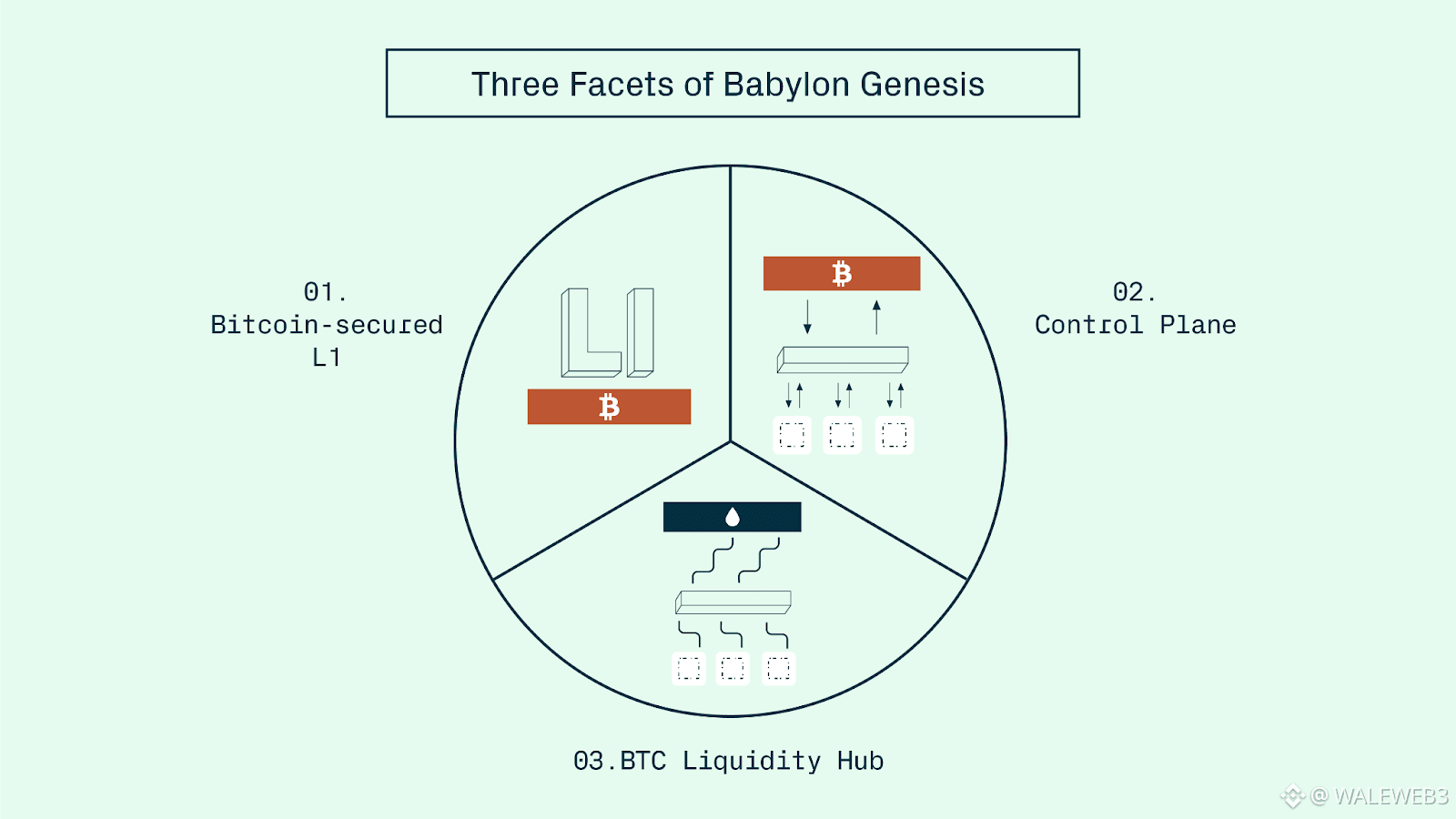
We talk a lot about delegators choosing finality providers based on commission rates and performance history. The assumption is that the decentralized free market will naturally elevate the safest, most reliable infrastructure operators for @BabylonLabs_io . But the market treats node operations as a commodity when it is actually a high-risk security operation.What actually happens behind the scenes is the devastating asymmetry of the slashing mechanism. A node operator can perform flawlessly for months, earning a small 5% commission on the yields they generate for their delegators.
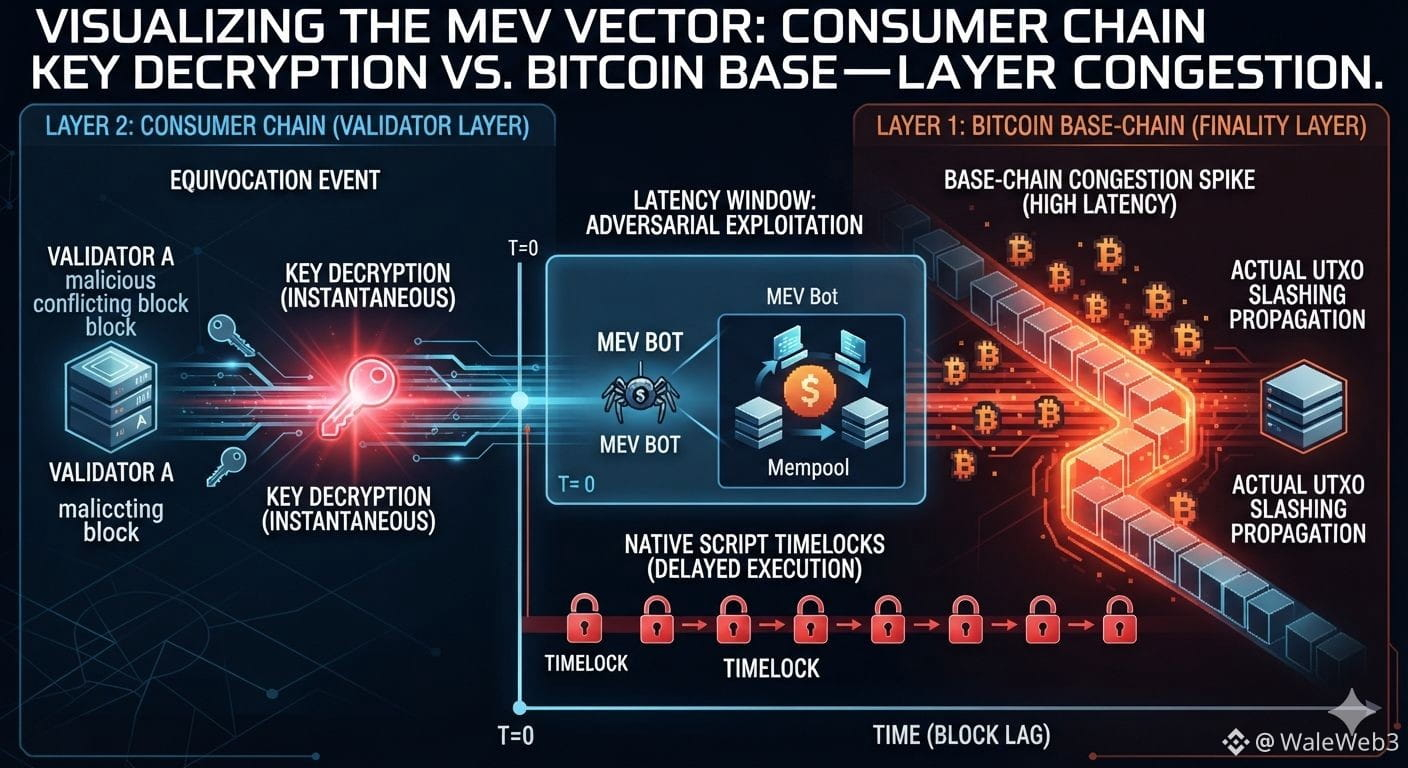
But a single operational mistake—a hardware failover misconfiguration that causes an accidental double-sign—triggers an EOTS condition that instantly slashes the delegators' actual Bitcoin.
The operator loses their reputation and a small amount of self-bonded stake, but the delegators lose their principal wealth. The financial downside for the operator is capped by their setup costs, while the downside for the staker is a direct hit to their balance sheet.This asymmetry means operators are incentivized to cut corners on expensive redundant architecture to stay competitive on fees.If the cost of running flawless, military-grade security infrastructure eats up the thin margins allowed by the market, are we accidentally incentivizing operators to take silent operational risks with other people's Bitcoin? $BABY #baby
$VIC $HOME
#CoinbaseBTCPremiumNegative77Days #USIranDealOrNoDeal #USJapanJointYenInterventionFirstSince2011 #YenRisesTo156
But a single operational mistake—a hardware failover misconfiguration that causes an accidental double-sign—triggers an EOTS condition that instantly slashes the delegators' actual Bitcoin.
The operator loses their reputation and a small amount of self-bonded stake, but the delegators lose their principal wealth. The financial downside for the operator is capped by their setup costs, while the downside for the staker is a direct hit to their balance sheet.This asymmetry means operators are incentivized to cut corners on expensive redundant architecture to stay competitive on fees.If the cost of running flawless, military-grade security infrastructure eats up the thin margins allowed by the market, are we accidentally incentivizing operators to take silent operational risks with other people's Bitcoin? $BABY #baby
$VIC $HOME
#CoinbaseBTCPremiumNegative77Days #USIranDealOrNoDeal #USJapanJointYenInterventionFirstSince2011 #YenRisesTo156
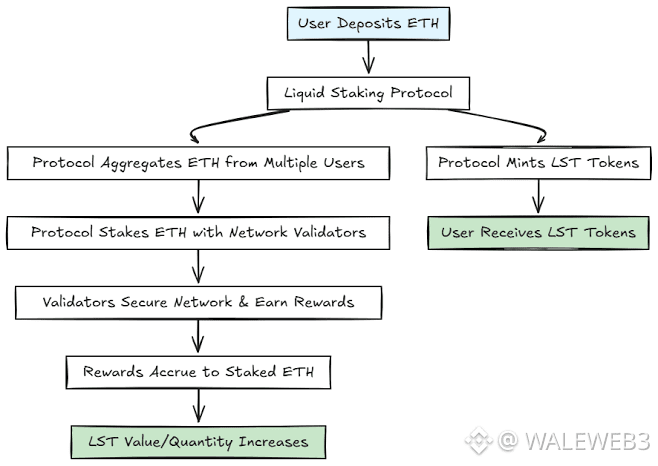
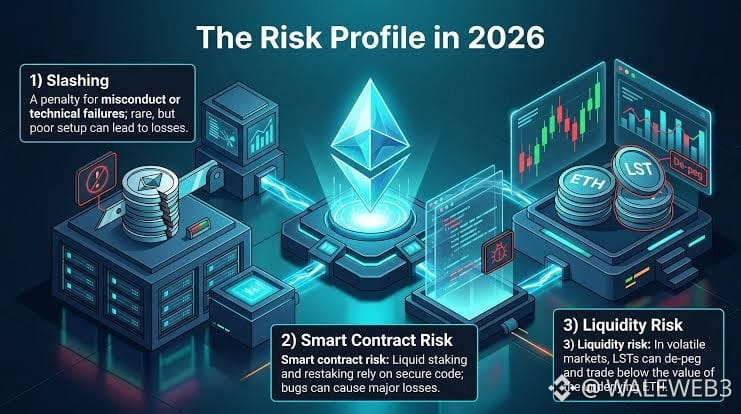
The current narrative suggests that Liquid Staking Tokens (LSTs) completely solve the capital inefficiency of locking up Bitcoin with @BabylonLabs_io . The pitch is simple: hand over your BTC, get a receipt token back, and use that receipt token to trade or farm while your real BTC secures the network.It sounds like a free lunch until you look at the decoupling risk.What actually happens is that you are layering smart contract risk on top of cryptographic security. The underlying Babylon protocol relies on native Bitcoin transactions and math, but the LST wrapper relies on Ethereum-style smart contracts or multi-sigs to issue that receipt token.
If the LST protocol suffers an exploit or its oracle misreports a price, the receipt token can de-peg rapidly in the market.
Your real BTC remains perfectly safe inside the Babylon vault, but your position is ruined anyway because the asset you are actually holding and trading has lost its value. You are forced to watch your capital sit behind an unbonding window, completely unable to rescue it while the secondary market panics.LSTs do not remove the risk of illiquidity; they just convert it into a structural dependency on a third-party wrapper.When the market experiences a true liquidity crunch, does the convenience of a receipt token actually matter, or does it just reveal that you traded Bitcoin's native security for an extra layer of systemic vulnerability? #baby $BABY
$MUBARAK $BICO #USToCancelIranAttackSubjectToDeal
#CLARITYActNotOnMondaySenateSchedule
If the LST protocol suffers an exploit or its oracle misreports a price, the receipt token can de-peg rapidly in the market.
Your real BTC remains perfectly safe inside the Babylon vault, but your position is ruined anyway because the asset you are actually holding and trading has lost its value. You are forced to watch your capital sit behind an unbonding window, completely unable to rescue it while the secondary market panics.LSTs do not remove the risk of illiquidity; they just convert it into a structural dependency on a third-party wrapper.When the market experiences a true liquidity crunch, does the convenience of a receipt token actually matter, or does it just reveal that you traded Bitcoin's native security for an extra layer of systemic vulnerability? #baby $BABY
$MUBARAK $BICO #USToCancelIranAttackSubjectToDeal
#CLARITYActNotOnMondaySenateSchedule
The assumption that a fast incident response team is the peak of Web3 security overlooks a deeper truth: relying on humans to act flawlessly under pressure is a systemic vulnerability.The part of Babylon’s Trustless Bitcoin Vault (TBV) design that completely shifted my perspective is that it intentionally treats human agility as a design flaw.In traditional security, an exploit is treated like a high-stakes chess match. Systems assume that when everything breaks, developers will log on, patch the leak dynamically, and manually steer capital to safety before assets disappear.TBV doesn't play chess and it flips the board.The protocol turns the standard security delay into a strict, single-lane tunnel connecting exactly two points: the Temporary Staking Address and the Ultimate Recovery Destination.It completely eliminates open-ended execution paths. Fluid decision-making is replaced by a pre-calculated pipeline that functions as a closed loop.If a compromise happens, there is no emergency war room. There is no frantic race to beat the clock in the mempool.An attacker cannot rewrite the coordinate script or invent a new exit point post-activation. They are trapped inside a temporal bottleneck on a predetermined track that does not lead to them.The delay is not a window for clever counter-moves. It is an unyielding mathematical barrier where the timer counts down to a destination the attacker cannot influence or exploit.Industry standards train us to think security means outrunning the threat.Babylon alters that model: real security means building a system so structurally rigid that speed becomes irrelevant.
#baby $BABY @BabylonLabs_io $HOME $HYPER
#baby $BABY @BabylonLabs_io $HOME $HYPER

#baby $BABY .....
Most Bitcoin collateral designs eventually blur together. I stopped assuming that after sitting with the TBV documentation.
What the system actually requires is trust in the cryptography, the Bitcoin and Ethereum networks, the application taking the collateral, and still active a governance and emergency multisig the team calls temporary. The vaults themselves keep the coins on Bitcoin under fixed script conditions, which is the part that feels genuinely different from the usual arrangements.Those extra keys do not ruin the design for me. They turn it into a live test of whether capital actually wants the pure version. Liquidity almost always arrives while the backstop is still present. Habits form around its quiet presence. People grow used to the knowledge that someone can still intervene if the translation between the two chains fails. When the keys are finally retired, or when enough people simply notice they were never gone, the locked BTC has to choose. Stay under the stricter rules, or move toward systems that never fully removed the human layer.That choice is what I am watching. Everything else is scaffolding.
@BabylonLabs_io
Most Bitcoin collateral designs eventually blur together. I stopped assuming that after sitting with the TBV documentation.
What the system actually requires is trust in the cryptography, the Bitcoin and Ethereum networks, the application taking the collateral, and still active a governance and emergency multisig the team calls temporary. The vaults themselves keep the coins on Bitcoin under fixed script conditions, which is the part that feels genuinely different from the usual arrangements.Those extra keys do not ruin the design for me. They turn it into a live test of whether capital actually wants the pure version. Liquidity almost always arrives while the backstop is still present. Habits form around its quiet presence. People grow used to the knowledge that someone can still intervene if the translation between the two chains fails. When the keys are finally retired, or when enough people simply notice they were never gone, the locked BTC has to choose. Stay under the stricter rules, or move toward systems that never fully removed the human layer.That choice is what I am watching. Everything else is scaffolding.
@BabylonLabs_io
Partly True
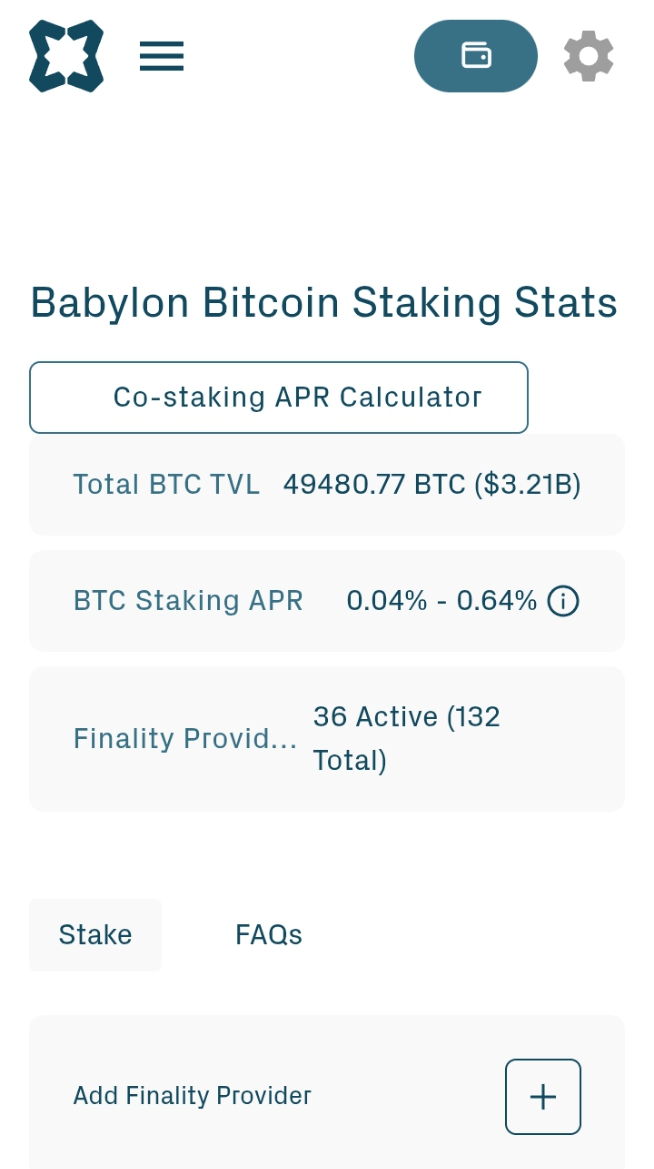
I woke up at 3:01 PM (15:01 UTC) and opened the Babylon dashboard, watching 49,480.77 BTC (~$3.21 Billion) populate the TVL column. Seeing billions of dollars locked away usually signals massive market confidence. But when my eyes hit the native APR—fluctuating between a microscopic 0.04% and 0.64%—reality felt like a cold shower.
Earning less than 1% on your capital in a crypto market built on high-yield promises feels like a bad joke. It forces a hard question: Why are whales locking up billions for virtually zero yield? The answer isn't the yield. It is the architectural constraint. The part of Babylon’s Trustless Bitcoin Vault (TBV) design that still feels radical is not the self-custody claim. It is the decision to finalize every legitimate spending path before a single satoshi moves.
At peg-in, the full transaction graph is constructed and pre-signed by every required party. Claim paths, refund paths, liquidation paths, self-claim paths—all of them exist as signed Bitcoin transactions before the vault is activated.After that moment, no participant can invent a new way to spend the BTC. The script and the signatures already define the complete set of legal outcomes.Most protocols leave the exit rules flexible and trust operators or governance to behave later.
TBV freezes the rules in cryptographic concrete first, then allows the vault to go live.With only 36 Active Finality Providers out of 132 Total, the infrastructure is proving exactly how deliberate this rollout is. The friction to enter is low—optimized at just 3 sats/vB—but the exit parameters are perfectly rigid.I paused with my thumb hovering over the "Enter Amount" box, staring at the screen. The future here is constrained on purpose. That constraint is the actual security model. You trade the flexibility of high-yield DeFi for the unyielding physics of Bitcoin scripts.
$BABY @BabylonLabs_io #baby #Babylon #StakingRevolution $GRVT
Earning less than 1% on your capital in a crypto market built on high-yield promises feels like a bad joke. It forces a hard question: Why are whales locking up billions for virtually zero yield? The answer isn't the yield. It is the architectural constraint. The part of Babylon’s Trustless Bitcoin Vault (TBV) design that still feels radical is not the self-custody claim. It is the decision to finalize every legitimate spending path before a single satoshi moves.
At peg-in, the full transaction graph is constructed and pre-signed by every required party. Claim paths, refund paths, liquidation paths, self-claim paths—all of them exist as signed Bitcoin transactions before the vault is activated.After that moment, no participant can invent a new way to spend the BTC. The script and the signatures already define the complete set of legal outcomes.Most protocols leave the exit rules flexible and trust operators or governance to behave later.
TBV freezes the rules in cryptographic concrete first, then allows the vault to go live.With only 36 Active Finality Providers out of 132 Total, the infrastructure is proving exactly how deliberate this rollout is. The friction to enter is low—optimized at just 3 sats/vB—but the exit parameters are perfectly rigid.I paused with my thumb hovering over the "Enter Amount" box, staring at the screen. The future here is constrained on purpose. That constraint is the actual security model. You trade the flexibility of high-yield DeFi for the unyielding physics of Bitcoin scripts.
$BABY @BabylonLabs_io #baby #Babylon #StakingRevolution $GRVT
Verified
Assume you need to prove something important on Bitcoin, but the only tools the chain itself trusts are a simple lockbox and a one-way shredder. You cannot
run complicated mathematics or heavy verification algorithms directly on Bitcoin.
This is the exact constraint Leslie Lamport faced in 1979 — and the same constraint Babylon faces today when building Trustless Bitcoin Vaults.
Lamport’s solution was elegant in its restraint. To sign a message, you first turn it into a long string of bits by hashing it. For every single bit, you prepare two sealed envelopes in advance: one for “0” and one for “1.”
Inside each envelope sits a random secret. You keep the secrets locked away and publish only their fingerprints — the result of running each secret through the shredder. When the time comes to sign, you open exactly one envelope per bit according to the hash. You reveal those secrets.
Anyone can run them through the same shredder and confirm the fingerprints match. If they do, the signature is valid.
The price is absolute: each set of envelopes can be used only once. Open them a second time and an attacker can forge future signatures. The key is spent the moment it is used.
This limitation is not a weakness. It is the reason the design remains so pure. Lamport signatures need nothing more than a reliable hash function. There is no elliptic curves, trusted setups, and complex assumptions. That simplicity is exactly why they become useful inside Babylon’s Trustless Bitcoin Vaults. Bitcoin’s script cannot verify a full SNARK proof on its own.
It can, however, check hashes and compare values. This is where Babylon gets clever. Complex proofs stay off-chain, but their outcome is reduced to Lamport secrets that Bitcoin Script can verify during a challenge. The BTC never leaves the vault. Bitcoin still has the final say. Simple cryptography. Strong enforcement.
$BABY #BABY @BabylonLabs_io $COTI $RE
run complicated mathematics or heavy verification algorithms directly on Bitcoin.
This is the exact constraint Leslie Lamport faced in 1979 — and the same constraint Babylon faces today when building Trustless Bitcoin Vaults.
Lamport’s solution was elegant in its restraint. To sign a message, you first turn it into a long string of bits by hashing it. For every single bit, you prepare two sealed envelopes in advance: one for “0” and one for “1.”
Inside each envelope sits a random secret. You keep the secrets locked away and publish only their fingerprints — the result of running each secret through the shredder. When the time comes to sign, you open exactly one envelope per bit according to the hash. You reveal those secrets.
Anyone can run them through the same shredder and confirm the fingerprints match. If they do, the signature is valid.
The price is absolute: each set of envelopes can be used only once. Open them a second time and an attacker can forge future signatures. The key is spent the moment it is used.
This limitation is not a weakness. It is the reason the design remains so pure. Lamport signatures need nothing more than a reliable hash function. There is no elliptic curves, trusted setups, and complex assumptions. That simplicity is exactly why they become useful inside Babylon’s Trustless Bitcoin Vaults. Bitcoin’s script cannot verify a full SNARK proof on its own.
It can, however, check hashes and compare values. This is where Babylon gets clever. Complex proofs stay off-chain, but their outcome is reduced to Lamport secrets that Bitcoin Script can verify during a challenge. The BTC never leaves the vault. Bitcoin still has the final say. Simple cryptography. Strong enforcement.
$BABY #BABY @BabylonLabs_io $COTI $RE

i watched my friends make life-changing money last year while my portfolio stood completely still. it was the most frustrating experience of my life. I consider myself a conservative investor. I don't touch meme coins, and I don't trade leverage. I accumulated a decent position in Bitcoin over two years of strict dollar-cost averaging. But during the last market surge, my portfolio barely moved while everyone around me was printing massive gains on native ecosystem utilities. Out of pure FOMO,I decided to take action. I moved about $2,000 worth of my assets into a wrapped liquidity pool to chase an 18% yield. Two weeks later, the protocol suffered an oracle manipulation exploit. The pool was drained, and my wrapped tokens lost nearly 40% of their value in an hour. I became panicked and withdrew at a massive loss, and felt completely defeated. I had violated my own safety rules just to keep up with the market.
That expensive, draining detour made me rethink the entire design of my portfolio execution. That is why @BabylonLabs_io completely transformed my perspective on asset utilization.
Instead of liquidating my long-term positions or taking on third-party security overhead just to capture a premium, Babylon's Trustless Bitcoin Vaults (TBV) keep my capital resting completely on its native network layer. There is no moving capital back and forth across foreign infrastructure or dealing with external administrative custody. The protocol turns stagnant capital directly into an active validation backbone, allowing me to accumulate $BABY metrics without ever violating my baseline risk profile. It completely alters the equation from chasing high-risk trends to activating institutional security plumbing.
@BabylonLabs_io #baby $BABY $AEON
That expensive, draining detour made me rethink the entire design of my portfolio execution. That is why @BabylonLabs_io completely transformed my perspective on asset utilization.
Instead of liquidating my long-term positions or taking on third-party security overhead just to capture a premium, Babylon's Trustless Bitcoin Vaults (TBV) keep my capital resting completely on its native network layer. There is no moving capital back and forth across foreign infrastructure or dealing with external administrative custody. The protocol turns stagnant capital directly into an active validation backbone, allowing me to accumulate $BABY metrics without ever violating my baseline risk profile. It completely alters the equation from chasing high-risk trends to activating institutional security plumbing.
@BabylonLabs_io #baby $BABY $AEON

Partly True
The Fallacy of Human Governance: Why I Swapped Committee Trust for Script Finality 🚨
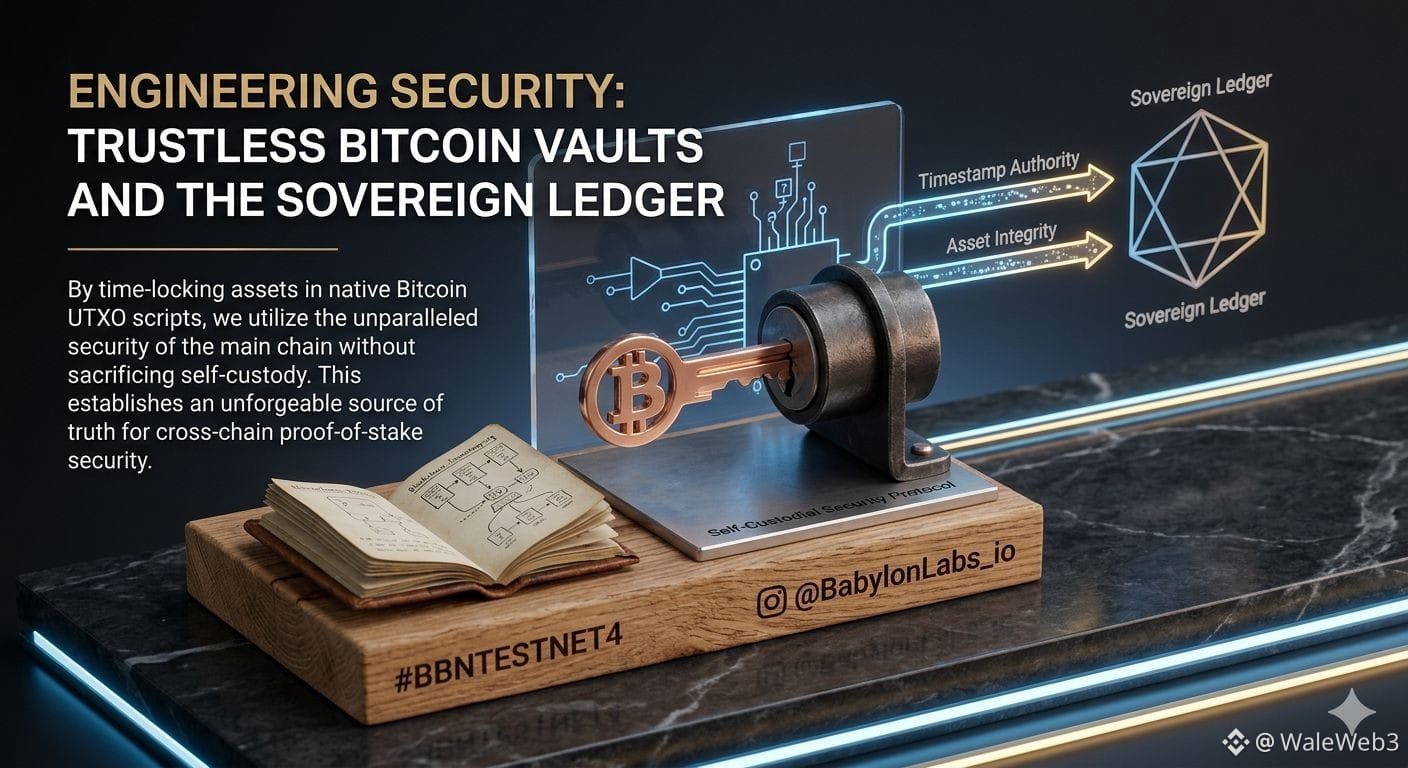
I assumed that a multi-sig consortium or an external validator committee was the only logical way to handle fund recovery paths across disparate networks during an on-chain crisis. I thought that human governance was an un-bypassable friction point for cross-chain infrastructure because someone had to manually verify that an external loan had been defaulted on or repaid before moving the underlying collateral. My technical evaluation of the @BabylonLabs_io protocol changed this view entirely by highlighting how Trustless Bitcoin Vaults (TBV) establish absolute exit finality through pure script determinism. By embedding relative time-locks directly into the individual MAST tree of each position via the native OP_CSV opcode, the system ensures that fund recovery is dictated solely by Bitcoin block consensus rather than human voting cycles. Even when your asset representation is actively interacting with complex liquidity pools on an external network, your underlying collateral parameters remain completely unalterable by external actors. If a critical network disconnect occurs, the native script path activates automatically, ensuring that no external platform or coordinator can freeze or front-run your asset recovery.
#baby $BABY @BabylonLabs_io
I assumed that a multi-sig consortium or an external validator committee was the only logical way to handle fund recovery paths across disparate networks during an on-chain crisis. I thought that human governance was an un-bypassable friction point for cross-chain infrastructure because someone had to manually verify that an external loan had been defaulted on or repaid before moving the underlying collateral. My technical evaluation of the @BabylonLabs_io protocol changed this view entirely by highlighting how Trustless Bitcoin Vaults (TBV) establish absolute exit finality through pure script determinism. By embedding relative time-locks directly into the individual MAST tree of each position via the native OP_CSV opcode, the system ensures that fund recovery is dictated solely by Bitcoin block consensus rather than human voting cycles. Even when your asset representation is actively interacting with complex liquidity pools on an external network, your underlying collateral parameters remain completely unalterable by external actors. If a critical network disconnect occurs, the native script path activates automatically, ensuring that no external platform or coordinator can freeze or front-run your asset recovery.
#baby $BABY @BabylonLabs_io
Verified
Moving Past the Wrapper Meta: My Deep Dive into vaultBTC Invariance Rules🚨
I assumed that any tokenized representation of Bitcoin deployed on a foreign virtual machine would inherently inherit systemic wrapper issuer risk. I thought that whether the custodian was a single company or a decentralized multi-sig federation, the token contract itself would always introduce structural vulnerabilities like unbacked minting or illicit pool rehypothecation. My technical evaluation of the data architecture built by @BabylonLabs_io for Trustless Bitcoin Vaults (TBV) forced me to completely rethink this wrapper paradigm. Within this framework, the minted vaultBTC token is hard-coded with strict structural invariants: it is non-transferable outside of whitelisted lending spoke interactions and is strictly bound to an individual, isolated vault address on the base ledger. A TBV behaves as a zero-pool cryptographic safe where asset individualization is absolute. The application layer manages liquidation and interest parameters externally, but the underlying collateral remains clean and completely insulated from the broader contagion vectors of shared liquidity pools.
@BabylonLabs_io #baby $BABY
I assumed that any tokenized representation of Bitcoin deployed on a foreign virtual machine would inherently inherit systemic wrapper issuer risk. I thought that whether the custodian was a single company or a decentralized multi-sig federation, the token contract itself would always introduce structural vulnerabilities like unbacked minting or illicit pool rehypothecation. My technical evaluation of the data architecture built by @BabylonLabs_io for Trustless Bitcoin Vaults (TBV) forced me to completely rethink this wrapper paradigm. Within this framework, the minted vaultBTC token is hard-coded with strict structural invariants: it is non-transferable outside of whitelisted lending spoke interactions and is strictly bound to an individual, isolated vault address on the base ledger. A TBV behaves as a zero-pool cryptographic safe where asset individualization is absolute. The application layer manages liquidation and interest parameters externally, but the underlying collateral remains clean and completely insulated from the broader contagion vectors of shared liquidity pools.
@BabylonLabs_io #baby $BABY
Solving the Asynchronous Settlement Myth: Restructuring My Liquidation Mental Model 🚨
I thought that executing automated liquidations for native Bitcoin collateral without a centralized intermediary was a structural impossibility due to block confirmation latency gaps. I assumed that if a sudden market flash-crash occurred, an on-chain liquidation mechanism requiring multiple native Bitcoin confirmations to verify a collateral shift would experience critical latency failure, leading to massive bad debt. Tracing the specification of Trustless Bitcoin Vaults (TBV) forced me to restructure my entire mental model. The system handles this confirmation lag by decoupling pool solvency from base-layer asset settlement via the specific functions of the BTC Vault Swap Spoke. When a borrower's credit line drops below its health threshold on Aave v4, liquidators do not broadcast or wait for a slow transaction on the Bitcoin mainnet. The destination-side spoke contract allows immediate local pool rebalancing using wrapper pairs like WBTC to eliminate bad debt instantly. The physical redemption of the native BTC out of the corresponding TBV is offloaded to specialized arbitrageurs who execute the base-layer Taproot redemption path asynchronously at a later time, fully protecting lending pools from confirmation delays.
@BabylonLabs_io #baby $BABY
I thought that executing automated liquidations for native Bitcoin collateral without a centralized intermediary was a structural impossibility due to block confirmation latency gaps. I assumed that if a sudden market flash-crash occurred, an on-chain liquidation mechanism requiring multiple native Bitcoin confirmations to verify a collateral shift would experience critical latency failure, leading to massive bad debt. Tracing the specification of Trustless Bitcoin Vaults (TBV) forced me to restructure my entire mental model. The system handles this confirmation lag by decoupling pool solvency from base-layer asset settlement via the specific functions of the BTC Vault Swap Spoke. When a borrower's credit line drops below its health threshold on Aave v4, liquidators do not broadcast or wait for a slow transaction on the Bitcoin mainnet. The destination-side spoke contract allows immediate local pool rebalancing using wrapper pairs like WBTC to eliminate bad debt instantly. The physical redemption of the native BTC out of the corresponding TBV is offloaded to specialized arbitrageurs who execute the base-layer Taproot redemption path asynchronously at a later time, fully protecting lending pools from confirmation delays.
@BabylonLabs_io #baby $BABY
Verified
Overturning the Contagion Model: My Realizations on Spoke Contract Isolation🚨
I assumed that any infrastructure attempting to mirror native Bitcoin liquidity into an external virtual machine like Ethereum would inherently expose my cold storage to destination-layer smart contract bugs. In my framework, if an ERC-20 lending pool experiences an oracle manipulation event or a logic exploit, every single asset locked inside that pool is drained by default. I spent my time auditing the architectural documentation submitted to the Aave DAO by @BabylonLabs_io to see if they could actually prove otherwise. What completely broke my assumptions was mapping the explicit contract separation enforced by Trustless Bitcoin Vaults (TBV). A TBV isolates the native asset entirely on the Bitcoin mainnet while managing foreign states through two separate network adapters on the EVM side: the Babylon Core Lending Spoke and the BTC Vault Swap Spoke. Instead of bridging the asset, the protocol utilizes vaultBTC—a transfer-restricted token bound exclusively to fixed whitelisted addresses. I realized the borrowing mechanics run completely decoupled from physical asset location, allowing users to draw stable asset liquidity on Ethereum while the underlying collateral custody remains tightly bound to native Taproot UTXO script paths.
#baby $BABY @BabylonLabs_io
I assumed that any infrastructure attempting to mirror native Bitcoin liquidity into an external virtual machine like Ethereum would inherently expose my cold storage to destination-layer smart contract bugs. In my framework, if an ERC-20 lending pool experiences an oracle manipulation event or a logic exploit, every single asset locked inside that pool is drained by default. I spent my time auditing the architectural documentation submitted to the Aave DAO by @BabylonLabs_io to see if they could actually prove otherwise. What completely broke my assumptions was mapping the explicit contract separation enforced by Trustless Bitcoin Vaults (TBV). A TBV isolates the native asset entirely on the Bitcoin mainnet while managing foreign states through two separate network adapters on the EVM side: the Babylon Core Lending Spoke and the BTC Vault Swap Spoke. Instead of bridging the asset, the protocol utilizes vaultBTC—a transfer-restricted token bound exclusively to fixed whitelisted addresses. I realized the borrowing mechanics run completely decoupled from physical asset location, allowing users to draw stable asset liquidity on Ethereum while the underlying collateral custody remains tightly bound to native Taproot UTXO script paths.
#baby $BABY @BabylonLabs_io
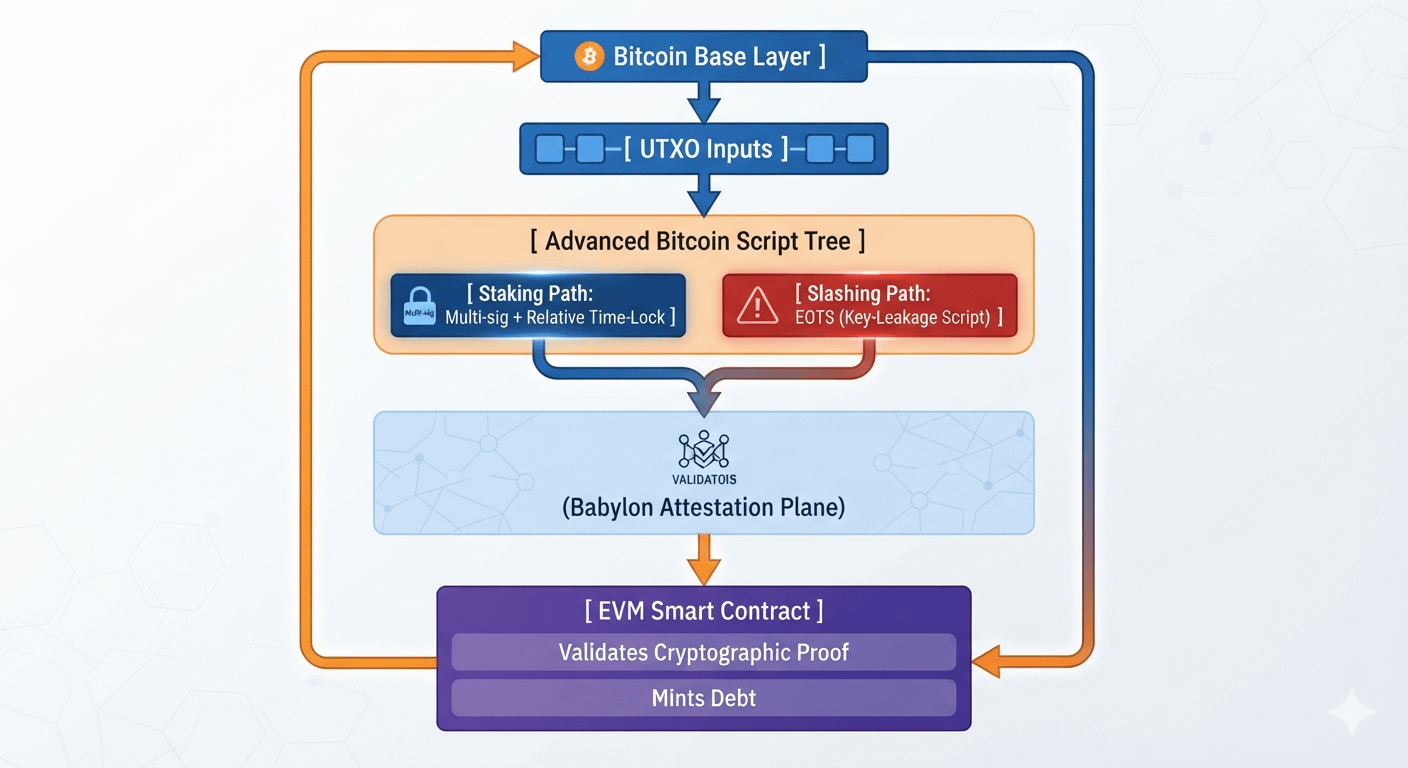
Verified
What if you could finally use your native Bitcoin as DeFi collateral without wrapping it, bridging it, or trusting a single intermediary? 🚨
I went hands-on with Babylon’s Trustless Bitcoin Vaults TBV Public Testnet, live since early June 2026, and the cryptographic architecture is genuinely impressive.
Most BTC solutions compromise on trust. WBTC and cbBTC lean on centralized custody like BitGo multisig or Coinbase vaults. tBTC improves with threshold cryptography but still adds bridge smart contract risk. TBV takes a purer, native-first approach: it locks Bitcoin on L1 using Taproot outputs where spending paths are pre-committed at vault creation among depositor keys, Vault Provider, and Application Vault Keeper. This enables direct Bitcoin script enforcement without moving the asset off-chain.The peg-in flow is precise and elegant: Pre-PegIn transaction broadcast on Signet, followed by 12 block confirmations for economic finality (roughly 2 hours), off-chain multi-party ACK signing rounds with 24-hour timeout, and activation through Ethereum smart contracts on Sepolia. Active vaults operate under tight parameters: 78% collateral factor, health factor below 1.0 triggering liquidation, per-position cap of 0.4 BTC supporting up to 10 vaults, plus a 3-day timelocked redemption challenge window with self-custodial refund timelocks.
Experiencing the complete lifecycle from Pre-PegIn construction to activation sequencing, position management, repayment, and timelock refunds revealed how cleanly TBV decouples Bitcoin’s immutable script guarantees from Ethereum’s programmable layer while preserving full private key sovereignty and recovery artifacts. This is real progress. Native, trust-minimized, and built for scale.
@BabylonLabs_io $BABY #baby
I went hands-on with Babylon’s Trustless Bitcoin Vaults TBV Public Testnet, live since early June 2026, and the cryptographic architecture is genuinely impressive.
Most BTC solutions compromise on trust. WBTC and cbBTC lean on centralized custody like BitGo multisig or Coinbase vaults. tBTC improves with threshold cryptography but still adds bridge smart contract risk. TBV takes a purer, native-first approach: it locks Bitcoin on L1 using Taproot outputs where spending paths are pre-committed at vault creation among depositor keys, Vault Provider, and Application Vault Keeper. This enables direct Bitcoin script enforcement without moving the asset off-chain.The peg-in flow is precise and elegant: Pre-PegIn transaction broadcast on Signet, followed by 12 block confirmations for economic finality (roughly 2 hours), off-chain multi-party ACK signing rounds with 24-hour timeout, and activation through Ethereum smart contracts on Sepolia. Active vaults operate under tight parameters: 78% collateral factor, health factor below 1.0 triggering liquidation, per-position cap of 0.4 BTC supporting up to 10 vaults, plus a 3-day timelocked redemption challenge window with self-custodial refund timelocks.
Experiencing the complete lifecycle from Pre-PegIn construction to activation sequencing, position management, repayment, and timelock refunds revealed how cleanly TBV decouples Bitcoin’s immutable script guarantees from Ethereum’s programmable layer while preserving full private key sovereignty and recovery artifacts. This is real progress. Native, trust-minimized, and built for scale.
@BabylonLabs_io $BABY #baby
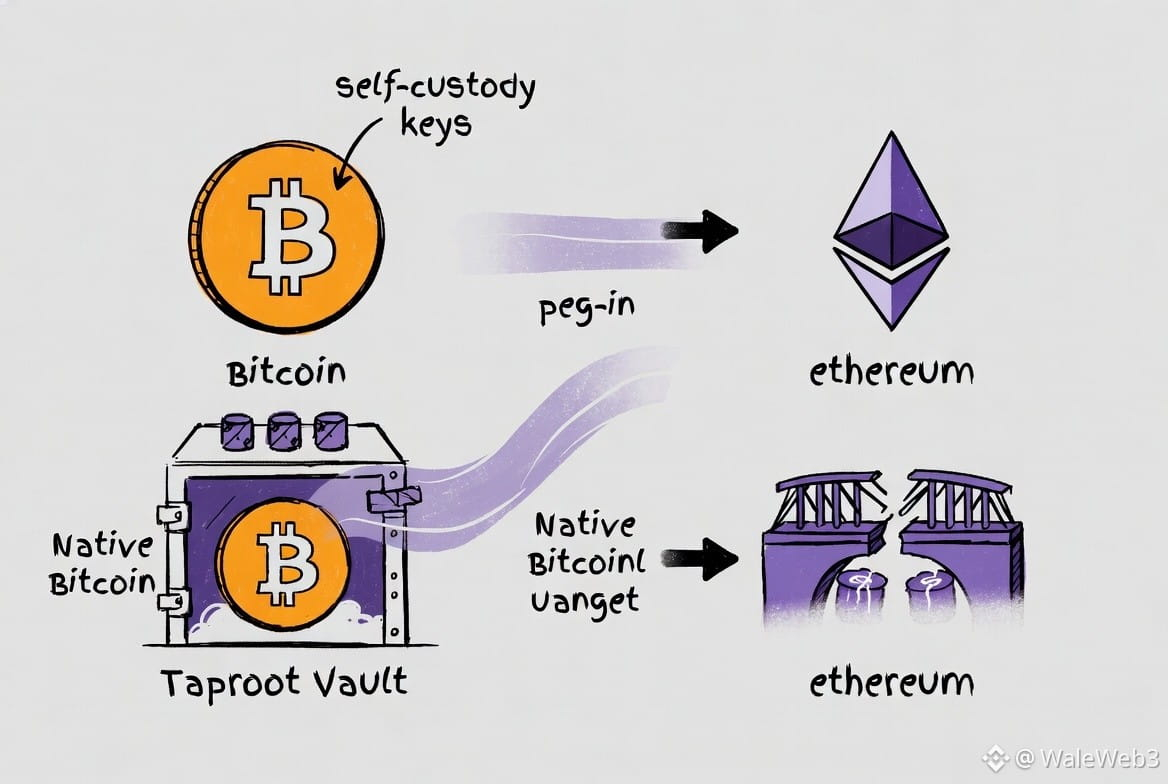
Verified
I used to be a strict Bitcoin security purist. Every project claiming to bring DeFi to Bitcoin always had the same structural flaw under the hood: they demanded I wrap my assets, bridge them, or trust a multi-sig federation of insiders. I always walked away because trading the ironclad security of Bitcoin consensus for a fragile external validator quorum made no sense.When I began analyzing @BabylonLabs_io , I brought that exact same skepticism. What completely flipped my perspective was mapping out the cryptographic logic powering Trustless Bitcoin Vaults (TBV).
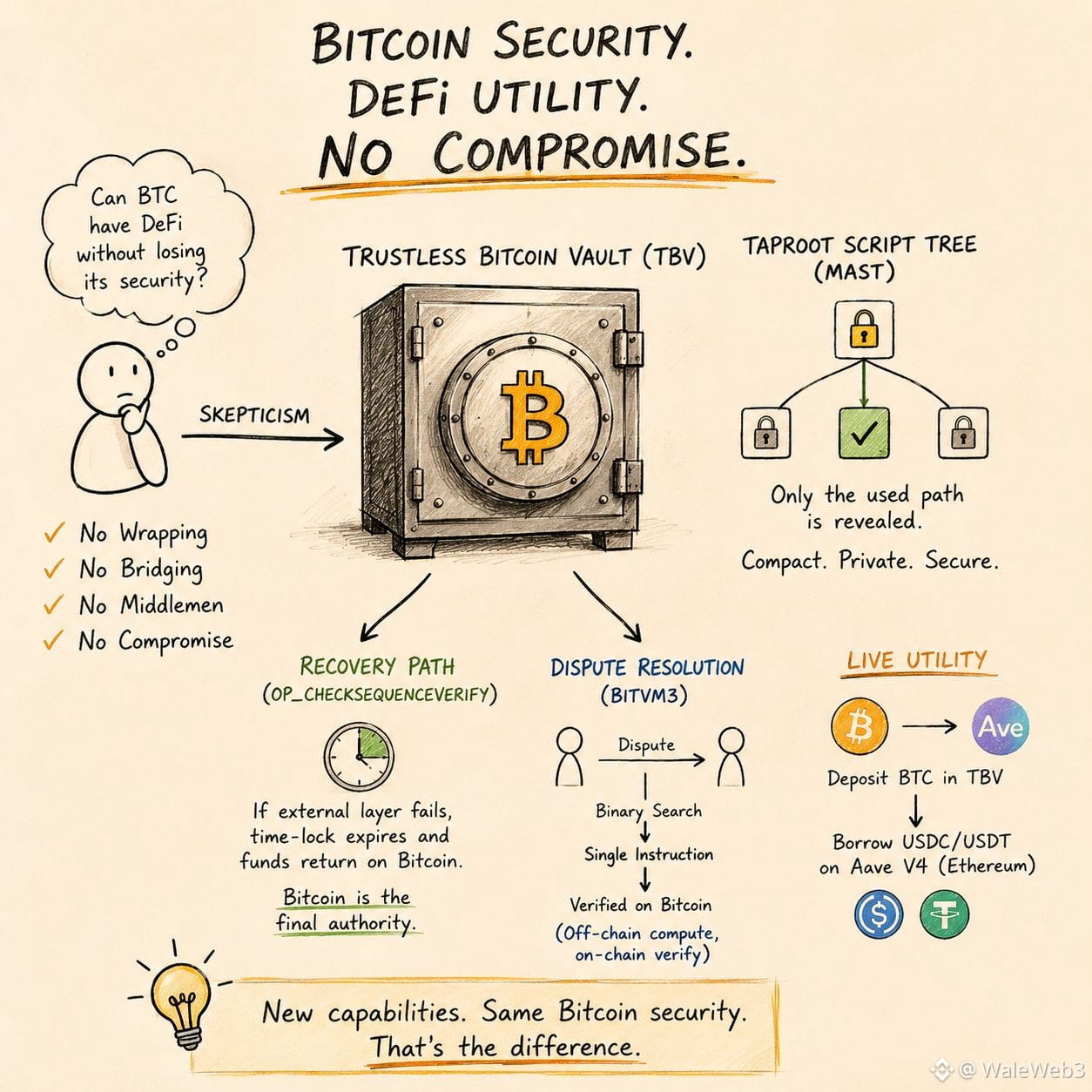
Instead of forcing BTC into a shared collateral pool, a TBV isolates your asset into an individual, native Taproot output using Pay-to-Taproot (P2TR) scripts. By committing spending paths to a MAST-based Taproot script tree, the system enforces complex financial logic on external chains while keeping the on-chain data footprint remarkably small. Your Bitcoin never leaves its native layer; the script tree handles state dependencies, revealing only the specific branch used for redemption. The absolute breakthrough for me was seeing how the protocol handles worst-case liveness failures. The TBV architecture integrates a dedicated recovery branch controlled by the OP_CHECKSEQUENCEVERIFY opcode. If an external execution layer goes dark, a relative time-lock matures naturally. Once that block interval passes, the recovery path opens automatically. No validator or federated group can block your transaction because base-layer Bitcoin consensus remains the absolute final execution authority over your funds.BitVM3 keeps heavy computation off-chain. If a state transition is disputed, an interactive challenge reduces it to a single CPU instruction verified against the Taproot commitment. Bitcoin remains the final arbiter. Babylon's TBV testnet proves the model—native BTC can secure USDC/USDT borrowing on Aave v4 without leaving Bitcoin's security model.
#baby $BABY @BabylonLabs_io
Instead of forcing BTC into a shared collateral pool, a TBV isolates your asset into an individual, native Taproot output using Pay-to-Taproot (P2TR) scripts. By committing spending paths to a MAST-based Taproot script tree, the system enforces complex financial logic on external chains while keeping the on-chain data footprint remarkably small. Your Bitcoin never leaves its native layer; the script tree handles state dependencies, revealing only the specific branch used for redemption. The absolute breakthrough for me was seeing how the protocol handles worst-case liveness failures. The TBV architecture integrates a dedicated recovery branch controlled by the OP_CHECKSEQUENCEVERIFY opcode. If an external execution layer goes dark, a relative time-lock matures naturally. Once that block interval passes, the recovery path opens automatically. No validator or federated group can block your transaction because base-layer Bitcoin consensus remains the absolute final execution authority over your funds.BitVM3 keeps heavy computation off-chain. If a state transition is disputed, an interactive challenge reduces it to a single CPU instruction verified against the Taproot commitment. Bitcoin remains the final arbiter. Babylon's TBV testnet proves the model—native BTC can secure USDC/USDT borrowing on Aave v4 without leaving Bitcoin's security model.
#baby $BABY @BabylonLabs_io
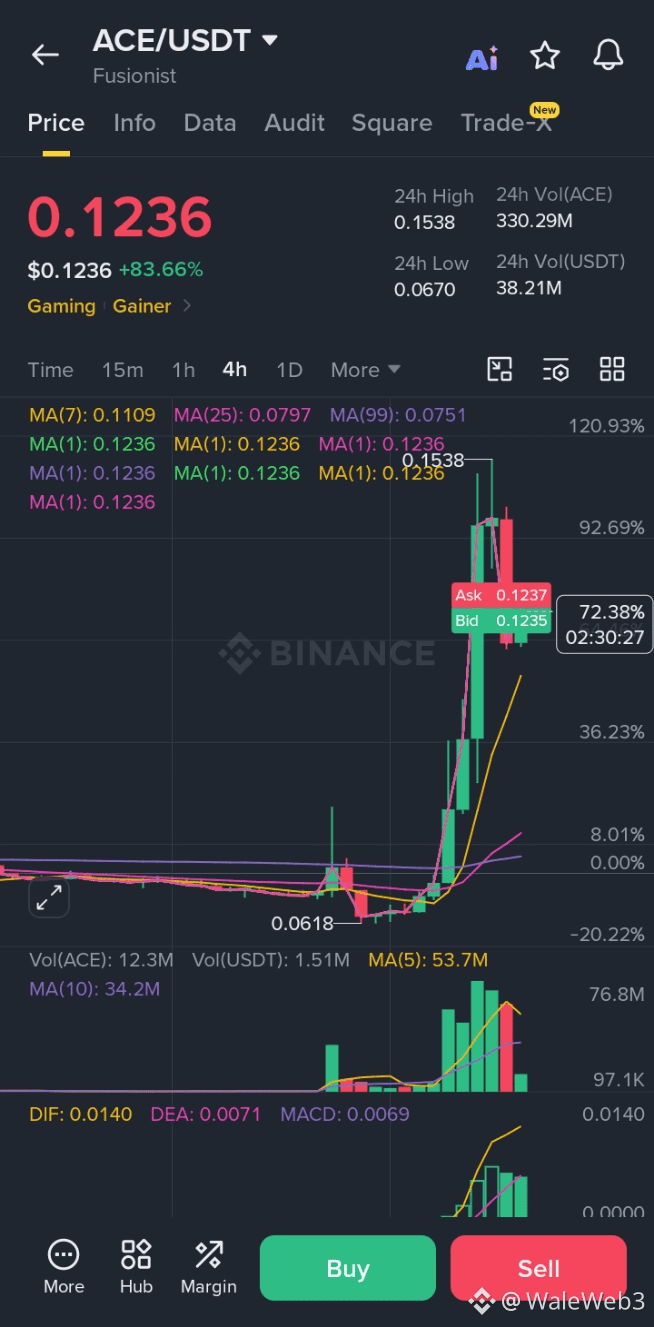
$ACE /USDT remains in a strong bullish structure after an explosive breakout, gaining over 80% within the current session.
Price is trading well above the 7, 25, and 99-period moving averages, confirming sustained upward momentum. However, the rejection from the $0.1538 high indicates profit-taking, making a short-term pullback or consolidation likely before the next move.
Entry: $0.1160–$0.1210
Take Profit: $0.1350 | $0.1480 | $0.1600
Stop Loss: $0.1090
Leverage: 3x–5x Isolated
Outlook: As long as ACE holds above the $0.1100 support zone, the broader bullish trend remains intact. A successful reclaim of $0.1538 with strong volume could trigger another leg higher toward $0.1700.
Traders should avoid chasing the current price and instead wait for a controlled retracement or a confirmed breakout above resistance.
Price is trading well above the 7, 25, and 99-period moving averages, confirming sustained upward momentum. However, the rejection from the $0.1538 high indicates profit-taking, making a short-term pullback or consolidation likely before the next move.
Entry: $0.1160–$0.1210
Take Profit: $0.1350 | $0.1480 | $0.1600
Stop Loss: $0.1090
Leverage: 3x–5x Isolated
Outlook: As long as ACE holds above the $0.1100 support zone, the broader bullish trend remains intact. A successful reclaim of $0.1538 with strong volume could trigger another leg higher toward $0.1700.
Traders should avoid chasing the current price and instead wait for a controlled retracement or a confirmed breakout above resistance.
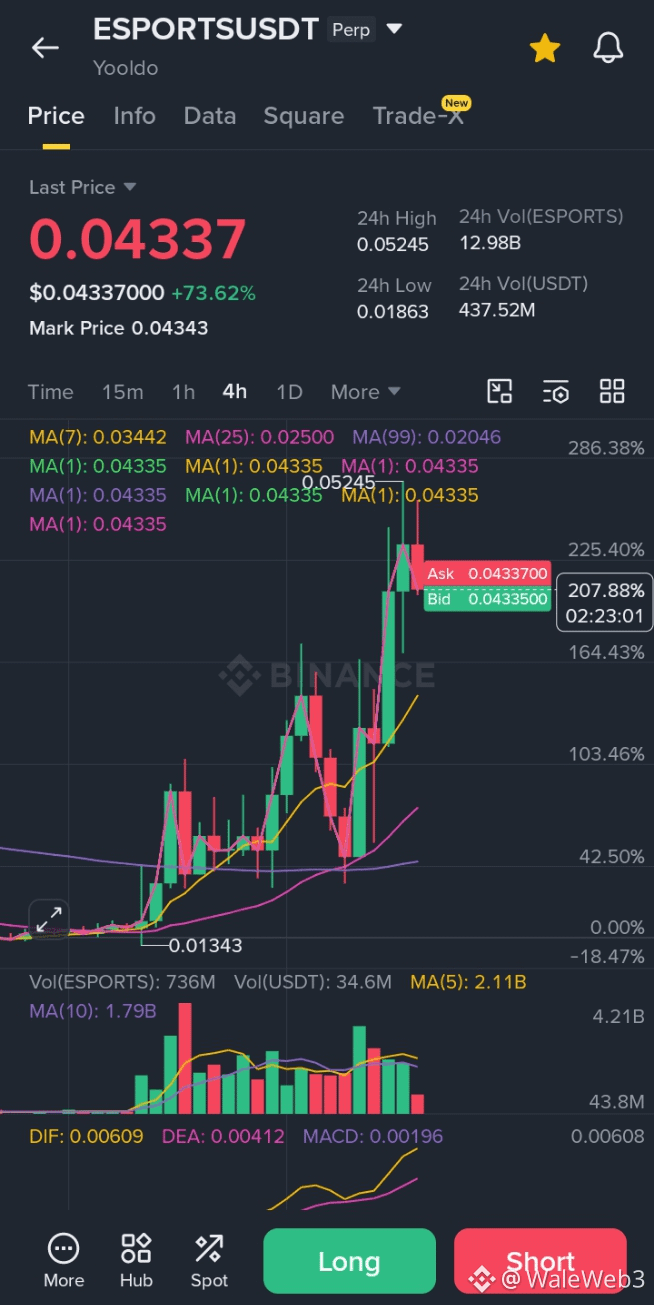
$ESPORTS Why LONG?
Price is above the 7, 25, and 99 MA, which is bullish.
MACD is still bullish with the MACD line above the signal line.
The overall trend remains upward despite some profit-taking.
Trade setup
Direction: 🟢 Long
Best entry: 0.0390–0.0405 USDT on a pullback.
Breakout entry: Above 0.0460 USDT after a confirmed 4H candle close.
Stop-loss: 0.0355 USDT
Take Profit 1: 0.0500 USDT
Take Profit 2: 0.0525 USDT
Take Profit 3: 0.0580 USDT
I would avoid opening a short unless the price loses 0.0390 with strong selling volume and a 4H candle closes below that support.
Conclusion: LONG bias, but wait for a better entry instead of buying at 0.04337.
Price is above the 7, 25, and 99 MA, which is bullish.
MACD is still bullish with the MACD line above the signal line.
The overall trend remains upward despite some profit-taking.
Trade setup
Direction: 🟢 Long
Best entry: 0.0390–0.0405 USDT on a pullback.
Breakout entry: Above 0.0460 USDT after a confirmed 4H candle close.
Stop-loss: 0.0355 USDT
Take Profit 1: 0.0500 USDT
Take Profit 2: 0.0525 USDT
Take Profit 3: 0.0580 USDT
I would avoid opening a short unless the price loses 0.0390 with strong selling volume and a 4H candle closes below that support.
Conclusion: LONG bias, but wait for a better entry instead of buying at 0.04337.
$DGB
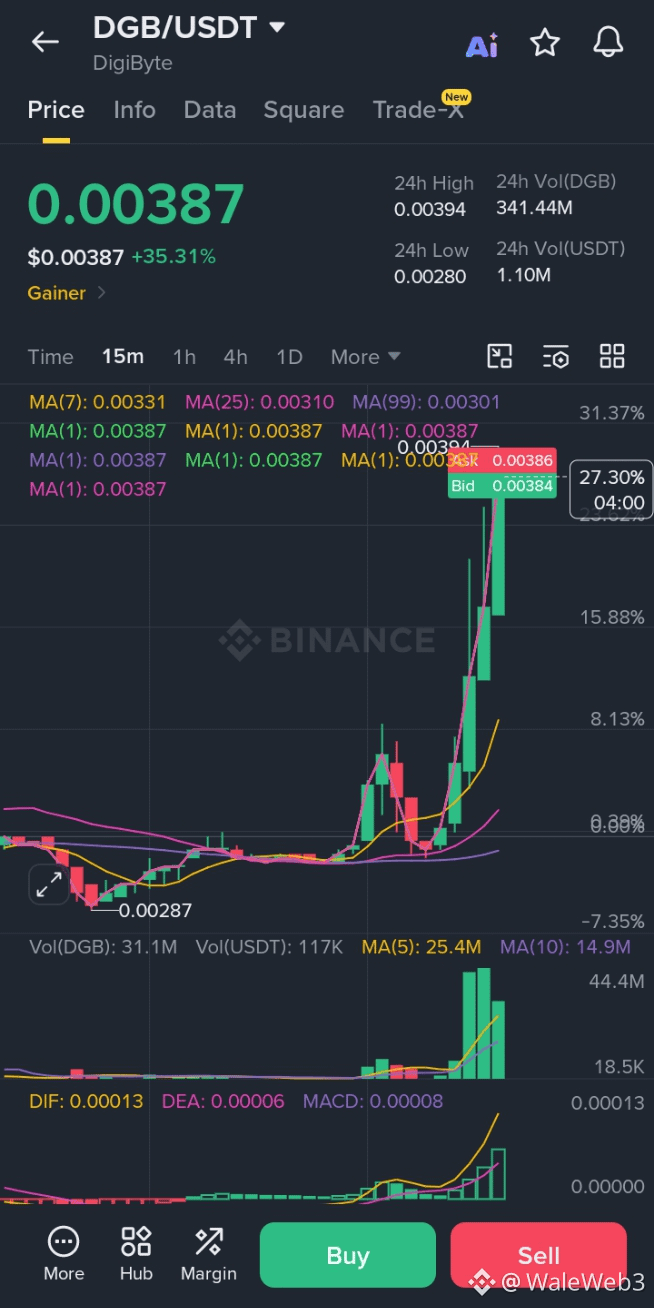
I'm staying bullish on DGB. Price has broken above all major moving averages, volume is expanding, and the MACD remains firmly bullish, showing buyers are still in control. Momentum is strong, but after a sharp 35% rally, I wouldn't FOMO into the current candle. I'd rather wait for a healthy pullback or a confirmed breakout above resistance.
Entry: 0.00360–0.00375 (pullback) or above 0.00394 on confirmation.
Take Profit: 0.00410, 0.00430, 0.00460.
Stop Loss: 0.00345.
Leverage: 3x–5x maximum.
As long as DGB holds above the 0.00360 area, I expect buyers to keep pushing for another leg higher. Patience is the better trade here.
I'm staying bullish on DGB. Price has broken above all major moving averages, volume is expanding, and the MACD remains firmly bullish, showing buyers are still in control. Momentum is strong, but after a sharp 35% rally, I wouldn't FOMO into the current candle. I'd rather wait for a healthy pullback or a confirmed breakout above resistance.
Entry: 0.00360–0.00375 (pullback) or above 0.00394 on confirmation.
Take Profit: 0.00410, 0.00430, 0.00460.
Stop Loss: 0.00345.
Leverage: 3x–5x maximum.
As long as DGB holds above the 0.00360 area, I expect buyers to keep pushing for another leg higher. Patience is the better trade here.
$BANK / $USDT
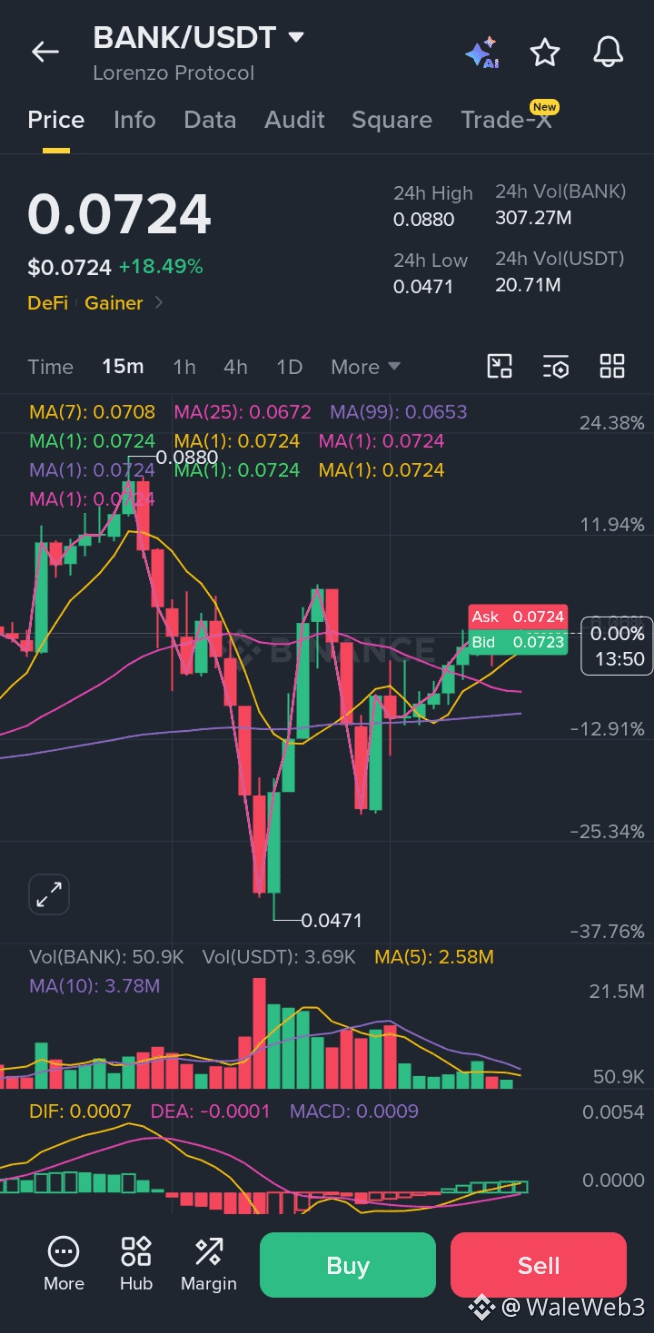
From what I'm seeing, BANK has shifted from a sharp recovery into a healthy consolidation. Price is trading around $0.0724, staying above the MA7 ($0.0708), MA25 ($0.0672), and MA99 ($0.0653), which tells me buyers still have the upper hand in the short term. The MACD remains bullish with expanding green histogram bars, although the declining volume suggests momentum needs fresh participation for the next leg higher.
I'm not interested in chasing candles here. I would rather look for entries around $0.0715–0.0725 or on a confirmed breakout above $0.0750 with stronger volume. As long as price holds above $0.0700, I expect buyers to keep targeting the recent high near $0.0880.
Trade Plan
Entry: $0.0715–0.0725
Stop Loss: $0.0670
Take Profit 1: $0.0785
Take Profit 2: $0.0840
Take Profit 3: $0.0880
Leverage: 5x–8x for better risk management
For me, the bullish setup remains valid while price stays above the key moving averages. A decisive break above $0.0750 could attract fresh momentum and open the path toward $0.0840–0.0880. If $0.0670 fails, I'd step aside and wait for a stronger support reaction before considering another long position.
From what I'm seeing, BANK has shifted from a sharp recovery into a healthy consolidation. Price is trading around $0.0724, staying above the MA7 ($0.0708), MA25 ($0.0672), and MA99 ($0.0653), which tells me buyers still have the upper hand in the short term. The MACD remains bullish with expanding green histogram bars, although the declining volume suggests momentum needs fresh participation for the next leg higher.
I'm not interested in chasing candles here. I would rather look for entries around $0.0715–0.0725 or on a confirmed breakout above $0.0750 with stronger volume. As long as price holds above $0.0700, I expect buyers to keep targeting the recent high near $0.0880.
Trade Plan
Entry: $0.0715–0.0725
Stop Loss: $0.0670
Take Profit 1: $0.0785
Take Profit 2: $0.0840
Take Profit 3: $0.0880
Leverage: 5x–8x for better risk management
For me, the bullish setup remains valid while price stays above the key moving averages. A decisive break above $0.0750 could attract fresh momentum and open the path toward $0.0840–0.0880. If $0.0670 fails, I'd step aside and wait for a stronger support reaction before considering another long position.
$XEC
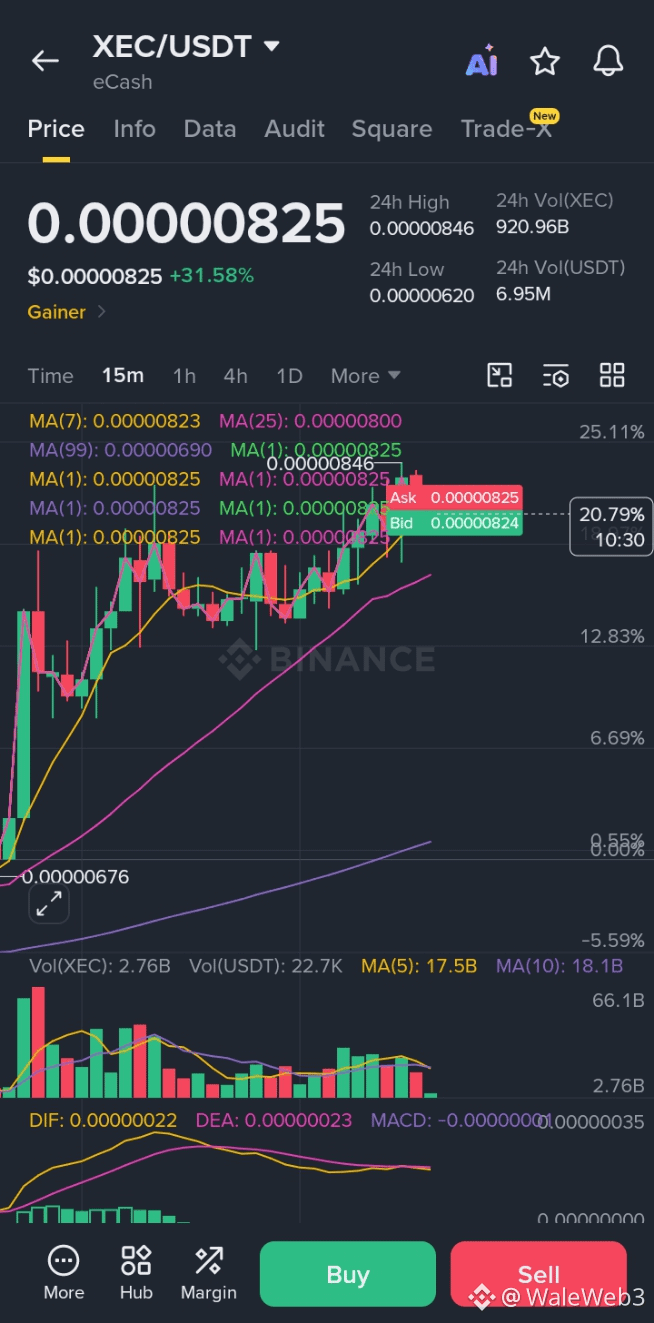
XEC is holding its gains after a strong 31% rally, with price consolidating just below 0.00000846 resistance. The MA(7) remains above MA(25), keeping the short-term trend bullish, although the flattening MACD suggests momentum is cooling.
I'm looking for a pullback into 0.00000818–0.00000825 before considering an entry.
Entry: 0.00000818–0.00000825
TP1: 0.00000846
TP2: 0.00000870
SL: 0.00000795
Leverage: 3x–5x
I wouldn't chase this move. A healthy retest with buying volume offers a much better risk-to-reward setup than entering after the breakout.
XEC is holding its gains after a strong 31% rally, with price consolidating just below 0.00000846 resistance. The MA(7) remains above MA(25), keeping the short-term trend bullish, although the flattening MACD suggests momentum is cooling.
I'm looking for a pullback into 0.00000818–0.00000825 before considering an entry.
Entry: 0.00000818–0.00000825
TP1: 0.00000846
TP2: 0.00000870
SL: 0.00000795
Leverage: 3x–5x
I wouldn't chase this move. A healthy retest with buying volume offers a much better risk-to-reward setup than entering after the breakout.
Log in to explore more content