
Aftab-tabi
4.8k Posts

Aftab-tabi
Everyday Learn & Earn From Binance
Open Trade
Frequent Trader
2.7 Years
321 Following
11.0K+ Followers
4.5K+ Liked
Posts
Portfolio
All
Quotes
Live

#MAGMAUSDT I am watching MAGMA closely after another explosive 24-hour move. MAGMA is trading around $0.52 up roughly 48% in the last day with the market capitalization near $100M. The token is also pushed toward a 24-hour high around $0.57 so its showing how aggressive the momentum has become.
What actually stands out to me is the volume: activity has expanded sharply with millions of dollars changing hands across markets. With 190M MAGMA circulating against a 1B maximum supply I am watching whether this momentum is supported by sustained liquidity and real protocol activity.
$MAGMA #MAGMAUSD #trading
#Binance #meme板块关注热点
What actually stands out to me is the volume: activity has expanded sharply with millions of dollars changing hands across markets. With 190M MAGMA circulating against a 1B maximum supply I am watching whether this momentum is supported by sustained liquidity and real protocol activity.
$MAGMA #MAGMAUSD #trading
#Binance #meme板块关注热点


#SOLJumps20%OnTheWeek
SOL is showing strong weekly momentum gaining around 20% as buyers step back in. The move puts Solana back in focus but the key question is whether volume, network activity and sustained demand can support the breakout. Traders should watch for follow through rather than assuming one strong week confirms a lasting trend. $SOL #sol
#solana
SOL is showing strong weekly momentum gaining around 20% as buyers step back in. The move puts Solana back in focus but the key question is whether volume, network activity and sustained demand can support the breakout. Traders should watch for follow through rather than assuming one strong week confirms a lasting trend. $SOL #sol
#solana

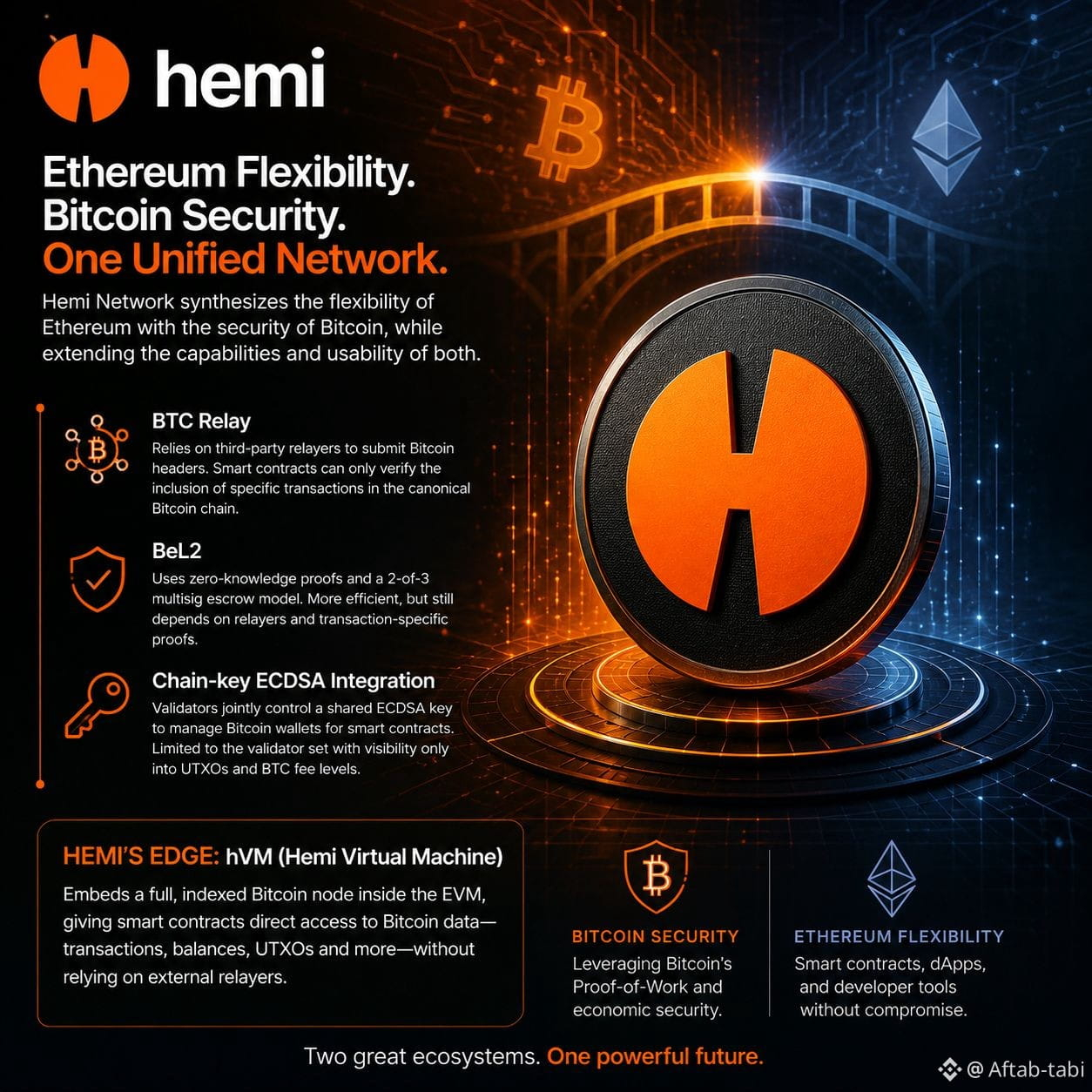
@Hemi I observed Hemi Network takes a different approach to Bitcoin interoperability by combining Ethereum’s programmability with Bitcoin’s security. Traditional BTC Relay systems rely on third-party relayers to submit Bitcoin headers and allowing smart contracts to verify specific transaction inclusion but offering limited access to the Bitcoin state. BeL2 uses zero-knowledge proofs and a 2-of-3 multisig escrow model are yet still depends on relayers and transaction-specific proofs. Chain-key ECDSA enables smart contracts to control Bitcoin wallets through a shared validator-managed key but introduces reliance on the validator set.
Hemi addresses these limitations through its Hemi Virtual Machine (hVM) which embeds a full, indexed Bitcoin node inside the EVM. This gives smart contracts direct access to Bitcoin data including transactions, balances and UTXOs without external relayers.
#HEMI #HEMİ $HEMI
$BTC
$ETH
#BTC #ETH #altcoins
Hemi addresses these limitations through its Hemi Virtual Machine (hVM) which embeds a full, indexed Bitcoin node inside the EVM. This gives smart contracts direct access to Bitcoin data including transactions, balances and UTXOs without external relayers.
#HEMI #HEMİ $HEMI
$BTC
$ETH
#BTC #ETH #altcoins
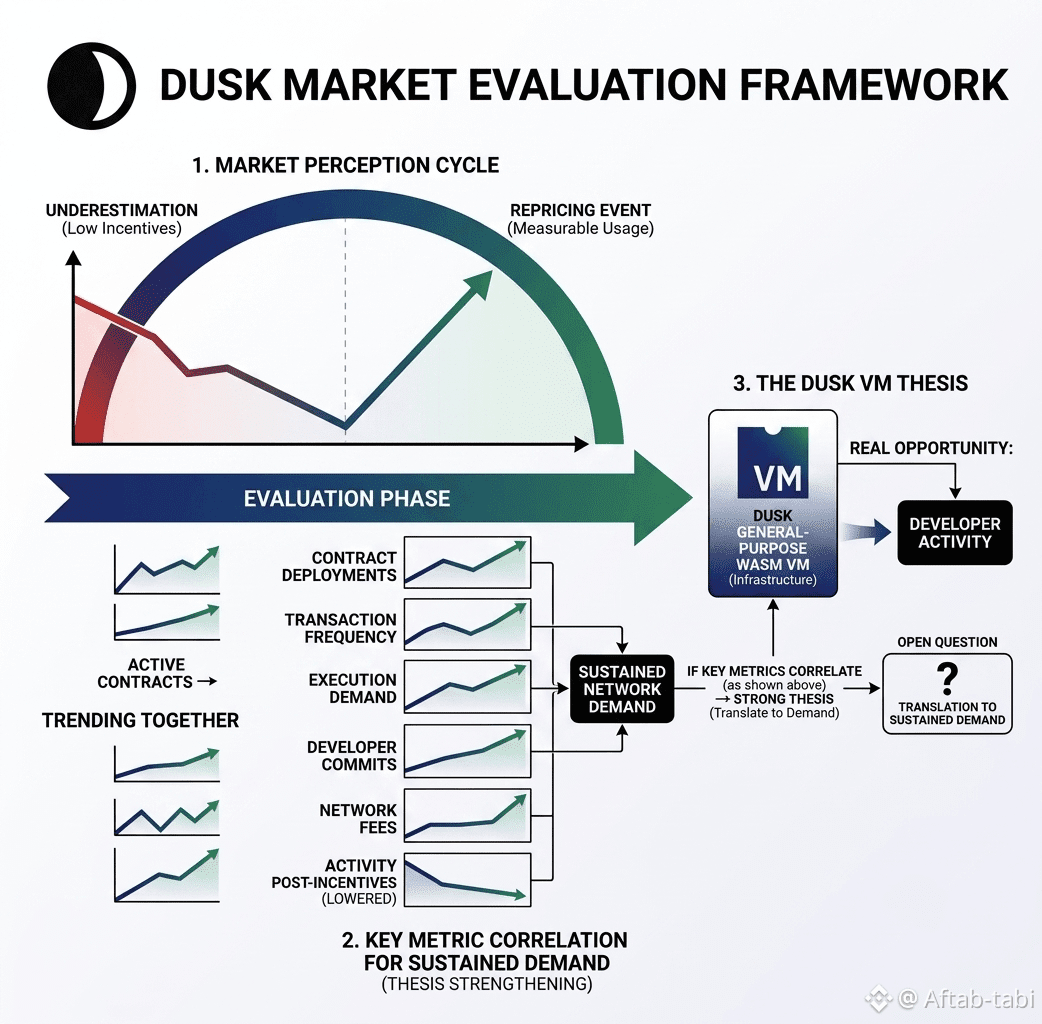
#dusk Last night I discussed with one of my friend when we are watching Dusk from market perspective and we noticed that markets often underestimate infrastructure when incentives are low then reprice it once usage becomes measurable. Dusk’s general-purpose WASM virtual machine is interesting from that angle, the opportunity is developer activity, not the VM it self.
I watch contract deployments, active contracts, transaction frequency, execution demand, developer commits, fees and whether activity persists after incentives weaken. So if those metrics trend together then the thesis gets stronger. Until then I just see the VM as useful infrastructure with an open question around whether it can translate into sustained network demand.
@Dusk $DUSK
I watch contract deployments, active contracts, transaction frequency, execution demand, developer commits, fees and whether activity persists after incentives weaken. So if those metrics trend together then the thesis gets stronger. Until then I just see the VM as useful infrastructure with an open question around whether it can translate into sustained network demand.
@Dusk $DUSK
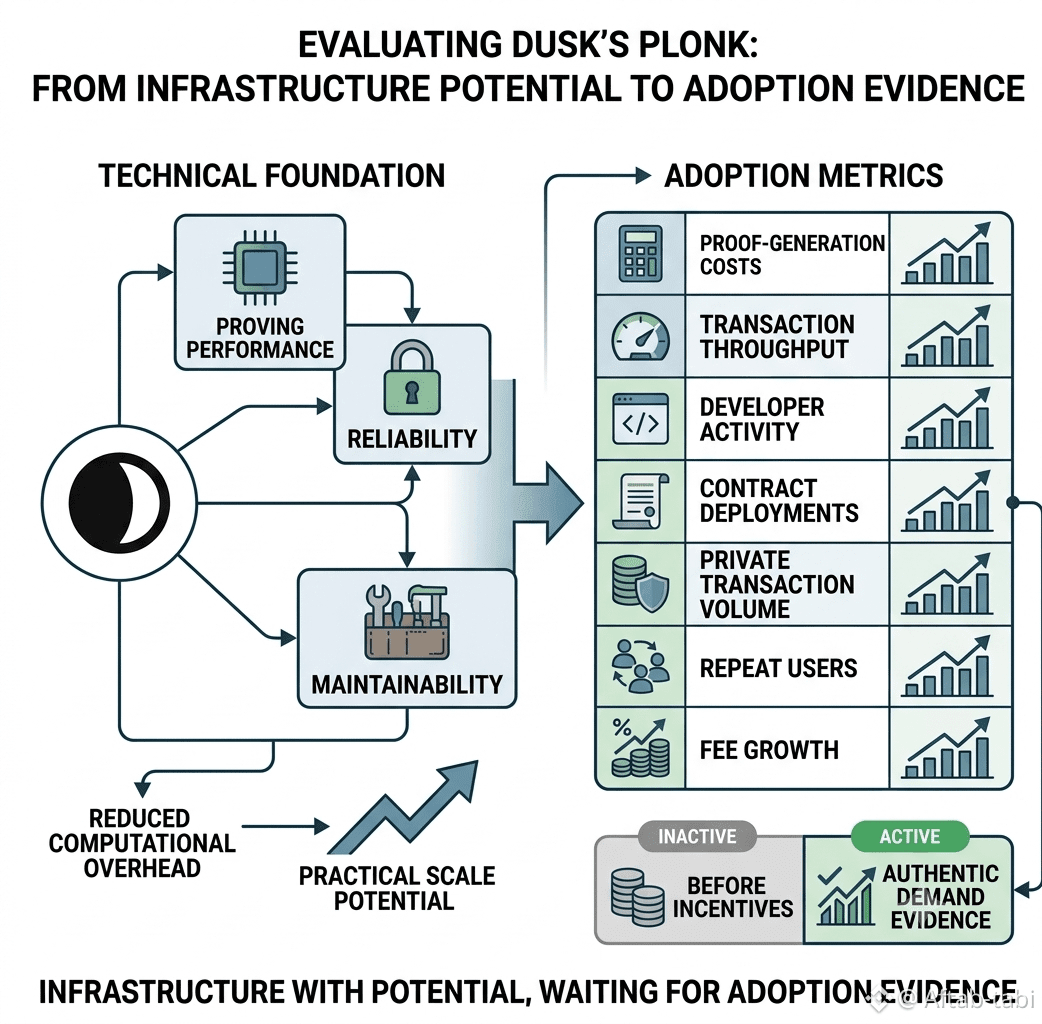
#dusk I noticed that Dusk’s Pure Rust PLONK implementation is interesting for these reason: proving performance, reliability and maintainability can influence whether zero-knowledge infrastructure becomes practical at scale.
The opportunity is real, especially if developers can build privacy applications without excessive computational overhead. But implementation quality alone doesn’t create demand. I’d want to see proof-generation costs, transaction throughput, developer activity, contract deployments, private transaction volume, repeat users and fee growth improving together.
So if those metrics start moving without heavy incentives, I will take the things more seriously. Until then, I see the cryptography as infrastructure with potential, not evidence of adoption.
@Dusk $DUSK
The opportunity is real, especially if developers can build privacy applications without excessive computational overhead. But implementation quality alone doesn’t create demand. I’d want to see proof-generation costs, transaction throughput, developer activity, contract deployments, private transaction volume, repeat users and fee growth improving together.
So if those metrics start moving without heavy incentives, I will take the things more seriously. Until then, I see the cryptography as infrastructure with potential, not evidence of adoption.
@Dusk $DUSK
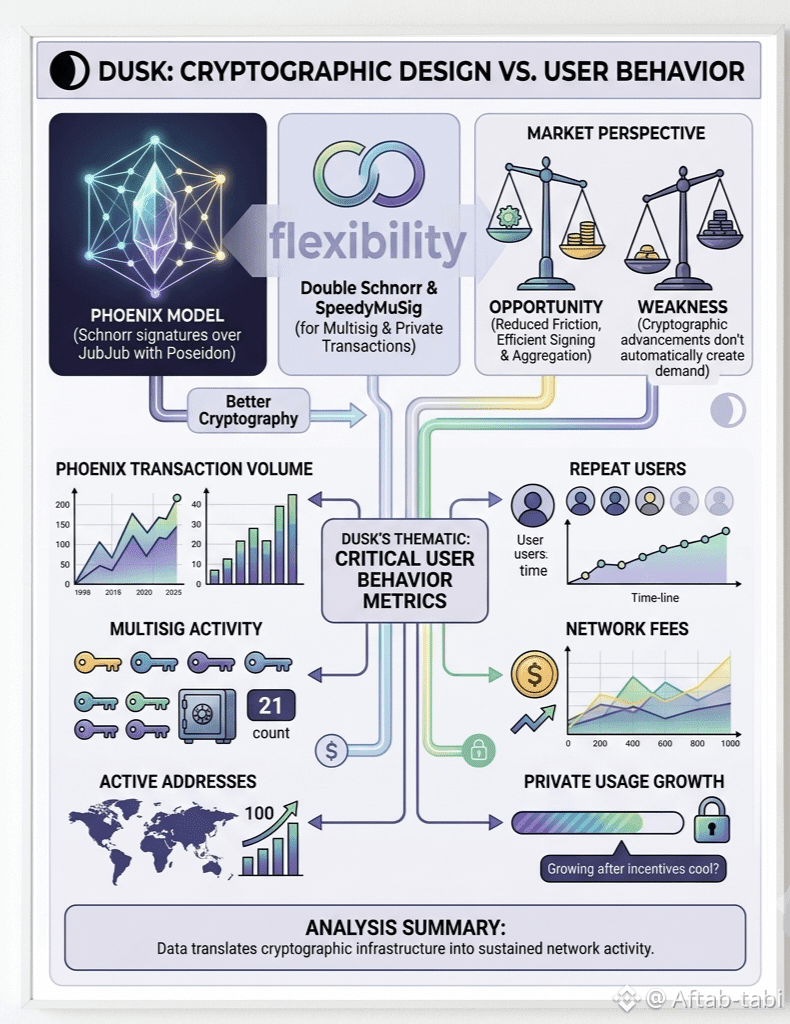
#dusk I feel that one thing Dusk makes me to watch closely is how much cryptographic design actually affects user behavior. It is Phoenix model uses Schnorr signatures over JubJub with Poseidon, while double Schnorr signatures and SpeedyMuSig add flexibility around private transactions and multisignature use.
From a market perspective the opportunity is straightforward, efficient signing and aggregation can reduce friction as private transaction activity grows. But the weakness is equally clear better cryptography does not automatically create demand.
I would not price the thesis on the technology alone. I’d watch Phoenix transaction volume, repeat users, multisig activity, fees, active addresses and whether private usage keeps growing after incentives cool. That data would tell me whether the cryptographic infrastructure is actually translating into sustained network activity.
@Dusk $DUSK
From a market perspective the opportunity is straightforward, efficient signing and aggregation can reduce friction as private transaction activity grows. But the weakness is equally clear better cryptography does not automatically create demand.
I would not price the thesis on the technology alone. I’d watch Phoenix transaction volume, repeat users, multisig activity, fees, active addresses and whether private usage keeps growing after incentives cool. That data would tell me whether the cryptographic infrastructure is actually translating into sustained network activity.
@Dusk $DUSK
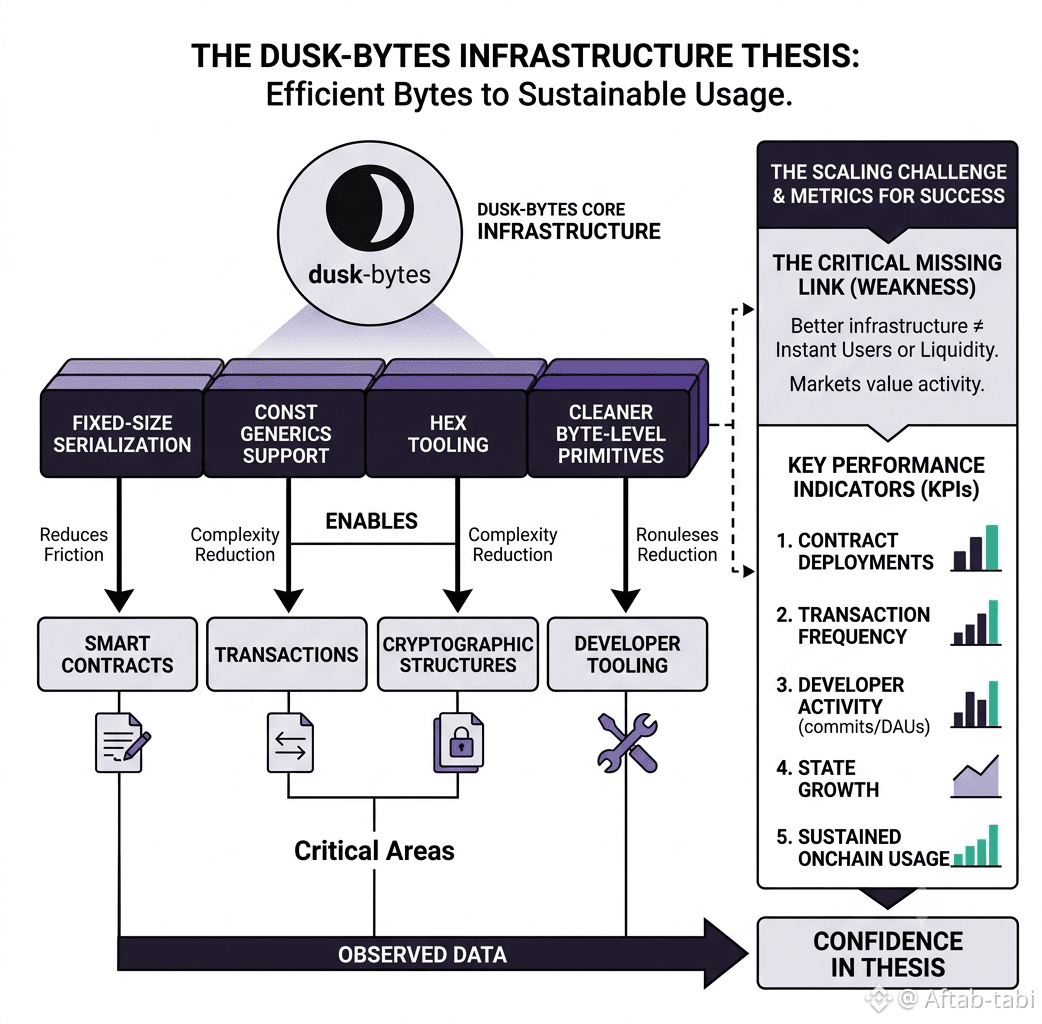
#dusk I have noticed that in crypto, small infrastructure pieces can matter more than they first appear when transaction activity scales. Dusk-bytes is a good example, fixed-size serialization, support, const generics and hex tooling keep data handling predictable across the stack.
That matters for the Dusk because serialization sits beneath contracts, transactions, cryptographic structures and developer tooling. Cleaner byte-level primitives can reduce friction and unnecessary complexity.
The weakness is that better infrastructure does not automatically create users, liquidity, or fees. Markets eventually price activity not elegant code alone.
I personally watch contract deployments, transaction frequency, developer activity, state growth and whether Dusk’s tooling actually translates into sustained onchain usage before becoming more confident in the thesis.
@Dusk $DUSK
That matters for the Dusk because serialization sits beneath contracts, transactions, cryptographic structures and developer tooling. Cleaner byte-level primitives can reduce friction and unnecessary complexity.
The weakness is that better infrastructure does not automatically create users, liquidity, or fees. Markets eventually price activity not elegant code alone.
I personally watch contract deployments, transaction frequency, developer activity, state growth and whether Dusk’s tooling actually translates into sustained onchain usage before becoming more confident in the thesis.
@Dusk $DUSK
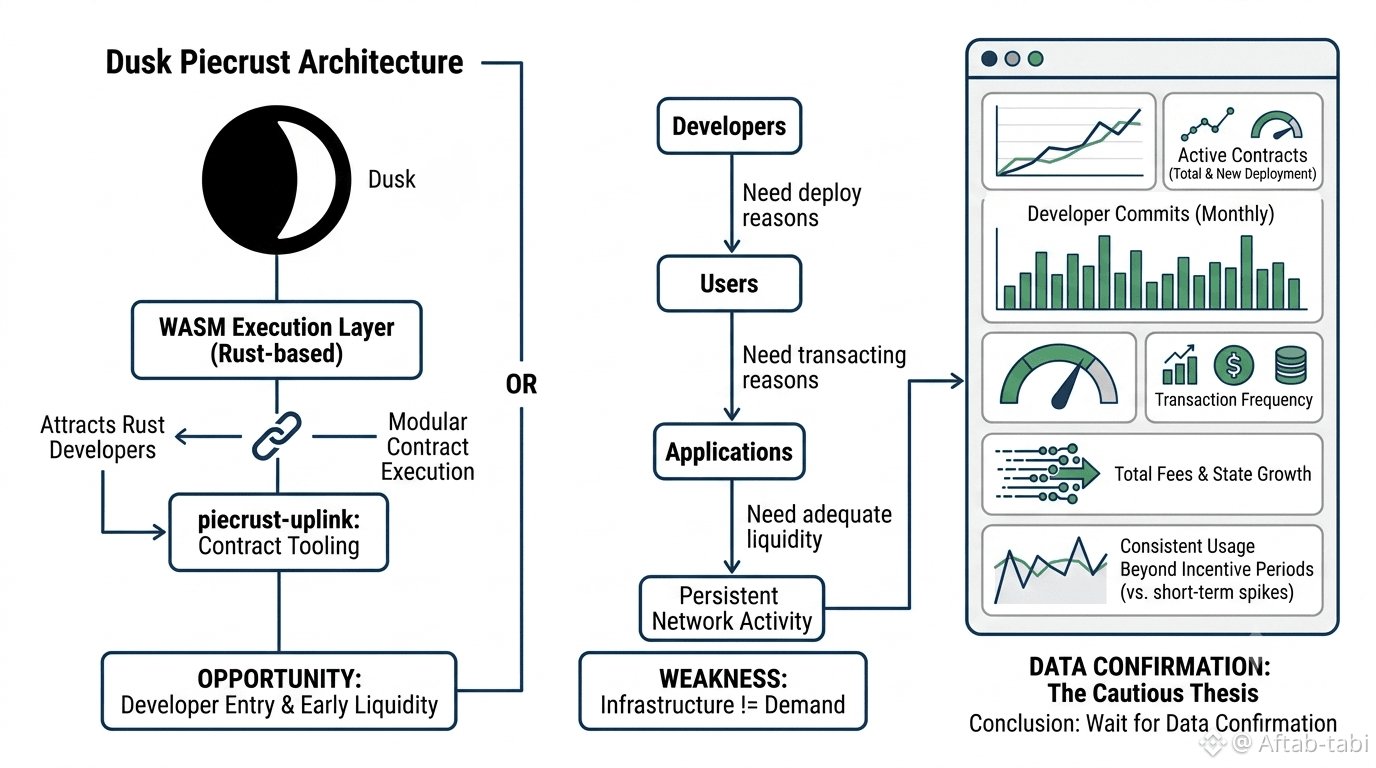
#dusk I am actually observing and I find Dusk’s Piecrust architecture interesting from a developer-liquidity angle. Piecrust provides the WASM execution layer, while piecrust-uplink gives developers the tooling to build the smart contracts directly on top of it.
What matters to me is whether this architecture can translate into persistent network activity. A Rust-based WASM environment could attract developers already comfortable with the Rust and make contract execution more modular. So that is the opportunity.
The weakness is straightforward, good infrastructure does not automatically create demand. Developers still need reasons to deploy, users need reasons to transact and applications need enough liquidity to remain active.
I would stay cautious until the data confirms the thesis. I personally monitor contract deployments, active contracts, transaction frequency, developer commits, fees, state growth and whether usage remains consistent beyond short-term incentive periods.
@Dusk $DUSK
What matters to me is whether this architecture can translate into persistent network activity. A Rust-based WASM environment could attract developers already comfortable with the Rust and make contract execution more modular. So that is the opportunity.
The weakness is straightforward, good infrastructure does not automatically create demand. Developers still need reasons to deploy, users need reasons to transact and applications need enough liquidity to remain active.
I would stay cautious until the data confirms the thesis. I personally monitor contract deployments, active contracts, transaction frequency, developer commits, fees, state growth and whether usage remains consistent beyond short-term incentive periods.
@Dusk $DUSK
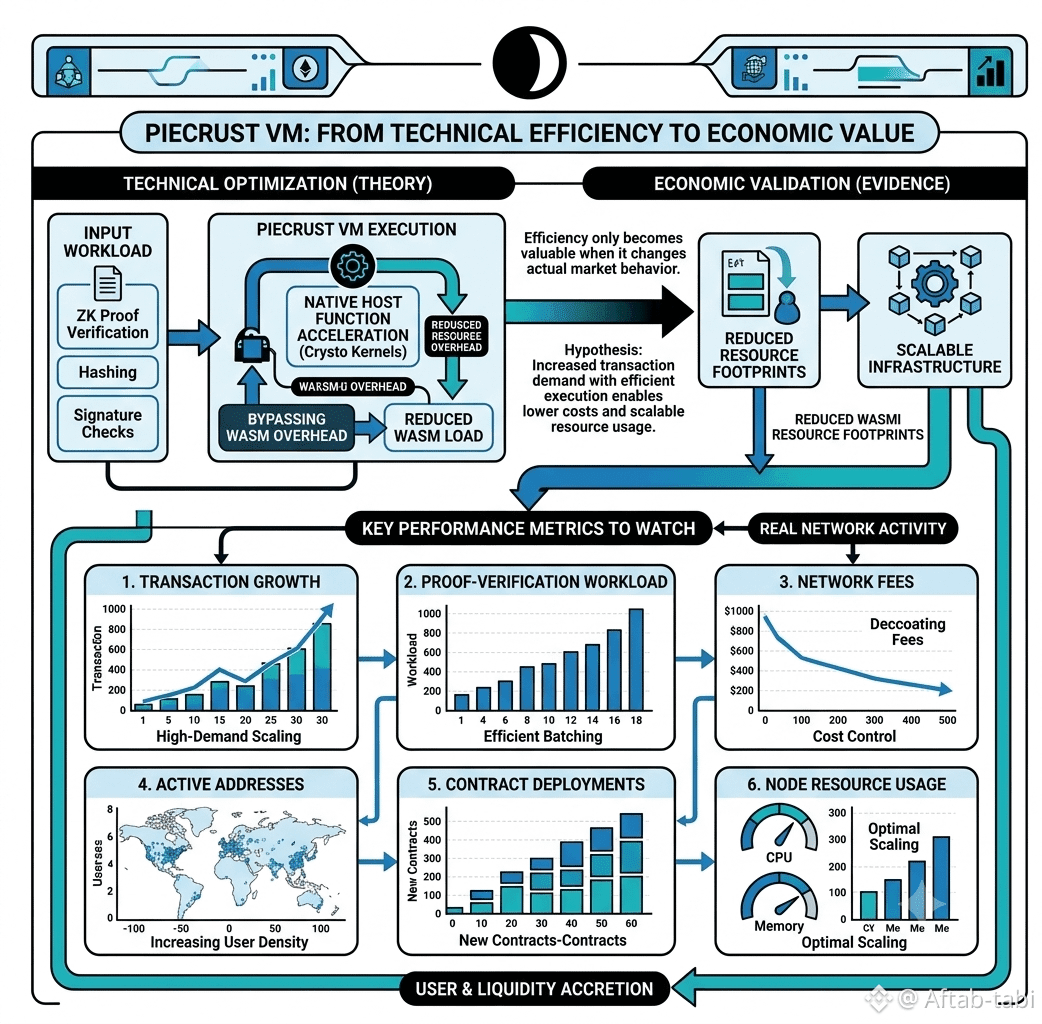
#dusk I have noticed that infrastructure only becomes valuable in crypto when the efficiency changes actual market behavior.
Dusk’s Piecrust VM takes an interesting route by moving heavy cryptographic work into native host functions. ZK proof verification, hashing and signature checks can avoid some WASM execution overhead.
The opportunity is straightforward, if transaction demand grows, efficient execution could help keep costs and resource usage under control.
But that thesis still needs evidence. Better architecture does not automatically create liquidity or users.
I’d watch transaction growth, proof-verification workload, fees, active addresses, contract deployments and node resource usage. If those improve alongside real network activity, I’d have more confidence that Piecrust’s efficiency matters economically not just technically.
@Dusk $DUSK
Dusk’s Piecrust VM takes an interesting route by moving heavy cryptographic work into native host functions. ZK proof verification, hashing and signature checks can avoid some WASM execution overhead.
The opportunity is straightforward, if transaction demand grows, efficient execution could help keep costs and resource usage under control.
But that thesis still needs evidence. Better architecture does not automatically create liquidity or users.
I’d watch transaction growth, proof-verification workload, fees, active addresses, contract deployments and node resource usage. If those improve alongside real network activity, I’d have more confidence that Piecrust’s efficiency matters economically not just technically.
@Dusk $DUSK
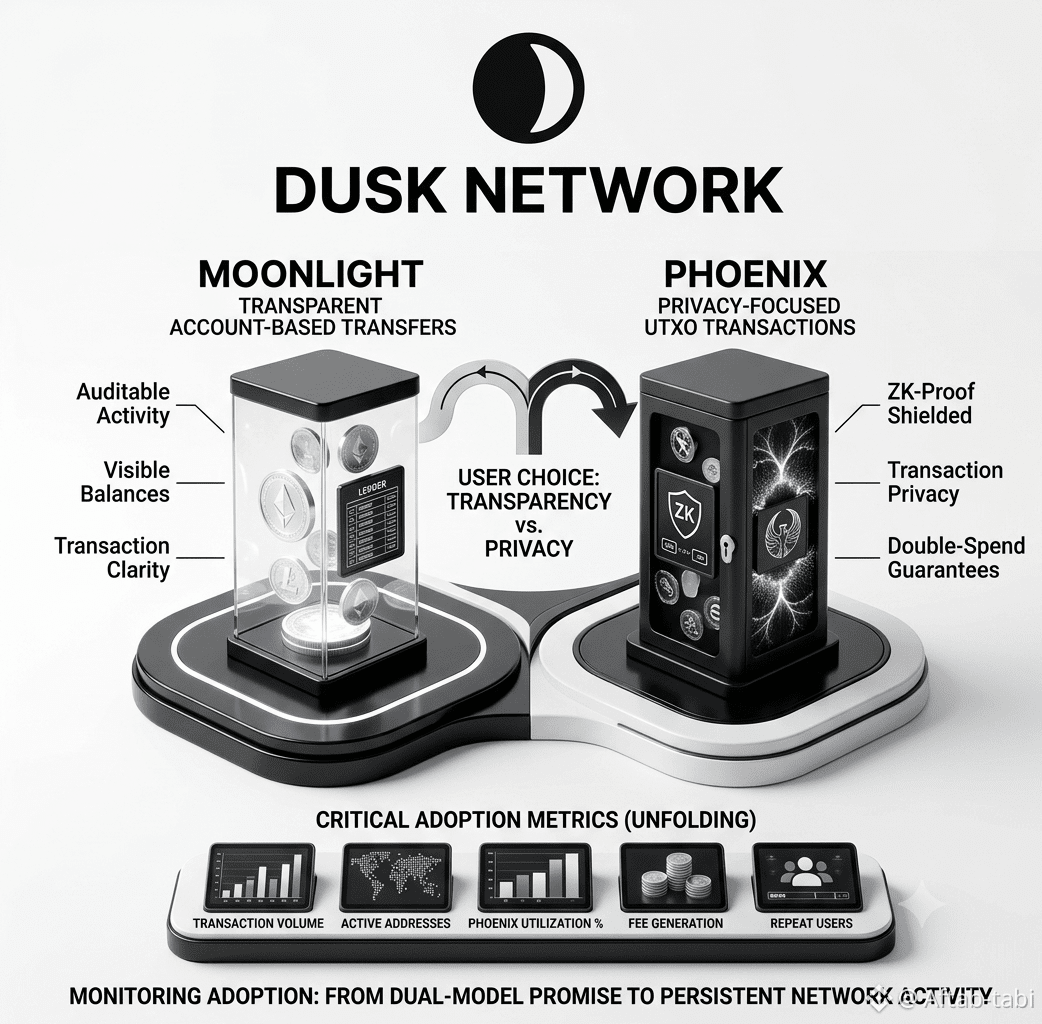
#dusk I have noticed that markets often overlook how the transaction design can influence where capital is willing to move. Dusk takes an interesting approach by supporting the both Moonlight and Phoenix it is giving users transparent account-based transfers alongside privacy-focused UTXO transactions.
That flexibility could matter if financial applications need different levels of disclosure. Moonlight makes balances and activity easier to verify while Phoenix can use zero-knowledge (ZK) proofs and nullifiers to preserve transaction privacy without removing core ownership, balance and double-spend guarantees.
But I would not treat the dual model as an adoption thesis by itself. More options only matter when the users actually choose them and activity becomes persistent.
The opportunity is real but the uncertainty is equally important. I would monitor transaction volume, active addresses, Phoenix usage, fee generation, repeat users and the mix between transparent and private activity before becoming more confident in the thesis.
@Dusk $DUSK
That flexibility could matter if financial applications need different levels of disclosure. Moonlight makes balances and activity easier to verify while Phoenix can use zero-knowledge (ZK) proofs and nullifiers to preserve transaction privacy without removing core ownership, balance and double-spend guarantees.
But I would not treat the dual model as an adoption thesis by itself. More options only matter when the users actually choose them and activity becomes persistent.
The opportunity is real but the uncertainty is equally important. I would monitor transaction volume, active addresses, Phoenix usage, fee generation, repeat users and the mix between transparent and private activity before becoming more confident in the thesis.
@Dusk $DUSK
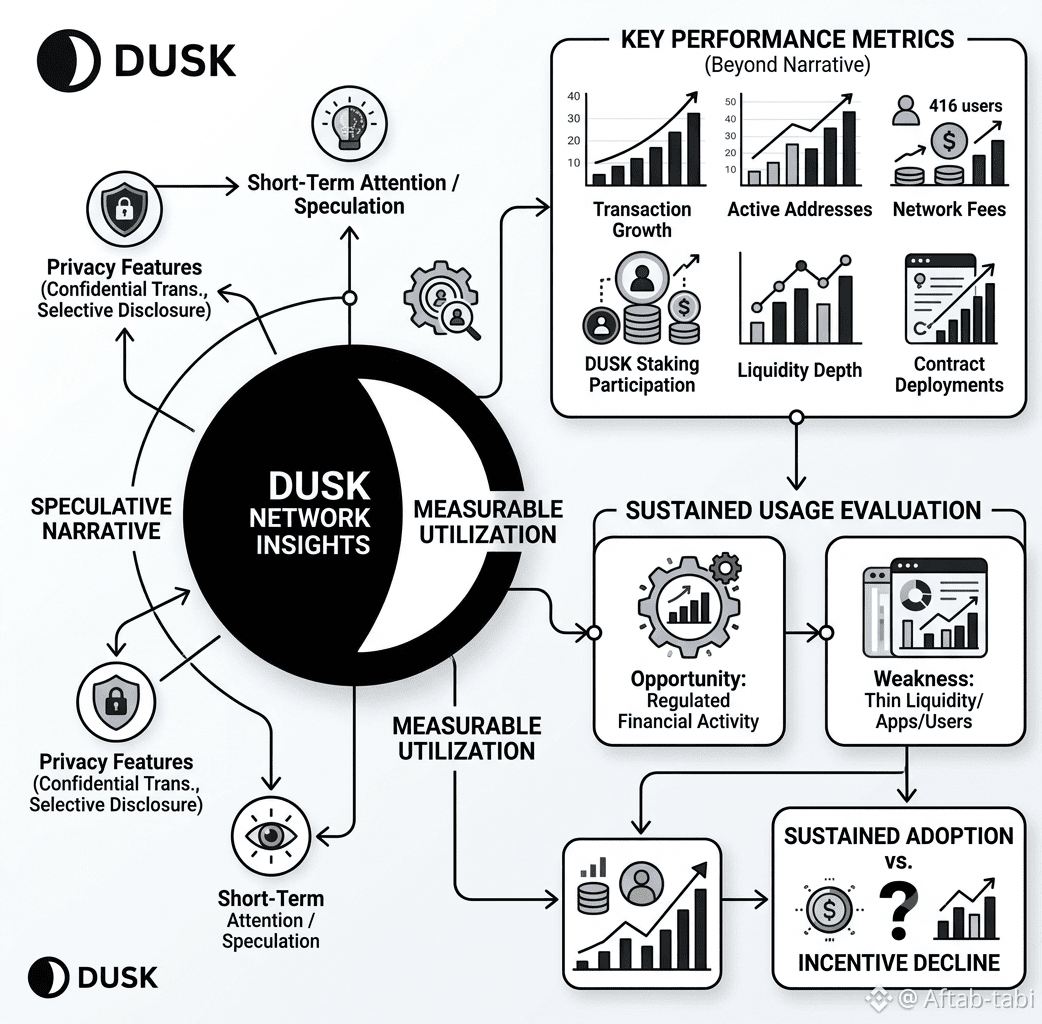
#dusk I personally noticed that privacy narratives can attract attention long before liquidity proves whether the market actually values the infrastructure. With Dusk actually I am watching whether confidential transactions and selective disclosure translate into sustained usage rather than short-term speculation.
The opportunity is clear if regulated financial activity creates recurring demand for the network. The only weakness is that strong technology can still struggle when liquidity, applications and users remain thin.
I do watch transaction growth, active addresses, fees, DUSK staking, liquidity depth, contract deployments and whether activity remains consistent after incentives decline. So those numbers should tell me more than the narrative.
@Dusk $DUSK
The opportunity is clear if regulated financial activity creates recurring demand for the network. The only weakness is that strong technology can still struggle when liquidity, applications and users remain thin.
I do watch transaction growth, active addresses, fees, DUSK staking, liquidity depth, contract deployments and whether activity remains consistent after incentives decline. So those numbers should tell me more than the narrative.
@Dusk $DUSK
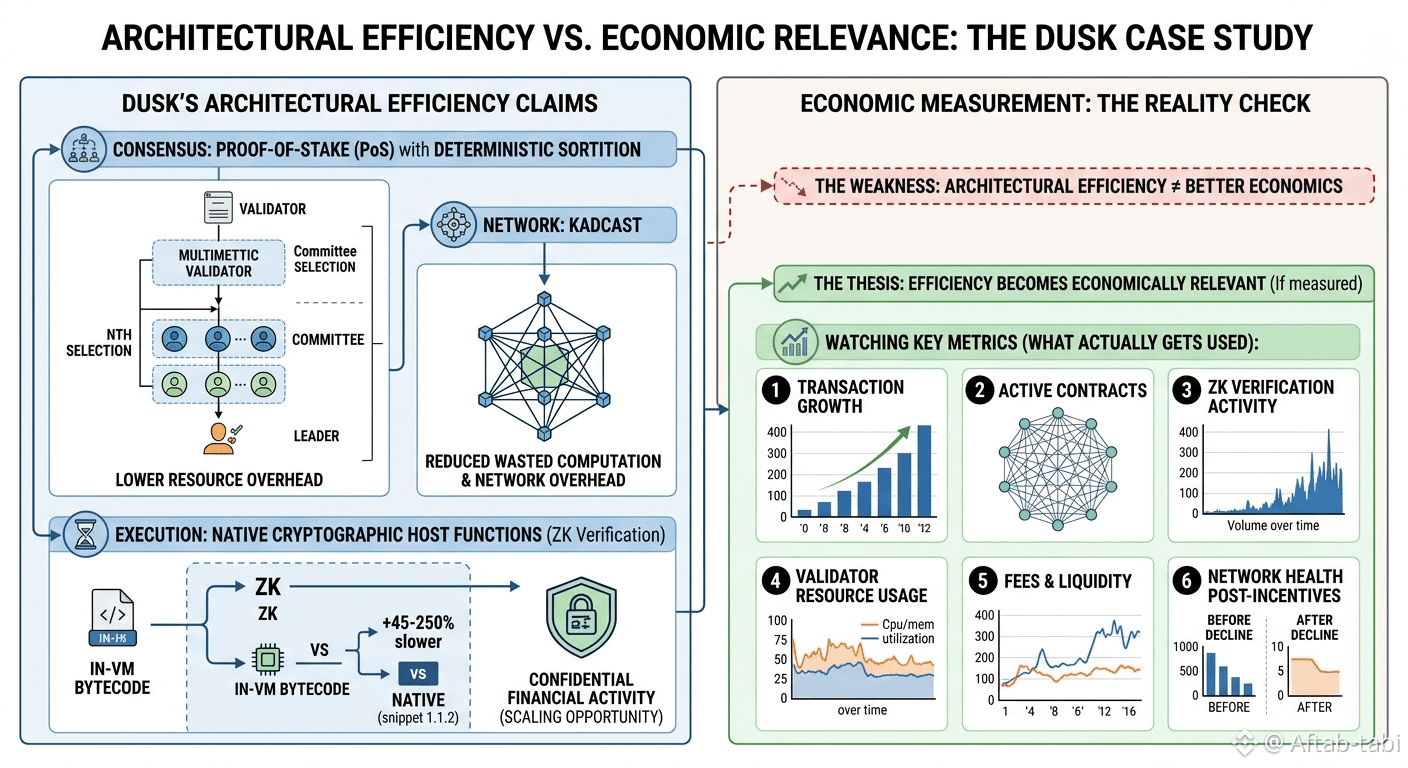
#dusk I have noticed that markets eventually separate efficient infrastructure from infrastructure that actually gets used. Dusk’s design is interesting here, PoS consensus, deterministic sortition, rolling finality, Kadcast and native cryptographic host functions all aim to reduce wasted computation and network overhead.
That creates an interesting opportunity if confidential financial activity scales, because lower resource overhead could matter as transaction volumes grow.
But the weakness is measurement. Architectural efficiency does not automatically translate into better economics or token demand.
I actually watch transaction growth, active contracts, ZK verification activity, validator resource usage, fees, liquidity and whether network activity remains healthy after incentives decline. Those numbers would tell me whether Dusk’s efficiency so the thesis is becoming economically relevant.
@Dusk $DUSK
That creates an interesting opportunity if confidential financial activity scales, because lower resource overhead could matter as transaction volumes grow.
But the weakness is measurement. Architectural efficiency does not automatically translate into better economics or token demand.
I actually watch transaction growth, active contracts, ZK verification activity, validator resource usage, fees, liquidity and whether network activity remains healthy after incentives decline. Those numbers would tell me whether Dusk’s efficiency so the thesis is becoming economically relevant.
@Dusk $DUSK
#dusk I have noticed after years of watching market cycles that privacy narratives matter most when they solve a specific user problem.
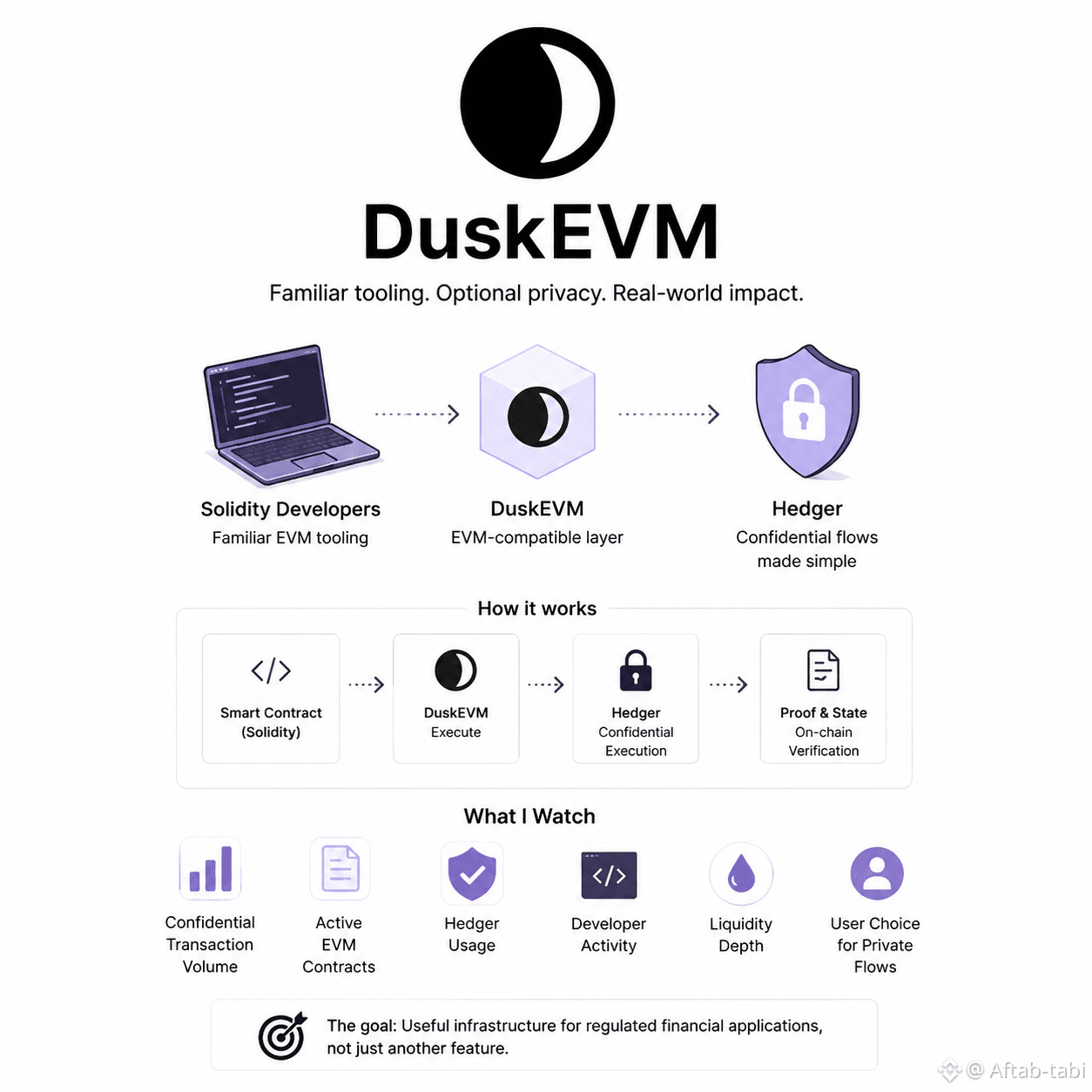
With DuskEVM I’d watch whether Solidity apps can actually use confidential flows through Hedger without adding too much friction. The opportunity is clear: familiar EVM tooling with optional privacy could make regulated financial applications more practical.
But the weakness is adoption. Privacy features can exist without meaningful demand.
I’d personally watch confidential transaction volume, active EVM contracts, Hedger usage, developer activity, liquidity, and whether users repeatedly choose private flows. That data would tell me whether Dusk is building useful infrastructure or just simply adding another feature.
@Dusk $DUSK
With DuskEVM I’d watch whether Solidity apps can actually use confidential flows through Hedger without adding too much friction. The opportunity is clear: familiar EVM tooling with optional privacy could make regulated financial applications more practical.
But the weakness is adoption. Privacy features can exist without meaningful demand.
I’d personally watch confidential transaction volume, active EVM contracts, Hedger usage, developer activity, liquidity, and whether users repeatedly choose private flows. That data would tell me whether Dusk is building useful infrastructure or just simply adding another feature.
@Dusk $DUSK
Verified
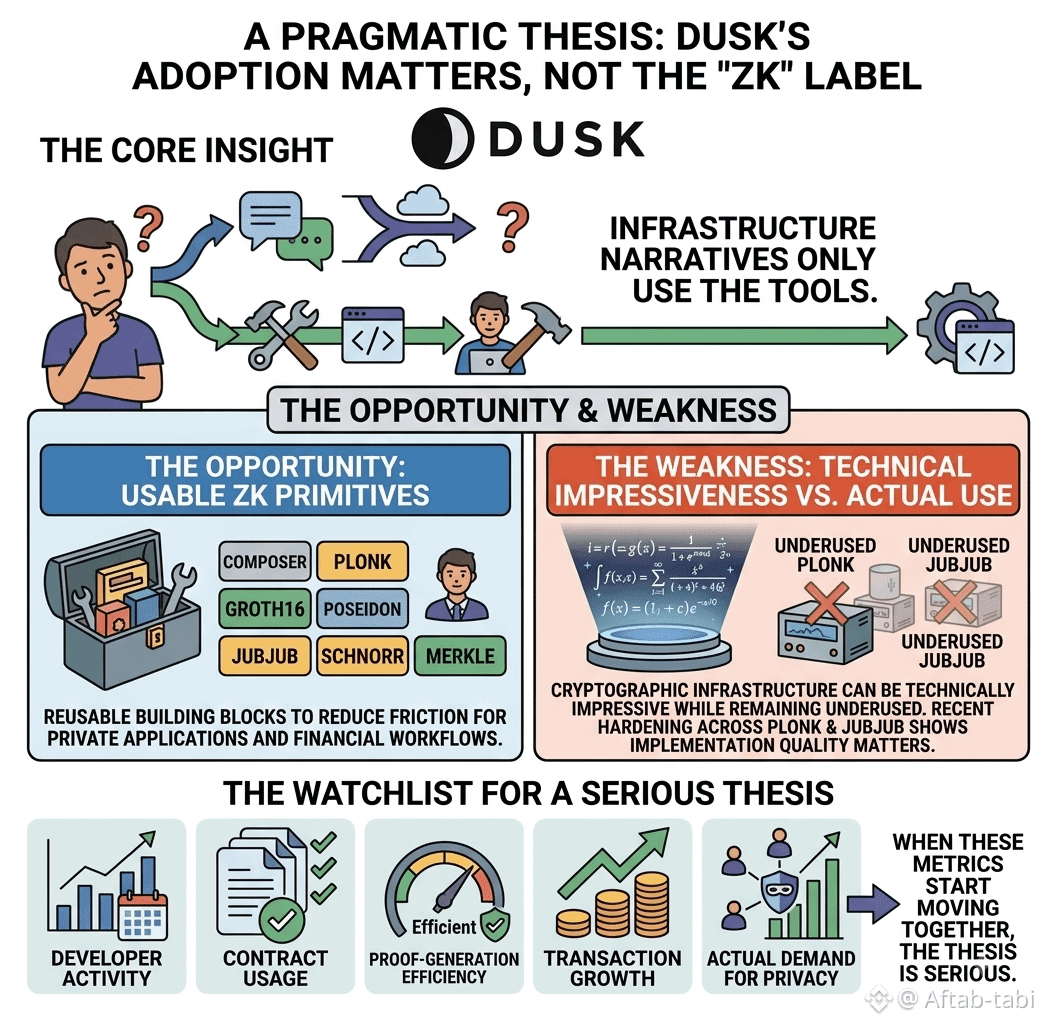
#dusk I personally noticed that infrastructure narratives only matter when developers actually use the underlying tools.
That is what makes Dusk interesting to me right now. Its ZK stack is not just a single proof system, Composer supports circuit construction, while PLONK, Groth16, Poseidon, Jubjub, Schnorr and Merkle components provide reusable cryptographic building blocks.
I think the opportunity is less about the “ZK” label and more about whether these primitives can reduce the friction of building private applications and financial workflows.
But there is a weakness I would not ignore. Cryptographic infrastructure can be technically impressive while remaining underused. Recent security hardening across PLONK, Jubjub and related components also shows how much implementation quality matters beyond the underlying mathematics.
So I would watch closely developer activity, contract usage, proof-generation efficiency, transaction growth and actual demand for privacy features. If those metrics start moving together, I would take the Dusk thesis more seriously.
@Dusk $DUSK
$ACE
$CYS
That is what makes Dusk interesting to me right now. Its ZK stack is not just a single proof system, Composer supports circuit construction, while PLONK, Groth16, Poseidon, Jubjub, Schnorr and Merkle components provide reusable cryptographic building blocks.
I think the opportunity is less about the “ZK” label and more about whether these primitives can reduce the friction of building private applications and financial workflows.
But there is a weakness I would not ignore. Cryptographic infrastructure can be technically impressive while remaining underused. Recent security hardening across PLONK, Jubjub and related components also shows how much implementation quality matters beyond the underlying mathematics.
So I would watch closely developer activity, contract usage, proof-generation efficiency, transaction growth and actual demand for privacy features. If those metrics start moving together, I would take the Dusk thesis more seriously.
@Dusk $DUSK
$ACE
$CYS
Verified
#dusk I have noticed that privacy narratives only become interesting when they start creating measurable user demand.
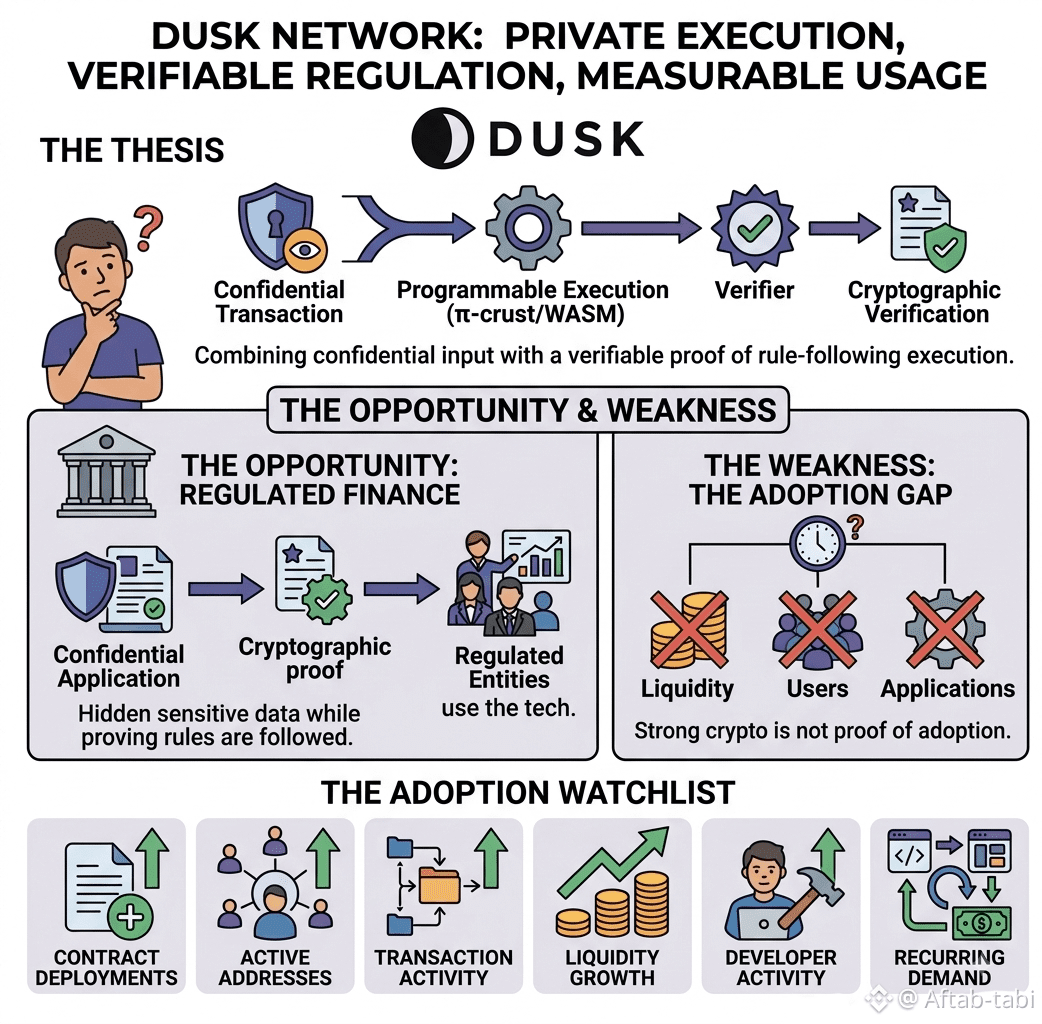
That is what I am watching with Dusk. Its architecture combines confidential transactions, programmable execution through π-crust/WASM and cryptographic verification. The interesting angle for me is not simply “privacy.” It is whether private execution can make financial applications more practical without sacrificing verifiability.
The opportunity is clear: regulated markets may need sensitive data hidden while still proving that transactions follow the required rules. But the weakness is equally important. Strong cryptography and infrastructure do not automatically create liquidity, users, or applications.
I am not treating the architecture as proof of adoption.
I am watching contract deployments, active addresses, transaction activity, liquidity growth, developer activity and whether real applications generate recurring demand.
If those metrics improve together I’d become more confident that Dusk is moving beyond a technically interesting privacy thesis toward genuine network usage.
@Dusk $DUSK
That is what I am watching with Dusk. Its architecture combines confidential transactions, programmable execution through π-crust/WASM and cryptographic verification. The interesting angle for me is not simply “privacy.” It is whether private execution can make financial applications more practical without sacrificing verifiability.
The opportunity is clear: regulated markets may need sensitive data hidden while still proving that transactions follow the required rules. But the weakness is equally important. Strong cryptography and infrastructure do not automatically create liquidity, users, or applications.
I am not treating the architecture as proof of adoption.
I am watching contract deployments, active addresses, transaction activity, liquidity growth, developer activity and whether real applications generate recurring demand.
If those metrics improve together I’d become more confident that Dusk is moving beyond a technically interesting privacy thesis toward genuine network usage.
@Dusk $DUSK
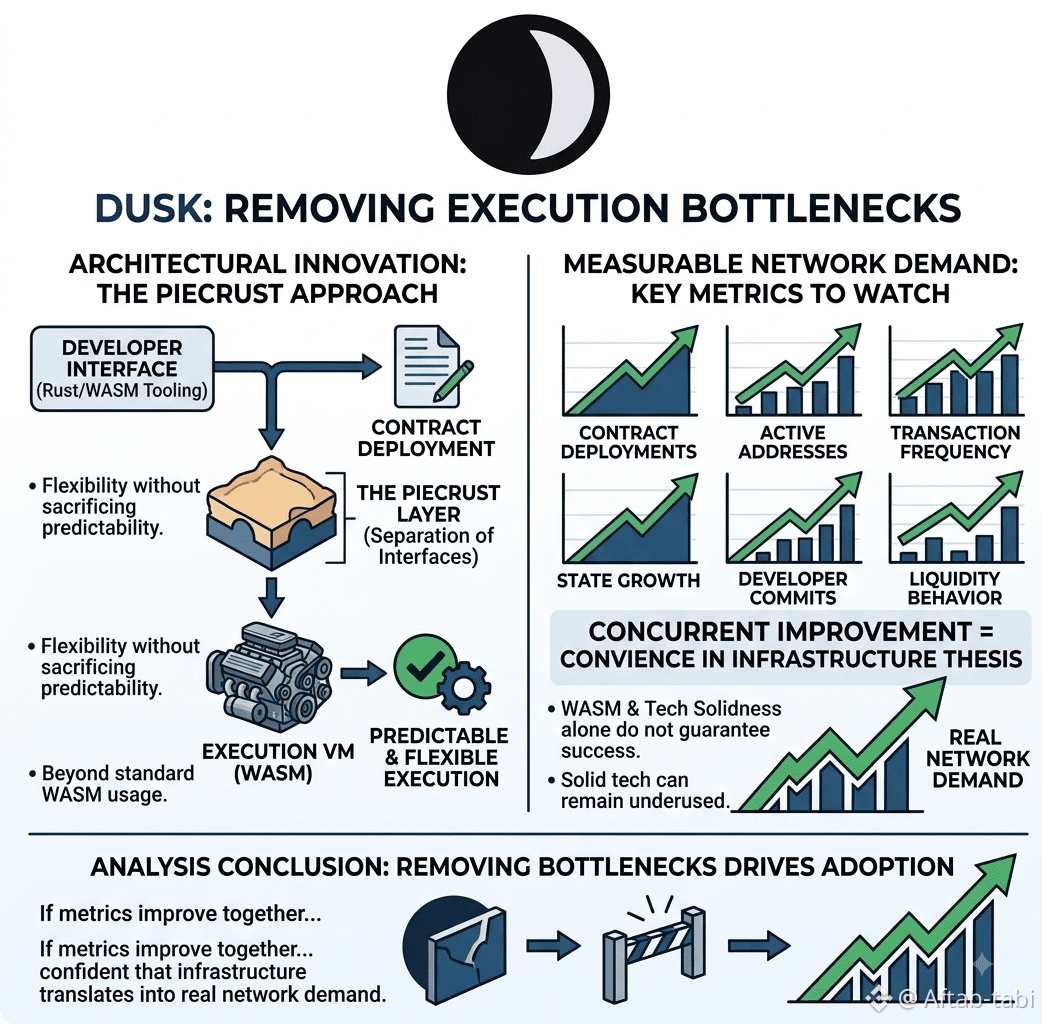
#dusk After years of watching crypto cycles, I have been looking less at narratives and more at where execution bottlenecks are being removed.
That is what makes Dusk’s Piecrust worth watching.
The interesting part is not simply that Dusk uses WASM. I have been looking at how Piecrust separates contract execution from the developer interface through "piecrust" That architecture could matter if Dusk needs contracts that are more flexible without sacrificing predictable execution.
The opportunity is developer activity. If more contracts are deployed, contract calls increase, state usage grows and developers actually build around the tooling that gives the infrastructure thesis something measurable behind it.
But I am not assuming adoption follows automatically. WASM execution, Rust tooling and better VM design do not guarantee liquidity or users. The weakness is that technically solid infrastructure can remain underused if applications fail to attract meaningful activity.
I have been looking at contract deployments, active addresses, transaction frequency, state growth, developer commits and liquidity behavior.
If those metrics improve together rather than independently, I’d become more confident that Dusk’s infrastructure is translating into real network demand.
@Dusk $DUSK
That is what makes Dusk’s Piecrust worth watching.
The interesting part is not simply that Dusk uses WASM. I have been looking at how Piecrust separates contract execution from the developer interface through "piecrust" That architecture could matter if Dusk needs contracts that are more flexible without sacrificing predictable execution.
The opportunity is developer activity. If more contracts are deployed, contract calls increase, state usage grows and developers actually build around the tooling that gives the infrastructure thesis something measurable behind it.
But I am not assuming adoption follows automatically. WASM execution, Rust tooling and better VM design do not guarantee liquidity or users. The weakness is that technically solid infrastructure can remain underused if applications fail to attract meaningful activity.
I have been looking at contract deployments, active addresses, transaction frequency, state growth, developer commits and liquidity behavior.
If those metrics improve together rather than independently, I’d become more confident that Dusk’s infrastructure is translating into real network demand.
@Dusk $DUSK
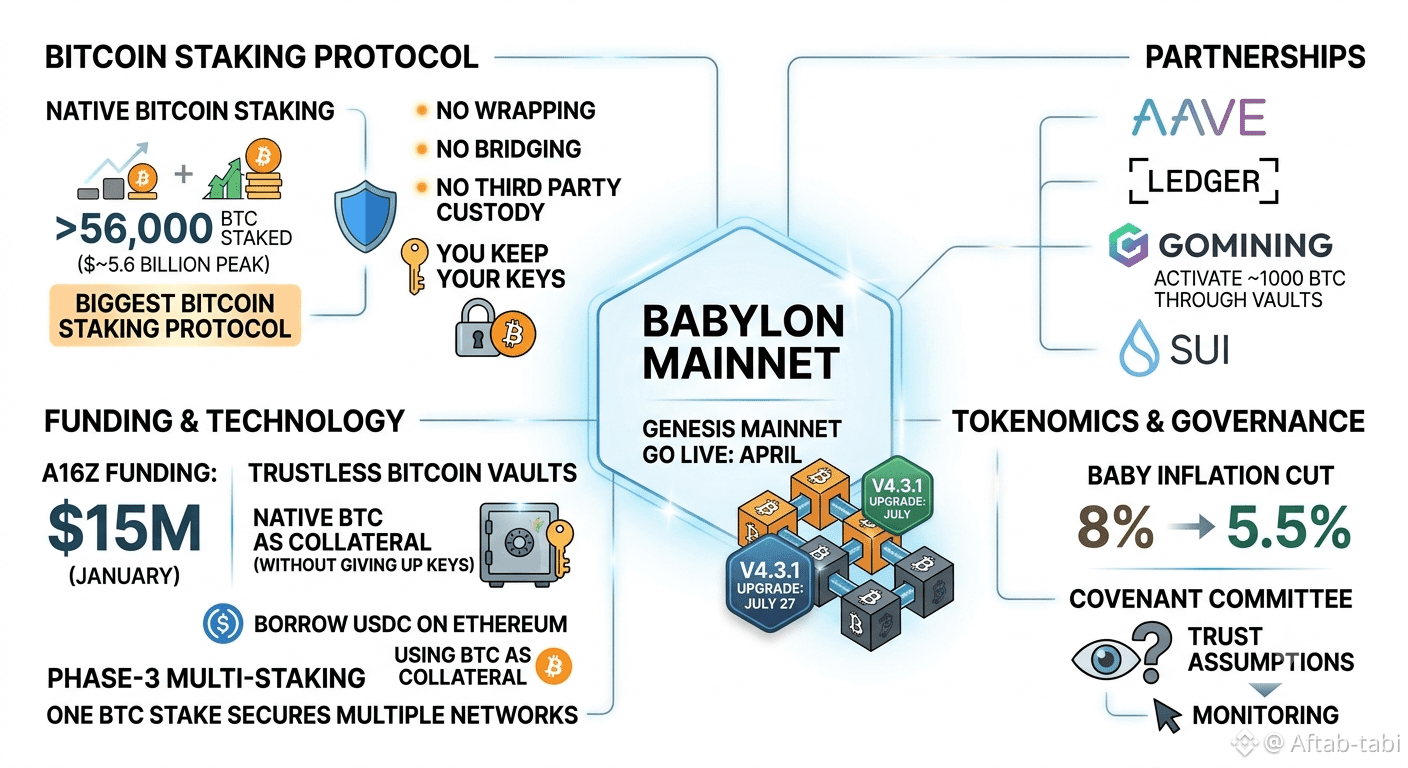
#baby I have been looking at Babylon mainnet stuff all morning. Not gonna lie it is actually kind of interesting what is happening over there. The Genesis mainnet went live back in April and since then things have been moving. They crossed like 56,000 BTC staked which is around $5.6 billion at peak. That makes it the biggest Bitcoin staking protocol out there right now. No wrapping no bridging no third party custody. Your BTC stays on Bitcoin.
The a16z money came in January $15 million. They are building out these Trustless Bitcoin Vaults. Basically lets you use native BTC as collateral without giving up your keys. They already ran a test where people borrowed USDC on Ethereum using BTC as collateral. That is actually wild when you think about it.
Partnerships are stacking up. Aave is in. Ledger too for hardware wallet support. Gomining wants to activate like 1000 BTC through the vaults. Sui is also working with them. Feels like something is building maybe.
Upgrade to v4.3.1 happening July 27. BABY inflation got cut from 8% to 5.5% earlier. The Phase-3 multi-staking thing is coming where one BTC stake can secure multiple networks at once. Not sure how that will play out though.
The covenant committee stuff still has some trust assumptions. Something to keep an eye on.
@BabylonLabs_io $BABY
The a16z money came in January $15 million. They are building out these Trustless Bitcoin Vaults. Basically lets you use native BTC as collateral without giving up your keys. They already ran a test where people borrowed USDC on Ethereum using BTC as collateral. That is actually wild when you think about it.
Partnerships are stacking up. Aave is in. Ledger too for hardware wallet support. Gomining wants to activate like 1000 BTC through the vaults. Sui is also working with them. Feels like something is building maybe.
Upgrade to v4.3.1 happening July 27. BABY inflation got cut from 8% to 5.5% earlier. The Phase-3 multi-staking thing is coming where one BTC stake can secure multiple networks at once. Not sure how that will play out though.
The covenant committee stuff still has some trust assumptions. Something to keep an eye on.
@BabylonLabs_io $BABY
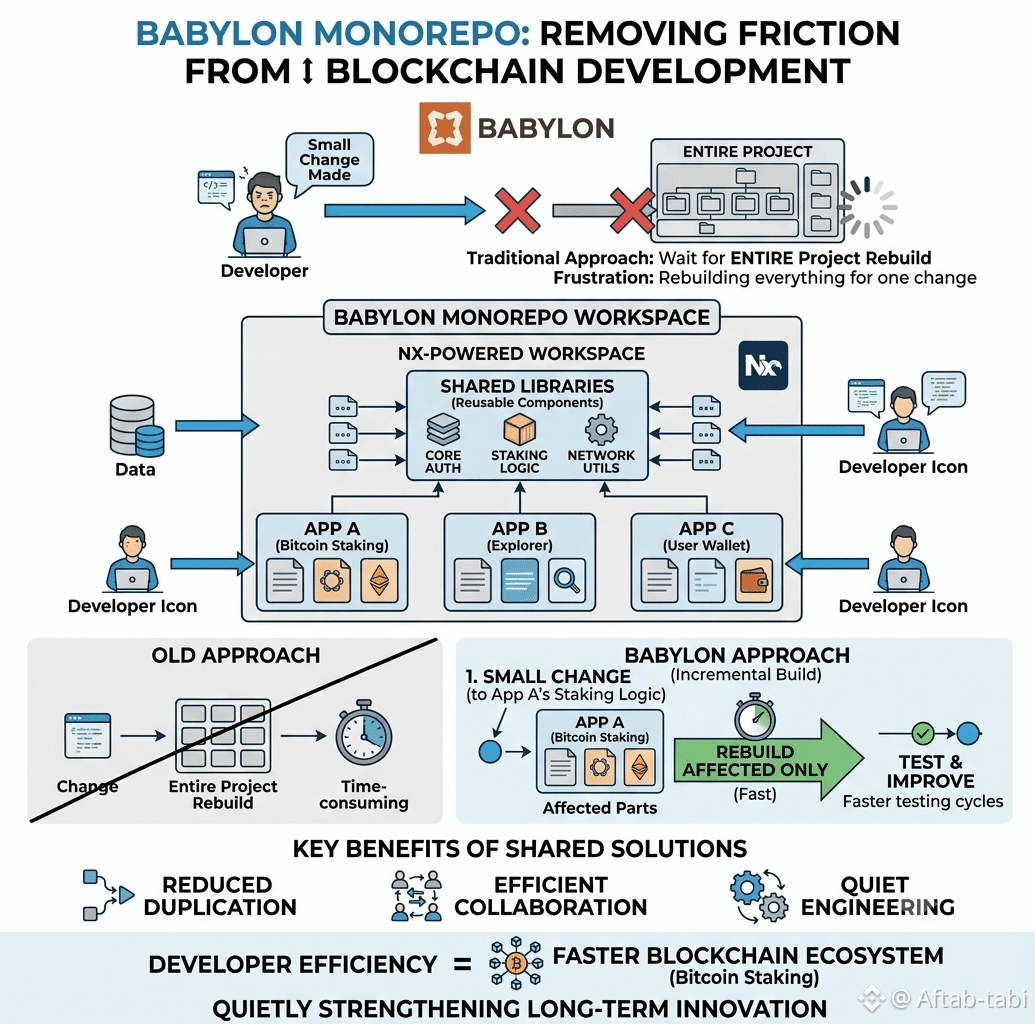
#baby I remember when I was chatting with one of my friend who is builds blockchain applications. He tell me how frustrating it was to make one small change and then wait for an entire project to rebuild before testing it. I remember this conversation then later on when I explore the Babylon Monorepo, I finally understood why its approach stood out. Everything was organized around shared libraries and an Nx-powered workspace, so developers could focus only on the parts that actually changed. It was not about flashy features or complicated tools. It was about removing everyday friction. I could imagine how much smoother collaboration becomes when everyone works from the same reusable components instead of creating duplicate solutions. When I learned more about it then I realized that speed in blockchain development is not only measured by transactions or block times. Sometimes it is measured by how efficiently developers can build, test and improve the products people use every day. That is the kind of engineering that quietly strengthens the entire Bitcoin staking ecosystem and supports long-term innovation.
@BabylonLabs_io $BABY
@BabylonLabs_io $BABY
Log in to explore more content