


If you like fast dogs and lightning speeds, then Volt Inu token is the one for you. The cryptocurrency coin ‘Volt Inu’ was launched in December 2021, and has recently completed its migration from V1 to V2 in April 2022.
The decision to migrate the protocol to a new smart contract in order to accelerate growth, speed and efficiency caused the value of native token VOLT to soar to an all-time highs recently, so this coin is one to watch.
Describing itself as “a hyper-deflationary token whose aim is to invest in multiple asset classes such as NFTs, nodes, altcoins, staking & farming of stablecoins”, you can tell that this coin is a token used mainly for crypto investments. Furthermore, Volt Inu’s diversity in their investments “allows mitigated risk while taking advantage of the possible non-correlated growth of the trending assets.”
This statement is not unfounded, as the purpose of $VOLT is to tokenize the Volt Inu Token community as well, with many of the following utility features:
Businesses and individuals can accept VOLT coins as payment or donations using NowPayments. Moreover, Shopping.io has teamed up with VOLT to make the cryptocurrency more accessible to investors. Due to this arrangement, token holders will be able to use their crypto on sites like eBay.
BTC Predictions with VOLT: Predict the price of bitcoin (BTC) with Volt Inu Tokens.
VOLTICHANGE: Volt Inu will have a swap and decentralised exchange that will be accessible to any DeFi projects that are currently using existing liquidity pools on protocols like Uniswap, Pancakeswap, etc.
The Volt Inu Token ($VOLT) has a maximum and total supply of 64.2 trillion (i.e. ~64,200,000,000,000 tokens or 12 numerals after the numeral 64).
Each time you complete the purchase and sale of ETH, the transaction is subjected to a 13% transaction fee. This implies that every time an investor decides to purchase a Volt Inu token, a 13% tax is withheld from his initial investment. This 13% is broken down into the following:
1% is used as reflection, which goes directly to each holder from each transaction. Notably, a reflection token rewards loyal holders by giving a certain part of the tax to the holders.
Another 4% is allocated to the marketing and development wallet, allowing the crypto to flourish and reach new audiences.
The treasury wallet receives 4% of the tokens. This is where the project should acquire money to invest in underlying assets. The BSC Tokenomics is everything of the above, except for a 4 per cent being transferred to a burn address, which aids in deflation.
For the last 4%, it is dependent whether or not the transaction has occurred in ETH or BSC. Because Volt Inu exists in both the Ethereum and Binance Smart Chain (ETH and BSC), there are two different tokenomics as seen below (see liquidity/automatic burn):
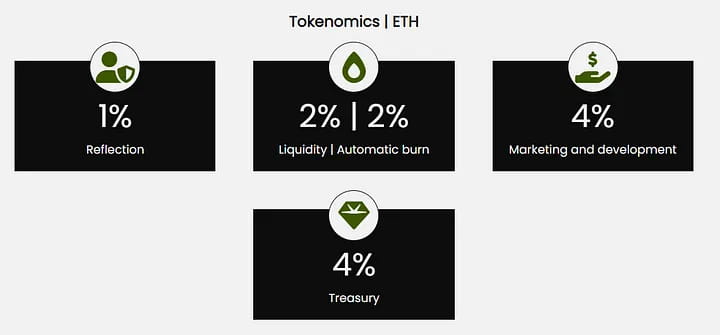
Hence, there is:
an automatic 2% burn tax on ETH, and
another automatic 4% burn tax on BSC.
The merger of these mechanisms guarantees a continuous rising price floor due to the decrease of the circulating supply.