


Vanar Chain feels like one of those projects that never tried to win the “fastest L1” race by shouting numbers first, because the way they talk about themselves has always been closer to real product thinking than pure crypto competition, and that difference matters when you’re aiming for adoption outside the usual onchain crowd.
The foundation of the project is simple to understand if you zoom out and stop looking for gimmicks, because Vanar is trying to build an L1 that actually fits into the places where mainstream users already spend their time, which is why gaming, entertainment, and brand ecosystems keep showing up as the center of gravity for the chain, and why the narrative around “the next 3 billion consumers” isn’t just a slogan, it’s a constraint that forces them to think differently about user experience, cost predictability, onboarding, and distribution.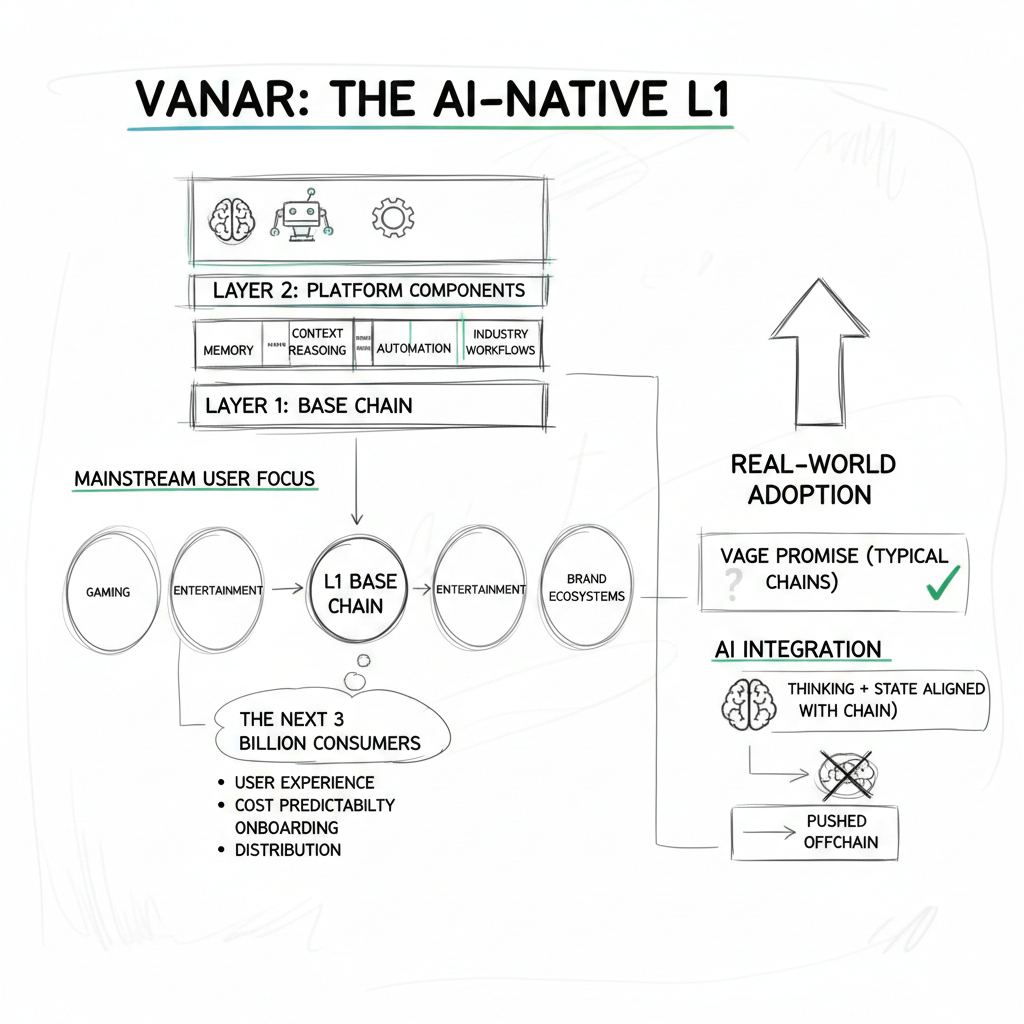
When a chain says it’s designed for real-world adoption, it usually becomes a vague promise, but Vanar tries to anchor that promise in a broader platform approach where the base chain is only one part of the story, and above it they’re pushing a layered stack concept that is meant to support AI-native applications through components focused on memory, context, reasoning, automation, and industry workflows, and whether you personally love the AI angle or not, the direction is clear because they are trying to create infrastructure where intelligent applications can run with more of their “thinking” and “state” aligned with the chain instead of being pushed entirely offchain.
Behind the scenes, the technical direction is not trying to reinvent everything from scratch in a way that scares developers away, because Vanar has leaned into EVM compatibility so existing Solidity builders can move faster without re-learning an entirely new environment, and that choice tends to be the difference between a chain that attracts experimentation and a chain that stays isolated in its own ecosystem bubble, especially when your goal is to bring in teams that already know how to ship consumer products and just need the blockchain layer to behave like reliable infrastructure.
The way Vanar frames network operations also suggests a practical start rather than a perfect ideological start, because early-stage networks often prioritize stability and control before gradually opening up validator participation and governance over time, and that approach can be a strength if the project communicates the progression clearly and proves it through visible milestones, since perception in crypto is brutal and any sign of stagnation seeps into the token narrative whether it is fair or not.
The token side is where Vanar’s story becomes more tangible, because VANRY is presented as the asset that powers the chain and acts as the fuel for transactions, and that “gas role” matters more than most people admit because it is one of the few token utilities that can become structural if real activity exists, and when you add staking and governance participation into that design, you end up with a token that is meant to be held for influence and network participation, not only traded for price movement, while the Ethereum-side token representation exists to keep accessibility and interoperability open in EVM environments so liquidity and integrations are not trapped inside a single ecosystem.
Where VANRY can become genuinely meaningful is not in how loudly the token is promoted, but in whether the chain starts behaving like a highway that consumer apps actually want to drive on, because if gaming and entertainment funnels keep growing and more products choose Vanar as the base layer for transactions, asset movement, and application logic, then VANRY becomes connected to usage in a way that feels natural rather than forced, and the market tends to respect that kind of demand because it is harder to fabricate for long periods.
The part that is easy to ignore when people are excited is the part that decides outcomes, because even a well-designed reward system creates constant sell pressure somewhere, and even a well-planned early validator phase creates centralization perception risk until decentralization becomes visible, and even the strongest AI narrative can turn into background noise if it doesn’t translate into tools that developers can actually touch, build with, and deploy into user-facing experiences, so the way to track Vanar properly is to stop measuring hype and start measuring execution through software releases, network upgrades, ecosystem growth that converts into actual usage, and the speed at which “coming soon” layers become things builders can access without needing a direct relationship with insiders.
If you’re asking why Vanar matters as a project on its own, the clean answer is that Vanar is trying to link blockchain infrastructure to real consumer distribution instead of hoping users magically appear, and that’s a serious difference because distribution is the hardest part in this industry, and the easiest way to fail is to build great infrastructure that nobody uses, while Vanar’s long-term play is to make the chain feel like the invisible foundation under experiences that already have demand, where the user doesn’t need to be a crypto native to participate and the blockchain doesn’t feel like a complicated extra step.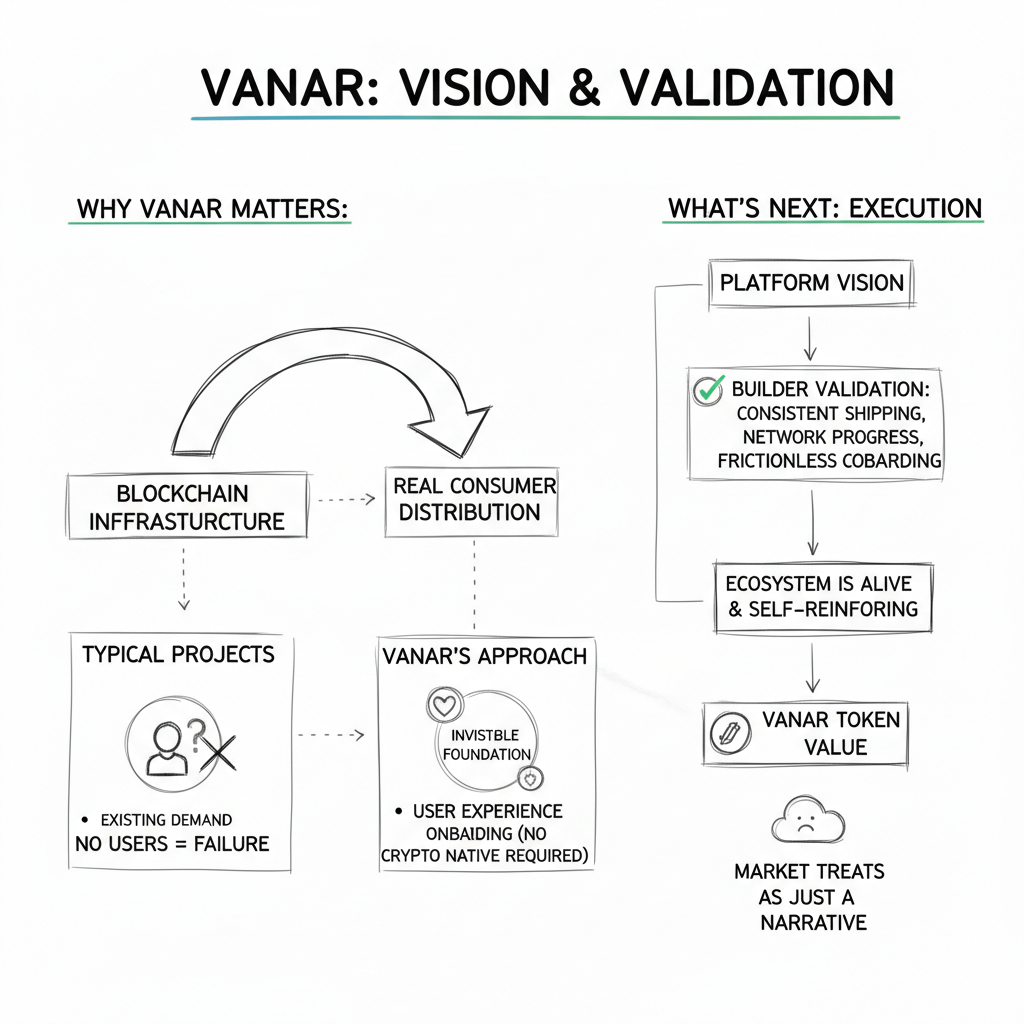
What’s next for Vanar, in the most honest way I can put it, is that the project has to keep turning its platform vision into something that feels real in the hands of builders, because the moment you see consistent shipping, clear network progress, and consumer-facing products that onboard people without heavy friction, the story becomes self-reinforcing and the token begins to feel like it belongs to an ecosystem that is alive, and if those pieces don’t arrive in a convincing way, the market will treat the narrative as just another promise, even if the intention is genuine.
My personal takeaway is that Vanar reads like a team that is aiming for a long runway outcome rather than a short-term marketing spike, and the smartest way to approach it is to watch for practical proof that they are quietly building the rails for mainstream experiences, because if they succeed at that, Vanar stops being just “an L1 token” and starts looking like an infrastructure bet on consumer adoption, where the technology, the ecosystem funnel, and the token utility all point in the same direction instead of pulling away from each other.
