
Wintermute OTC's article has pointed out a very important point that many investors are still not fully aware of: the four-year cycle of crypto is not just delayed, it's dead. This is not a mild comment or a temporary forecast—it's a profound structural change in the way the crypto market operates, and it has profound implications for investors, especially those looking for growth opportunities in 2026 and beyond.
To understand this better, we need to go back in history. The four-year cycle of crypto—often called the "halving cycle"—has been one of the most predictable phenomena in financial market history. It is based on a simple assumption: every four years, the reward for mining BTC will be halved. This event is supposed to create an artificial scarcity, leading to a price increase. And indeed, in the three previous halving cycles (2012, 2016, 2020), this happened pretty much as expected.
However, 2025 broke this pattern. Although the BTC halving happened in April 2024, the market did not follow the traditional script. Instead, we witnessed an extreme concentration of capital into a few large assets, while the rest of the altcoin market was left behind. This shows that the fundamental factors of the halving cycle are no longer the main determinants of market performance.
Instead, what is determining market performance is where the capital is actually flowing into. And in 2025, the capital flowed into a few large assets—mainly BTC, ETH, and some other large altcoins—rather than being dispersed across the entire market as in previous cycles.
A significant factor contributing to the fragmentation of the crypto market is the rise of ETFs and digital investment tools (DATs). These products have formed 'walled gardens', where new capital inflows into the market are concentrated on a limited group of assets they support.
The operating mechanism of ETFs and DATs makes it easy for institutional investors to access crypto without having to manage wallets or face security risks. However, to pass strict regulatory approval processes, they often only include major, highly liquid, and widely recognized assets such as Bitcoin, Ethereum, and some top altcoins.

As a result, new capital is mainly 'locked' in these assets, rather than spreading to smaller projects or less prominent altcoins. Unlike previous cycles, where Bitcoin's bull run often triggered a ripple effect or capital flow to Ethereum and then to smaller altcoins, this phenomenon has almost disappeared in 2025. Capital is retained in 'walled gardens' instead of being widely distributed.
According to data from Wintermute OTC, the extent of capital diffusion has significantly declined. Specifically, altcoin price rallies have become shorter and less frequent: if they lasted an average of 60 days in 2024, they only lasted about 20 days in 2025.
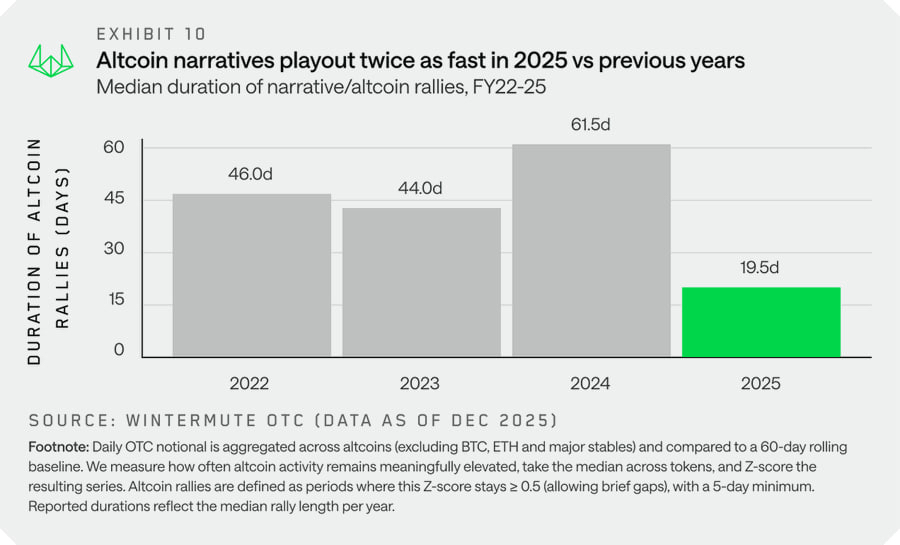
According to data from Wintermute OTC, the spread of capital has significantly declined. Specifically, altcoin price rallies have become shorter and less frequent: if they lasted an average of 60 days in 2024, they only lasted about 20 days in 2025.

