
When I spend time with new infrastructure, I try not to form opinions too quickly. Most systems look fine at the beginning. State is clean. Context is fresh. Nothing has been used long enough to show strain. Early impressions are usually generous by default.
What I pay more attention to is how a system behaves once novelty wears off. That’s where most problems start to appear.
Many blockchains feel optimized for beginnings. Launch phases. New applications. Clean assumptions. They perform well when attention is high and activity is concentrated. Over time, that posture becomes harder to maintain.
What I noticed while interacting with Vanar was that it didn’t seem particularly focused on beginnings at all. It behaved more like a system that expected to be used, left alone, and returned to later without ceremony.
That stood out.
I didn’t interact with Vanar in a structured way. There was no stress test or deliberate evaluation. I used it casually, stepped away, and came back after gaps. The behavior didn’t feel reset or degraded by absence. Context didn’t feel stale. Nothing seemed to require refreshing.
Most platforms feel subtly uncomfortable with that kind of usage. Old state accumulates. Interfaces assume recency. Systems behave as if they expect a reset or an upgrade cycle to clear accumulated complexity.
Vanar didn’t give me that impression.
It felt like it expected to exist over long stretches without intervention.
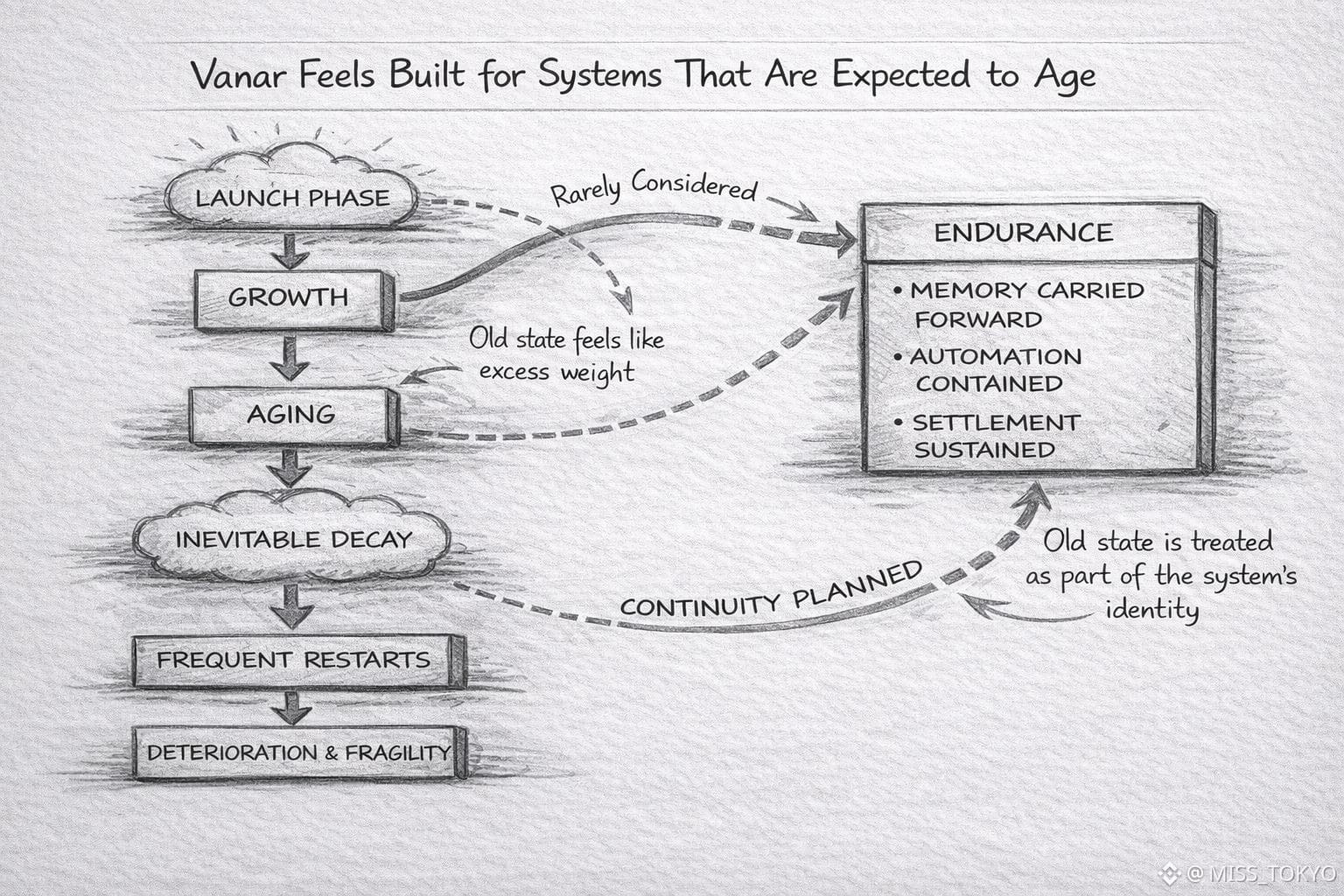
That’s not something you notice in a single session. It becomes apparent only after repetition and distance. After leaving things alone and returning without aligning your behavior to the system’s expectations.
This matters more than it sounds, especially once systems stop being actively managed.
AI systems don’t restart cleanly unless you force them to. They accumulate state. They develop patterns. Over time, they age structurally. Infrastructure that assumes frequent resets struggles in that environment.
Vanar didn’t feel built around that assumption.
Memory is the first place where this difference becomes visible.
On many chains, memory is treated as something to store and retrieve. Data is written, read, and reconstructed when needed. Context exists, but it often feels fragile across time. Systems assume developers will rebuild meaning when they return.
Through myNeutron, memory on Vanar feels less like storage and more like continuity. Context doesn’t appear to depend on recent interaction to remain coherent. It persists quietly, even when nothing is happening.
That’s important for systems that are expected to run for long periods without supervision.
AI systems don’t maintain intent actively. They rely on preserved context. When memory is treated as disposable, systems slowly lose coherence even if execution remains correct.
Vanar’s approach doesn’t prevent decay entirely, but it feels like it acknowledges that decay is the default state unless something counters it.
Reasoning shows a similar posture.
Kayon doesn’t feel designed to explain outcomes for presentation’s sake. It feels designed to remain inspectable over time. Reasoning exists whether or not someone is looking at it. It doesn’t announce itself. It doesn’t disappear after execution.
That matters in aging systems.
Over time, the hardest problems aren’t about performance. They’re about understanding why something behaves the way it does. Systems that don’t preserve reasoning force humans to reconstruct intent long after it has faded.
Vanar feels more tolerant of long-term inspection.
Automation is where aging systems usually reveal their weaknesses.
Automated processes that made sense early on often drift out of alignment. Conditions change. Context shifts. Automation continues anyway. Without boundaries, it accelerates decay rather than efficiency.
Flows doesn’t feel designed to push automation aggressively. It feels designed to constrain it. Automation appears deliberate rather than expansive, which suggests an awareness that automation must age alongside the system, not outpace it.
That’s not an obvious design choice. It’s one that usually comes from experience.
The background in games and persistent digital environments makes sense here. Games that last don’t get to reset history every year. Players remember. Systems accumulate meaning. Mechanics that weren’t designed to age become liabilities.
Designers in that space learn to think about endurance, not just correctness.
Vanar feels shaped by that way of thinking.
Payments add another layer to this.
Economic systems that age poorly accumulate distortions. Incentives that worked early become misaligned later. Tokens designed for growth struggle during long plateaus. Infrastructure that assumes constant momentum tends to fracture when activity slows.
From what I observed, $VANRY doesn’t feel positioned as a short-term accelerator. It feels embedded in a settlement layer that expects uneven usage and long periods of stability without requiring reinvention.
That’s not a statement about price or speculation. It’s an observation about structural role.
Settlement feels designed to keep functioning even when systems enter maintenance phases rather than growth phases.
Cross-chain availability fits into this as well.
Systems that age don’t stay isolated. They integrate. They migrate. They extend. Infrastructure that treats each environment as a reset point loses continuity.
Vanar extending its technology beyond a single chain, starting with Base, feels aligned with maintaining continuity across environments rather than starting over each time.
This isn’t about expansion as a goal. It’s about not tying longevity to a single ecosystem’s lifecycle.
I don’t think most people will notice this quickly. It doesn’t show up in metrics. It doesn’t translate well into demos. It becomes visible only after systems have existed long enough to feel neglected.
That’s usually when infrastructure either starts to feel brittle or quietly proves it was built with endurance in mind.
Vanar feels closer to the second outcome.
I’m not suggesting it’s finished or flawless. Aging is messy. No system ages cleanly. What matters is whether aging was considered at all.
Vanar behaves like it was.
It doesn’t assume constant renewal. It doesn’t demand attention to remain coherent. It doesn’t feel like it expects to be replaced soon.
It feels like something that expects to stick around.
That’s not a guarantee of success. But in a space obsessed with momentum, it’s a posture worth paying attention to.
Most infrastructure is built to move fast. Very little is built to last.
Vanar feels more aligned with the second category.
Not because it claims to be, but because of how it behaves when nothing is changing.
You leave. You come back. The system hasn’t lost itself.
That’s a quiet quality. It’s easy to overlook. But for systems meant to support AI, games, and long-running digital environments, it may matter more than anything else.
