
That night I watched a wallet get frozen in just a few minutes not because of a hack, but because of a blacklist order coming from somewhere the user could never reach, and the whole chat room went silent like the power had been cut.
Stablecoins are often sold as the life raft of the crypto market, but maybe anyone who has lived through a few cycles knows they are closer to a “contract of trust” than a law of physics.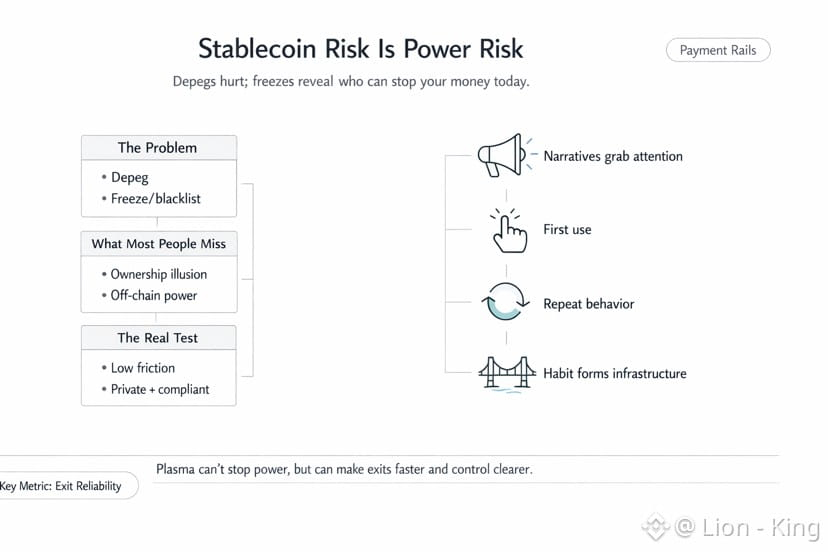
A depeg is not just a red candle. It is the moment you realize the thing you call money can slip away from the 1.00 mark in a thin liquidity session.
Freezes and blacklists are worse. How bitterly ironic that they tend to happen right when you need a stablecoin most: when you want to withdraw, when you need to rotate capital, when you are trying to step away from risk. Honestly, a lot of people only see stablecoins as a balance inside an app until they learn that “ownership” in crypto can still come with a stop button somewhere.
@Plasma shows up right inside that fatigue, and I think that is why it is worth a closer look rather than treating it as just another new story. Instead of trying to be a blockchain for everything, #Plasma positions itself as infrastructure built specifically for stablecoins, focused on making “digital dollars” move fast, cheaply, simply, and at a scale that can support real payments.
On its website and in its materials, it emphasizes a high performance Layer 1 for stablecoins, EVM compatibility, and near instant USDT transfers with very low fees, even aiming for free basic USDT transfers.
But when you talk about stablecoin risk, you have to separate the layers. Depegs are largely a story of reserve quality, issuance mechanics, and market liquidity. Plasma cannot “ban” depegs from happening, and it cannot force every stablecoin to be neutral. What Plasma is doing is choosing a different battlefield: reducing operational friction so stablecoins move more like money, meaning fast, cheap, easy to integrate, and not turning every transfer into a drawn out ritual of signing and approvals. When users have to pay high fees, wait too long for confirmations, or rely on complex detours, a single bad headline can amplify panic. Less friction does not erase risk, but sometimes it makes the fall less violent because people still have an exit.
And what about freezes and blacklists. I have always treated this as the “reality tax” of centralized stablecoins: if you want broad acceptance, you often end up accepting a degree of control at the issuer level. Tether freezing addresses has happened many times, and it is a reminder that some power lives off chain, whether you are on Ethereum, Tron, or anything else. Plasma cannot erase that power, but it can build rails so users and businesses are not trapped inside a single pipe, and can design payment and custody flows in ways that create fewer choke points. Or put differently, Plasma is not promising absolute censorship resistance. It is trying to make control, if it exists, explicit and operable within a compliance reality.
What I am watching most closely with Plasma is how it talks about being “private but compliant,” and its long term direction of anchoring state to Bitcoin over time. It sounds elegant, but it touches two long running anxieties: privacy in payments, and neutrality at the base layer. If Plasma can truly enable private transactions while still meeting compliance requirements, and if the path to anchoring into Bitcoin is executed with discipline, then it is attempting to recover some of the “cash like” quality for stablecoins without pushing the system outside the legal perimeter. Who would have thought a product that sounds as dry as a settlement layer could become such a psychological battlefield.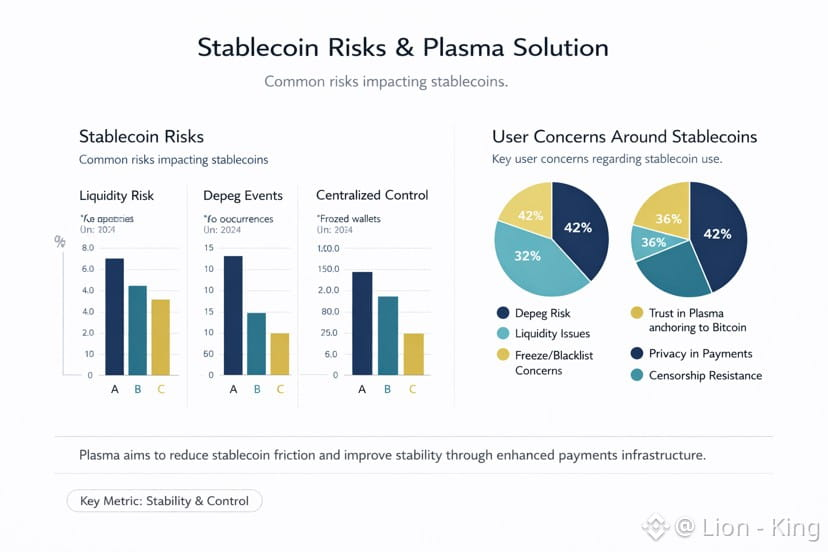
Still, I do not buy stories on slogans alone. A stablecoin rail that deserves trust has to prove three things: production readiness, a validator model that is decentralized enough, and an upgrade path that does not turn users into hostages.
Plasma is often discussed with details around verifiers, threshold signing, and bridging routes, but the real test is still deployment and audits under adversarial conditions, with real users, real incidents, and real pressure. I think the market will forgive slow progress, but it will not forgive a single infrastructure level “freeze” caused by rushed design.
The biggest lesson stablecoins have taught me is this: the danger is not price volatility. It is volatility of power.
If Plasma does it right, it is not a miracle cure for depegs or blacklists. It is an attempt to put stablecoins on a more serious operating rail, where payment experience, security, and transparency are prioritized instead of chasing TVL or growth narratives. And the question I keep for myself, and for anyone who has ever been trapped by a sudden freeze, is whether we are choosing stablecoin infrastructure because it is convenient on ordinary days, or because it can still stand upright on the worst day. $XPL

