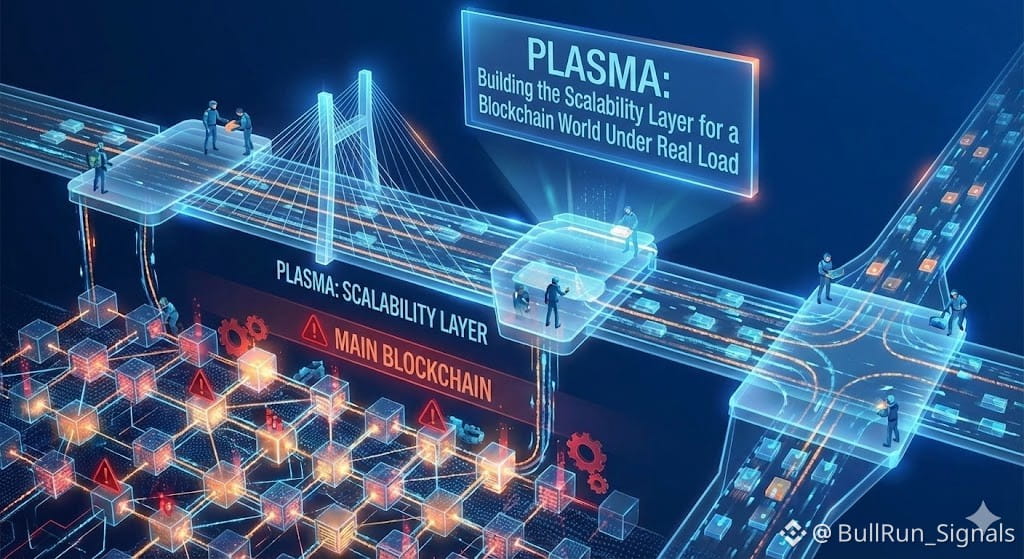
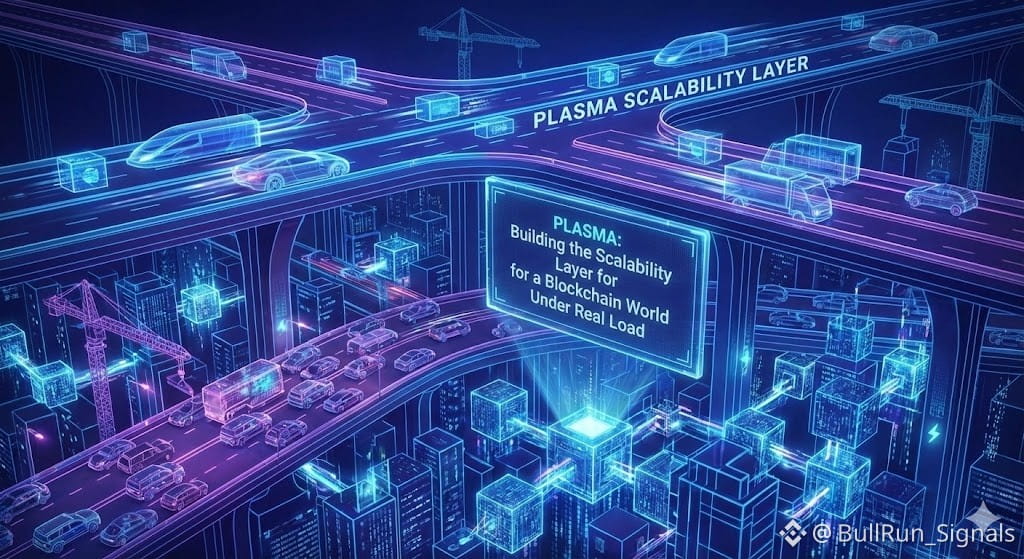
Blockchain adoption is no longer a theoretical discussion. Millions of users interact with DeFi protocols, NFT marketplaces, gaming platforms, and on-chain applications every day. Yet despite years of innovation, the ecosystem still struggles with a fundamental challenge: scaling reliably under sustained demand.
High transaction fees, network congestion, delayed confirmations, and fragmented user experiences remain common during periods of activity. These are not edge cases. They are signals that current infrastructure is still incomplete.
Plasma was designed to address this gap.
The Real Scalability Problem
Most discussions around scalability focus on headline metrics—transactions per second, block times, or benchmark performance. While these figures matter, they often fail to capture the real issue: how a network behaves when demand spikes and stays high.
In real market conditions, blockchains face:
Congestion during volatile periods
Rising fees that price out users
Reduced composability across applications
Complex solutions that sacrifice usability
True scalability is not about peak performance. It is about consistency, efficiency, and resilience.
Plasma’s Design Philosophy
Plasma approaches scalability from an architectural perspective rather than a marketing one. Its core objective is to reduce the load on base layers while preserving security and decentralization.
By shifting execution away from the main chain and relying on efficient verification mechanisms, Plasma enables:
Lower transaction costs
Higher effective throughput
Reduced network congestion
Predictable performance under stress
Instead of forcing every interaction onto a single layer, Plasma allows blockchains to scale horizontally, adapting naturally as usage increases.
Efficiency Over Excess
One of Plasma’s defining characteristics is its focus on execution efficiency. Rather than maximizing raw speed at the cost of complexity, Plasma optimizes how transactions are processed, batched, and finalized.
This efficiency-first approach benefits:
Developers, who can build without worrying about sudden fee spikes
Users, who experience faster and cheaper interactions
Protocols, which remain usable during peak activity
Scalability that breaks during success is not scalability at all. Plasma is designed to function when networks are busiest.
Built for Real Applications
Plasma is not limited to a single use case. Its architecture supports a wide range of high-demand applications, including:
DeFi platforms requiring frequent transactions and low latency
Blockchain games with continuous micro-interactions
Payment systems and remittances where cost predictability matters
NFT ecosystems operating during high-traffic launches
These sectors are not future possibilities—they are active today. Plasma is built for current and growing demand, not hypothetical adoption.
Plasma in the Market Cycle
Historically, infrastructure projects gain recognition after they prove their value under pressure. During bull markets, congestion exposes weaknesses. During quieter phases, builders focus on solving them.
Plasma is emerging in a period where:
Attention has shifted from hype to utility
Capital is more selective
Long-term design is prioritized over short-term speculation
This positions Plasma as a protocol aligned with sustainable ecosystem growth, rather than temporary narratives.
The Bigger Picture
Blockchain’s future depends on whether it can support millions of users without friction. Adoption will not be driven by slogans or promises—it will be driven by systems that work quietly and reliably.
Plasma represents this philosophy. It is not designed to dominate headlines. It is designed to hold the ecosystem together when demand peaks.
In every technology cycle, the projects that last are not the loudest ones.
They are the ones that become indispensable.
Plasma is building toward that role.