
It is commonly anticipated that AI systems are more likely to behave like ongoing services, and not discrete tools. They retain memory, process changing context, instigate action, and also connect to users and systems across extended durations of time. It is not intelligence, but infrastructure that plays the role of facilitating this transition. Most of the current networks have been developed to execute discretely, i.e. one transaction, starting and finishing fast. Continuous AI implementation presents the underlying system with vastly different requirements.
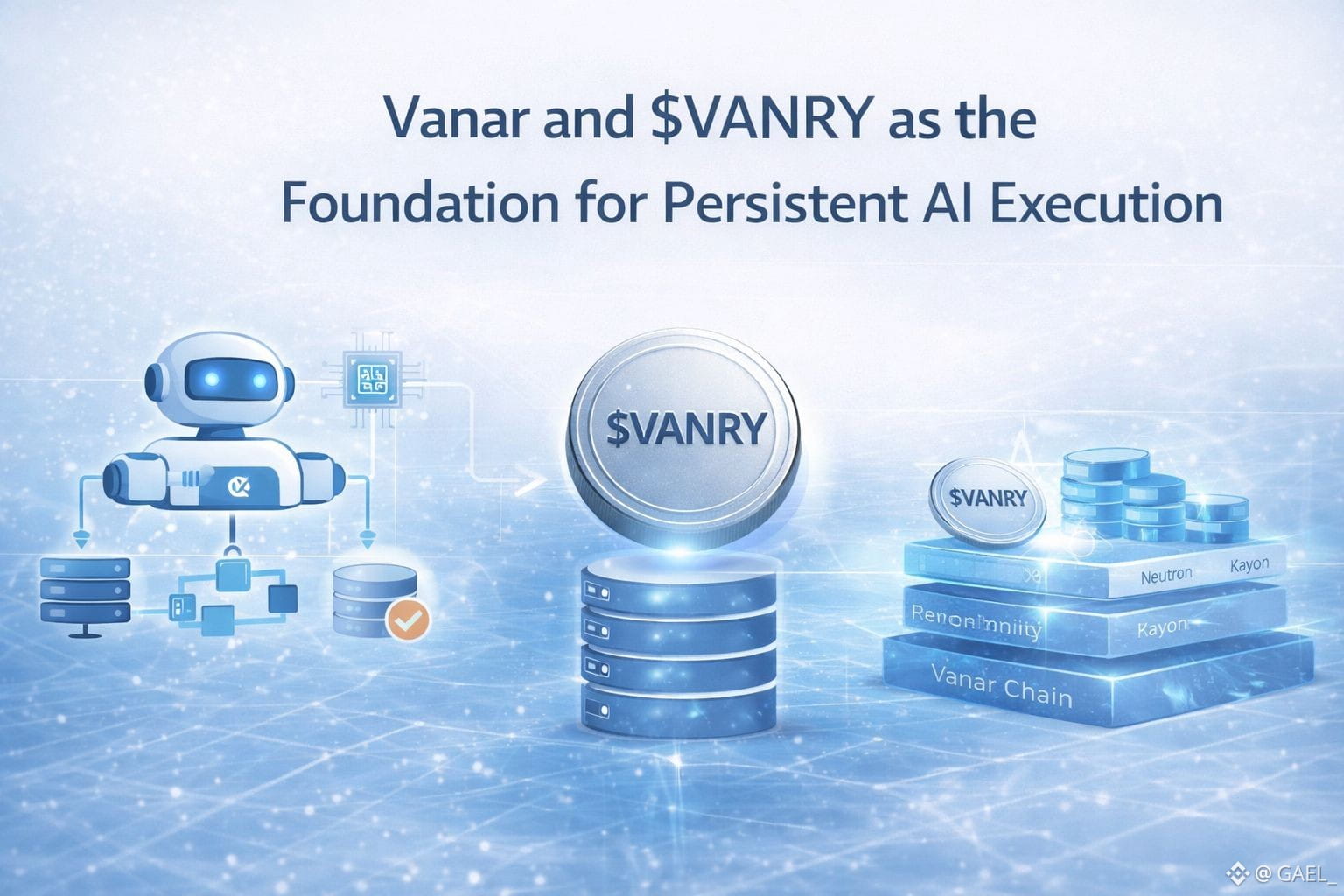
Vanar attempts to solve this issue by considering persistence and execution as infrastructure demands. The network is designed to accommodate long run processes which will be completed in a reliable manner rather than optimizing it to get a momentary throughput or a transactional volume. In this architecture, the operational base is $VANRY which holds the execution, the coordination and continuity together.
Continuous AI implementation has three conditions: guaranteed availability of resources, reliability in the execution of processes, and responsibility in the event of failures. In the absence of them, AI systems become best-effort services that fail in a sporadic manner under load. The traditional models presuppose that incentives will be in line once the execution is made. Vanar turns this supposition around. Implementation is estimated prior to implementation.
The key to this design is played by $VANRY. It is not fierced as a narration tool or hypothetical overlay, but as a tool which enforces execution certainties. The network is able to preempt the resources required in a task compute, storage, coordination and settlement capacity by demanding economic commitment. Once a process is initiated, it is the duty of the system to accomplish it within stipulated parameters. This makes execution more of a certainty rather than a possibility.
Such a difference is most important to AI-based systems. AI agents and processes require memory, which is preserved over multiple sessions, context, which changes with time, and operations, which have to run sequentially. Should any of those links fail unexpectedly, then the system will be unreliable. The architecture of Vanar is such that this problem cannot be done.
Another important consideration is dealing with failure. In most settings, failure of a given task leads to lack of clarity of responsibility. Was it the network, the validator or about the application? This uncertainty renders it challenging to create systems, which institutions or enterprises can rely on. Vanar alleviates this ambiguity by relating execution to economic commitment. In the case of an upfront commitment of VANRY, execution failures are visible and constrained on the infrastructure level. This is necessary in the case of systems that are required to be running.
Predictability goes past the execution to the cost structure. The AI applications cannot perform well when the conditions of fees are volatile or opaque. Unexpected cost rises interrupt the working process and ruin user experience. Vanar solves this by removing complexity out of the application layer. The predictable execution condition is under the interaction of developers, and the economic mechanics is underwritten in the infrastructure that does not want end users to comprehend blockchain dynamics.
Other critical design guidelines in Vanar include making blockchain dynamics opaque. Users that use AI-powered services must feel that they have just another software solution, and not an experimental network. The interface level is not exposed to gas pricing, validator behavior and congestion of the network. This invisibility can only occur in a case where execution is reliable. $VANRY makes this possible because it is an internal mode of enforcement and not an external point of interaction.
The focus on real products and the layers built by Vanar supports this strategy. Continuous memory, situational thinking and automated processes are only important when they can be maintained in the long-term. Remaining reachable, actionable logic, and processes should not stop and this is anchored in the economics of VANRY so as to guarantee continuity throughout the lifecycle of intelligent systems.
The manner of measuring the value of infrastructure is also re-packaged in this model. Vanar does not emphasize the number of transactions that can be made or the hypothetical scalability, but instead reliability. Execution that completes. Memory that persists. Systems which act as they should in real-life situations. VANRY helps with this transition by financing continuity and not events.
With the transition to AI systems in production settings and not experimentation, the infrastructure expectations shift. Dependability, responsibility and perseverance are no longer negotiable. Networks which cannot ensure execution will fail to run real-life AI load, no matter how sophisticated its models might be. It is with this fact in mind that Vanar architecture is constructed.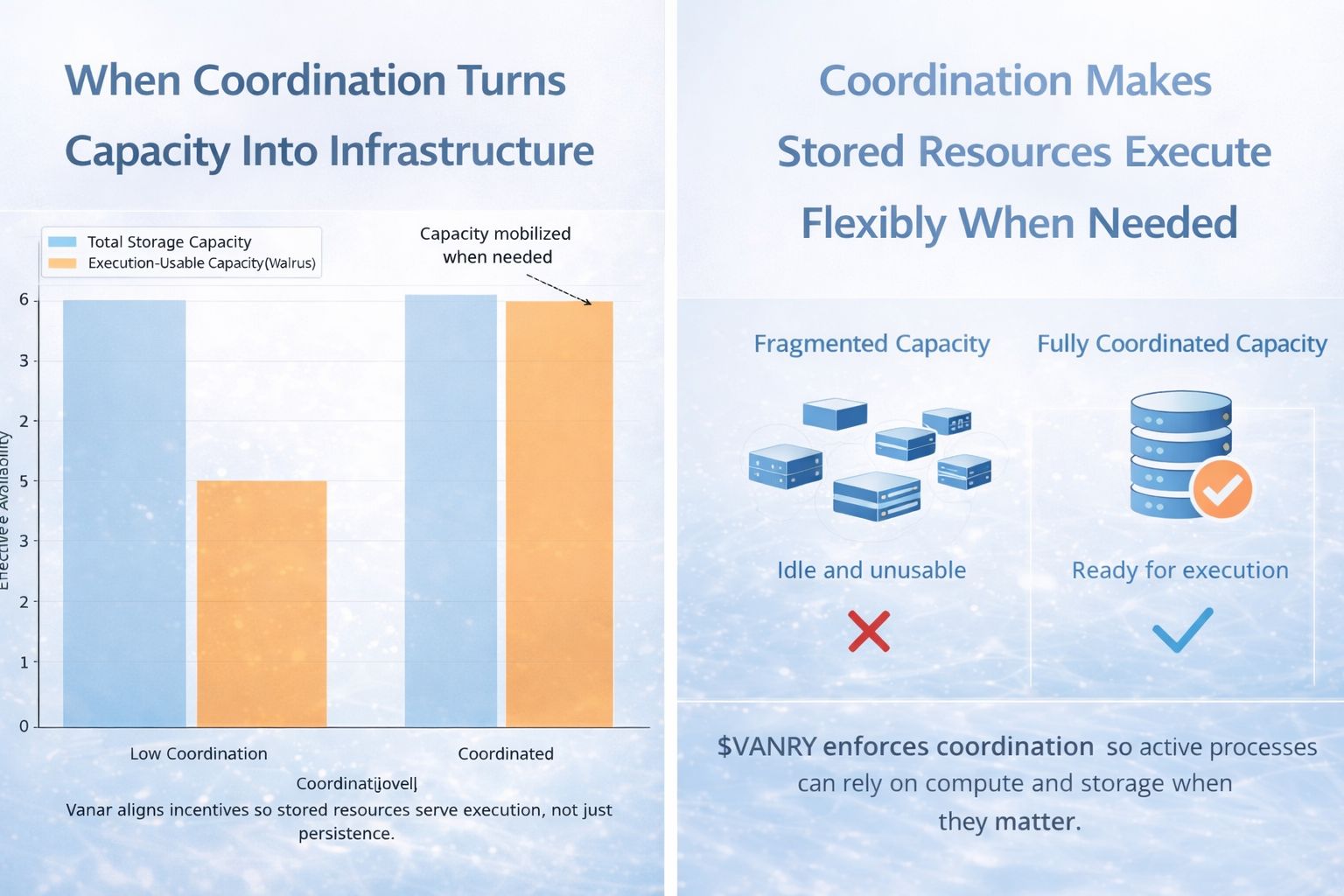
The collaboration between Vanar and $VANRY is a basis of continuous AI implementation, as it contaminates economic commitment and operational responsibility. Implementation is imposed, resources are synchronized and systems are devised to run without a condition but as a continuous one. Persistence is not a choice in an ecosystem where AI is becoming more and more dependent on the long-term context and automation. It is fundamentative and Vanar has been made in such a way that it is supportive.
