

The U.S. debt story is often told as a domestic issue. Trillions spent, deficits widening, interest costs rising. But that framing misses the real picture.
America’s debt is not just America’s problem — it is a global system.
As of 2026, total U.S. debt has crossed $38 trillion, increasing at a pace of roughly $93,000 every single second. This is not a slow burn. It’s a constant, compounding pressure on the global financial structure.
And here’s the part most people underestimate…
Nearly 24% of U.S. debt — over $9.1 trillion — is held by foreign countries.
That means governments, central banks, and sovereign funds around the world are directly tied to the stability of U.S. Treasury markets. This isn’t symbolic ownership. This is systemic dependency.
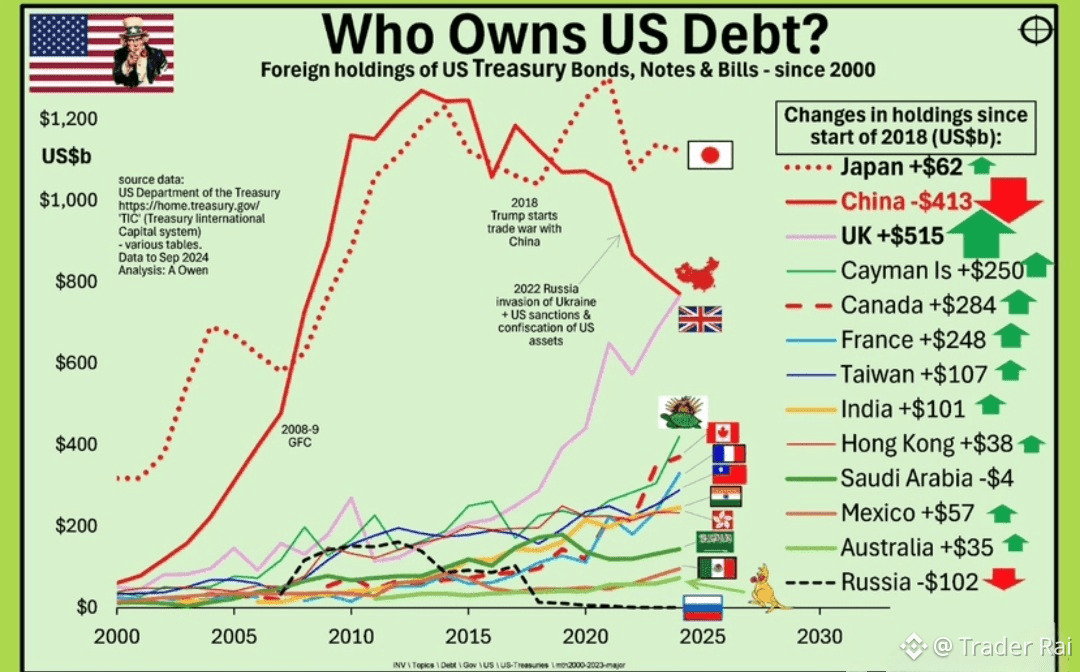
Who Holds the Paper That Holds the System Together?
Among foreign holders, a few names dominate the list:
Japan — approximately $1.13 trillion
United Kingdom — around $779 billion
China — roughly $765 billion
Canada — about $426 billion
These are not passive positions. These holdings are the result of decades of trade surpluses, reserve accumulation, and trust in U.S. dollar liquidity.
For many countries, buying U.S. Treasuries isn’t optional — it’s structural. Export-driven economies recycle surplus dollars back into U.S. debt to stabilize their currencies, manage reserves, and keep trade flowing.
This Is How the Dollar System Really Works
The global financial system runs on USD recycling.
Countries sell goods to the U.S.
They receive dollars.
Those dollars must go somewhere.
They return — as U.S. Treasury purchases.
This loop keeps the dollar strong, U.S. borrowing cheap, and global liquidity deep. It’s a finely balanced machine built over decades.
But systems like this don’t break from noise.
They break when confidence shifts.
Why This Isn’t Just About Numbers
When foreign ownership of U.S. debt grows, the system becomes more interconnected — and more fragile.
If trust in U.S. fiscal discipline weakens…
If geopolitical tensions escalate…
If reserve diversification accelerates…
Even small reallocations can create large market shocks.
Bond yields spike.
Currencies swing.
Liquidity dries up faster than expected.
This is why U.S. debt is not just an economic metric — it’s a geopolitical instrument.
The Bottom Line
The U.S. doesn’t finance itself in isolation.
The world helps finance the United States — because the system demands it.
But the moment that recycling loop slows, questions turn into pressure…
And pressure turns into volatility.
This isn’t fear.
It’s structure.
And understanding that structure is what separates surface-level narratives from real macro awareness.