
Decentralized systems often promise trust minimization, yet quietly depend on trust when it comes to data availability. Files are expected to remain accessible because someone is incentivized to care, or because a service provider is assumed to remain online.
Over time, those assumptions break. Operators leave. Costs rise. Attention shifts. Walrus approaches this problem from an economic perspective rather than a moral one. Instead of asking participants to behave reliably, it designs a system where reliability is the only profitable behavior.
At the core of @Walrus 🦭/acc is the idea that data availability must be enforced through incentives, not belief. Storage nodes are not trusted custodians. They are economic actors responding to measurable rewards and penalties. Walrus requires nodes to continuously demonstrate that they still possess the data they are responsible for. These proofs are not symbolic. They directly determine whether a node is paid. Availability is no longer an assumption built into the system. It becomes a condition that must be satisfied again and again over time.
This shifts storage from a static service into a live market. In many decentralized storage systems, the act of storing data happens once, and persistence is hoped for afterward. @Walrus 🦭/acc rejects this model. Data lives only as long as the network continues to verify its existence. Nodes that go offline, fail to respond, or attempt to cheat are economically filtered out. Nodes that remain reliable earn sustained rewards. The result is a feedback loop where long-term participation is more valuable than short-term extraction.
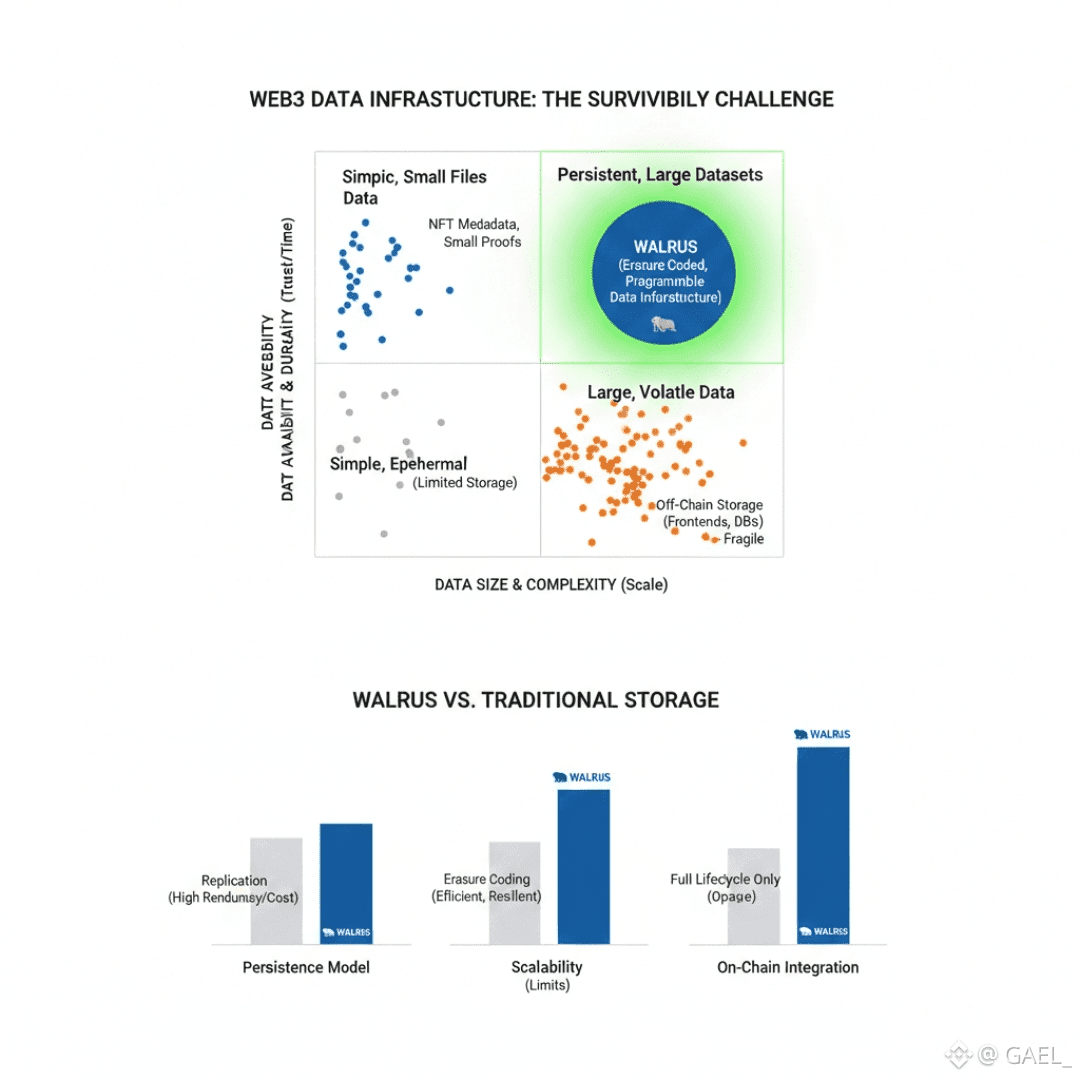
A key reason this works at scale is @Walrus 🦭/acc use of erasure coding. Rather than requiring every node to store complete copies of data, Walrus distributes encoded fragments across many participants. The system only needs a subset of those fragments to reconstruct the original data. This dramatically lowers storage overhead while increasing resilience. More importantly, it allows the network to tolerate churn without sacrificing availability. The economics remain stable even as individual nodes come and go.
@Walrus 🦭/acc also addresses a deeper issue often overlooked in decentralized design. Storage is not just about capacity. It is about time. Data must remain accessible long after the original application, team, or narrative has faded. By tying rewards to ongoing verification rather than one-time commitments, Walrus creates an environment where maintaining old data is just as economically rational as storing new data. Persistence is not sentimental. It is profitable.
This model has significant implications for applications that rely on historical integrity. Governance systems depend on old proposals and voting records. Financial protocols rely on historical states and datasets. AI systems require persistent training data and outputs that can be audited later. In each case, losing data is not a minor inconvenience. It undermines legitimacy. Walrus ensures that this legitimacy is backed by enforceable economics rather than trust in off-chain services.
@Walrus 🦭/acc does not claim that data should live forever by default. Instead, it makes longevity an explicit, programmable choice backed by incentives. This clarity is what allows the system to scale sustainably. By treating availability as an economic problem rather than a storage problem, Walrus builds infrastructure that remains reliable even when trust disappears. In decentralized systems, that difference defines what endures.
