


When businesses evaluate blockchain-based transactions, the first questions are rarely ideological. They are practical: Can this reduce costs? Can it simplify coordination? Can it lower operational risk? Walrus positions WAL not as a speculative currency, but as an operational unit that prices data availability and verification in a predictable, auditable way. For organizations that depend on data-intensive workflows, this distinction matters.
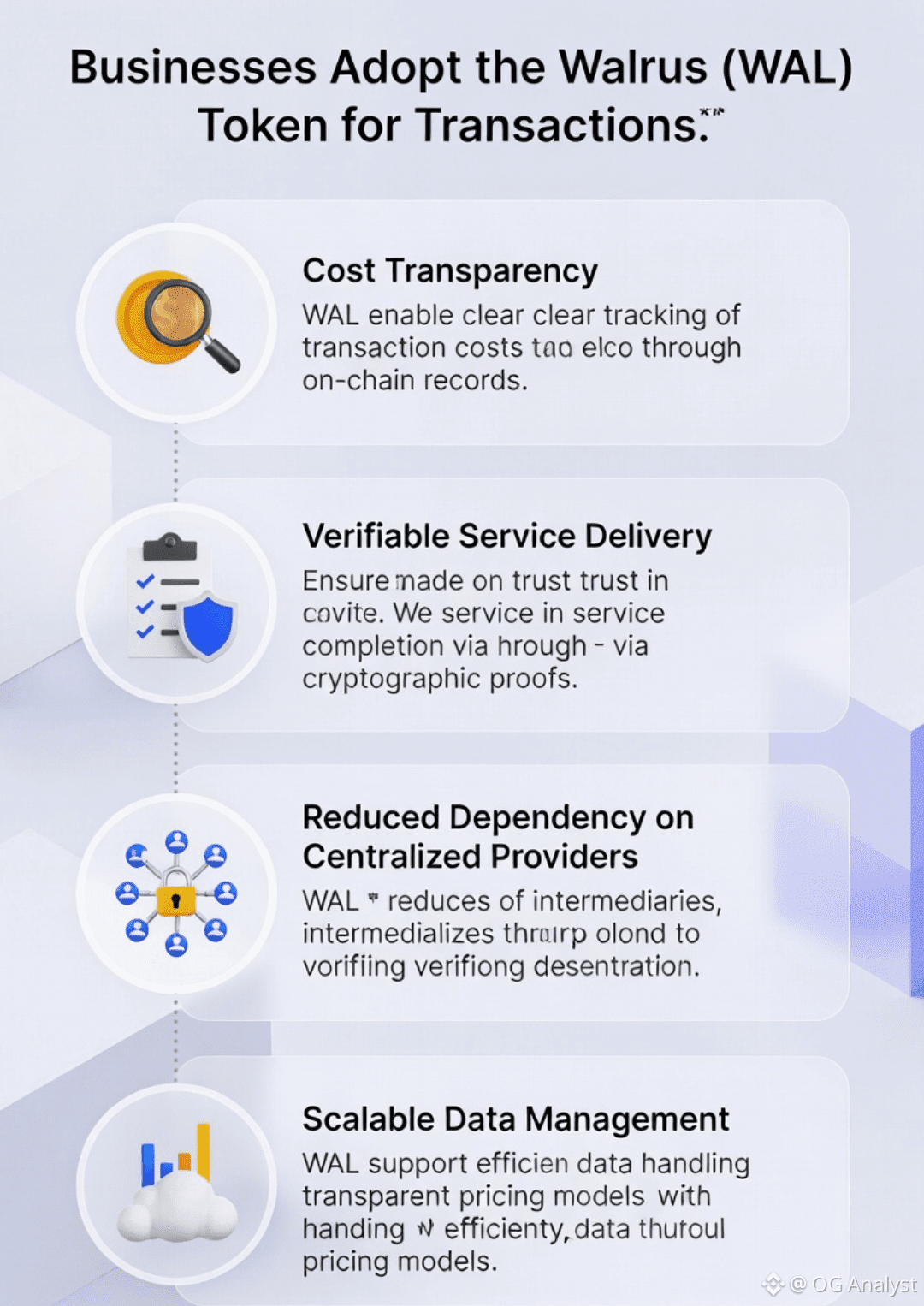
Clear cost structure for data services
Traditional data infrastructure bundles storage, access, redundancy, and availability into opaque pricing models. Costs often rise unpredictably as usage scales. Walrus separates these concerns and prices them explicitly.
By transacting in WAL, businesses pay directly for measurable outcomes—data storage duration, availability guarantees, and verification. This creates clearer budgeting and easier cost attribution. Finance and operations teams can reason about data expenses in concrete terms rather than abstract service tiers.
Reduced reliance on centralized intermediaries
Using WAL allows businesses to interact directly with a decentralized storage network without relying on a single provider’s uptime or policies. This reduces vendor lock-in and mitigates risks associated with unilateral service changes, outages, or data access restrictions.
For industries where data continuity is critical—such as media, research, logistics, or compliance-heavy sectors—this decentralization offers operational resilience rather than ideological decentralization.
Verifiable transactions and auditability
Every WAL-based transaction is recorded on-chain, creating a transparent audit trail. For businesses, this simplifies reconciliation, compliance, and internal auditing.
Rather than trusting off-chain reports or opaque invoices, organizations can verify what services were paid for and whether they were delivered. This is particularly valuable when multiple teams or partners share responsibility for data assets.
Alignment between service quality and payment
WAL transactions are tightly coupled to performance expectations. Storage providers are compensated only when they meet availability and proof requirements. This aligns incentives in a way that traditional service contracts often struggle to enforce.
Businesses benefit from this alignment by paying for outcomes rather than promises. If service quality degrades, economic consequences follow automatically through protocol rules rather than legal escalation.
Scalable integration with decentralized applications
For businesses building or integrating with dApps, WAL provides a native way to handle data-related payments inside programmable workflows. Storage, retrieval, and verification can be triggered and settled automatically without manual intervention.
This reduces operational overhead and enables new automation patterns—especially for platforms managing large volumes of user-generated or machine-generated data.
Long-term data durability as a strategic asset
Many businesses underestimate the long-term cost of data loss or degradation. Walrus, through WAL-based incentives, is designed to maintain data availability over extended periods.
For enterprises that view historical data as a strategic asset—analytics, training datasets, intellectual property—this durability reduces future recovery and migration costs.
A conservative entry point into token-based infrastructure
Importantly, adopting WAL does not require businesses to redesign their entire financial stack. WAL can be treated as a utility token used for specific operational functions, not as a treasury asset or speculative holding.
This lowers the barrier to experimentation while keeping financial exposure controlled.
Conclusion
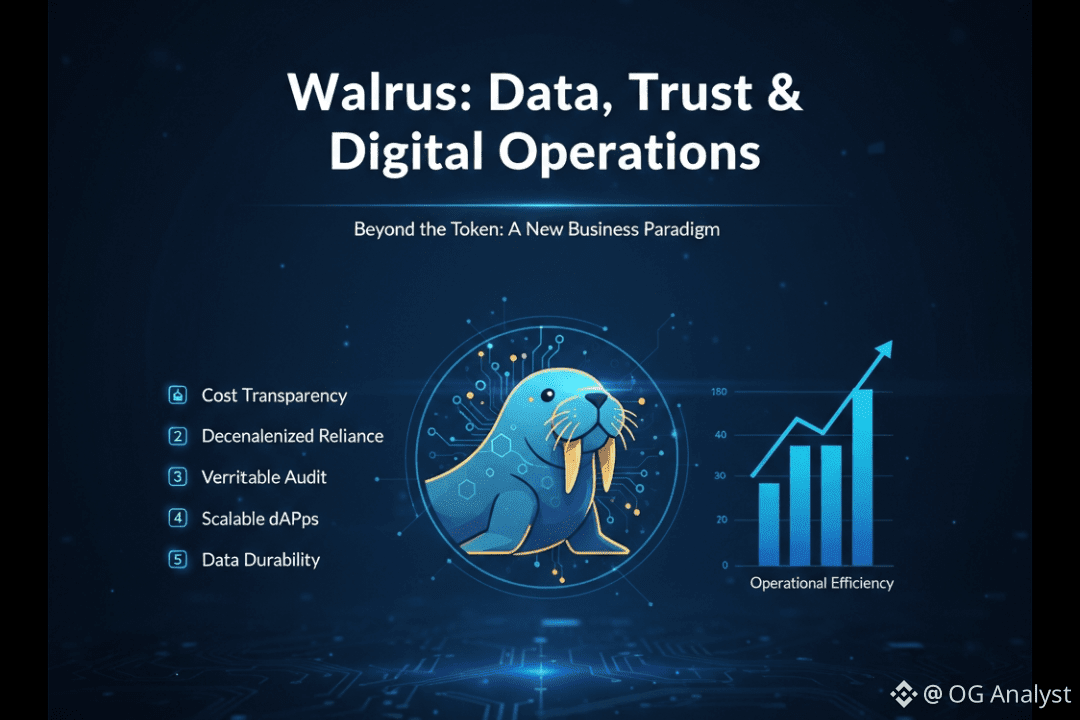
Businesses that adopt the Walrus (WAL) token for transactions gain more than an alternative payment method. They gain cost transparency, verifiable service delivery, reduced dependency on centralized providers, and a scalable way to manage data-intensive operations. WAL functions as an operational instrument—quietly embedding accountability and efficiency into transactions that businesses already need to execute.

