
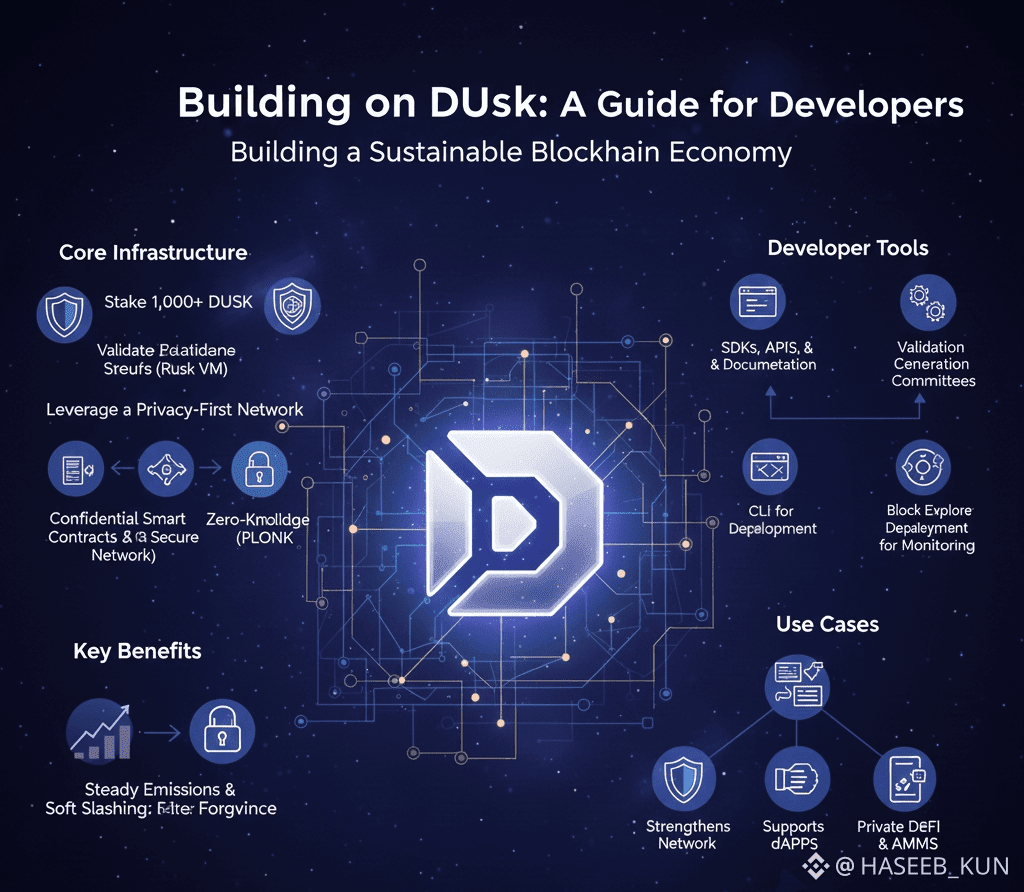
There's a particular moment every blockchain developer experiences—that instant when you realize the platform you're building on can't actually deliver what your users need. Maybe it's when you're designing a decentralized exchange and discover that every trade you execute will be visible to front-running bots. Perhaps it's when you're tokenizing real-world assets and realize you can't enforce regulatory requirements without sacrificing the permissionless nature that makes blockchain valuable. Or it could be that sinking feeling when a client asks how you'll keep their business transactions confidential, and you have no good answer.
This is the wall that countless talented developers have hit. The promise of blockchain—decentralization, automation, transparency—suddenly collides with the messy requirements of real-world applications. Privacy isn't just a nice-to-have feature; for many use cases, it's absolutely non-negotiable.
Enter Dusk Network, a platform specifically architected to solve these problems. Building on Dusk means accessing infrastructure designed from the ground up for confidential smart contracts, privacy-preserving transactions, and regulatory compliance without centralized gatekeepers. For developers tired of compromising their vision to fit platform limitations, Dusk offers something different: the tools to build applications that actually work the way financial systems need to work.
This guide takes you deep into what it means to develop on Dusk—the architecture you'll work with, the tools at your disposal, the patterns you'll implement, and the entirely new categories of applications you can finally build properly.
Understanding the Developer Landscape
Before diving into code and architecture, let's establish context. What makes Dusk different from a developer's perspective? Why would you choose to build here rather than on more established platforms?
The Privacy Infrastructure Gap
Most blockchain platforms force developers into an uncomfortable choice. You can build on transparent networks where every transaction detail is public, or you can use permissioned systems that sacrifice the openness and censorship resistance that make blockchain valuable in the first place.
Dusk exists specifically to bridge this gap. The platform provides privacy-preserving infrastructure that's genuinely permissionless—anyone can build, deploy, and interact with applications without asking permission. But unlike transparent blockchains, applications built on Dusk can implement confidentiality where it matters.
Think about what this enables. You're building a decentralized lending protocol. On transparent chains, every borrower's collateral amount, loan size, and liquidation price is public knowledge. Sophisticated actors can monitor these positions and execute targeted liquidations for profit. On Dusk, your lending protocol can verify collateralization through zero-knowledge proofs while keeping position details confidential. The protocol works identically from a logical perspective, but the privacy fundamentally changes the user experience and security model.
This isn't about making minor improvements to existing platforms. It's about enabling entirely new categories of applications that simply don't work without privacy.
The Regulatory Compliance Reality
Here's an uncomfortable truth that many in crypto prefer to ignore: most valuable real-world assets exist within regulatory frameworks that aren't going away. Securities regulations, anti-money laundering requirements, know-your-customer rules—these aren't just bureaucratic annoyances. They're the legal infrastructure that enables trillions of dollars in economic activity.
As a developer, you can either pretend these regulations don't exist and build applications that remain perpetually confined to crypto-native use cases, or you can embrace compliance and build infrastructure that can actually bring real-world assets on-chain.
Dusk takes the second approach seriously. The platform provides confidential security contracts—smart contract primitives specifically designed for tokenizing regulated assets. These contracts can enforce transfer restrictions, implement accredited investor requirements, and provide selective disclosure to regulators, all while maintaining confidentiality from the general public.
For developers, this means you can build applications that actually comply with securities laws without sacrificing the automation and efficiency that make blockchain valuable. You're not waiting for regulations to change; you're building with them.
The Technical Sophistication Requirement
Building privacy-preserving applications involves technologies that sound intimidating: zero-knowledge proofs, confidential transaction models, cryptographic commitments, homomorphic operations. Many developers assume they need PhD-level cryptography knowledge to work with these tools.
Dusk's developer experience intentionally abstracts this complexity. You don't need to understand the mathematics of zk-SNARKs to build confidential smart contracts any more than you need to understand elliptic curve cryptography to use digital signatures. The platform provides high-level APIs and frameworks that make privacy accessible to mainstream developers.
That said, understanding the underlying concepts helps you build better applications. This guide balances practical implementation details with enough conceptual explanation that you'll understand what your code is actually doing under the hood.
Architecture Overview: The Foundation You're Building On
Every platform has architectural decisions that shape what you can build and how you'll build it. Understanding Dusk's architecture helps you design applications that leverage the platform's strengths rather than fighting against its constraints.
The Transaction Model: Phoenix
Dusk implements Phoenix, a novel transaction model specifically designed for privacy-preserving payments and smart contract interactions. Unlike account-based models where addresses have visible balances, Phoenix uses a note-based system where users control discrete notes with hidden values.
When you spend a note, you prove in zero-knowledge that you own it and that you're not double-spending, without revealing which note you're spending or its value. New notes are created for recipients, again with hidden values. The entire transaction graph remains confidential while the network maintains consensus on validity.
As a developer, this model influences how you design applications. Instead of querying an account balance, your applications work with note sets. Instead of transferring value by modifying account states, you consume input notes and create output notes. This might seem unfamiliar at first, but the model provides powerful privacy guarantees that account-based systems can't match.
Phoenix also enables elegant patterns for confidential smart contracts. Contract state can remain hidden, with state transitions verified through zero-knowledge proofs. Your decentralized exchange can process swaps without revealing trade sizes. Your lending protocol can verify collateralization without exposing position details. These patterns are natural in Phoenix but extremely difficult or impossible in account-based models.
The Consensus Layer: Segregated Byzantine Agreement
While you won't typically interact with consensus mechanisms directly, understanding how Dusk reaches agreement influences application design, particularly around timing assumptions and finality guarantees.
Segregated Byzantine Agreement separates block generation from validation, allowing the network to achieve fast finality while maintaining decentralization. For your applications, this means transactions confirm in seconds rather than minutes, enabling use cases that require quick settlement—important for financial applications where transaction certainty matters.
The consensus mechanism also validates zero-knowledge proofs natively, meaning validators can verify confidential transactions without seeing their contents. This is crucial for maintaining privacy at the protocol level rather than just the application layer.
Understanding finality matters for your smart contracts. Unlike probabilistic finality systems where transactions become increasingly unlikely to reverse over time, Dusk provides deterministic finality. Once a transaction is included in a finalized block, it's truly final. Your contracts can make irreversible decisions without worrying about reorganizations.
Smart Contract Execution: Piecrust VM
Dusk smart contracts run on Piecrust, a virtual machine specifically designed for privacy-preserving computation. Unlike virtual machines that were retrofitted with privacy features, Piecrust was built from the ground up to support confidential contracts.
You'll write smart contracts in Rust, a systems programming language with strong safety guarantees and excellent tooling. If you're familiar with Rust, you'll feel immediately at home. If not, the learning curve is worthwhile—Rust's ownership model and type system help prevent entire categories of bugs that plague smart contract development.
Piecrust provides APIs for zero-knowledge operations, cryptographic primitives, and state management. Your contracts can create and verify proofs, generate commitments, and perform confidential computations. The VM handles the complexity of proof generation and verification, exposing clean interfaces that you can use without cryptographic expertise.
Importantly, Piecrust is deterministic—given the same inputs, contract execution always produces identical outputs. This determinism is crucial for consensus, allowing validators to independently verify contract execution and agree on state transitions.
Development Environment: Your Toolkit
Let's get practical. What tools will you use? How do you set up a development environment? What does the workflow look like?
SDK and Libraries
Dusk provides comprehensive software development kits for contract development and application integration. The core SDK includes:
Contract Development Framework: Libraries and macros for writing smart contracts in Rust, with abstractions for common patterns like token standards, access control, and state management.
Cryptographic Primitives: High-level APIs for zero-knowledge proofs, commitments, and other privacy-preserving operations. You can generate proofs, create confidential transactions, and verify cryptographic assertions without implementing the underlying mathematics.
Client Libraries: Tools for building frontend applications that interact with Dusk contracts. These libraries handle wallet integration, transaction signing, and contract calls, abstracting the complexity of cryptographic operations from application developers.
Testing Utilities: Frameworks for unit testing contracts, integration testing with local networks, and property-based testing for verifying invariants. Testing privacy-preserving contracts requires special considerations, and these utilities make it manageable.
The SDK documentation covers installation, configuration, and basic usage patterns. Getting started involves installing Rust and the Dusk toolchain, then creating a new contract project with the provided templates.
Local Development Networks
You can't develop effectively without rapid iteration. Waiting for mainnet confirmations or even testnet blocks slows development to a crawl. Dusk provides local development networks that run entirely on your machine, giving you instant feedback as you develop.
These local networks simulate the full protocol stack—consensus, transaction processing, contract execution—but with dramatically faster block times and without requiring tokens. You can deploy contracts, send transactions, and test application logic without leaving your development environment.
The local network also provides debugging capabilities unavailable on live networks. You can inspect contract state, trace execution paths, and analyze gas consumption. When something goes wrong—and something always goes wrong—these tools help you understand why.
Testnet Environment
Once your contracts work locally, you'll deploy to testnet—a public network that mirrors mainnet configuration but uses test tokens without real value. Testnet serves several purposes in your development workflow.
First, it's where you validate that contracts work in a real network environment with actual consensus, networking delays, and the messiness that doesn't exist in local development. Bugs that never appear locally often emerge when dealing with actual P2P networks and validator sets.
Second, testnet is where you invite others to test your applications. Beta users, security auditors, and integration partners can interact with your contracts without risking real funds. You can gather feedback, identify usability issues, and iterate on designs before mainnet launch.
Third, testnet provides performance profiling under realistic conditions. You can measure transaction throughput, analyze gas consumption patterns, and optimize hot paths with realistic workloads.
Documentation and Learning Resources
Comprehensive documentation separates frustrating development experiences from productive ones. Dusk maintains extensive technical documentation covering:
Getting Started Guides: Step-by-step tutorials that take you from zero to your first deployed contract, covering environment setup, basic contract patterns, and common workflows.
API References: Detailed documentation of every function, struct, and trait in the SDK, with examples and explanations of expected behavior.
Architecture Deep Dives: Technical explanations of Phoenix transactions, zero-knowledge proof systems, and consensus mechanisms for developers who want deeper understanding.
Pattern Libraries: Collections of proven design patterns for common use cases—token contracts, access control, upgradeable contracts, confidential operations.
Example Applications: Complete, working applications that demonstrate best practices and realistic implementations. You can study these examples, fork them as starting points, or use them as references when implementing similar functionality.
Beyond official documentation, the developer community creates tutorials, tools, and libraries that extend the ecosystem. Forums and community channels provide places to ask questions, share knowledge, and collaborate on challenging problems.
Writing Your First Confidential Contract
Theory and tooling matter, but nothing beats actually building. Let's walk through creating a simple confidential contract to understand the development workflow and key concepts.
A Confidential Token: Privacy-Preserving Assets
We'll build a confidential token—a digital asset where balances and transfer amounts remain private. This is conceptually similar to standard tokens but with privacy guarantees that make all the difference for real-world applications.
Your token contract needs several capabilities: creating new tokens (minting), transferring tokens between users, and allowing users to prove their balance to authorized parties without revealing it publicly. These operations should work confidentially—observers shouldn't learn balances or transfer amounts by watching the blockchain.
Starting with contract structure, you define state variables for the token's total supply, metadata like name and symbol, and importantly, note commitments representing user balances. Unlike transparent contracts where you'd store a mapping of addresses to balances, confidential contracts store cryptographic commitments that hide the actual values.
When minting tokens, the contract creates notes for recipients with specified values. These notes contain hidden amounts proven through zero-knowledge proofs. The contract verifies that the mint operation is authorized (perhaps by checking that the caller is the contract owner) and that the new notes have been properly constructed.
Transfer operations consume input notes and create output notes, similar to how Bitcoin transactions work but with privacy. The sender proves they own the input notes, that the input values equal output values (conservation of value), and that they're not double-spending, all without revealing the actual amounts. The contract verifies these proofs and updates its state to reflect the note set changes.
Zero-Knowledge Operations in Practice
The real magic happens in how your contract handles zero-knowledge proofs. Dusk's SDK provides abstractions that make this surprisingly straightforward.
When a user wants to transfer tokens, their client generates a proof that demonstrates: they know the opening of the input note commitments (proving ownership), the sum of input values equals the sum of output values plus any fees (proving conservation), and the notes haven't been spent before (proving no double-spend). This proof is a compact cryptographic argument that validators can verify quickly.
Your contract doesn't generate these proofs—the client does. Your contract's job is verifying proofs and updating state accordingly. The SDK provides verification functions that abstract the cryptographic details. You call a verification function with the proof and public inputs, and it returns a boolean indicating validity.
This separation between proof generation and verification is crucial. Proof generation is computationally intensive and happens off-chain. Verification is relatively cheap and happens on-chain in your contract. This architecture keeps gas costs reasonable while enabling sophisticated privacy-preserving operations.
Testing Confidential Contracts
Testing privacy-preserving contracts requires different approaches than testing transparent contracts. You can't simply query balances and assert they match expected values because balances are hidden.
Instead, you test invariants and protocols. After a transfer, you verify that the transaction was accepted by the contract and that the recipient can subsequently spend their notes. You test that unauthorized transfers are rejected. You verify that the total supply remains constant through operations (unless minting or burning).
The testing framework provides utilities for simulating users, generating valid proofs, and interacting with contracts from different perspectives. You can test both the happy path where everything works correctly and failure cases where proofs are invalid or operations are unauthorized.
Integration tests validate that multiple contracts interact correctly. Your token might be used as collateral in a lending protocol or as an asset in a decentralized exchange. These integration tests ensure that contracts compose properly and that privacy guarantees hold across contract boundaries.
Advanced Patterns: Building Complex Applications
Once you understand basic contract development, you can tackle more sophisticated applications that leverage Dusk's unique capabilities.
Confidential Securities: Regulatory Compliance Meets Privacy
Securities represent one of the most compelling use cases for Dusk—tokenizing real-world assets like stocks, bonds, and investment funds while maintaining regulatory compliance and investor privacy.
A confidential security contract extends basic token functionality with transfer restrictions, holder verification, and selective disclosure. When tokens are transferred, the contract verifies that both sender and receiver are authorized holders—perhaps by checking that they've passed KYC verification or meet accredited investor requirements.
These checks happen through zero-knowledge proofs. Instead of storing a public list of authorized addresses (which would violate privacy), the contract verifies proofs that demonstrate authorization without revealing identities. A holder can prove they're on the authorized list without revealing which entry they correspond to.
The contract can enforce time-based restrictions like lock-up periods where tokens can't be transferred until a certain date. It can implement geographic restrictions, preventing transfers to addresses in prohibited jurisdictions. All of this happens programmatically through smart contract logic rather than intermediaries.
Selective disclosure enables regulatory compliance without public transparency. The contract can generate reports for regulators showing holder distributions, transaction volumes, and compliance metrics, all without making this information publicly visible. Different parties see different views of the same data depending on their authorization level.
Confidential Decentralized Finance
DeFi protocols—lending platforms, exchanges, derivatives markets—take on new dimensions when built on privacy-preserving infrastructure.
Consider a confidential lending protocol. Borrowers can take loans without publicly revealing collateral amounts or loan sizes. Lenders provide liquidity without exposing their positions. The protocol verifies collateralization ratios through zero-knowledge proofs, automatically liquidating undercollateralized positions while keeping position details confidential.
This privacy fundamentally changes DeFi dynamics. Large positions don't attract predatory liquidation bots. Traders don't get front-run because pending transactions aren't visible. Institutional participants can use DeFi without broadcasting their strategies to competitors.
Building confidential DeFi requires careful cryptographic design. You need to verify financial properties—collateralization, solvency, price bounds—without revealing underlying values. Dusk's SDK provides cryptographic primitives for these operations, letting you prove inequalities, compute on committed values, and verify complex financial conditions.
Enterprise Integration Patterns
Blockchain often serves as coordination infrastructure between organizations that need to interact economically without complete trust. Privacy becomes essential in these multi-party scenarios.
Imagine a supply chain application tracking goods from manufacturer to retailer. Each participant needs to verify that goods meet certain criteria without seeing commercially sensitive details like pricing or supplier relationships. Dusk enables selective disclosure where each party sees only information relevant to them.
Your smart contract might hold commitments to product specifications, certifications, and transfer history. When goods move between parties, the contract verifies that quality requirements are met through zero-knowledge proofs. The buyer confirms that goods were sourced from approved suppliers without learning exact pricing. The manufacturer proves compliance with standards without revealing proprietary processes.
These enterprise patterns often involve off-chain computation with on-chain verification. Heavy processing happens in private, with results committed to the blockchain and verified through succinct proofs. This hybrid approach provides privacy, efficiency, and the auditability that blockchain enables.
Optimization and Best Practices
Writing code that works is one thing. Writing efficient, secure, maintainable code is another. Let's explore optimization techniques and best practices specific to Dusk development.
Gas Optimization for Confidential Operations
Zero-knowledge proofs and confidential operations cost more gas than simple transparent transactions. This isn't a Dusk limitation—it's fundamental to the mathematics involved. However, careful design dramatically reduces these costs.
First, minimize proof complexity. Every constraint in your proof adds to generation and verification costs. Design contracts that verify the minimum necessary properties rather than proving everything possible. A proof that verifies a simple transfer costs less than one that also proves complex predicates about the notes involved.
Second, batch operations where possible. Verifying ten proofs separately costs more than verifying one proof that covers ten operations. If your application processes multiple transactions, consider batching them into single proof-verification operations.
Third, use appropriate cryptographic primitives. Dusk provides multiple tools for different use cases—commitments, range proofs, general zk-SNARKs. Choose the simplest tool that accomplishes your goal. A specialized range proof costs less than a general-purpose SNARK proving the same constraint.
Finally, optimize hot paths. Profile your contracts to identify where gas consumption concentrates, then focus optimization efforts there. Often, 80% of costs come from 20% of operations. Optimizing those critical paths yields disproportionate improvements.
Security Considerations for Privacy-Preserving Contracts
Confidential contracts face unique security challenges beyond those in transparent contracts. Privacy itself introduces attack vectors that don't exist in public systems.
Information leakage through side channels is a constant concern. Even if your contract keeps values confidential, patterns in execution might leak information. Timing differences in conditional branches, gas consumption variations, or error message details can all reveal what you intended to hide. Design contracts with constant-time operations and uniform gas consumption across different code paths.
Replay attacks become more subtle with privacy. An attacker might be unable to see transaction details but could try resubmitting captured transactions. Your contracts should include mechanisms—nonces, timestamps, unique identifiers—that prevent replay.
Proof malleability is another consideration. Without careful construction, different valid proofs might exist for the same statement, allowing attackers to manipulate proofs in unexpected ways. Use SDK-provided proof functions that include malleability protections.
Front-running changes character in confidential environments. Attackers can't see transaction details, but they might observe transaction patterns or timing. Your contracts should be robust against attacks that don't require seeing confidential data.
Code Maintainability and Upgradeability
Smart contracts are often described as immutable, but practical applications require evolution. You'll fix bugs, add features, and adapt to changing requirements. Designing for maintainability from the start saves enormous headaches later.
Contract upgradeability patterns allow changing logic while preserving state. Dusk supports proxy patterns where a router contract delegates calls to implementation contracts that can be swapped. This separates state storage from logic execution, allowing logic updates without losing user data.
However, upgradeability introduces centralization risks. If a single administrator can upgrade contracts arbitrarily, you've essentially created a centralized system with blockchain overhead. Implement governance mechanisms—multisig requirements, timelocks, community voting—that decentralize upgrade authority.
Thorough documentation becomes critical for long-term maintenance. Your future self and other developers need to understand not just what your code does but why you made particular design decisions. Document invariants, security assumptions, and cryptographic properties. Explain complex algorithms and optimization rationales.
Version control and testing infrastructure enable confident evolution. Comprehensive test suites let you refactor fearlessly, knowing tests will catch regressions. Staged rollouts to testnet before mainnet deployment provide safety nets for new versions.
Building User-Facing Applications
Smart contracts are backend infrastructure. Users interact through frontend applications that abstract blockchain complexity into intuitive interfaces.
Wallet Integration
Users need wallets to sign transactions and manage notes. Dusk-compatible wallets handle key management, note tracking, and transaction construction. Your application integrates with these wallets through standard APIs.
The integration flow typically involves: detecting available wallets, requesting connection permission from users, retrieving account information (public keys, note sets), and presenting transaction requests for signing. The wallet handles cryptographic operations—proof generation, signature creation—while your application focuses on user experience.
Good wallet integration balances security and convenience. You should never ask for private keys or seed phrases—the wallet manages secrets internally. Transaction requests should clearly explain what users are authorizing, presenting human-readable descriptions rather than raw transaction data.
Consider supporting multiple wallet implementations. Different users prefer different wallet software, and supporting various options makes your application more accessible. Standard wallet APIs make this straightforward—once you integrate one wallet, supporting others requires minimal additional work.
Frontend Architecture for Confidential Applications
Building UIs for confidential applications requires rethinking typical blockchain frontend patterns. Users can't just query balances from blockchain state because balances are hidden. Your application must track user-specific data locally while coordinating with on-chain state.
A typical architecture includes local note tracking where the frontend maintains a database of notes the user owns, encrypted state storage for sensitive information that never leaves the client device, and proof generation workers that handle computationally intensive cryptographic operations without blocking the UI.
Performance matters enormously in privacy-preserving applications. Zero-knowledge proof generation can take seconds or even minutes for complex proofs. Your UI needs to handle this gracefully—showing progress indicators, allowing users to continue other activities while proofs generate, and providing clear feedback when operations complete.
Synchronization between local state and blockchain state requires care. When the user performs transactions, you update local state optimistically to provide instant feedback, then confirm those updates when transactions finalize on-chain. If transactions fail, you need to rollback local state and inform the user clearly.
User Experience Design
Privacy fundamentally changes user experience design. Operations that are simple on transparent blockchains—checking balances, viewing transaction history, auditing contract state—become complex when everything is confidential.
Your application must strike a balance between privacy and usability. Complete opacity frustrates users who can't verify what's happening. Complete transparency defeats the purpose of confidential infrastructure. The solution often involves selective disclosure—showing users their own data clearly while keeping it hidden from others.
Loading states and progress indicators become critical because confidential operations take longer than transparent ones. Users need to understand that generating proofs takes time and that this delay is a feature, not a bug—it's the computational cost of privacy.
Error handling requires extra attention. When transactions fail on transparent blockchains, users can inspect chain state to understand why. Confidential systems make this inspection impossible. Your application must provide clear error messages that explain failures without compromising privacy.
Education shouldn't be overlooked. Most users have never interacted with privacy-preserving financial applications. Your UI should explain key concepts—what notes are, why proof generation takes time, how privacy protects them—without overwhelming users with technical details.
Ecosystem Integration and Interoperability
Your application rarely exists in isolation. It needs to integrate with other protocols, exchange data with external systems, and compose with the broader blockchain ecosystem.
Cross-Contract Communication
Dusk supports contract-to-contract calls, allowing protocols to build on each other. Your lending protocol might use another protocol's price oracle. Your token might integrate with a decentralized exchange. These integrations enable composability—the ability to combine simple protocols into complex financial instruments.
When designing contracts for composability, focus on clean interfaces. Other developers should be able to integrate your contract by calling well-documented functions with clear semantics. Avoid implementation details bleeding through your API. Maintain backward compatibility when possible, or provide migration paths when breaking changes are necessary.
Privacy complicates composability. When one confidential contract calls another, both must coordinate on what information gets revealed. You might need to prove properties about confidential data to satisfy another contract's requirements without revealing the data itself. Dusk's SDK provides primitives for these cross-contract privacy-preserving interactions.
Oracle Integration
Many applications need external data—asset prices, interest rates, real-world events. Oracles provide this data to smart contracts, bridging the gap between blockchain and the outside world.
Integrating oracles into confidential applications requires care. If you're building a confidential lending protocol, you need price data to verify collateralization, but you might want to hide which price feeds you're checking or what threshold prices trigger liquidations. Privacy-preserving oracle queries allow contracts to obtain data while minimizing information leakage.
Trust models matter for oracles. Centralized oracles introduce single points of failure. Decentralized oracle networks provide better security guarantees through redundancy and reputation systems. Your application should use reputable oracle sources and implement fallback mechanisms for when primary oracles fail.
Bridging and Cross-Chain Integration
The future of blockchain likely involves multiple specialized networks, each optimized for particular use cases. Cross-chain bridges enable asset transfers and message passing between networks, expanding what your applications can do.
Dusk supports bridging infrastructure that allows confidential assets to move to other networks and vice versa. Building applications that leverage multiple chains requires careful architecture. You need to handle atomicity across chains—ensuring that operations either complete on both chains or fail on both. You need to manage liquidity across networks. You need to maintain security even when interacting with less secure chains.
Privacy considerations become particularly complex in cross-chain scenarios. When confidential assets leave Dusk, they might lose privacy guarantees on the destination chain. Your application should make these tradeoffs explicit to users, clearly explaining what happens to privacy when assets bridge to transparent networks.
## The Path Forward: Growing With the Ecosystem
Building on emerging platforms means growing alongside the ecosystem itself. Early developers shape not just their own applications but the entire platform's trajectory.
Contributing to Core Development
Dusk is open-source, and contributions from the developer community drive platform evolution. You can contribute in multiple ways: improving SDK documentation based on your development experience, building developer tools that you wish existed, optimizing core libraries for better performance, or proposing protocol improvements through governance mechanisms.
These contributions benefit the entire ecosystem while establishing you as a thought leader in the space. Early contributors to successful platforms often find themselves in positions of influence as those platforms mature.
Building Developer Tools and Infrastructure
Every new platform needs infrastructure that makes development easier—improved IDEs, testing frameworks, deployment tools, monitoring systems, analytics platforms. Building this infrastructure serves two purposes: solving your own development challenges and providing tools that attract other developers to the ecosystem.
Developer tooling often becomes a business in itself. Companies build successful products providing infrastructure and services to application developers. As Dusk grows, demand for professional-grade development tools will increase, creating opportunities for developer-focused businesses.
Ecosystem Collaboration
The strongest blockchain ecosystems feature tight-knit developer communities where people collaborate more than they compete. Sharing knowledge, contributing to open-source projects, providing feedback on others' work, and collaborating on challenging problems accelerate everyone's progress.
Participate in community channels, attend developer calls, contribute to discussions about platform direction. These interactions provide support when you're stuck, opportunities to learn from others' experiences, and chances to influence ecosystem evolution.
Conclusion: Building the Future of Private Finance
Developing on Dusk means joining a mission to bring privacy-preserving financial infrastructure into reality. The technical tools exist—zero-knowledge cryptography, confidential contracts, privacy-preserving consensus. The development environment provides what you need to build sophisticated applications. The use cases span tokenized securities, confidential DeFi, enterprise coordination, and applications we haven't yet imagined.
But tools and infrastructure mean nothing without builders who use them. The applications you create determine whether Dusk achieves its vision of enabling confidential, compliant, permissionless finance.
This is the frontier of blockchain development—working with cutting-edge cryptography to build applications that weren't possible before. It's challenging work that requires learning new concepts and patterns. But the reward is building applications that actually serve real-world needs rather than compromising on privacy or compliance.
For developers tired of platform limitations that prevent building what users actually need, Dusk offers infrastructure purpose-built for confidential applications. For those who believe finance should be both efficient and private, both compliant and permissionless, here's your platform.
The applications you build on Dusk won't just be interesting technical demonstrations—they could become the infrastructure that brings institutional finance onto blockchain, that enables privacy-respecting DeFi, that creates new models for financial coordination. That's not hyperbole; that's the opportunity that privacy-preserving blockchain infrastructure creates.
Start building. Experiment with confidential contracts. Deploy to testnet. Join the developer community. Contribute to open-source tools. Share what you learn. The ecosystem grows through the collective efforts of developers who see the potential and commit to realizing it.
The tools are ready. The platform is here. The opportunities await discovery. Now comes the most important part—the part where you build something remarkable that leverages privacy in ways we haven't seen before. Welcome to Dusk development. Let's build the future of private finance together.
