
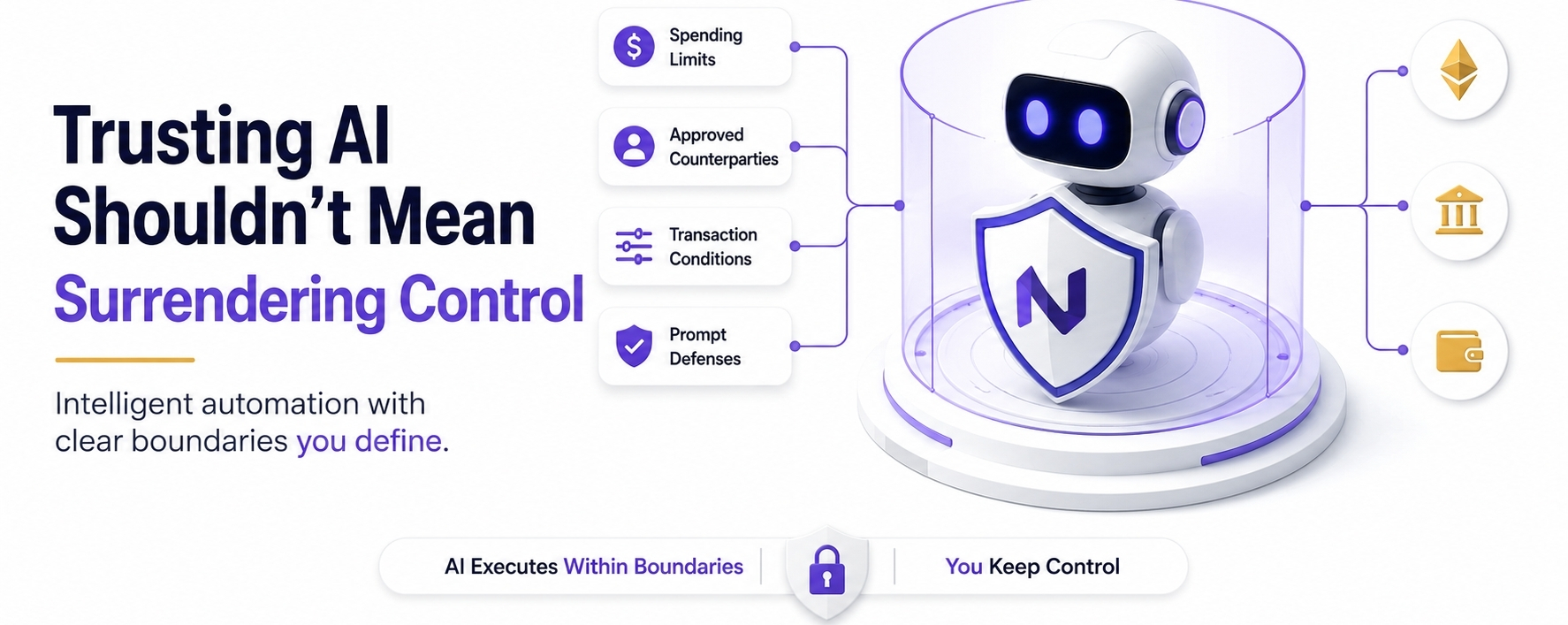

@NewtonProtocol The conversation around AI agents often assumes that more autonomy is always better. The goal seems to be removing as much human involvement as possible.
The more I follow this space the more I think that misses the real challenge.
The hard part is not making AI more independent.
It is making AI trustworthy enough that people are comfortable delegating real financial decisions.
That is one reason Newton Protocol has stayed on my radar.
Instead of asking users to hand over complete control, the protocol is built around the idea that delegation should always come with enforceable limits. That feels like a far more practical direction for autonomous finance.
The concerns surrounding AI agents are easy to understand.
An agent can react faster than any human.
That does not make it safer.
A spending limit means very little if it can be ignored.
An approved counterparty offers no protection if it can be bypassed.
Even prompt injection becomes a serious problem once AI starts interacting with real assets.
Newton approaches those risks differently.
Before an important action is executed the protocol evaluates programmable policies that define what an AI agent is allowed to do.
Developers can set spending caps.
They can approve specific counterparties.
They can define transaction conditions and prompt defenses.
Those rules become part of execution instead of optional safeguards added later.
That is the distinction I find most interesting.
The protocol does not ask users to trust AI blindly.
It asks them to define the boundaries AI cannot cross.
Good automation is not about unlimited authority.
It is about knowing exactly where that authority begins and where it ends.
The architecture reinforces the same philosophy.
AI strategies execute inside Newton's secure rollup where policy enforcement remains verifiable throughout the process. At the same time the system stays compatible with Ethereum wallets and smart contracts. Developers can introduce intelligent authorization without rebuilding the infrastructure users already know.
The permission model also stands out.
AI agents never need unrestricted access to private keys.
They receive only the permissions required for specific actions.
Those permissions can be changed or revoked whenever necessary.
Users keep control while automation handles the work it has been authorized to perform.
I also think this changes how developers compete.
The Model Registry allows builders to publish AI strategies that anyone can use.
Success is no longer defined only by how intelligent a model appears.
It is also defined by whether people trust the rules surrounding that model enough to use it with meaningful capital.
Of course guardrails are not a perfect solution.
Policies are still written by people.
Poorly designed authorization logic can introduce new risks just as flawed smart contracts can.
As autonomous systems become more capable those policies will need continuous improvement instead of remaining fixed forever.
There is another challenge as well.
Some developers will always chase higher returns because performance attracts attention.
Newton can provide the tools for responsible automation.
The ecosystem still has to reward builders who value reliability just as much as profitability.
I also wonder whether users truly want complete automation.
Many people seem comfortable letting AI assist with financial decisions.
Far fewer appear ready to hand over complete control of their capital.
That is why Newton's approach feels realistic to me.
It accepts that people want automation without giving up ownership.
The more I study Newton Protocol the less I think the future belongs to AI agents that replace human judgment.
The strongest systems will probably combine intelligent automation with clear and enforceable boundaries.
If autonomous finance is going to earn lasting trust users should never have to choose between control and convenience.
They should be able to keep both.