
Most crypto users still try to read Pixels through one old template: a cute farming game, but on-chain.
I think that misses the architecture completely.
Built on the Ronin Network for speed and low fees, Pixels is designed as a social-casual Web3 gaming platform. The core idea isn't just to "pay you to play." It's to build a sustainable ecosystem that rewards players for actions that create real, long-term value.
This shifts the question from "can I make money here?" to something much more powerful:
What player actions actually benefit the ecosystem, and how can the platform prove it?
This is where their model gets clever. Instead of the failed P2E model of rewarding every mindless click, Pixels introduces what they call "Play-to-Airdrop 2.0." It’s a system built to analyze on-chain data and player reputation, directing rewards to those who genuinely contribute to the ecosystem's growth. It’s less about grinding and more about building a reputation.
That already separates Pixels from the graveyard of inflationary P2E tokens.
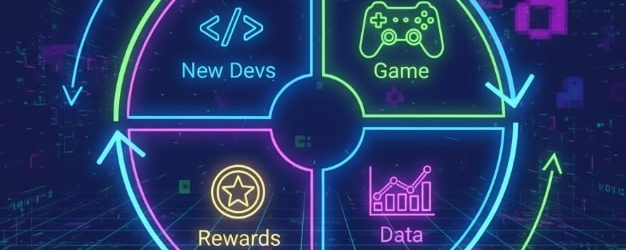
But the architecture gets even more interesting when you look at their long-term vision: the "Publishing Flywheel." The model is simple: good games attract players, which generates data. That data powers the P2A 2.0 engine, lowering user acquisition costs, which in turn attracts more developers to build on the platform.
This is critical because Pixels isn't just building a game.
It's building a decentralized game publisher.
And the $PIXEL token isn't just a reward. It’s the key to the entire economy. The campaign docs are clear: it's the token you'll use for minting new NFTs, joining social guilds, buying VIP battle passes, and eventually, participating in governance. It’s a utility token, not just an exit strategy.
So when I look at Pixels, I don't see "just another gaming token." I see a serious attempt to build a full stack on Ronin:
Engaging games for retention.
Play-to-Airdrop 2.0 for a sustainable, bot-resistant economy.
A publishing flywheel for long-term scaling.
$PIXEL as a hard utility token woven into every part of the experience.
That’s way harder than launching a simple game.
But it’s also the only way this model actually works.