
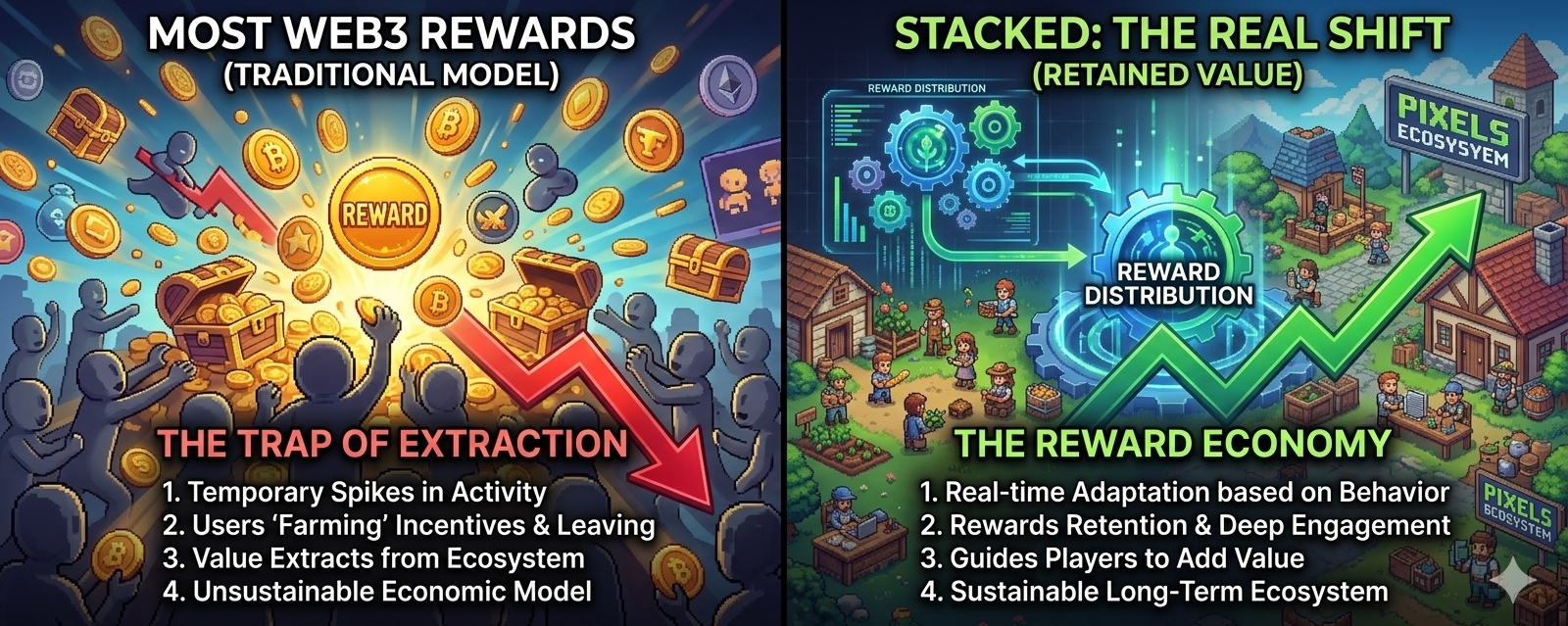
@Pixels I’ll be honest, after watching enough Web3 cycles unfold, reward systems start to feel very predictable. In the beginning, everything looks exciting. Incentives go live, users rush in, activity spikes, and dashboards start lighting up with positive numbers. It creates the impression that something meaningful is happening. But if you stay long enough and actually observe how people behave, a different pattern starts to show. A large portion of users aren’t there to stay or contribute — they’re there to collect, extract, and move on. The system might still look active from the outside, but underneath, value is quietly slipping away. That’s the part most metrics don’t capture, and it’s where many of these systems start to fall apart.
This is exactly why Stacked caught my attention in a different way. At first, it’s easy to assume it’s just another tool designed to distribute rewards more efficiently. But the more I looked into it, the more it felt like that’s not really the point. It’s not just about sending rewards out — it’s about what those rewards actually do once they’re in the hands of players. That shift in perspective is subtle, but it changes everything. Instead of asking how to give rewards, it’s asking whether those rewards are creating the right kind of behavior inside the ecosystem. And honestly, that’s a much harder and more important problem to solve.
Most reward systems follow the same loop. Launch something new, push incentives, watch activity go up, and then repeat the process once things slow down. It works for short bursts, but it doesn’t build anything that lasts. What feels different here is the idea of adapting in real time. Instead of treating all activity as valuable, the system looks at how players are actually engaging and adjusts accordingly. If a certain incentive is bringing people back and keeping them involved in a meaningful way, it gets reinforced. If it’s just attracting low-effort farming behavior, it gets reduced or removed. That makes it feel less like a simple reward mechanism and more like a system that’s actively shaping how the game evolves.
From what I’ve seen, the real issue in GameFi was never about having too few rewards. If anything, there were plenty. The problem was that those rewards were often pointed in the wrong direction. When incentives encourage extraction instead of participation, the entire economy starts to weaken over time. Users learn how to optimize for quick gains rather than long-term involvement, and once that mindset sets in, it’s very difficult to change. That’s why it matters where rewards are going and what they’re encouraging. Are players coming back because they actually enjoy being part of the system? Are they staying longer and adding value? Or are they simply taking what’s available and leaving? Those distinctions are what separate a temporary spike from something sustainable.
What stands out here is the focus on outcomes that actually matter. Retention, engagement depth, and real contribution to the in-game economy stop being just metrics on a dashboard and start becoming signals that guide decisions. Instead of blindly distributing rewards, the system becomes more selective and intentional. It filters for better behavior, guides users toward meaningful participation, and continuously adjusts based on what’s working and what isn’t. It’s less about running campaigns and more about managing an economy in motion.
Timing also plays a big role in why this feels relevant right now. Players are not as naive as they used to be. They’ve seen enough incentive-driven systems to recognize the patterns early. Token emissions alone don’t hold attention anymore, and most reward models feel easy to game once you understand how they’re structured. That means systems need to become smarter and more adaptive, otherwise users will continue to outpace them. In that context, something like this doesn’t feel like a small improvement — it feels necessary.
Another important point is that this isn’t just an idea sitting in theory. It’s already being used within the Pixels ecosystem, which means it has been exposed to real players, real behaviors, and real economic pressure. That kind of testing matters more than people often admit. It’s easy for something to sound good on paper, but once users interact with it, flaws show up quickly. The fact that this system is already operating in a live environment suggests it has moved past that initial stage where most concepts fail.
If I had to simplify it, the difference comes down to intent. Most systems are designed to increase activity, no matter the quality. This approach seems focused on increasing useful activity — the kind that actually strengthens the ecosystem over time. It’s a small distinction in words, but a massive one in practice. One creates temporary growth, the other has a chance to create something that lasts. I’m not saying it fixes every problem in Web3 gaming, but it does feel like one of the few approaches that’s addressing the root issue instead of just making the surface look better. And that’s exactly why it stands out to me.@Pixels $PIXEL #pixel