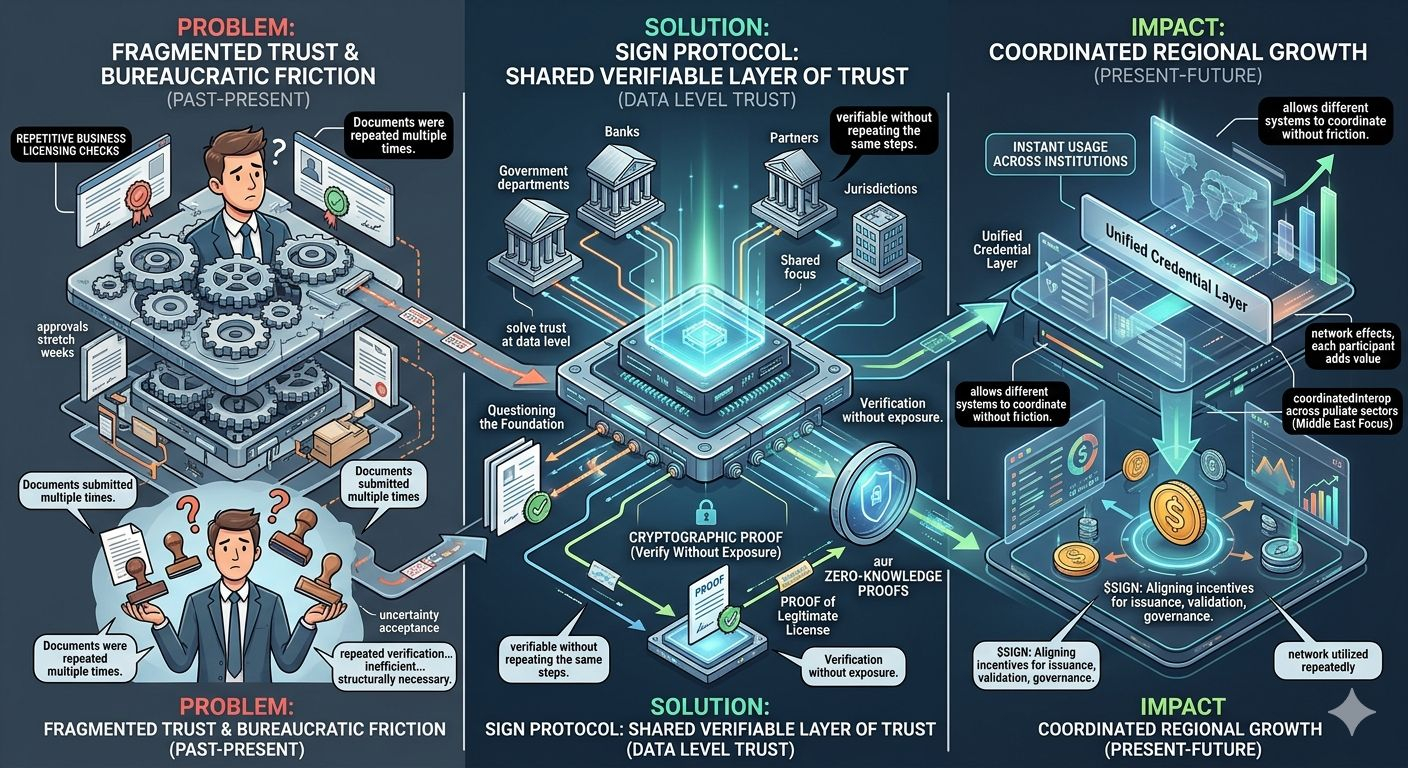
$SIGN . I remember a time when I was helping a friend register a small online business. The idea itself was simple but the process behind it was not. Documents had to be submitted multiple times approvals stretched into weeks and at every step there was uncertainty about whether the records would even be accepted or rejected for unclear reasons. At that time I assumed this was simply how systems worked especially in regions where bureaucracy still plays a dominant role in economic activity.
But when I looked deeper into the structure behind these delays I realized the issue was not just inefficiency or slow processing. The real problem was the absence of a shared and verifiable layer of trust between institutions. Each department had to independently verify the same information because there was no single source of truth they could rely on. That repeated verification was not just inefficient it was structurally necessary because trust was fragmented.
That experience changed how I evaluate infrastructure projects in crypto. I stopped focusing only on speed improvements and started paying attention to systems that attempt to solve trust at the data level. In most real-world systems, delays are not caused by lack of technology but by lack of coordination, and coordination depends on whether information can be trusted without being rechecked.
What if governments could issue credentials that are instantly verifiable without relying on repeated manual checks?
That shift in perspective is why Sign caught my attention. Not because it introduces a new narrative or promises faster transactions but because it focuses on a deeper layer of interaction between institutions. It is not optimizing the process it is questioning the foundation on which the process exists.
In the context of business licensing this becomes practical very quickly. Many startups do not struggle because of weak ideas. They lose time because they cannot prove legitimacy across different systems without repeating the same steps. Each interaction becomes a reset instead of a continuation, which slows down growth and limits scalability.
According to project documentation Sign operates as a protocol for creating and verifying digital credentials on-chain while avoiding exposure of sensitive data. Instead of storing full information it relies on cryptographic proofs that confirm authenticity. A government or authority issues a credential anchors it on-chain and allows others to verify it instantly without reprocessing the original data.
Can a system like Sign actually create a shared layer of trust where credentials are both secure and instantly usable across institutions?
A useful way to understand this is to think of it as a verification layer that works across platforms and jurisdictions. Instead of each institution repeating checks they rely on a shared proof system. The token supports this structure by enabling credential issuance validation and governance aligning incentives between participants who maintain and use the network.
This becomes especially relevant in the Middle East where economic growth is increasingly tied to digital services, startup ecosystems and cross-border activity. If trust remains fragmented inefficiencies scale with growth. A unified credential layer does not just reduce delays it allows different systems to coordinate without friction which is essential for long-term economic expansion.
The market is already showing early attention toward this type of infrastructure. The Sign token has been gaining visibility through discussions community growth and engagement around digital identity. Trading activity appears consistent rather than purely speculative and holder distribution is gradually expanding, which suggests interest is spreading beyond short-term participants.
But this is where the real test begins. The challenge is not technical feasibility but institutional adoption.
Are businesses actually using these credentials repeatedly or are they issued once and forgotten?
If credentials are not reused across multiple interactions, the system does not create network effects. Each new participant should increase the value of the network but that only happens when usage becomes consistent. Without repetition, the infrastructure remains underutilized regardless of how well it is designed.
In the Middle East this dynamic becomes more critical because economic systems depend on coordination between public and private sectors. If Sign integrates into these processes it becomes infrastructure. If it does not it risks remaining an isolated solution that works in theory but lacks practical impact.
$JCT & $A2Z focus on integrating verifiable on-chain identity signals to improve trust and transparency in decentralized participation systems.
So the real question is not whether the system works at a technical level.
Do institutions trust it enough to rely on it continuously rather than experimentally?
What would increase confidence is clear evidence of integration into real workflows. Consistent credential issuance by recognized authorities interoperability across platforms and applications built around these credentials would all indicate that the system is becoming part of a larger ecosystem. On the other hand limited issuance lack of real usage or liquidity without functional demand would suggest that the market is still driven more by narrative than by utility. These signals matter because infrastructure projects are validated over time through usage, not attention.
So if you are watching this project focus less on token movement and more on how often credentials are issued verified and reused. In systems like this value comes from repeated trust embedded in everyday interactions.
A business license that can be verified instantly across borders is not just a technical improvement. It changes how quickly economies can operate. In emerging digital systems the difference between an idea and real impact usually comes down to one thing. Systems that matter are the ones that are used consistently not occasionally until they quietly become part of how everything works.
$SIGN @SignOfficial l #SignDigitalSovereignInfra