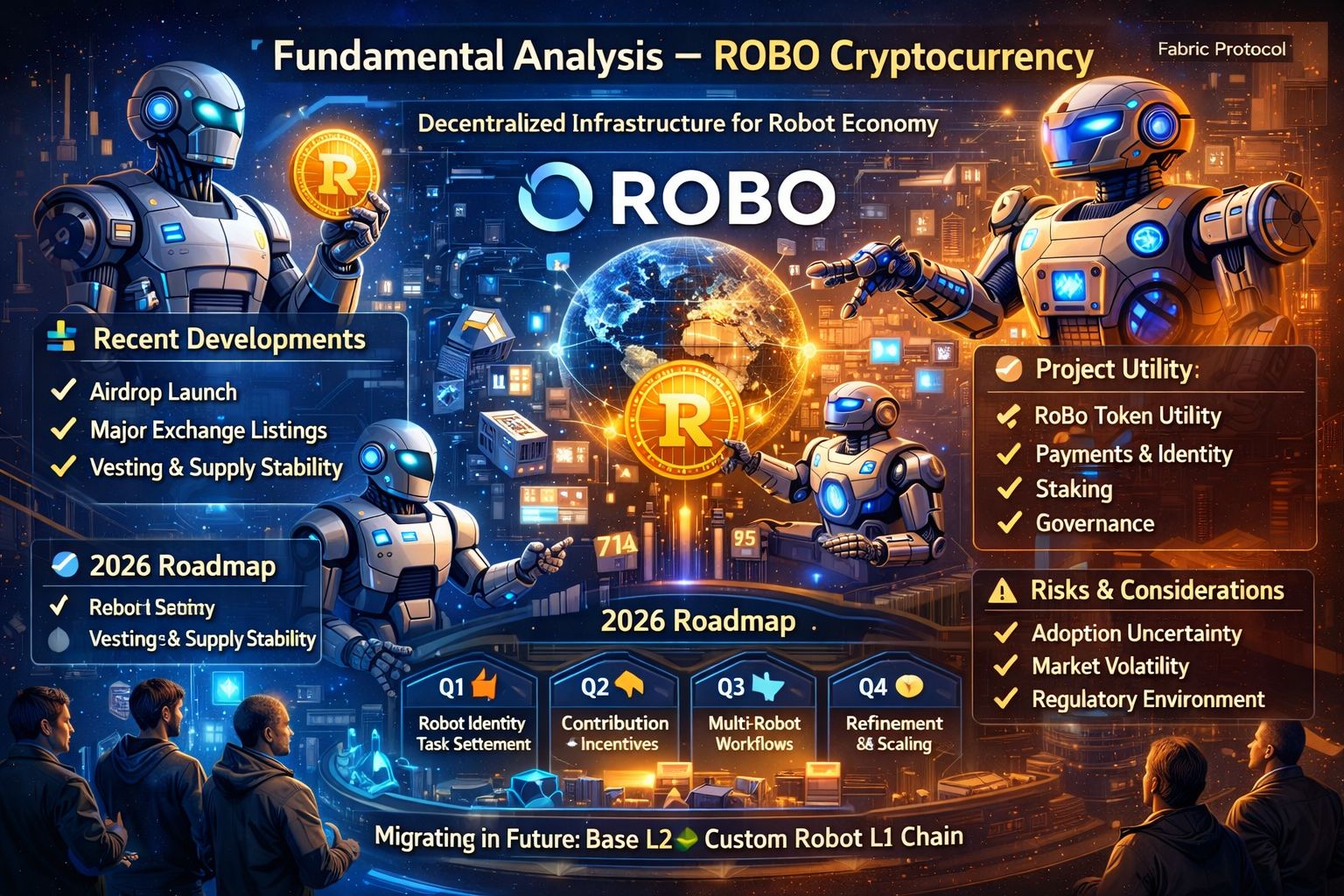
$ROBO (@Fabric Foundation ) is the native utility and governance token of the Fabric Protocol, part of the Fabric Foundation’s vision to create a decentralized infrastructure for coordinating and governing autonomous robots and AI systems. Rather than just being another speculative token, ROBO is aimed at powering what some call a robot economy — a future where robotic systems interact, transact, and contribute value on the blockchain.
🌐 Project Vision & Utility
The Fabric Protocol sees a future where robots have on-chain identities, wallets, and payment systems. In this environment:
ROBO is the fee currency for payments, identity verification, and protocol transactions.
Participants and developers must stake $ROBO to access network services and coordinate robot hardware deployment.
The token also enables governance, letting holders vote on key decisions that shape the ecosystem.
This positions ROBO not just as a digital asset but as a functional requirement for operating within a distributed robot coordination layer.
📈 Key Recent Developments
🔹 Major Exchange Listings
ROBO officially began trading on February 27, 2026, with listings on top platforms including Binance Alpha, Coinbase, KuCoin, Bybit, Bitget, and MEXC. These listings significantly increase liquidity, accessibility, and exposure to both retail and institutional participants.
🔹 Airdrop & Community Distribution
Prior to launch, Fabric opened a ROBO airdrop eligibility portal — helping distribute tokens and decentralize ownership before the main market debut. This strategy supported early engagement and built initial community participation.
🔹 Structured Tokenomics for Stability
ROBO has a fixed supply of 10 billion tokens with long-term vesting schedules for investors and team members (12-month initial lock followed by multi-year vesting). This helps reduce early sell pressure and aligns interests longer term.
🛣️ Roadmap & Future Catalysts
The Fabric Protocol’s 2026 roadmap focuses on gradual development of core infrastructure that positions ROBO for real-world robotics interaction:
Q1 2026: Deployment of robot identity and task settlement components — foundational systems that let robots transact and verify actions onchain.
Q2 2026: Rollout of contribution-based incentives, rewarding verified task completion and work contributions on the network.
Q3 2026: Introduction of multi-robot workflows, enabling coordination across fleets or collaborative robotic tasks.
Q4 2026: Refinement and scaling phase, improving incentive mechanisms and preparing for broader adoption.
Beyond 2026, the team plans to migrate the network from Base Layer-2 to a custom Layer-1 blockchain designed specifically for robotic economic activity and large-scale firm deployments, maximizing the value captured from machine-native transactions.
⚠️ Risks & Considerations
While ROBO’s vision is compelling, several factors matter:
Adoption uncertainty: The idea of onchain robot coordination is still emerging and may take time to prove meaningful in real world.
Volatility risk: With recent listings and price swings, short-term trading dynamics can differ greatly from long-term fundamentals.
Regulatory environment: As with all crypto projects tied to AI and robotics, evolving regulation could impact growth.
Overall, $ROBO scores highly for innovation and long-term potential, especially given its clear utility design and roadmap execution — but it remains a high-risk, high-reward play on a future ecosystem that hasn’t fully materialized yet.
#ROBO #XCryptoBanMistake #GoldSilverOilSurge #USIsraelStrikeIran