I have been spending more time studying Fogo and the deeper I go the more obvious it becomes that this chain is not trying to blend into the crowd. Fogo is building something with a very clear intention. It is not chasing every possible use case or every trend in the market. It is not positioning itself as a universal playground. Fogo is going after a very specific user. Traders. Market makers. High frequency strategies. Anyone who needs on chain execution that actually behaves like modern market infrastructure. This is what makes the entire design feel unique and very easy to understand once you step into the mindset behind it.
When you look at traditional blockchains you usually see two types. There are chains that want to be fast but end up becoming generalized systems. And then there are chains that want to be secure and decentralized but sacrifice performance because they try to satisfy every possible group. Both approaches have their own value but it leaves a large space unsolved. What about the traders who need sub second execution. What about liquidity engines that need to refresh quotes without relying on priority fees. What about professional capital that cannot work with unpredictable block times and heavy congestion. This is the gap that Fogo is targeting directly.
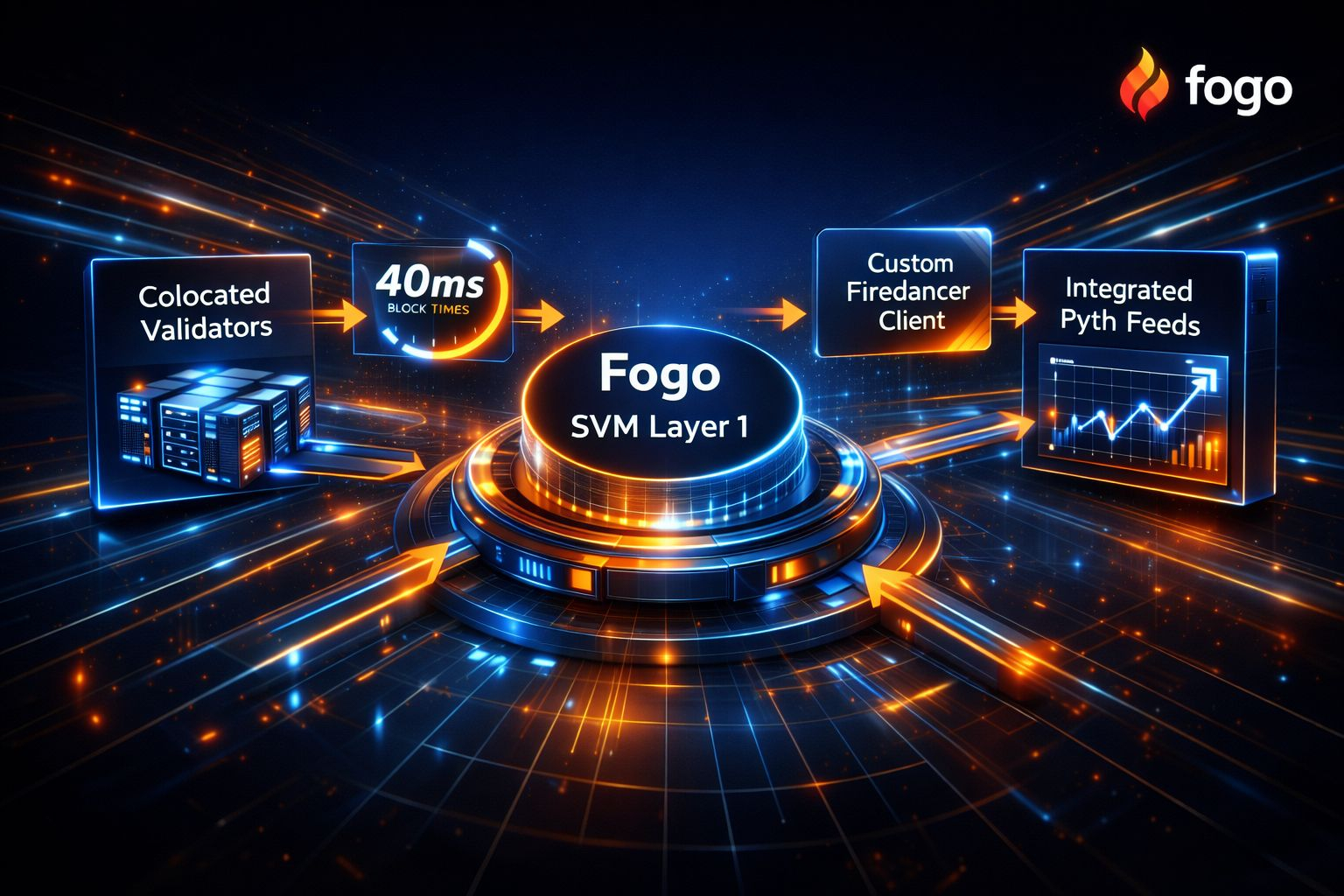
Fogo is a high performance layer 1 that uses the Solana Virtual Machine. But the way it uses the SVM is different from any normal chain. Instead of running multiple clients across the network it uses a single custom Firedancer based client developed from the Agave codebase and then optimized specifically for Fogo’s design. This removes the coordination overhead that slows upgrades. It removes the performance variance that comes from multiple teams maintaining different implementations. And it allows the network to push block times down to around 40 milliseconds which puts it in a completely different category compared to anything we see today.
When the conditions of execution are compressed this aggressively something interesting happens. Variance disappears. Randomness stops hiding inefficiencies. Validator performance becomes measurable and the fastest implementation wins without needing luck. This is very important for a chain designed for traders because predictable execution is not just a technical achievement. It is a requirement for real capital. If every validator performs at a similar level and everything is colocated in controlled environments the network behaves more like a coordinated engine rather than a scattered system.
Another major point that stands out to me is how Fogo is using Pyth Network at the protocol level. Most chains rely on oracles as an external component. Fogo integrates the price feeds directly into the base layer. For serious trading this is a big deal. It reduces latency, reduces unnecessary overhead, and keeps data fresh. When you combine this with a high speed execution layer the whole system starts to feel like a purpose built trading infrastructure instead of a blockchain that happens to support trading.
The validator design is also selective for a reason. By keeping the set controlled, colocated, and optimized for performance the network can guarantee that block production and state propagation behave consistently. The chain is not aiming to be a completely open experiment. It is aiming to serve a real segment of the market that values reliability and speed above everything else. Institutional traders, market makers, and automated strategies are not looking for maximum validator diversity. They are looking for execution that behaves the same way every time.
The more I look at Fogo the more I see how everything connects back to this same philosophy. Every technical choice leads to the same destination. Faster execution. Lower latency. More predictable outcomes. Fewer surprises. Cleaner pathways for liquidity and market structure. A high performance SVM environment where traders can finally operate without fighting the chain itself.
Fogo feels like the closest step we have seen toward on chain infrastructure that competes with centralized exchanges while still keeping ownership and settlement on chain. This is not a chain trying to be everything. It is a chain trying to do one thing exceptionally well. And honestly I see why more people are starting to pay attention to it. The more real traders test it the more they realize how much faster and more consistent their strategies can run in an environment built for speed instead of built for generality.
If this is the direction blockchain infrastructure moves toward I think Fogo becomes one of the most interesting ecosystems to watch in 2026. It solves a problem that has existed for years. It offers a path for serious capital to operate on chain without friction. And it shows that purpose built design can sometimes outperform broad design by a huge margin.
This is why I keep revisiting it. This is why I feel this chain has a very real chance of becoming a core execution layer for on chain trading. And this is why I say keep your eyes on @Fogo Official . Things are moving fast and $FOGO is at the center of it. #fogo