


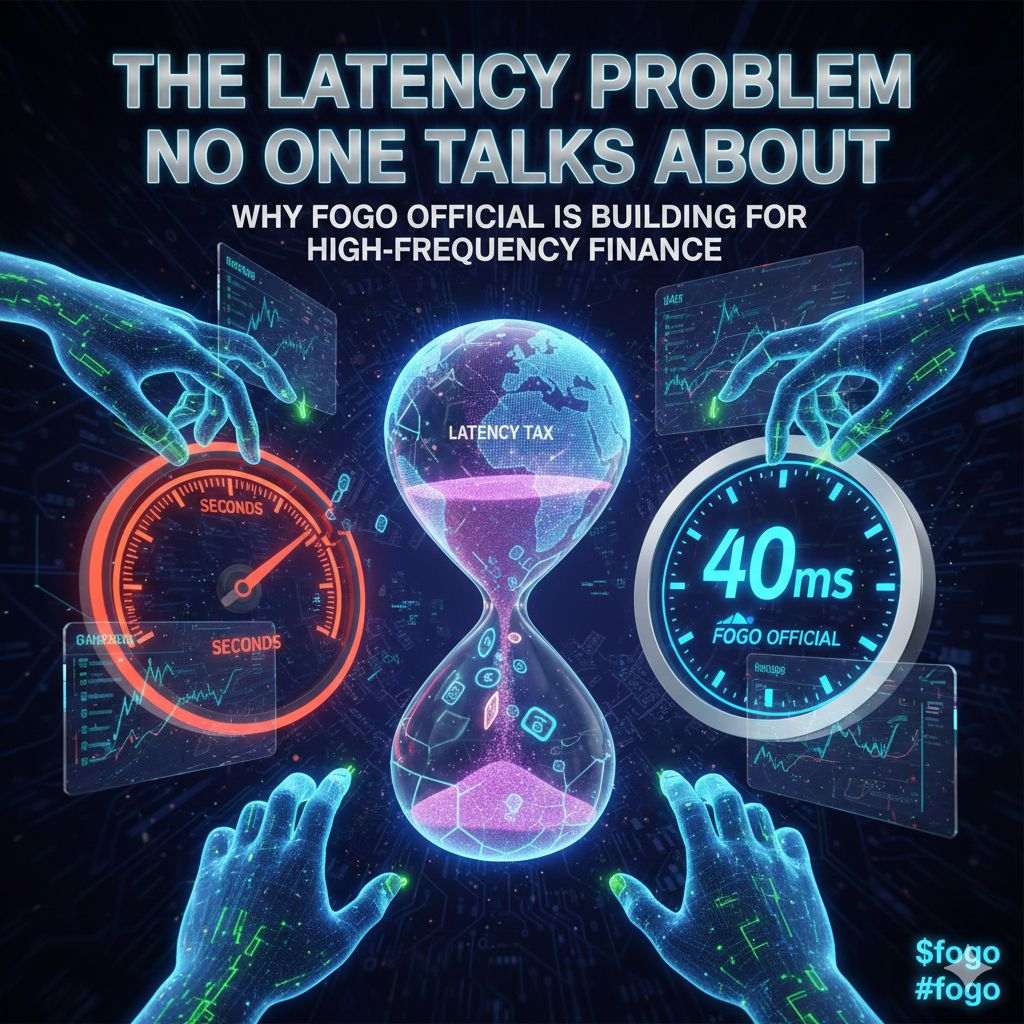
𝗧𝗵𝗲 𝗟𝗮𝘁𝗲𝗻𝗰𝘆 𝗣𝗿𝗼𝗯𝗹𝗲𝗺 𝗡𝗼 𝗢𝗻𝗲 𝗧𝗮𝗹𝗸𝘀 𝗔𝗯𝗼𝘂𝘁: 𝗪𝗵𝘆 @Fogo Official 𝗜𝘀 𝗕𝘂𝗶𝗹𝗱𝗶𝗻𝗴 𝗳𝗼𝗿 𝗛𝗶𝗴𝗵-𝗙𝗿𝗲𝗾𝘂𝗲𝗻𝗰𝘆 𝗙𝗶𝗻𝗮𝗻𝗰𝗲
For years, the blockchain industry has been obsessed with TPS.
More transactions per second.
Higher throughput.
Bigger numbers.
But here is the uncomfortable truth:
Traders don’t feel TPS — they feel latency.
When a trader clicks buy or sell, they don’t care how many transactions the network can process.
They care about how fast their order actually executes.
This is the real bottleneck of DeFi today.
The Hidden “Latency Tax” of DeFi
Every serious trader eventually faces the same frustration:
• Slippage during volatility
• Orders executing seconds later
• Liquidations happening before confirmations
• Congestion during market spikes
This invisible cost is what many call the latency tax.
It’s the main reason professional traders still prefer centralized exchanges.
Not because DeFi lacks innovation.
But because execution quality still feels slower.
Why Most L1s Aren’t Built for Traders
Most Layer 1 blockchains are designed as general-purpose platforms.
They try to support:
Gaming, NFTs, DeFi, SocialFi, RWAs — everything at once.
That sounds great in theory.
But in practice, generalization often leads to compromise.
And in trading, compromise equals latency.
Enter the SVM Approach
@Fogo Official takes a different path.
Instead of trying to be everything for everyone, Fogo focuses on one core idea:
High-frequency finance needs specialized infrastructure.
By building on the Solana Virtual Machine (SVM), Fogo enables:
• Parallel execution
• Instant finality
• Extremely low fees
• High-throughput order flow
This architecture is designed to handle market-level activity, not just basic transactions.
The 40ms Block Time Goal
One of the most interesting targets Fogo is pursuing is a 40ms block time.
To put this into perspective:
Traditional chains → seconds
Fast chains → hundreds of milliseconds
Fogo’s target → tens of milliseconds
That difference may sound small…
But in trading, milliseconds decide winners and losers.
Why This Matters for DeFi Adoption
If DeFi wants to compete with centralized exchanges, one thing must change:
Execution must feel instant.
Not fast.
Not acceptable.
Not “good enough.”
Instant.
This is where Fogo’s focus on deterministic, low-latency execution becomes extremely interesting.
Because once execution quality improves, the biggest barrier to DeFi adoption disappears.
The Bigger Narrative
Crypto narratives constantly evolve:
2017 → Payments
2020 → DeFi
2021 → NFTs
2024 → AI & RWAs
Now a new narrative is quietly emerging:
High-Frequency On-Chain Finance.
And infrastructure designed for speed may become the foundation of this shift.
The Big Question
If latency has been the hidden weakness of DeFi…
and a new generation of chains starts solving it…
What happens next?
Do traders finally move fully on-chain?
Would love to hear your thoughts 👇
