
I feel like the blockchain world is entering a new phase. For many years projects competed on promises, features, and big ideas, but users were still left waiting for transactions to confirm and hoping the system would respond in time. What matters now is not how complex a chain sounds but how it behaves when people rely on it. Fogo feels like a project born from that realization. It is a high performance Layer One network built on the Solana Virtual Machine, and its entire direction points toward one goal. Make blockchain interaction feel fast, predictable, and real.
When I think about why Fogo exists, it feels less like an experiment and more like a response to real pressure. Traders feel anxiety when seconds decide outcomes. Gamers lose connection when the chain delays their actions. Developers feel stuck when infrastructure cannot match their ideas. Fogo seems built around those human frustrations. The project is not only trying to increase speed. It is trying to reduce the emotional distance between action and result so users can trust what happens the moment they interact.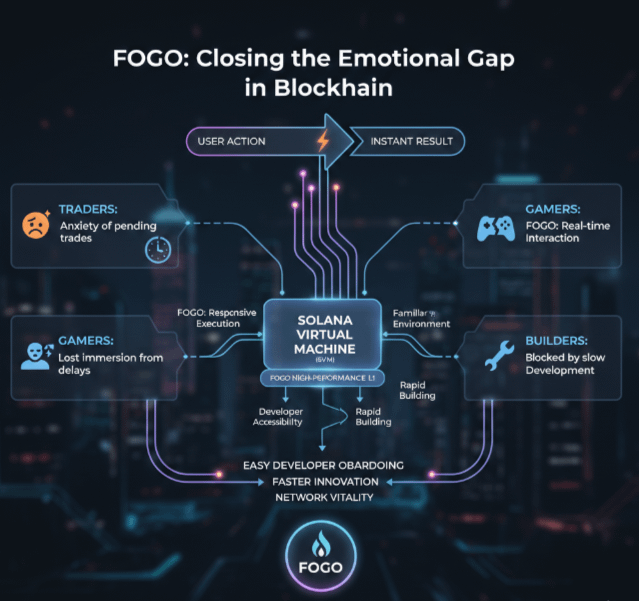
One of the clearest signals of this mindset is their decision to build on the Solana Virtual Machine. Instead of asking developers to learn an entirely new system, they chose an execution model that already proved it can handle heavy workloads. This shows a focus on accessibility and momentum. If developers can move easily, they can build faster. If they build faster, the network gains life and purpose. Fogo is not trying to slow builders down with complexity. It is trying to make creation feel natural and immediate.
We are seeing the project put deep attention on latency, and this might be the heart of the entire chain. Speed is often discussed as a number, but real speed is about confidence. It is the difference between clicking once and waiting nervously, or clicking once and knowing instantly that the system responded. Fogo seems designed around that human expectation. If interaction becomes fast and consistent, people stop thinking about the technology and begin trusting the experience itself.
Another important layer behind Fogo is fairness. Many users quietly worry that blockchain systems do not always treat everyone equally. Some transactions arrive first because of infrastructure advantage. Some users move faster simply because of location or network timing. These invisible differences create doubt even when everything technically works. Fogo appears to be trying to reduce those hidden imbalances by improving validator coordination, execution ordering, and network efficiency. If execution becomes more neutral, users may begin to feel that outcomes depend more on their decisions rather than on technical luck.
The chain also feels intentionally focused. Instead of trying to serve every possible use case, it seems designed for environments where timing shapes outcomes. Real time trading systems, on chain order books, financial platforms, interactive digital worlds, and high speed applications all depend on predictable execution. In these spaces even small delays matter. If the network proves reliable in those conditions, it could become infrastructure that serious digital systems rely on instead of just another experimental platform.
The role of the Fogo token connects to this deeper vision. Like most base layer tokens, it is expected to support transaction fees, staking, and validator incentives. But its real strength will come from usage. Tokens gain meaning when they represent access to something people actually depend on. If applications run smoothly and users interact daily, the token naturally becomes part of that living ecosystem. If adoption stays low, it remains symbolic rather than essential. The future of the token is therefore tied directly to whether the chain becomes a place where real activity grows.
Right now Fogo still feels like it is building its foundation, but the intention behind it feels steady. The project is not chasing attention through noise. It is chasing reliability through performance. That is often a slower path, but it is usually the one that creates systems that last. If developers arrive, if users stay, and if the network proves stable when demand rises, Fogo could quietly grow into infrastructure people depend on without even thinking about it.
If that moment comes, the story of Fogo will not be about hype or sudden excitement. It will be about a quiet shift toward blockchains that feel dependable enough for real life use. It will be about the point where users stop asking whether the chain will respond and start assuming that it will. And if we are seeing the early stage of that transition now, then Fogo may not just be another Layer One project. It may be part of the step that turns blockchain from an experiment into something people truly trust.
