
When I look at Vanar, I don’t see a blockchain trying to impress the usual crypto crowd with buzzwords or chasing attention through the same liquidity games everyone else plays. I see a project that’s trying to solve a much more practical problem, which is how you take people who already love digital experiences and move them into true on-chain ownership without forcing them to become “crypto users” first, because the truth is most people will never wake up excited to download a wallet, learn gas fees, or sign confusing prompts just to enjoy a game, a collectible, or a membership experience.
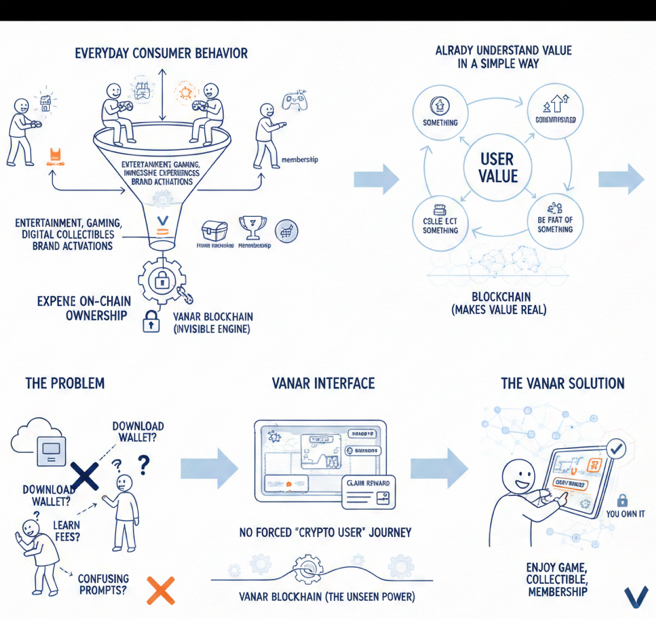
Vanar’s adoption funnel starts with everyday consumer behavior, because that’s where real adoption actually lives, and the way it positions itself makes it clear that it wants to meet users inside entertainment, gaming, digital collectibles, immersive experiences, and brand-style activations where people already understand value in a simple way, meaning they already understand what it feels like to earn something, to collect something, to level up, to gain status, and to feel like they’re part of something, and once you start from that point, you don’t need to convince people that blockchain matters, because the experience is the hook and the blockchain becomes the invisible engine that makes the value real.
The strongest part of this approach is that Vanar doesn’t need to begin with “here’s a wallet, here’s a token, now figure it out,” because that is where most normal users drop off instantly, and instead the funnel works best when the user enters through a product first, through an experience that feels familiar, smooth, and rewarding, and only later starts to realize that what they earned is not just a temporary in-app item that can disappear, but something that can actually be owned, tracked, carried, and used as a persistent part of their digital life, which is the moment where the user stops being a visitor and starts becoming attached.
This is what invisible onboarding really means in the Vanar context, because the chain should sit behind the scenes like infrastructure, not stand in front like a barrier, and the best onboarding is the one where a person can join quickly, interact instantly, earn something meaningful, and keep moving forward without feeling forced into technical steps that don’t match the emotion of the moment, because the moment someone is having fun or feeling rewarded is not the moment to interrupt them with a complicated signature request or a confusing fee screen, and if the Vanar stack is built correctly, the user flow stays clean while the on-chain layer quietly records ownership and state in a way that can later unlock identity, membership, and economy.
The funnel only works if it kills the exact frictions that have been blocking mainstream adoption for years, and I keep coming back to the same weak points that almost every mainstream user hates even if they don’t know how to explain it, because normal people want to click and continue, they want to log in and start, they want rewards to appear smoothly, and they want the system to feel safe and understandable, so if the first interaction feels unfamiliar or the signup feels like a security exam, the user is gone, and if a wallet has to be created in a scary way before the user has even received value, the user is gone, and if fees feel random or confusing, the user is gone, and if signing prompts show up with no context, the user is gone, and if recovery feels like “one mistake and everything is gone forever,” the user is gone, so Vanar’s real challenge and real advantage is whether it can remove these friction points so completely that a user can stay inside the experience while the on-chain layer quietly does the work.
What makes Vanar’s funnel feel serious is that it doesn’t depend on a single magic moment, because it’s built like a progression path, and the path feels natural if you think like a product builder instead of thinking like a trader. First comes curiosity, which is simply the user joining an experience because it looks fun, interesting, or rewarding, then comes ownership, where the user earns or receives something that feels personal enough to care about, then comes identity, where the user’s profile begins to matter and their progress starts to feel real because it carries weight over time, then comes the economy, where spending, trading, upgrading, unlocking, and collecting become normal actions that feel like part of the experience rather than “crypto behavior,” and finally comes the loyalty loop, where the user returns because rewards and status compound and the experience starts to feel like a place where leaving would mean losing progress, which is exactly how strong ecosystems are built in the real world, because people don’t just return for incentives, they return for identity and momentum.
The identity stage is the part I think most people underestimate, and it’s also where Vanar can build a real moat if it executes properly, because ownership alone is not enough to keep people coming back, but identity creates continuity, identity creates status, identity creates belonging, and once a user feels like their profile, reputation, memberships, and achievements are building toward something, the experience stops being a one-time interaction and starts feeling like a long-term journey, and that’s where adoption becomes durable, because the user is no longer just “trying something,” they’re building something.
When the funnel reaches the economy stage, the project has to prove it can handle repeated everyday actions without turning the experience into a confusing or expensive mess, because mainstream user economies are built on small actions repeated often, not on giant transactions done rarely, so the system has to stay smooth and predictable when users are upgrading items, earning rewards, unlocking access, trading within experiences, and moving through different parts of the ecosystem, and if the rails remain stable, the economy becomes a natural extension of the experience rather than a separate financial product that only a niche group understands.
This is also where VANRY fits in a way that feels natural when the funnel is designed correctly, because the strongest adoption model is not “buy the token to join,” and it’s not “the token is the first step,” and it’s not forcing users into a purchase before they’ve even felt value, because that shrinks the funnel instantly and turns a consumer product into a speculative gate, but in a healthy Vanar funnel, VANRY becomes relevant as usage scales and as the ecosystem grows, meaning the token becomes part of the deeper participation layer, where it supports the infrastructure side of the network through fees and alignment, supports staking for long-term participants, supports incentives that strengthen loyalty, and supports ecosystem access as more layers and products develop, and the user meets the token at the right time, which is after they already care about what they’ve earned and what they’ve built, not before.
If I wanted to prove that Vanar is actually achieving adoption through this funnel, I wouldn’t focus on the loudest market metrics because those can move on hype, and I wouldn’t let short-term attention convince me, because real adoption looks quieter but more consistent, so I would focus on daily active usage that reflects real people interacting, I would track repeat users and retention because returning behavior matters more than first-time spikes, I would measure time-to-first-value because the faster a new user earns something meaningful, the stronger the funnel, I would watch how cheap and smooth the average user journey stays as activity grows because micro-actions must remain viable at scale, and I would track product-level growth because the strongest adoption signal is when the experiences themselves keep expanding and improving over time.
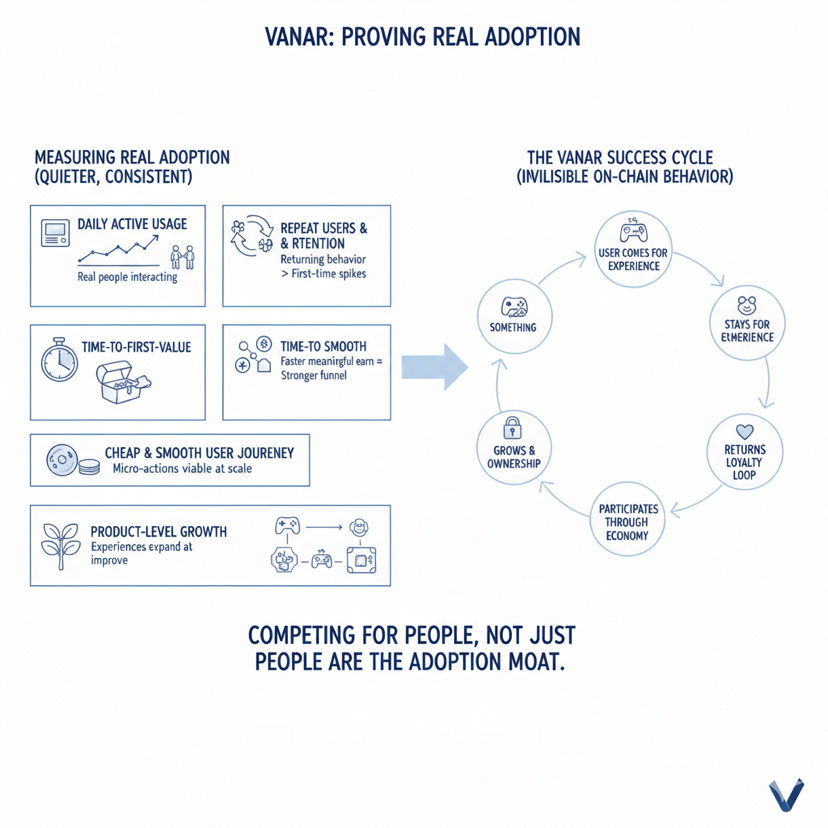
The reason this funnel matters so much is because it points to a different kind of success, where Vanar isn’t trying to win by attracting temporary attention, and it isn’t trying to win by copying the same playbook that cycles through the market every year, and instead it’s trying to win by turning normal behavior into on-chain behavior in a way that feels almost invisible, because the user comes for the experience, stays for ownership, grows through identity, participates through economy, and returns through a loyalty loop that compounds, and if Vanar keeps building in that direction, then the project isn’t just competing for liquidity, it’s competing for people, and people are the only adoption moat that doesn’t disappear the moment the narrative shifts.
