


Crypto investment company ByteTree released its latest research and investment report, which pointed out that the current Bitcoin market cannot be considered a "bear market". To be more precise, it should be a "calm bull market."
If we go back to April 2021, when Bitcoin was trading at over $60,000, few would have guessed that today's price would be halved, but even so, Bitcoin still outperformed the stock market during the crisis.
technical analysis
At this stage, Bitcoin futures look good, especially when you compare them to the crisis in the bond market, and while there is still huge resistance to break through $30,000, it will be overcome sooner or later. The current Bitcoin spot price is above $25,000, which is the overhead resistance from May 2022 to March 2023. If it can hold, then Bitcoin is in a bull market, albeit a quiet one.

Think about everything Bitcoin has been through in the past few years, Western regulators, fraud and hype cycles, and even with all the obstacles, Bitcoin is close to its 12-month relative high compared to the well-performing S&P 500.

Most importantly, Bitcoin is a true safe haven for U.S. bonds. Among long-term bonds, Bitcoin has begun to show competitiveness.
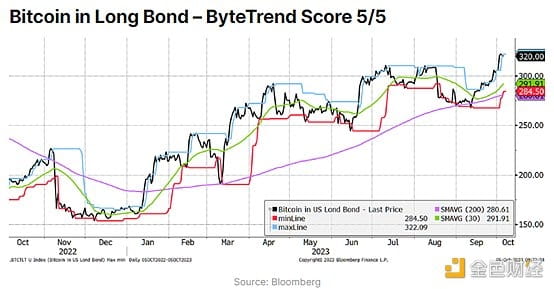
Futures are used because similar to how the S&P or bonds behave when they are traded simultaneously, real Bitcoin can be traded 24/7, whereas Bitcoin futures are much more relaxed and only trade during office hours on weekdays, excluding public holidays. The point of futures is that you can determine the price far in the future. If the price drops, due to a mismatch in supply and demand due to various market factors, then the contract will only disappoint.
The ProShares Bitcoin Futures ETF (BITO) was launched nearly two years ago, with analysts previously predicting that the futures product would lag behind Bitcoin by 5% to 8% per year. However, this has not been the case. Since its launch, BITO has lagged behind Bitcoin by 9.5% due to its higher rolling yield. When BITO purchases new contracts, they have to pay exorbitant fees, resulting in lower returns.
Bitcoin futures put ETFs in trouble
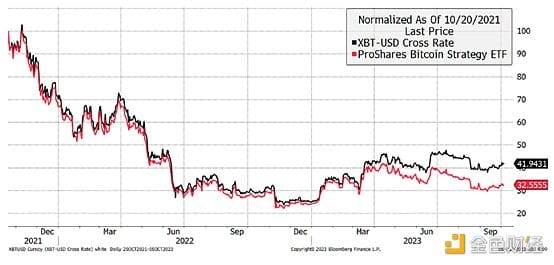
Some people believe that the SEC allows futures ETFs mainly to "protect investors" from the impact of spot ETFs. Regulators should be a force for good, but ByteTree analyst Charlie Morris is skeptical. The green pick in the figure below shows the rollover yield of futures, and Bitcoin is shown on it. The rollover measures the comparison between the third month of the futures contract and the second month. The difference between them is about 0.8%, which is equivalent to 10% per year. The blue marks the rolling highs and the red marks the rolling lows. The results show that the highs usually coincide with the peak of Bitcoin prices.
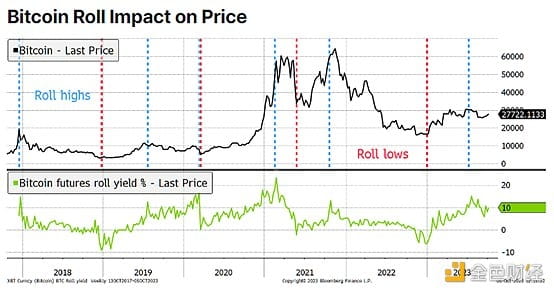
Note that the roll yield was low last year, which allowed BITO to be comparable to Bitcoin, and it is still high this year, partly due to interest rates, which the SEC should take note of.
The chart below shows the Bitcoin network strength/health versus price.
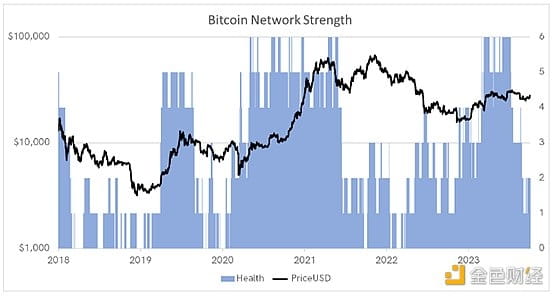
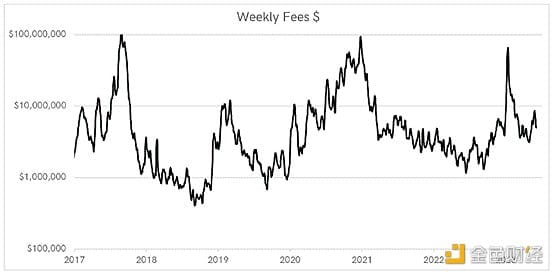
In terms of network fees, Bitcoin network fees increased significantly in early 2023, mainly due to the outbreak of Ordinals, but have now fallen back. In fact, in the first half of 2023, the Ethereum network generated a total of approximately $743 million in transaction fees, TRON generated approximately $282 million in transaction fees, and Bitcoin network fee revenue was only $80 million.
In terms of transaction volume, the Bitcoin network transaction volume has dropped significantly in recent times (as shown in the figure below), which may affect fees if it continues.
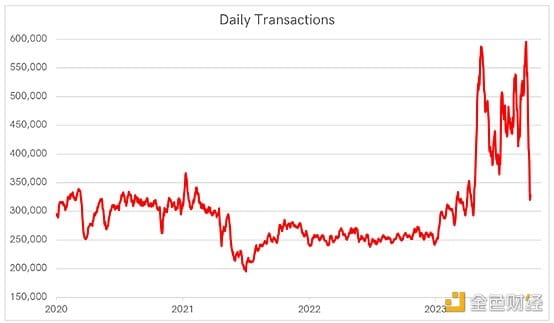
Currently, the Bitcoin network transaction volume is weak, and we must take this into account. Another thing to watch is that the Bitcoin block reward is expected to halve in April 2024, which is the fourth halving, and there are about 200 days left. The growth rate of new supply of Bitcoin was exponential in the beginning, but as we get closer to the final stage of 21 million Bitcoins being mined, this growth rate has dropped to 1.8% per year. After April, this ratio will be halved to 0.9%. Bitcoin will become increasingly scarce, which is likely to support the price.

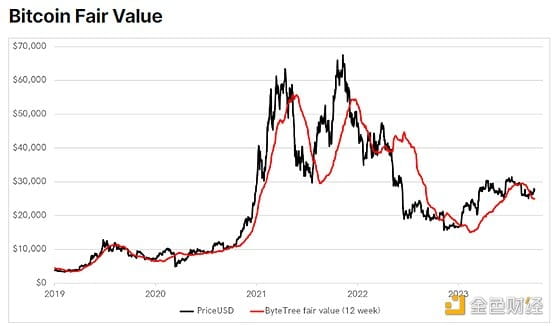
In any case, it all depends on the demand for the fixed supply, which is cashed out through its network activity or the USD equivalent value transferred through the blockchain. Currently, the fair value of Bitcoin is above $25,000 (see the figure below), which has dropped since last month, but seems to be stabilizing. This simple idea can help us understand how much influence a wave of institutional investors has on Bitcoin.
Investment Flows
Overall, Bitcoin investment flows have performed well, but have fallen back over the past month, but bearish signals would be worse than this. So overall, it is stable.

Crypto-related stock performance
Many people are afraid to buy Bitcoin through an exchange, which is why we need ETFs. Stock ETFs that cover cryptocurrencies include: VanEck Digital Transformation (DAPP) and Invesco CoinShares Global Blockchain (BCHN).
DAPP holds shares in Coinbase, MicroStrategy, Block, and Bitcoin mining companies; BCHN is more cautious about holding companies involved in the broader technology ecosystem, such as SBI, Monex, Samsung, TSMC, and CME. DAPP's volatility in the past year was 85%, while Bitcoin was 40% and BCHN was 35%.

Since DAPP was launched at the end of 2021, its performance does not seem to be as good as BCHN, as shown in the figure below.
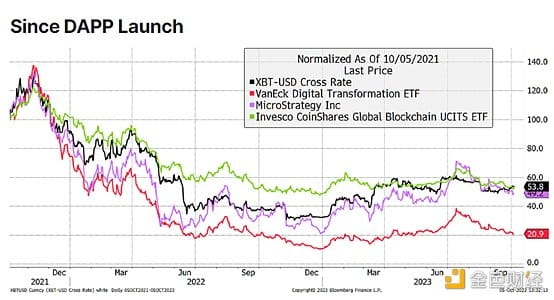
In 2023, both DAPP and MSTR beat Bitcoin in market performance, while BCHN lagged behind, but it has less risk.
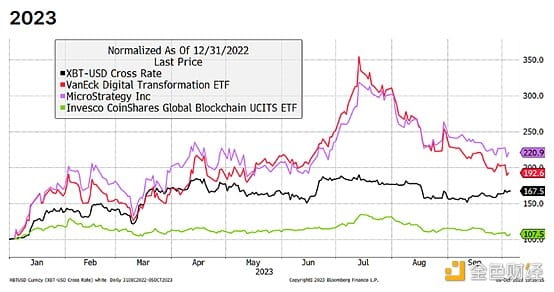
MicroStrategy (MSTR) CEO Michael Saylor announced his Bitcoin holdings in August 2020, sending the company’s stock soaring. Today, he owns 158,245 BTC, worth $4.38 billion, or 0.8% of all BTC in circulation.
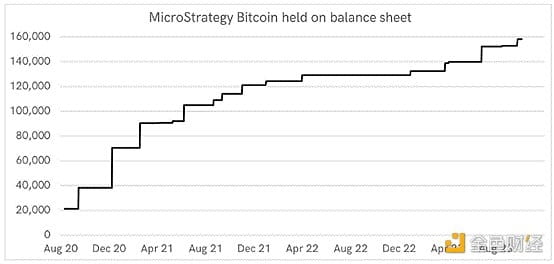
Michael Saylor first spent his own $500 million in cash, then issued $2.2 billion in debt and bought more BTC.

As long as MSTR stock is trading above its net asset value, Michael Saylor appears to continue buying Bitcoin. As an MSTR investor, you may want to take the opposite view and buy the stock at a discount, which is currently 40%.

As an investor, you benefit from leverage (due to the debt) when the price of Bitcoin goes up, but you do worse if the price of Bitcoin goes down. The bottom line is, if you want to own Bitcoin, your best option is to buy it through an exchange or an ETF.
Macro scenario
With the bond market under pressure, it is not possible to elaborate too much on the macro economy at this time, but investors need to be reminded that according to ByteTree's analysis, Bitcoin is currently in the upper right corner of the figure below. When bond yields rise, Bitcoin performs well in risk appetite. After all, more than 90% of Bitcoin's historical gains have occurred when bond yields and inflation are flat or rising.

Other assets in the upper right box include commodities, banks, and heavy industry. Bitcoin is a digital commodity with a limited supply.
Summarize
The world is in chaos and caution is needed right now. A lot can and probably will go wrong. Despite the carnage in the financial markets, Bitcoin is unlikely to be at the center of the storm right now because the worst is over.
The halving is coming, and Bitcoin is becoming increasingly scarce.
#DeFiChallenge #一起来跟单 #注意资金安全 #美联储是否加息? #BTC
【Disclaimer】The market is risky, so be cautious when investing. This article does not constitute investment advice, and users should consider whether any opinions, views or conclusions in this article are suitable for their specific circumstances. Investing based on this information is at your own risk.