
imrankhanIk
10.3k ပို့စ်များ

imrankhanIk
 Square Verified+
High-Frequency Trader
6 Years
580 ဖော်လိုလုပ်ထားသည်
54.9K+ ဖော်လိုလုပ်သူများ
46.5K+ လိုက်ခ်လုပ်ထားသည်
ပို့စ်များ
အားလုံး
Quotes
တိုက်ရိုက်ထုတ်လွှင့်ခြင်း
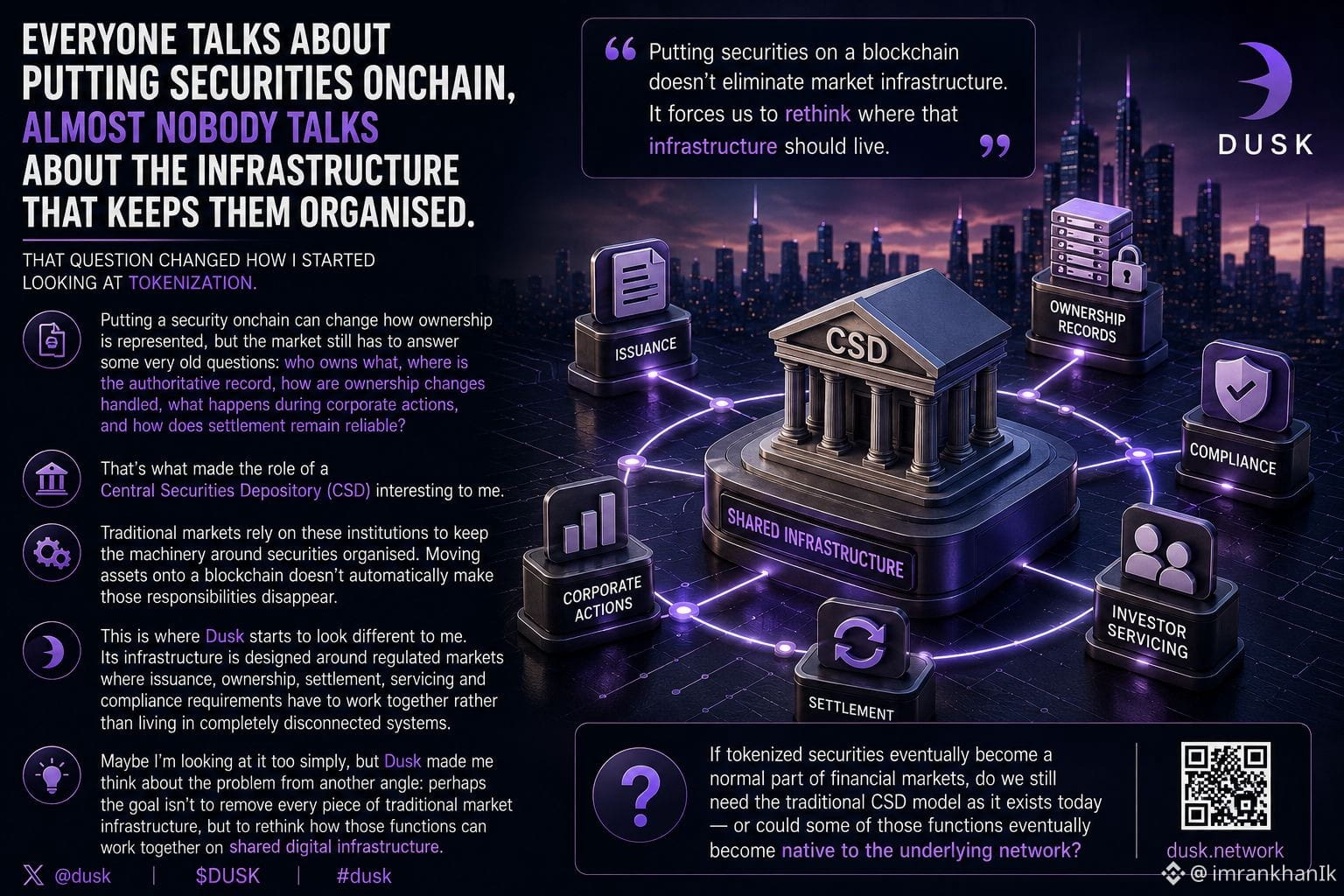
Everyone talks about putting securities onchain.
Almost nobody talks about what happens to the infrastructure that keeps those securities organised.
That question changed how I started looking at tokenization.
Putting a security onchain can change how ownership is represented, but the market still has to answer some very old questions: who owns what, where is the authoritative record, how are ownership changes handled, what happens during corporate actions, and how does settlement remain reliable?
That’s what made the role of a Central Securities Depository (CSD) interesting to me.
Traditional markets rely on these institutions to keep the machinery around securities organised. Moving assets onto a blockchain doesn’t automatically make those responsibilities disappear.
This is where Dusk starts to look different to me. Its infrastructure is designed around regulated markets where issuance, ownership, settlement, servicing and compliance requirements have to work together rather than living in completely disconnected systems.
Maybe I’m looking at it too simply, but Dusk made me think about the problem from another angle: perhaps the goal isn’t to remove every piece of traditional market infrastructure, but to rethink how those functions can work together on shared digital infrastructure.
Putting securities on a blockchain doesn’t eliminate market infrastructure. It forces us to rethink where that infrastructure should live.
If tokenized securities eventually become a normal part of financial markets, do we still need the traditional CSD model as it exists today — or could some of those functions eventually become native to the underlying network?
#dusk $DUSK @Dusk
Almost nobody talks about what happens to the infrastructure that keeps those securities organised.
That question changed how I started looking at tokenization.
Putting a security onchain can change how ownership is represented, but the market still has to answer some very old questions: who owns what, where is the authoritative record, how are ownership changes handled, what happens during corporate actions, and how does settlement remain reliable?
That’s what made the role of a Central Securities Depository (CSD) interesting to me.
Traditional markets rely on these institutions to keep the machinery around securities organised. Moving assets onto a blockchain doesn’t automatically make those responsibilities disappear.
This is where Dusk starts to look different to me. Its infrastructure is designed around regulated markets where issuance, ownership, settlement, servicing and compliance requirements have to work together rather than living in completely disconnected systems.
Maybe I’m looking at it too simply, but Dusk made me think about the problem from another angle: perhaps the goal isn’t to remove every piece of traditional market infrastructure, but to rethink how those functions can work together on shared digital infrastructure.
Putting securities on a blockchain doesn’t eliminate market infrastructure. It forces us to rethink where that infrastructure should live.
If tokenized securities eventually become a normal part of financial markets, do we still need the traditional CSD model as it exists today — or could some of those functions eventually become native to the underlying network?
#dusk $DUSK @Dusk
စိစစ်အတည်ပြုထားသည်
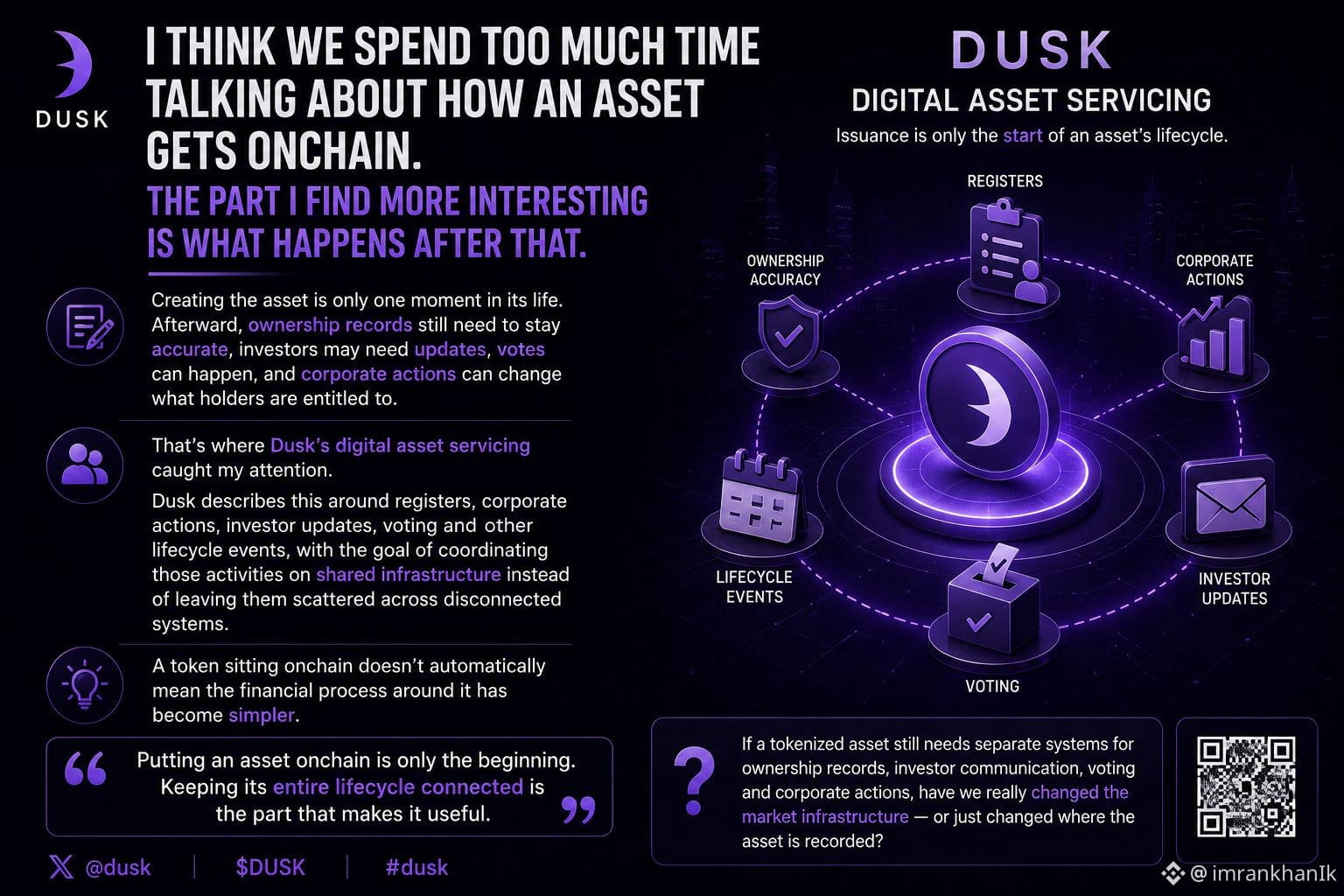
I think we spend too much time talking about how an asset gets onchain.
The part I find more interesting is what happens after that.
Creating the asset is only one moment in its life. Afterward, ownership records still need to stay accurate, investors may need updates, votes can happen, and corporate actions can change what holders are entitled to.
That’s where Dusk’s digital asset servicing caught my attention.
Dusk describes this around registers, corporate actions, investor updates, voting and other lifecycle events, with the goal of coordinating those activities on shared infrastructure instead of leaving them scattered across disconnected systems.
And honestly, that made me look at tokenization a little differently.
A token sitting onchain doesn't automatically mean the financial process around it has become simpler.
Putting an asset onchain is only the beginning. Keeping its entire lifecycle connected is the part that makes it useful.
Maybe I'm looking at it too simply, but that's where I think the real infrastructure question starts.
If a tokenized asset still needs separate systems for ownership records, investor communication, voting and corporate actions, have we really changed the market infrastructure — or just changed where the asset is recorded?
#dusk $DUSK @Dusk
The part I find more interesting is what happens after that.
Creating the asset is only one moment in its life. Afterward, ownership records still need to stay accurate, investors may need updates, votes can happen, and corporate actions can change what holders are entitled to.
That’s where Dusk’s digital asset servicing caught my attention.
Dusk describes this around registers, corporate actions, investor updates, voting and other lifecycle events, with the goal of coordinating those activities on shared infrastructure instead of leaving them scattered across disconnected systems.
And honestly, that made me look at tokenization a little differently.
A token sitting onchain doesn't automatically mean the financial process around it has become simpler.
Putting an asset onchain is only the beginning. Keeping its entire lifecycle connected is the part that makes it useful.
Maybe I'm looking at it too simply, but that's where I think the real infrastructure question starts.
If a tokenized asset still needs separate systems for ownership records, investor communication, voting and corporate actions, have we really changed the market infrastructure — or just changed where the asset is recorded?
#dusk $DUSK @Dusk
စိစစ်အတည်ပြုထားသည်
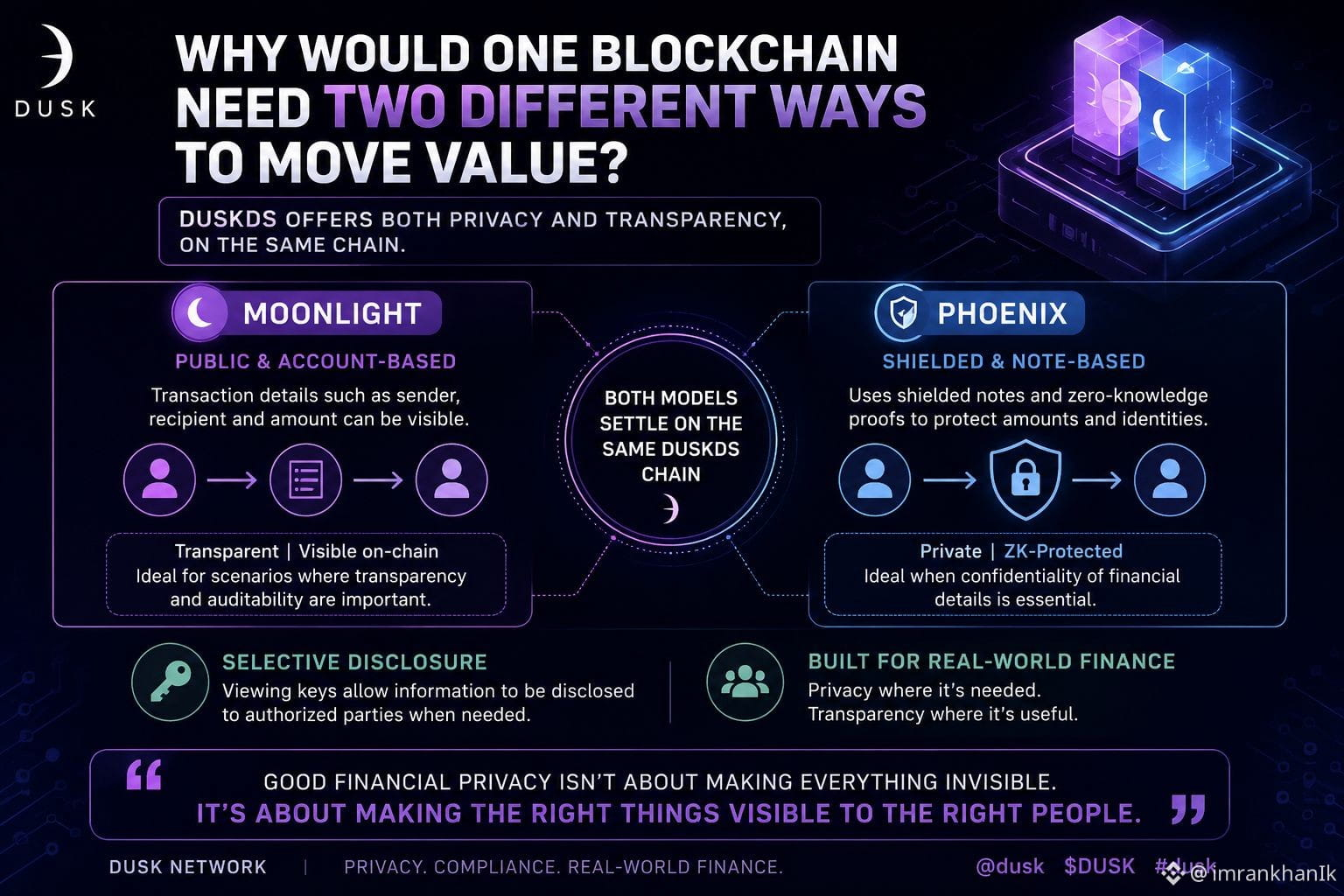
What if owning an asset isn't enough to legally transfer it?
That question came to mind when I started looking deeper into how regulated assets could actually work onchain.
On a normal blockchain, a transfer can look incredibly simple: one address sends an asset and another receives it.
But regulated finance can add another layer.
The system may need to know whether the holder is eligible, whether the recipient is permitted, and whether the transfer itself follows the rules attached to that asset.
That's where Dusk's access-control design caught my attention.
In Dusk, identity credentials, wallet binding and smart-contract rules can work together so applications can check things like who is eligible to hold an asset or whether a particular transfer should be allowed.
Maybe I'm looking at it too simply, but this made me think about ownership differently.
Onchain ownership can tell you what you have. Access control decides what you're allowed to do with it.
And I think that distinction becomes important when blockchain infrastructure is being designed for regulated markets.
The trade-off is interesting, though: stronger controls can make compliance easier, but too many restrictions could make markets less flexible.
Where do you think the balance should be should eligibility be checked before an asset moves, or should those checks remain outside the transaction itself?
@Dusk $DUSK #dusk
That question came to mind when I started looking deeper into how regulated assets could actually work onchain.
On a normal blockchain, a transfer can look incredibly simple: one address sends an asset and another receives it.
But regulated finance can add another layer.
The system may need to know whether the holder is eligible, whether the recipient is permitted, and whether the transfer itself follows the rules attached to that asset.
That's where Dusk's access-control design caught my attention.
In Dusk, identity credentials, wallet binding and smart-contract rules can work together so applications can check things like who is eligible to hold an asset or whether a particular transfer should be allowed.
Maybe I'm looking at it too simply, but this made me think about ownership differently.
Onchain ownership can tell you what you have. Access control decides what you're allowed to do with it.
And I think that distinction becomes important when blockchain infrastructure is being designed for regulated markets.
The trade-off is interesting, though: stronger controls can make compliance easier, but too many restrictions could make markets less flexible.
Where do you think the balance should be should eligibility be checked before an asset moves, or should those checks remain outside the transaction itself?
@Dusk $DUSK #dusk
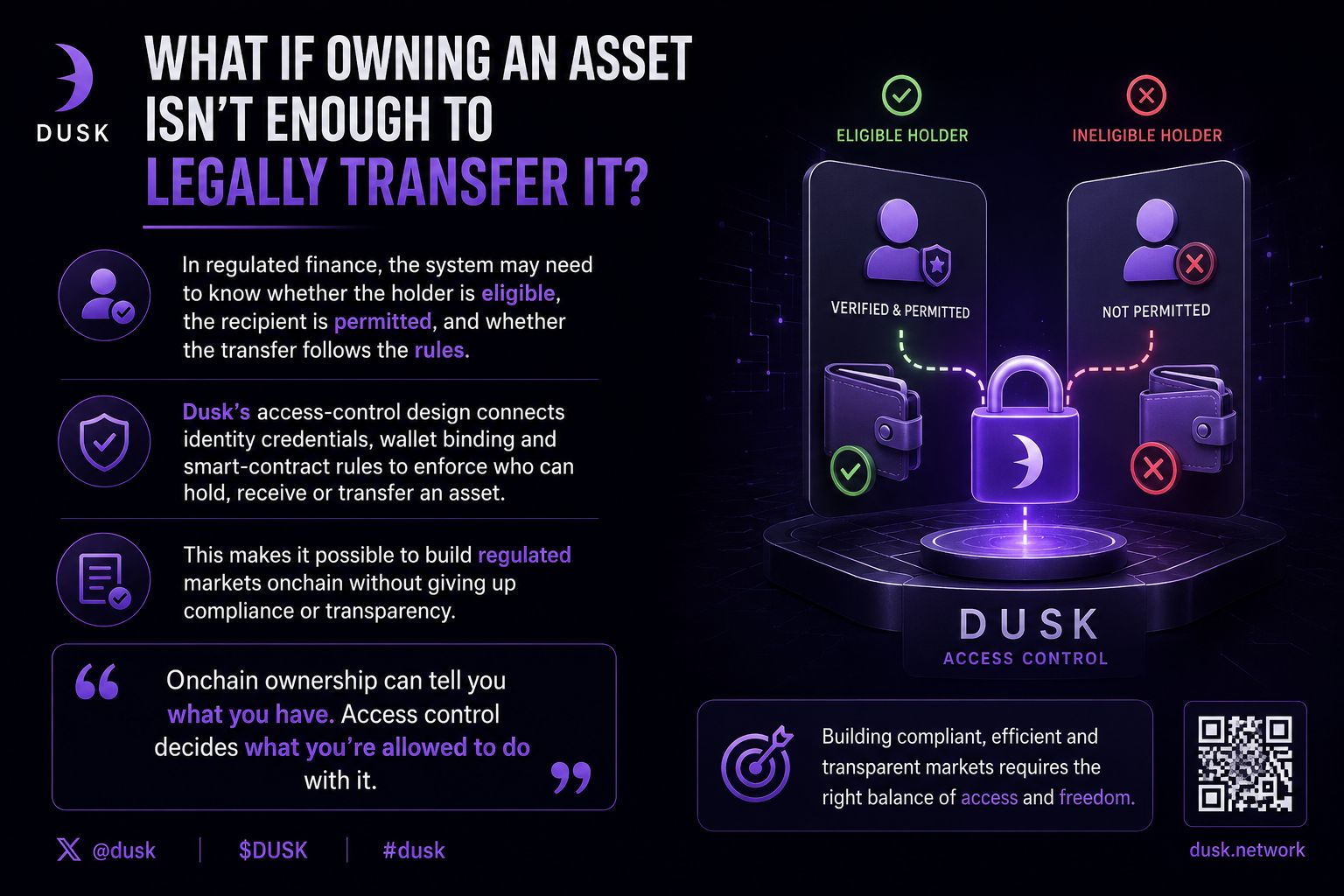
The interesting part of this crypto rally isn’t Bitcoin going up.
It’s what happens after BTC leads.
Money is starting to rotate across ETH and selected alts, while ETF flows are showing renewed institutional interest.
That’s when I start watching the market differently.
Not “what coin will pump?”
But “where is capital moving next?”
That’s usually where the better opportunities begin. 👀
#Crypto #bitcoin
It’s what happens after BTC leads.
Money is starting to rotate across ETH and selected alts, while ETF flows are showing renewed institutional interest.
That’s when I start watching the market differently.
Not “what coin will pump?”
But “where is capital moving next?”
That’s usually where the better opportunities begin. 👀
#Crypto #bitcoin
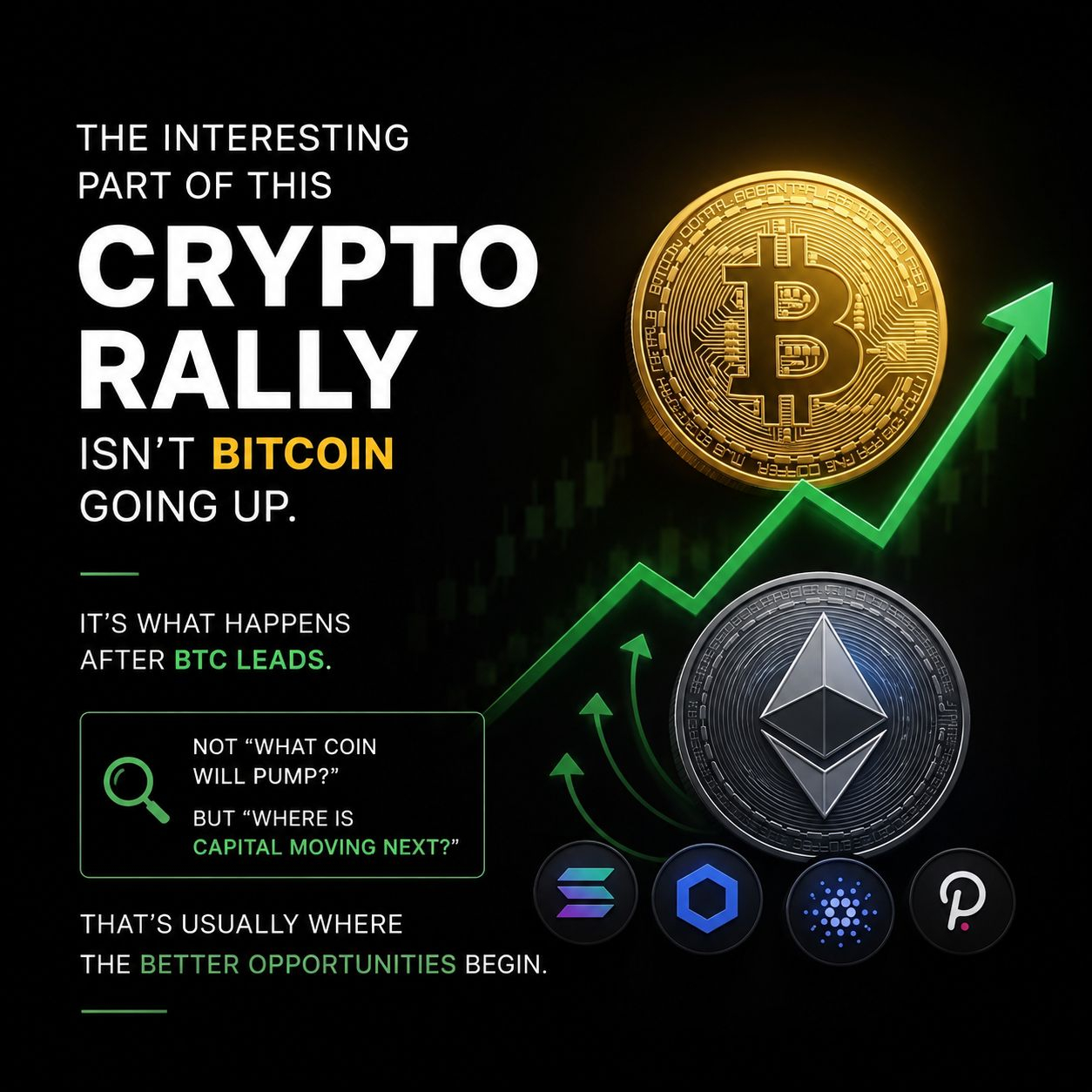
Why would one blockchain need two different ways to move value?
Honestly, I didn’t think much about that question at first.
But when I started looking deeper into DuskDS, I noticed something I found quite interesting.
There are two native ways to handle transactions.
Moonlight is the public, account-based model. The sender, recipient and transaction amount can be visible onchain.
Then there’s Phoenix.
Phoenix works with shielded notes and zero-knowledge proofs. In simple terms, a transaction can be verified without putting the same financial details on display for everyone.
And both models settle on the same DuskDS chain.
That made me stop for a moment.
Because I don't think every financial transaction needs the same level of visibility.
Sometimes you want the activity to be easy to verify.
Other times, exposing the amount or financial position to the whole network simply doesn't make much sense.
What I find interesting is that Dusk doesn't seem to force one answer for every situation. It also has viewing keys for cases where information needs to be disclosed to an authorized party.
Maybe I'm looking at it too simply, but this changed the way I think about blockchain privacy.
Good financial privacy isn't about hiding everything. It's about knowing what should be visible, and to whom.
That sounds much closer to how real financial systems actually work.
So I'm curious:
Should a financial blockchain decide the visibility for every transaction, or should the transaction itself determine what needs to be seen?
#dusk $DUSK @Dusk
Honestly, I didn’t think much about that question at first.
But when I started looking deeper into DuskDS, I noticed something I found quite interesting.
There are two native ways to handle transactions.
Moonlight is the public, account-based model. The sender, recipient and transaction amount can be visible onchain.
Then there’s Phoenix.
Phoenix works with shielded notes and zero-knowledge proofs. In simple terms, a transaction can be verified without putting the same financial details on display for everyone.
And both models settle on the same DuskDS chain.
That made me stop for a moment.
Because I don't think every financial transaction needs the same level of visibility.
Sometimes you want the activity to be easy to verify.
Other times, exposing the amount or financial position to the whole network simply doesn't make much sense.
What I find interesting is that Dusk doesn't seem to force one answer for every situation. It also has viewing keys for cases where information needs to be disclosed to an authorized party.
Maybe I'm looking at it too simply, but this changed the way I think about blockchain privacy.
Good financial privacy isn't about hiding everything. It's about knowing what should be visible, and to whom.
That sounds much closer to how real financial systems actually work.
So I'm curious:
Should a financial blockchain decide the visibility for every transaction, or should the transaction itself determine what needs to be seen?
#dusk $DUSK @Dusk
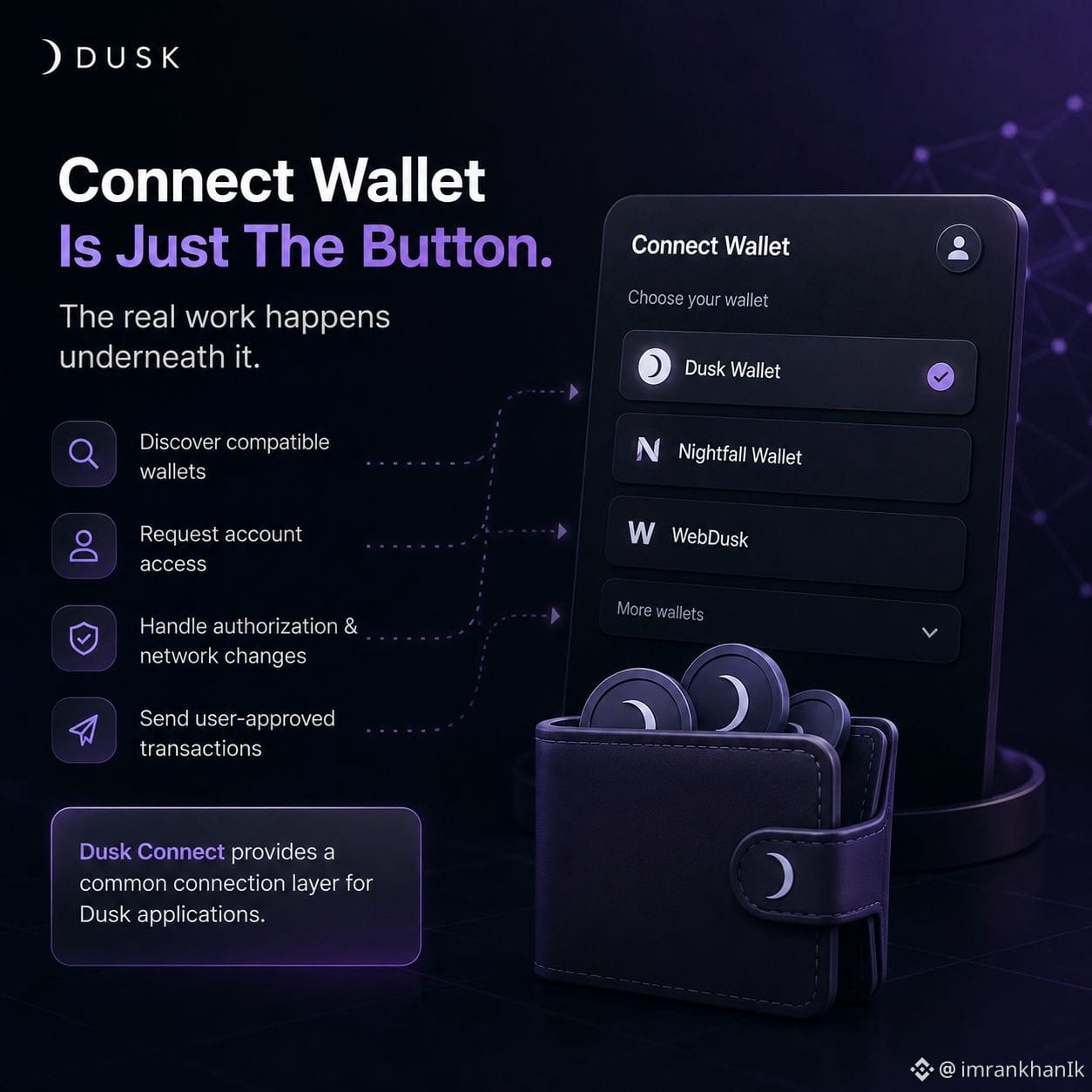
I used to think “Connect Wallet” was just a button.
Then I looked at what actually happens behind that button.
A dApp has to discover a compatible wallet, let the user choose it, request access, handle authorization and network changes, and then pass user-approved transactions through the wallet.
That’s where Dusk Connect caught my attention.
The current Dusk docs show that Connect can discover one or more compatible wallets, rather than tying an application to one specific wallet provider.
That sounds like a small developer detail.
I don’t think it is.
If every application handles wallet connections differently, the experience can become fragmented quickly. A common connection layer gives developers a cleaner starting point.
Maybe I’m looking at it too simply, but this changed how I see the familiar “Connect Wallet” button.
The button is simple. The infrastructure underneath it is not.
For Dusk applications, would you rather have every dApp build its own wallet integration, or use a common layer that lets applications discover compatible wallets?
#dusk $DUSK @Dusk
Then I looked at what actually happens behind that button.
A dApp has to discover a compatible wallet, let the user choose it, request access, handle authorization and network changes, and then pass user-approved transactions through the wallet.
That’s where Dusk Connect caught my attention.
The current Dusk docs show that Connect can discover one or more compatible wallets, rather than tying an application to one specific wallet provider.
That sounds like a small developer detail.
I don’t think it is.
If every application handles wallet connections differently, the experience can become fragmented quickly. A common connection layer gives developers a cleaner starting point.
Maybe I’m looking at it too simply, but this changed how I see the familiar “Connect Wallet” button.
The button is simple. The infrastructure underneath it is not.
For Dusk applications, would you rather have every dApp build its own wallet integration, or use a common layer that lets applications discover compatible wallets?
#dusk $DUSK @Dusk
စိစစ်အတည်ပြုထားသည်
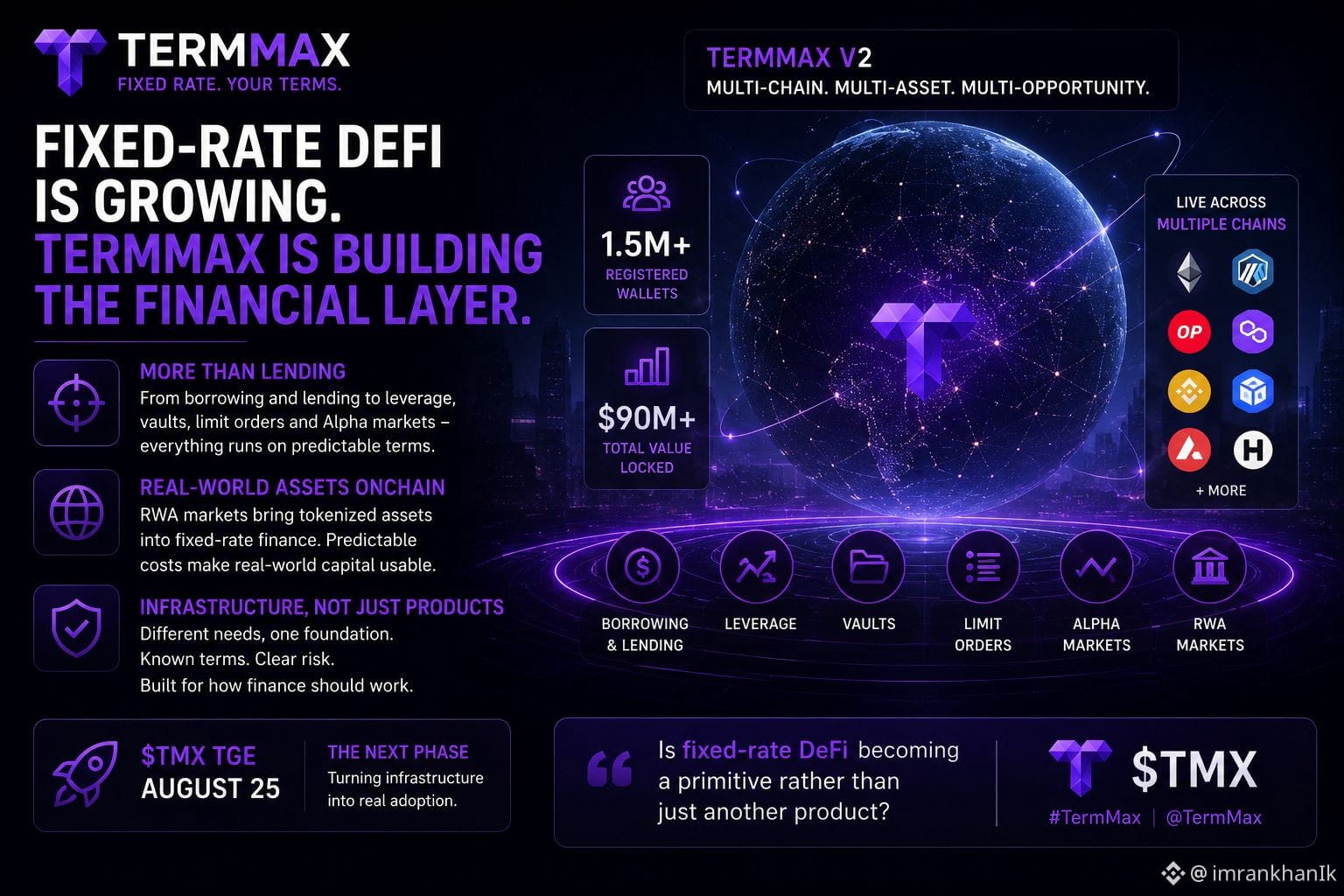
The more I watch @TermMax the more I think its real challenge is no longer proving that fixed-rate DeFi is useful.
It’s proving that fixed-rate markets can become a complete financial layer.
That distinction matters to me.
A lending protocol can offer fixed rates and stop there. But TermMax is building around much more than lending.
There are fixed-term borrowing and lending markets, leverage, vaults, limit orders, Alpha markets and now RWA-focused products appearing across its ecosystem.
What caught my attention is how these pieces start connecting.
For example, a user looking for predictable borrowing costs is solving a different problem from someone looking for leveraged exposure or yield through a vault. Yet they can all sit around the same underlying idea: known terms instead of constantly changing conditions.
And the expansion into tokenized assets makes that even more interesting.
If onchain finance is eventually going to handle more real-world assets, I think predictable financing becomes increasingly important. Capital needs terms that can actually be planned around.
Of course, more products also mean more complexity and more risks to understand. Bigger infrastructure doesn’t automatically mean safer infrastructure.
That’s why I’m watching TermMax differently now.
Not just as another DeFi lending protocol, but as an attempt to build a broader fixed-rate financial market onchain.
With $TMX TGE approaching, I’m curious to see whether the next phase can turn that infrastructure into something people actually use at scale.
Is fixed-rate DeFi becoming a primitive rather than just another product?
$TMX #TermMax @TermMax #termamx
It’s proving that fixed-rate markets can become a complete financial layer.
That distinction matters to me.
A lending protocol can offer fixed rates and stop there. But TermMax is building around much more than lending.
There are fixed-term borrowing and lending markets, leverage, vaults, limit orders, Alpha markets and now RWA-focused products appearing across its ecosystem.
What caught my attention is how these pieces start connecting.
For example, a user looking for predictable borrowing costs is solving a different problem from someone looking for leveraged exposure or yield through a vault. Yet they can all sit around the same underlying idea: known terms instead of constantly changing conditions.
And the expansion into tokenized assets makes that even more interesting.
If onchain finance is eventually going to handle more real-world assets, I think predictable financing becomes increasingly important. Capital needs terms that can actually be planned around.
Of course, more products also mean more complexity and more risks to understand. Bigger infrastructure doesn’t automatically mean safer infrastructure.
That’s why I’m watching TermMax differently now.
Not just as another DeFi lending protocol, but as an attempt to build a broader fixed-rate financial market onchain.
With $TMX TGE approaching, I’m curious to see whether the next phase can turn that infrastructure into something people actually use at scale.
Is fixed-rate DeFi becoming a primitive rather than just another product?
$TMX #TermMax @TermMax #termamx

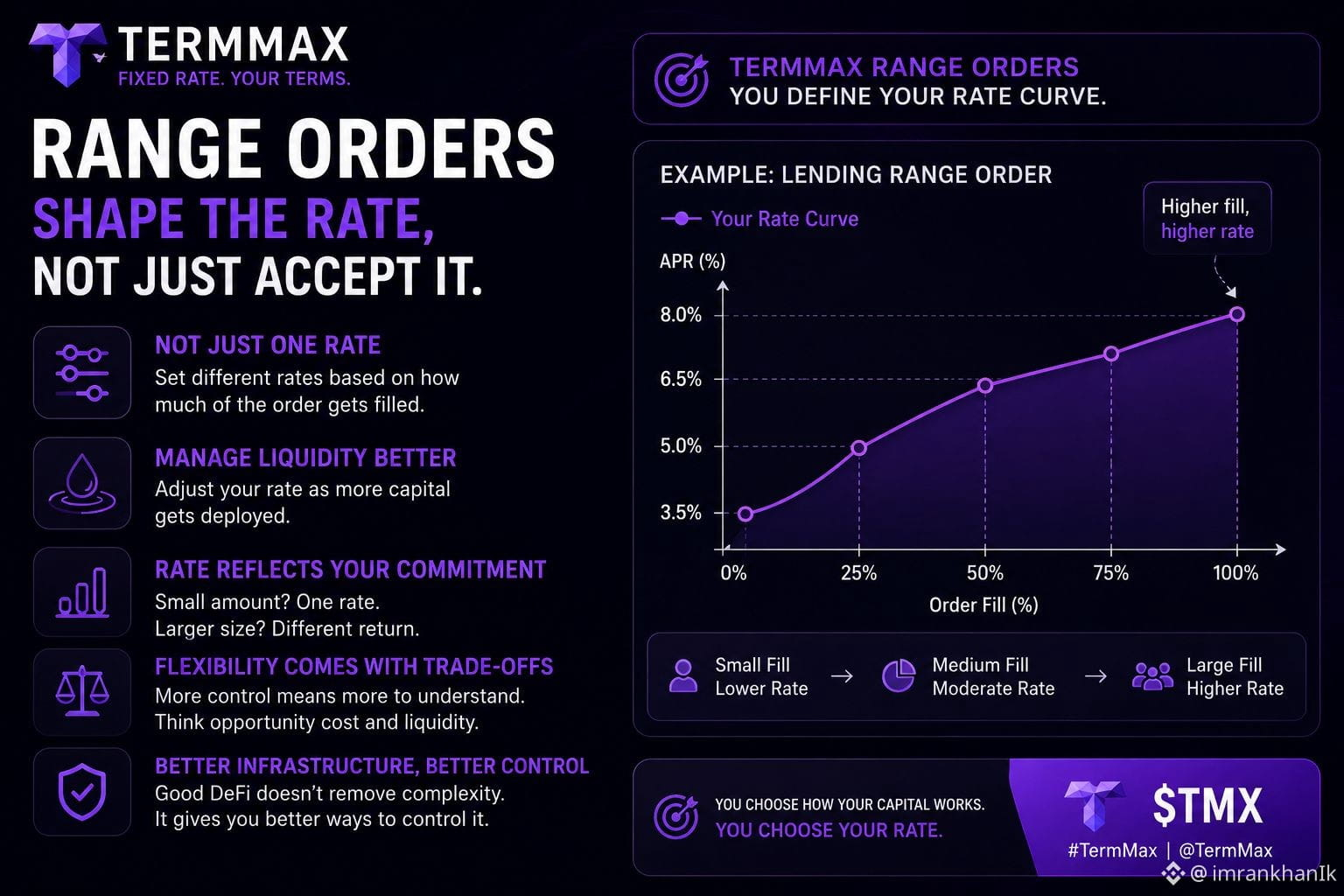
The more I look into @TermMax the more I think the interesting part of fixed-rate DeFi isn’t just the fixed rate.
It’s how you can actually shape the rate you’re willing to accept.
That’s where TermMax’s Range Orders caught my attention.
Instead of saying “this is the one rate I want,” a lender can set different rates depending on how much of the order gets filled. Borrowers can do something similar from the other side.
That sounds like a small difference, but I think it changes how liquidity can be managed.
If I’m lending a small amount, I might be comfortable with one rate. If much more of my capital gets deployed, I may want a different return for taking on less available liquidity.
So the rate doesn’t have to be a single number anymore. It can reflect the size of the position and how much capital I’m willing to commit.
The trade-off is that more flexibility also means more things to understand.
Good DeFi infrastructure shouldn’t remove complexity by hiding it. It should give users better ways to control it.
That’s the part of TermMax I’m watching closely.
$TMX #termmax @TermMax
It’s how you can actually shape the rate you’re willing to accept.
That’s where TermMax’s Range Orders caught my attention.
Instead of saying “this is the one rate I want,” a lender can set different rates depending on how much of the order gets filled. Borrowers can do something similar from the other side.
That sounds like a small difference, but I think it changes how liquidity can be managed.
If I’m lending a small amount, I might be comfortable with one rate. If much more of my capital gets deployed, I may want a different return for taking on less available liquidity.
So the rate doesn’t have to be a single number anymore. It can reflect the size of the position and how much capital I’m willing to commit.
The trade-off is that more flexibility also means more things to understand.
Good DeFi infrastructure shouldn’t remove complexity by hiding it. It should give users better ways to control it.
That’s the part of TermMax I’m watching closely.
$TMX #termmax @TermMax
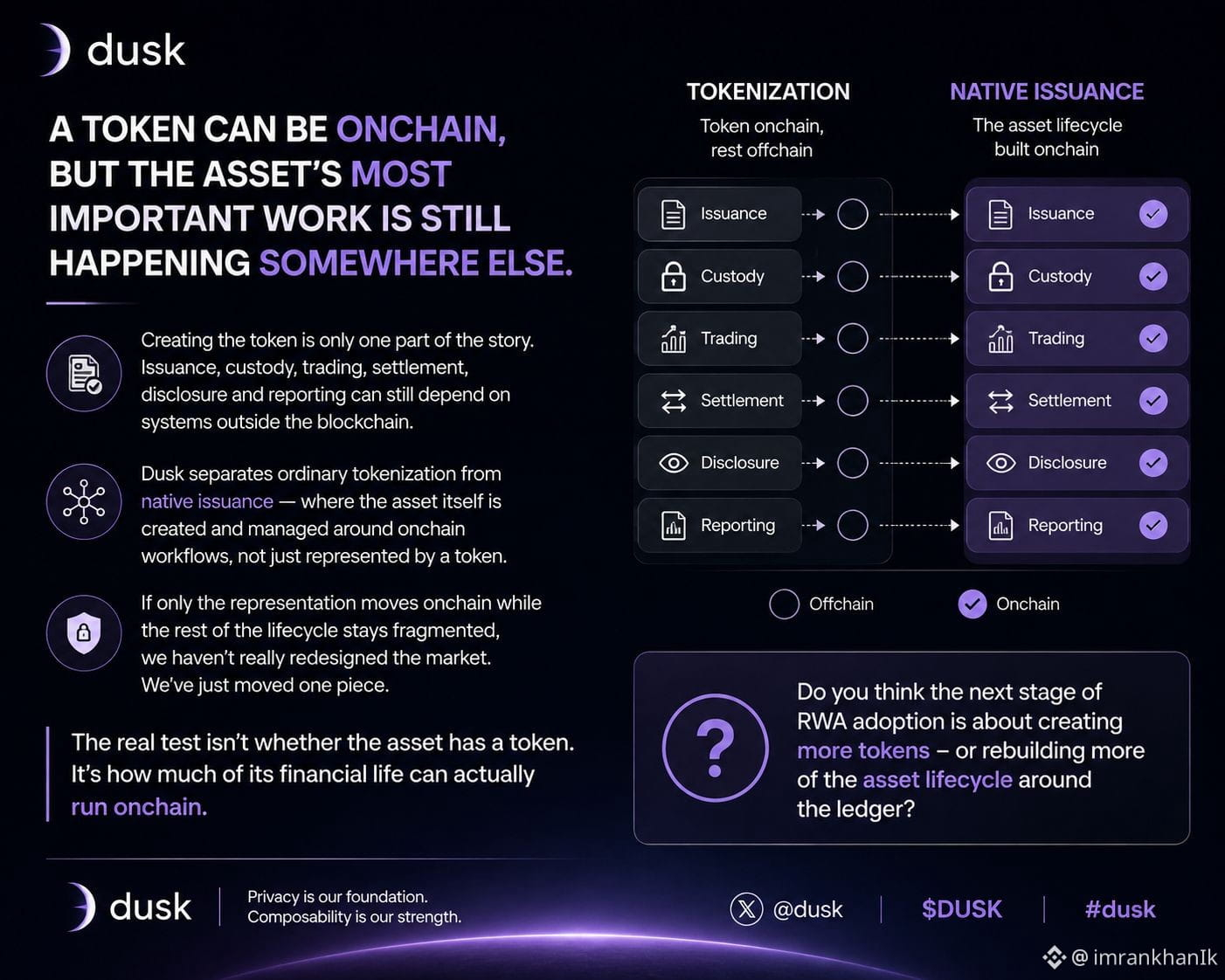
A token can be onchain while the asset’s most important work is still happening somewhere else.
That sounds strange at first.
But the more I looked into tokenized financial assets, the more I realised that creating the token is only one part of the story.
Issuance, custody, trading, settlement, disclosure and reporting can still depend on systems outside the blockchain.
That’s where Dusk caught my attention.
The interesting part is that Dusk looks beyond simply putting a representation of an asset onchain and focuses on how the wider asset lifecycle can work around onchain infrastructure.@Dusk
Maybe I’m looking at it too simply, but that distinction feels important.
If only the representation moves onchain while the rest of the lifecycle stays fragmented, we haven’t really redesigned the market.
We’ve just moved one piece.
For me, native issuance is a more interesting question than simply asking whether an asset can be tokenized.
The real test isn’t whether the asset has a token. It’s how much of its financial life can actually run onchain.
Do you think the next stage of RWA adoption is about creating more tokens or rebuilding more of the asset lifecycle around the ledger?
#dusk $DUSK
That sounds strange at first.
But the more I looked into tokenized financial assets, the more I realised that creating the token is only one part of the story.
Issuance, custody, trading, settlement, disclosure and reporting can still depend on systems outside the blockchain.
That’s where Dusk caught my attention.
The interesting part is that Dusk looks beyond simply putting a representation of an asset onchain and focuses on how the wider asset lifecycle can work around onchain infrastructure.@Dusk
Maybe I’m looking at it too simply, but that distinction feels important.
If only the representation moves onchain while the rest of the lifecycle stays fragmented, we haven’t really redesigned the market.
We’ve just moved one piece.
For me, native issuance is a more interesting question than simply asking whether an asset can be tokenized.
The real test isn’t whether the asset has a token. It’s how much of its financial life can actually run onchain.
Do you think the next stage of RWA adoption is about creating more tokens or rebuilding more of the asset lifecycle around the ledger?
#dusk $DUSK
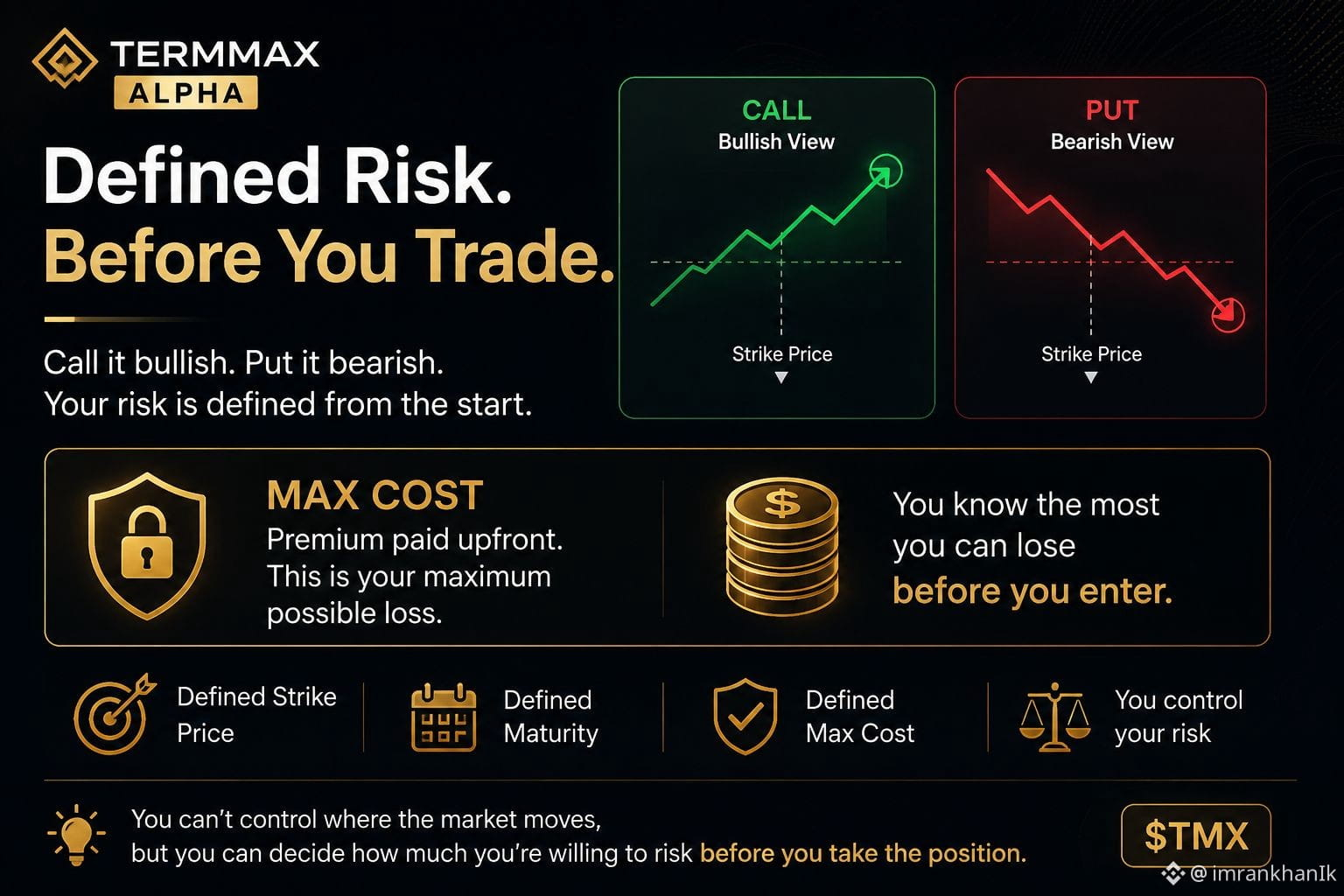
I’ve been looking at the Alpha side of @TermMax today, and one thing stood out to me: the way it defines the risk before the trade starts.
On TermMax Alpha, a bullish view can be taken through a Call, while a bearish view can be taken through a Put. Each position has its own strike price and maturity, so the trade starts with clearly defined conditions.
But the part I find more interesting is Max Cost.
The premium is paid upfront, and TermMax defines that amount as the maximum possible loss of the position. That gives the trader something important before entering: a clear number for what they are putting at risk.
Of course, that doesn’t make the trade safe. The market can still move against you, and closing before maturity can depend on available liquidity and may involve slippage.
Still, I like the idea of thinking about the downside first instead of only thinking about the potential upside.
You can’t control where the market moves, but you can decide how much you’re willing to risk before you take the position.
That’s what makes the Alpha design on TermMax interesting to me. It isn’t just about adding options to a DeFi protocol; it’s about giving a trade defined conditions and a known maximum cost from the start.
$TMX #termmax @TermMax
On TermMax Alpha, a bullish view can be taken through a Call, while a bearish view can be taken through a Put. Each position has its own strike price and maturity, so the trade starts with clearly defined conditions.
But the part I find more interesting is Max Cost.
The premium is paid upfront, and TermMax defines that amount as the maximum possible loss of the position. That gives the trader something important before entering: a clear number for what they are putting at risk.
Of course, that doesn’t make the trade safe. The market can still move against you, and closing before maturity can depend on available liquidity and may involve slippage.
Still, I like the idea of thinking about the downside first instead of only thinking about the potential upside.
You can’t control where the market moves, but you can decide how much you’re willing to risk before you take the position.
That’s what makes the Alpha design on TermMax interesting to me. It isn’t just about adding options to a DeFi protocol; it’s about giving a trade defined conditions and a known maximum cost from the start.
$TMX #termmax @TermMax
#dusk $DUSK @Dusk
I used to think faster settlement was the main goal. Then I started looking at what financial markets actually need after a trade happens.
A transaction can be quick, but that doesn't automatically tell you when the outcome is final.
That’s the part of Dusk I find interesting.
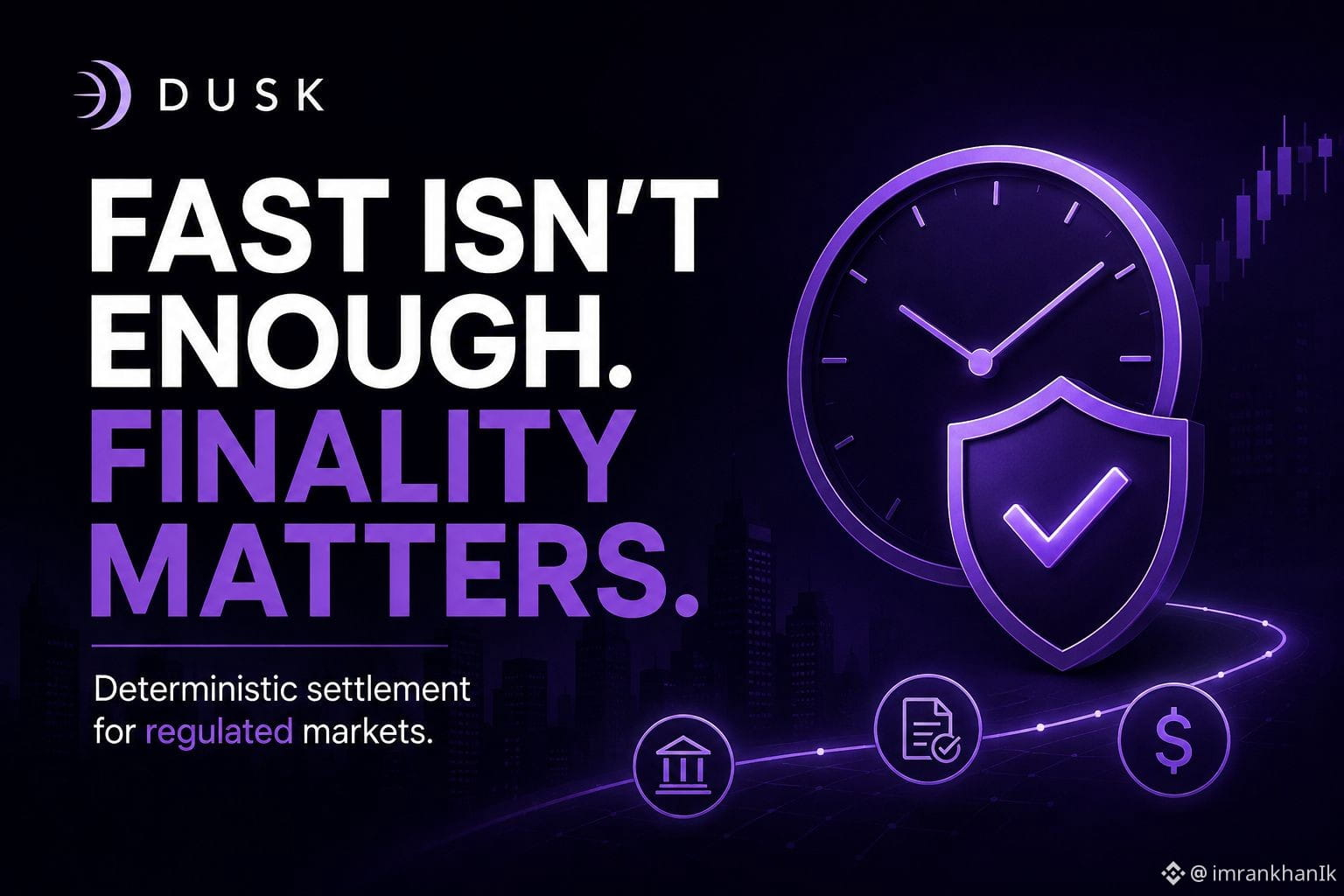
Dusk is designed around deterministic settlement, where transaction finality is intended to be predictable rather than leaving participants uncertain about when a result can be treated as final.
For financial markets, that distinction matters.
If an asset changes hands, there can be more happening around that transaction ownership, compliance, payment and settlement.
The interesting part for me is that Dusk isn't only thinking about how quickly a transaction can happen. It is also thinking about what participants need to know after it happens.
Maybe I'm looking at it too simply, but predictable finality feels like a different problem from simply making a blockchain faster.
Speed tells you how quickly something happened. Deterministic finality tells you when you can treat the outcome as settled.
If regulated finance is moving onchain, should predictable finality matter more than simply having the fastest transaction speed?
I used to think faster settlement was the main goal. Then I started looking at what financial markets actually need after a trade happens.
A transaction can be quick, but that doesn't automatically tell you when the outcome is final.
That’s the part of Dusk I find interesting.
Dusk is designed around deterministic settlement, where transaction finality is intended to be predictable rather than leaving participants uncertain about when a result can be treated as final.
For financial markets, that distinction matters.
If an asset changes hands, there can be more happening around that transaction ownership, compliance, payment and settlement.
The interesting part for me is that Dusk isn't only thinking about how quickly a transaction can happen. It is also thinking about what participants need to know after it happens.
Maybe I'm looking at it too simply, but predictable finality feels like a different problem from simply making a blockchain faster.
Speed tells you how quickly something happened. Deterministic finality tells you when you can treat the outcome as settled.
If regulated finance is moving onchain, should predictable finality matter more than simply having the fastest transaction speed?
စိစစ်အတည်ပြုထားသည်
I was looking at how leverage works on @TermMax and one detail stood out to me.
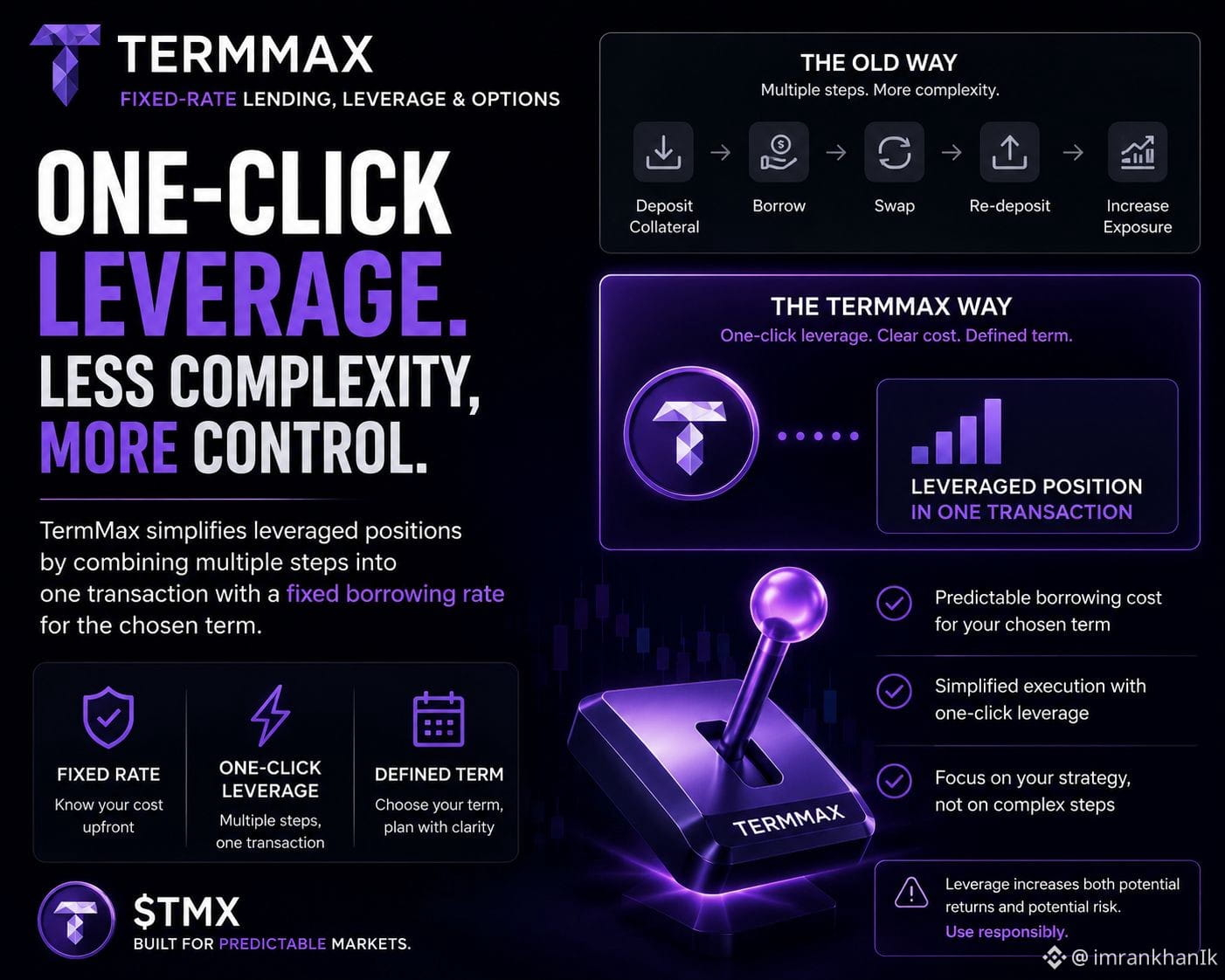
Normally, building a leveraged DeFi position can become a bit messy. You deposit collateral, borrow against it, swap the borrowed assets, and then repeat the process if you want to increase the position.
TermMax approaches that process differently with its one-click leverage feature. Those steps can be combined into a single transaction, while the borrowing rate can remain fixed for the chosen term.
I think the interesting part isn't simply being able to use more leverage.
It is the combination of less transaction complexity and more predictable borrowing costs.
That doesn't make leverage safe. Collateral can still fall, liquidation risk still exists, and the market can move against the position. But removing some of the unnecessary moving parts is meaningful when managing a leveraged strategy.
The best infrastructure is often the part that makes a complicated strategy feel simple without hiding the risk.
That’s an aspect of TermMax I’ll be watching closely.
$TMX #termmax @TermMax
Normally, building a leveraged DeFi position can become a bit messy. You deposit collateral, borrow against it, swap the borrowed assets, and then repeat the process if you want to increase the position.
TermMax approaches that process differently with its one-click leverage feature. Those steps can be combined into a single transaction, while the borrowing rate can remain fixed for the chosen term.
I think the interesting part isn't simply being able to use more leverage.
It is the combination of less transaction complexity and more predictable borrowing costs.
That doesn't make leverage safe. Collateral can still fall, liquidation risk still exists, and the market can move against the position. But removing some of the unnecessary moving parts is meaningful when managing a leveraged strategy.
The best infrastructure is often the part that makes a complicated strategy feel simple without hiding the risk.
That’s an aspect of TermMax I’ll be watching closely.
$TMX #termmax @TermMax
#dusk $DUSK
The more I think about financial privacy, the more I realise that “private” doesn’t have to mean hidden from everyone.
In regulated markets, different participants need different levels of information.
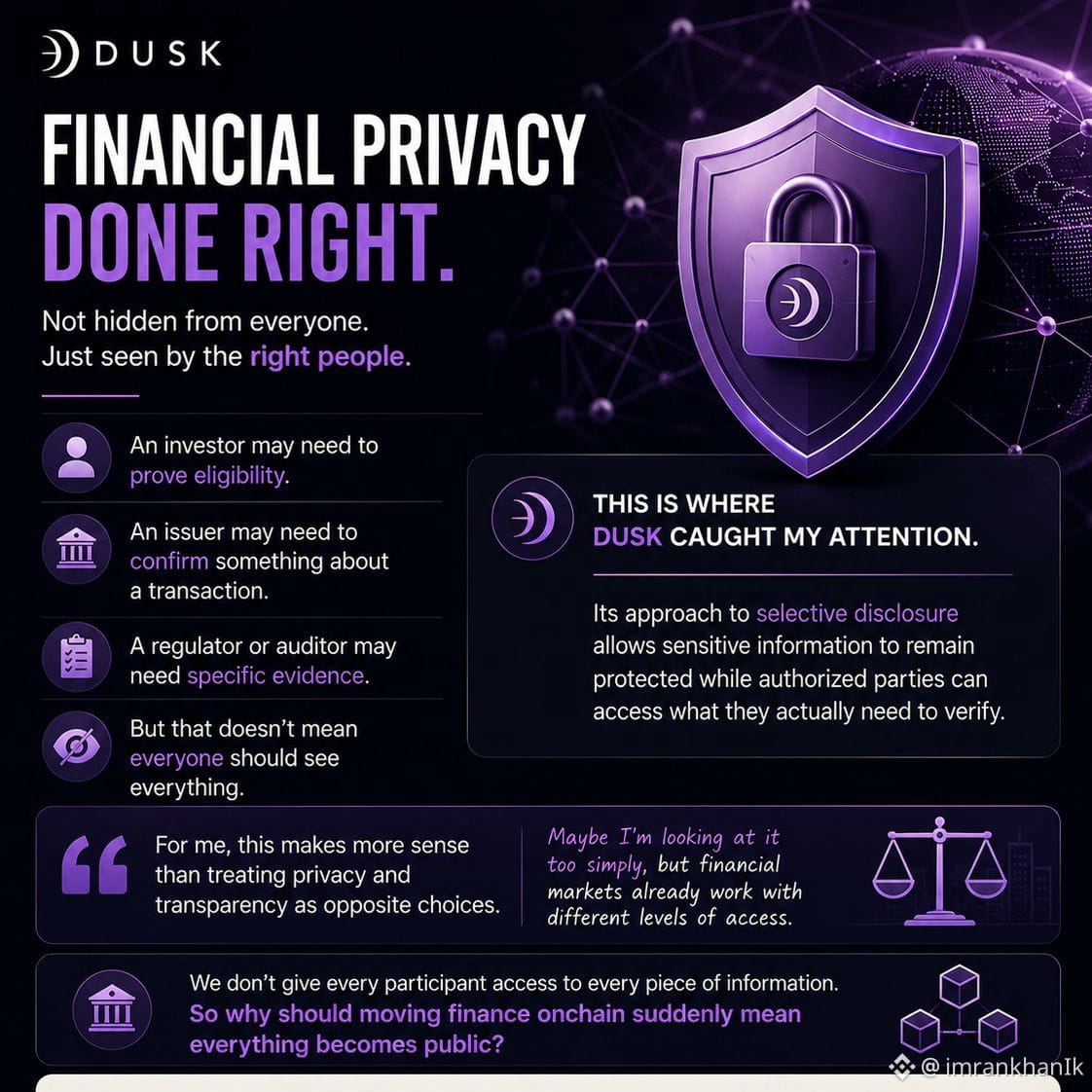
An investor may need to prove eligibility. An issuer may need to confirm something about a transaction. A regulator or auditor may need specific evidence.
But that doesn't mean everyone should see everything.
This is where Dusk caught my attention.
Its approach to selective disclosure allows sensitive information to remain protected while authorized parties can access what they actually need to verify.
For me, this makes more sense than treating privacy and transparency as opposite choices.
Maybe I’m looking at it too simply, but financial markets already work with different levels of access. We don't give every participant access to every piece of information.
So why should moving finance onchain suddenly mean everything becomes public?
Good financial privacy isn't about hiding everything. It's about revealing the right information to the right party.
If regulation requires proof, should investors have to reveal everything — or only what actually needs to be verified?
@Dusk
The more I think about financial privacy, the more I realise that “private” doesn’t have to mean hidden from everyone.
In regulated markets, different participants need different levels of information.
An investor may need to prove eligibility. An issuer may need to confirm something about a transaction. A regulator or auditor may need specific evidence.
But that doesn't mean everyone should see everything.
This is where Dusk caught my attention.
Its approach to selective disclosure allows sensitive information to remain protected while authorized parties can access what they actually need to verify.
For me, this makes more sense than treating privacy and transparency as opposite choices.
Maybe I’m looking at it too simply, but financial markets already work with different levels of access. We don't give every participant access to every piece of information.
So why should moving finance onchain suddenly mean everything becomes public?
Good financial privacy isn't about hiding everything. It's about revealing the right information to the right party.
If regulation requires proof, should investors have to reveal everything — or only what actually needs to be verified?
@Dusk
Log in to explore more content