
Crypto Queen 012
14.2k Posts
 LIVE
LIVECrypto Queen 012
1.4K+ Following
10.4K+ Followers
9.5K+ Liked
Posts
All
Quotes
Live
PINNED
Most people think energy efficiency in blockchain is mainly about lowering costs. I used to see it that way too. But the deeper issue is what happens when financial infrastructure has to run continuously, at scale, without turning every increase in activity into a bigger resource burden.
That changed how I looked at Dusk.
The interesting part of @DuskNetwork’s design is not simply that it aims to be energy efficient. It is the assumption behind it: if blockchain is ever going to support real financial markets, efficiency cannot be treated as a side benefit. It has to be part of the infrastructure itself.
The Dusk Network Mainnet Beta makes that question more practical. Instead of asking, “Can a blockchain process transactions?” I find myself asking, “Can it do that in a way that still makes sense when the network becomes part of everyday financial activity?”
That is where I think $DUSK becomes interesting.
But there is an uncomfortable side to this. Energy efficiency alone does not guarantee adoption. Real institutions bring regulation, liquidity, reliability, privacy expectations, and years of existing infrastructure with them. A technically efficient network still has to prove that people actually want to build on it.
So maybe the real experiment is not whether Dusk can be efficient.
It is whether efficiency, privacy, and financial usability can coexist well enough to matter in the real world.
Would that change how you judge a blockchain built for finance?
#Dusk @Dusk $DUSK #dusk
That changed how I looked at Dusk.
The interesting part of @DuskNetwork’s design is not simply that it aims to be energy efficient. It is the assumption behind it: if blockchain is ever going to support real financial markets, efficiency cannot be treated as a side benefit. It has to be part of the infrastructure itself.
The Dusk Network Mainnet Beta makes that question more practical. Instead of asking, “Can a blockchain process transactions?” I find myself asking, “Can it do that in a way that still makes sense when the network becomes part of everyday financial activity?”
That is where I think $DUSK becomes interesting.
But there is an uncomfortable side to this. Energy efficiency alone does not guarantee adoption. Real institutions bring regulation, liquidity, reliability, privacy expectations, and years of existing infrastructure with them. A technically efficient network still has to prove that people actually want to build on it.
So maybe the real experiment is not whether Dusk can be efficient.
It is whether efficiency, privacy, and financial usability can coexist well enough to matter in the real world.
Would that change how you judge a blockchain built for finance?
#Dusk @Dusk $DUSK #dusk
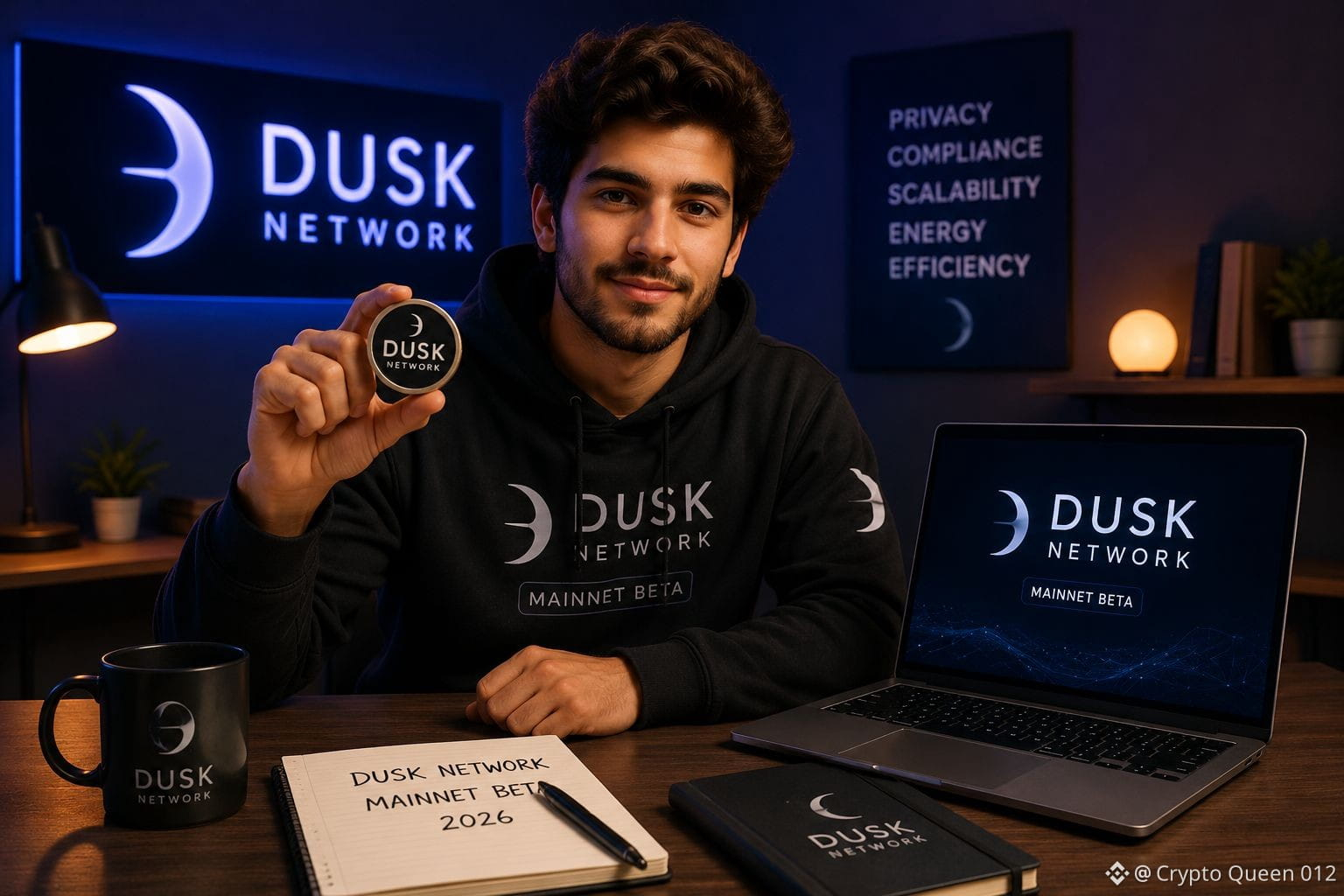
PINNED
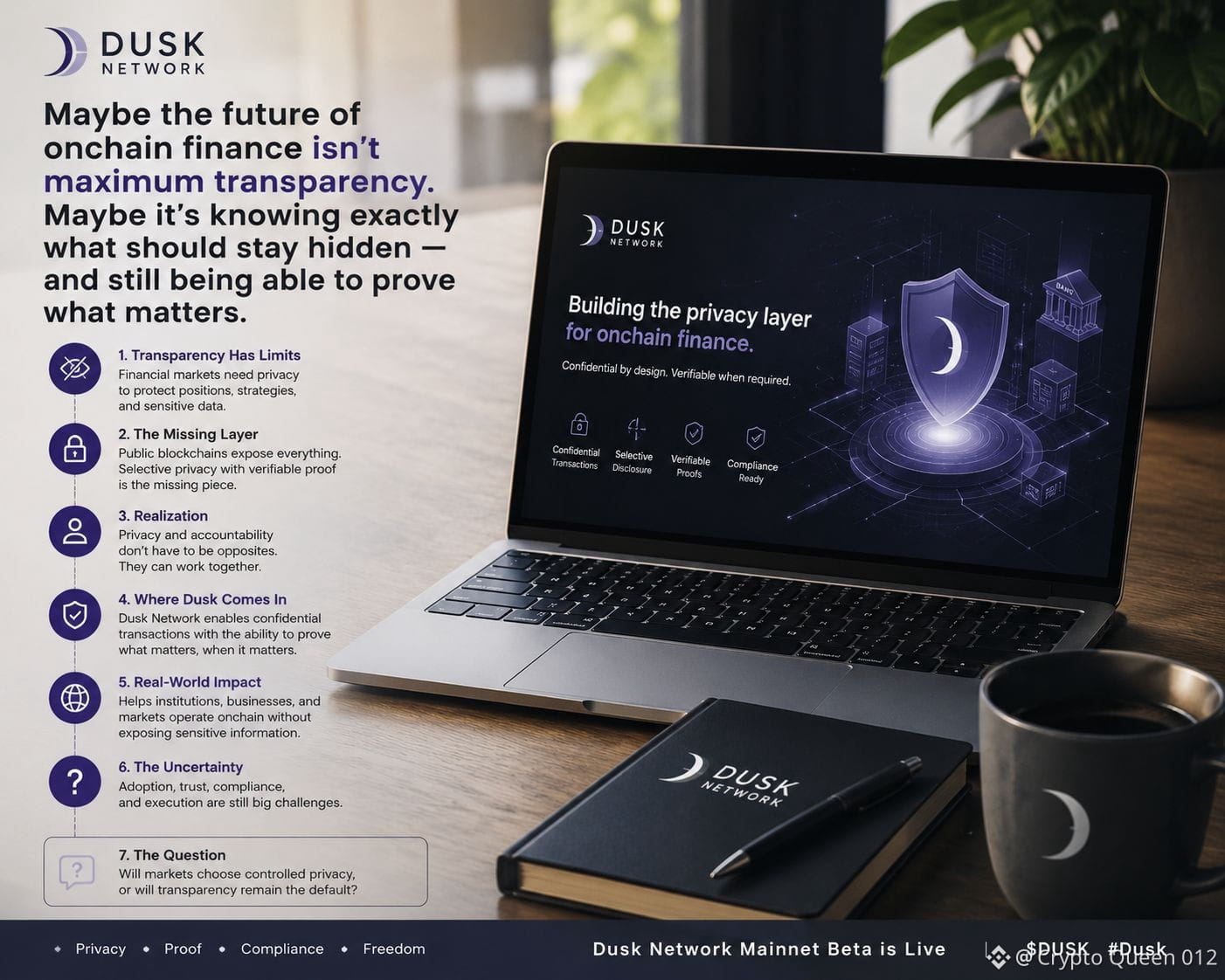
I used to think the biggest advantage of blockchain was simple: put everything on a public ledger and let everyone verify it.
The more I looked at real financial markets, the more I questioned that idea.
Imagine a company moving millions, a fund changing its position, or an institution settling a trade. Do they really want every detail visible to everyone forever? Probably not. But hiding everything creates another problem: how do you prove that the rules were followed?
That’s the part of @DuskNetwork that caught my attention.
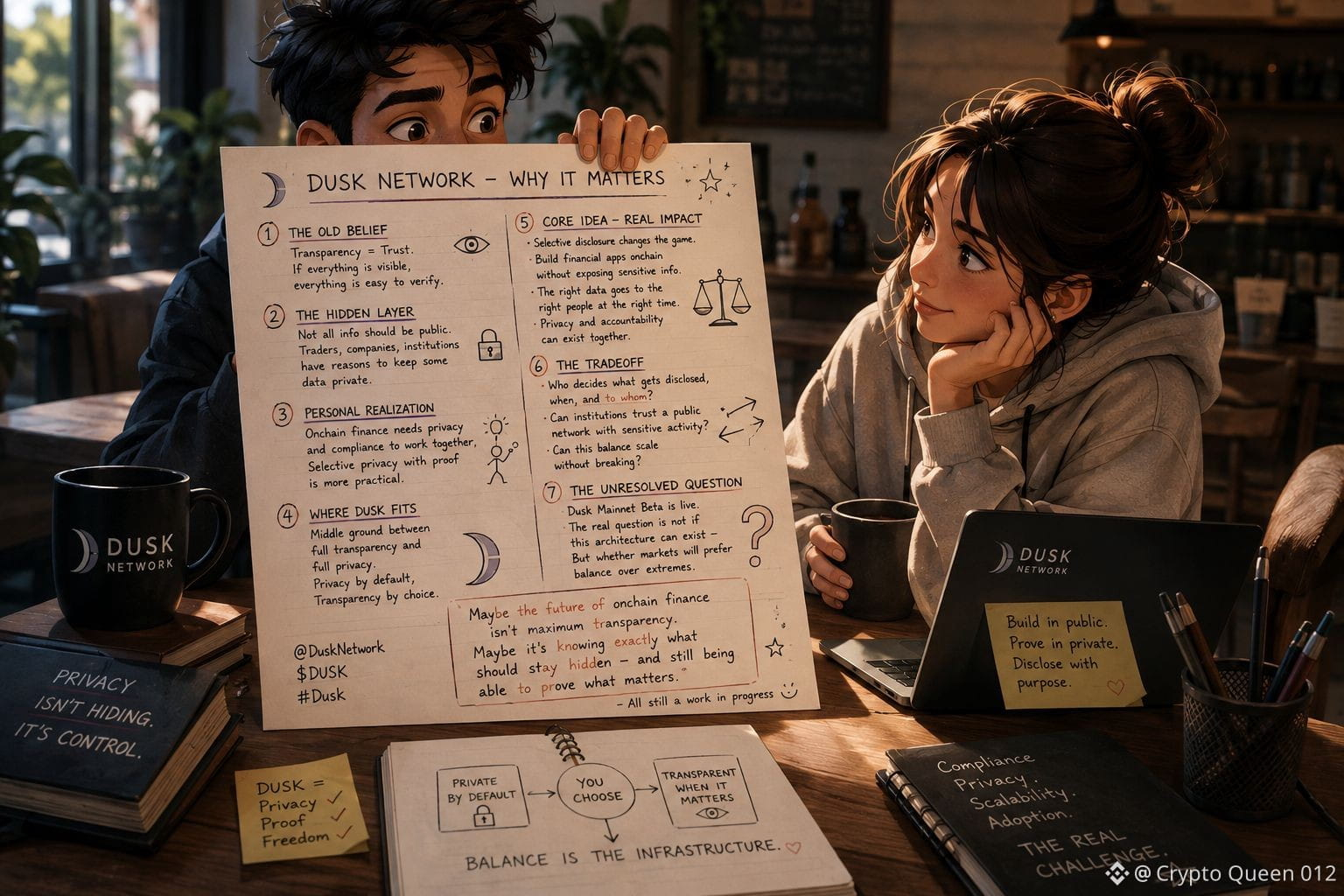
The interesting idea isn’t just putting “privacy” on a blockchain. It’s trying to find a middle ground where financial activity can stay confidential while the information that actually matters can still be verified when needed.
That sounds much more useful to me than simply making everything private.
But there’s a catch.
The technology can work and the market can still reject it. Institutions have compliance requirements, existing systems, legal processes and, above all, trust issues. Getting real financial activity onto a new network is a completely different challenge from proving that the infrastructure works.
With Dusk Network Mainnet Beta, this is becoming something that can be tested rather than just discussed.
I’m curious whether markets will eventually see controlled privacy as necessary infrastructure, or whether public blockchains will keep pushing toward maximum transparency.
Maybe the real breakthrough isn’t choosing privacy over transparency.
Maybe it’s deciding where each one actually belongs.
@Dusk $DUSK #dusk
The more I looked at real financial markets, the more I questioned that idea.
Imagine a company moving millions, a fund changing its position, or an institution settling a trade. Do they really want every detail visible to everyone forever? Probably not. But hiding everything creates another problem: how do you prove that the rules were followed?
That’s the part of @DuskNetwork that caught my attention.
The interesting idea isn’t just putting “privacy” on a blockchain. It’s trying to find a middle ground where financial activity can stay confidential while the information that actually matters can still be verified when needed.
That sounds much more useful to me than simply making everything private.
But there’s a catch.
The technology can work and the market can still reject it. Institutions have compliance requirements, existing systems, legal processes and, above all, trust issues. Getting real financial activity onto a new network is a completely different challenge from proving that the infrastructure works.
With Dusk Network Mainnet Beta, this is becoming something that can be tested rather than just discussed.
I’m curious whether markets will eventually see controlled privacy as necessary infrastructure, or whether public blockchains will keep pushing toward maximum transparency.
Maybe the real breakthrough isn’t choosing privacy over transparency.
Maybe it’s deciding where each one actually belongs.
@Dusk $DUSK #dusk

$PROM
/ $UAI
— HIGH-VOLTAGE SETUP
EP: Support zone / breakout retest
SL: 3–5% below EP
TP1: +5%
TP2: +10%
TP3: +15%
Pro Tip: Don’t chase the first pump. Wait for a clean breakout with strong volume and a successful retest. If support fails, exit fast and protect capital.
Trade the setup, not the emotion.
/ $UAI
— HIGH-VOLTAGE SETUP
EP: Support zone / breakout retest
SL: 3–5% below EP
TP1: +5%
TP2: +10%
TP3: +15%
Pro Tip: Don’t chase the first pump. Wait for a clean breakout with strong volume and a successful retest. If support fails, exit fast and protect capital.
Trade the setup, not the emotion.
BULLISH
BEARISH
🟢 MARKET BIAS: BULLISH
18 hr(s) left
$ZORA
| $MORPHO
| $STX
— Trade Setup
$ZOR
Entry: Support zone
TP1: +5% | TP2: +10% | TP3: +15%
SL: Below support
$MORPHO
Entry: Support zone
TP1: +5% | TP2: +10% | TP3: +15%
SL: Below support
$STX
Entry: Support zone
TP1: +5% | TP2: +10% | TP3: +15%
SL: Below support
Watch volume and resistance. Strong volume + clean breakout can confirm the next move.
| $MORPHO
| $STX
— Trade Setup
$ZOR
Entry: Support zone
TP1: +5% | TP2: +10% | TP3: +15%
SL: Below support
$MORPHO
Entry: Support zone
TP1: +5% | TP2: +10% | TP3: +15%
SL: Below support
$STX
Entry: Support zone
TP1: +5% | TP2: +10% | TP3: +15%
SL: Below support
Watch volume and resistance. Strong volume + clean breakout can confirm the next move.
BULLISH
42%
BEARISH
52%
🟢 MARKET BIAS: BULLISH
6%
31 votes • Voting closed
$TRUMP
$POL
$TUR.ETF
— Trade Watch
$TRU: Buy near support. TP1 +5%, TP2 +10%, TP3 +15%. SL below support.
$POL : Buy on a strong support hold. TP1 +5%, TP2 +10%, TP3 +15%. SL below support.
$ZOC: Entry near support. TP1 +6%, TP2 +12%, TP3 +18%. SL below support.
Wait for volume and confirmation before entry. If support breaks, the setup is invalid.
$POL
$TUR.ETF
— Trade Watch
$TRU: Buy near support. TP1 +5%, TP2 +10%, TP3 +15%. SL below support.
$POL : Buy on a strong support hold. TP1 +5%, TP2 +10%, TP3 +15%. SL below support.
$ZOC: Entry near support. TP1 +6%, TP2 +12%, TP3 +18%. SL below support.
Wait for volume and confirmation before entry. If support breaks, the setup is invalid.
BULLISH
55%
BEARISH
28%
🟢 MARKET BIAS: BULLISH
17%
29 votes • Voting closed
$ZEC
and $DUSK
are both worth watching.
$ZEC : Watch the breakout above resistance for momentum.
DUSK: Holding support could open the way for a fresh move higher.
Trade smart, manage risk, and wait for confirmation.
and $DUSK
are both worth watching.
$ZEC : Watch the breakout above resistance for momentum.
DUSK: Holding support could open the way for a fresh move higher.
Trade smart, manage risk, and wait for confirmation.
BULLISH
54%
BEARISH
46%
13 votes • Voting closed
I used to think blockchain performance was mostly a consensus problem.
Then I started paying more attention to what happens before consensus can even do its job.
If transactions and blocks cannot move through the network efficiently, faster settlement on paper doesn’t mean much in practice.
That is what made me look differently at Kadcast.
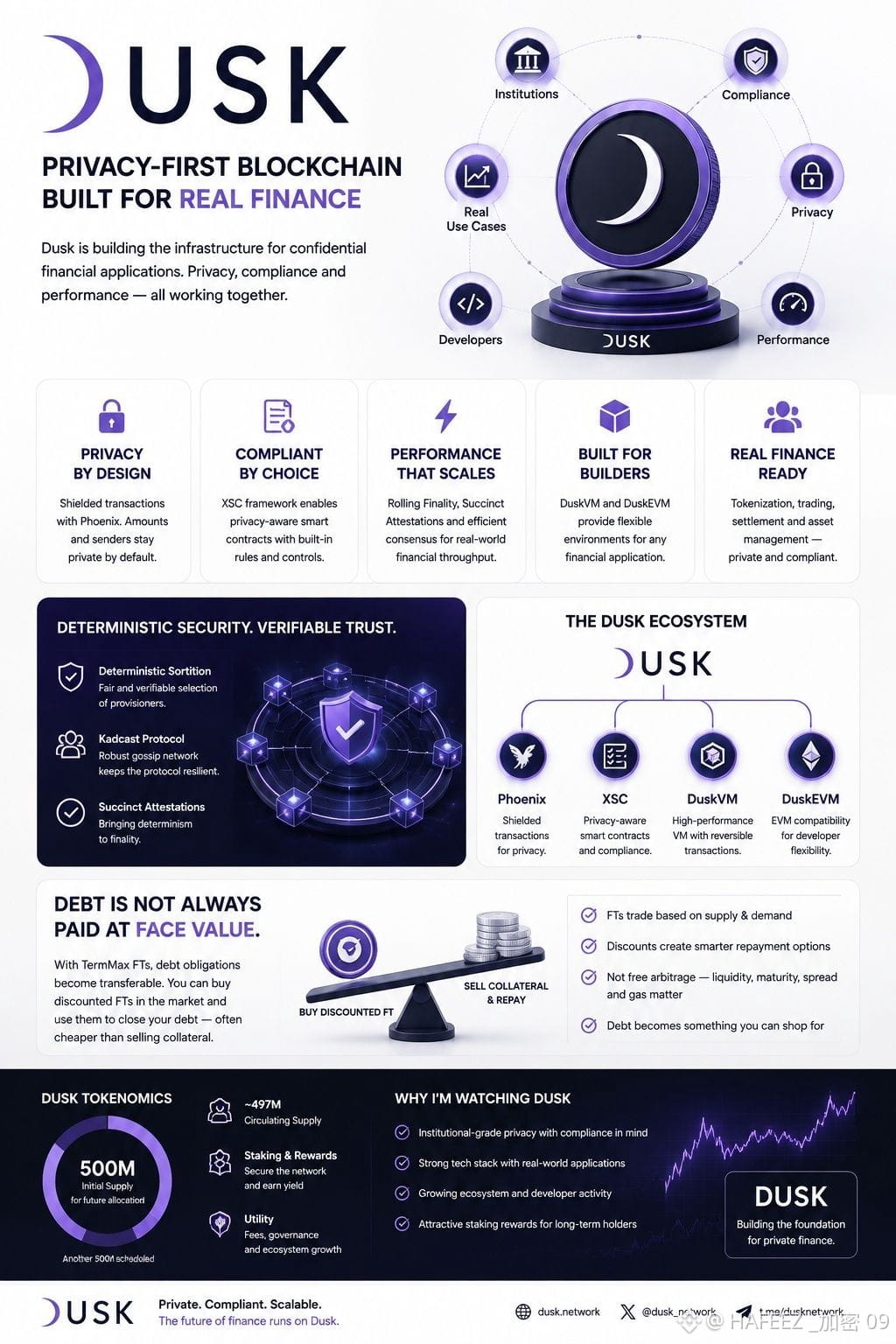
Dusk uses a structured peer-to-peer overlay rather than relying on traditional random gossip. The idea is fairly simple: instead of sending the same information broadly and hoping it spreads efficiently, the network gives message propagation a more deliberate structure. Dusk’s own documentation says this is intended to reduce bandwidth use and make latency more predictable.
For a blockchain aimed at financial applications, that detail feels more important than it first appears.
Financial infrastructure is not only about privacy or smart contracts. It also depends on predictable communication between the machines actually maintaining the ledger.
And that creates an interesting question for @DuskNetwork.
Kadcast has been audited, with Dusk reporting a 9.8/10 overall result, but real adoption is a different test: more validators, more traffic, more applications, and less forgiving financial workloads.
So I’m less interested in asking whether Kadcast looks clever on paper.
I’m more interested in whether this networking design still feels predictable when Dusk’s financial ambitions meet real network pressure.
That may be the harder test.
@Dusk $DUSK #dusk
#Dusk
Then I started paying more attention to what happens before consensus can even do its job.
If transactions and blocks cannot move through the network efficiently, faster settlement on paper doesn’t mean much in practice.
That is what made me look differently at Kadcast.
Dusk uses a structured peer-to-peer overlay rather than relying on traditional random gossip. The idea is fairly simple: instead of sending the same information broadly and hoping it spreads efficiently, the network gives message propagation a more deliberate structure. Dusk’s own documentation says this is intended to reduce bandwidth use and make latency more predictable.
For a blockchain aimed at financial applications, that detail feels more important than it first appears.
Financial infrastructure is not only about privacy or smart contracts. It also depends on predictable communication between the machines actually maintaining the ledger.
And that creates an interesting question for @DuskNetwork.
Kadcast has been audited, with Dusk reporting a 9.8/10 overall result, but real adoption is a different test: more validators, more traffic, more applications, and less forgiving financial workloads.
So I’m less interested in asking whether Kadcast looks clever on paper.
I’m more interested in whether this networking design still feels predictable when Dusk’s financial ambitions meet real network pressure.
That may be the harder test.
@Dusk $DUSK #dusk
#Dusk
— Watch the support zone. A clean breakout with volume can open the way higher. Stop below support.
— Holding support keeps the bullish structure alive. Break resistance with volume for continuation. Stop below key support.
— Strong above support. A breakout and close above resistance could trigger the next move. Stop below support.
$THE — Watch for a volume breakout. Holding support keeps the setup valid; losing it can invalidate the trade.
— Holding support keeps the bullish structure alive. Break resistance with volume for continuation. Stop below key support.
— Strong above support. A breakout and close above resistance could trigger the next move. Stop below support.
$THE — Watch for a volume breakout. Holding support keeps the setup valid; losing it can invalidate the trade.
BULLISH
52%
BEARISH
43%
🟢 MARKET BIAS: BULLISH
5%
21 votes • Voting closed
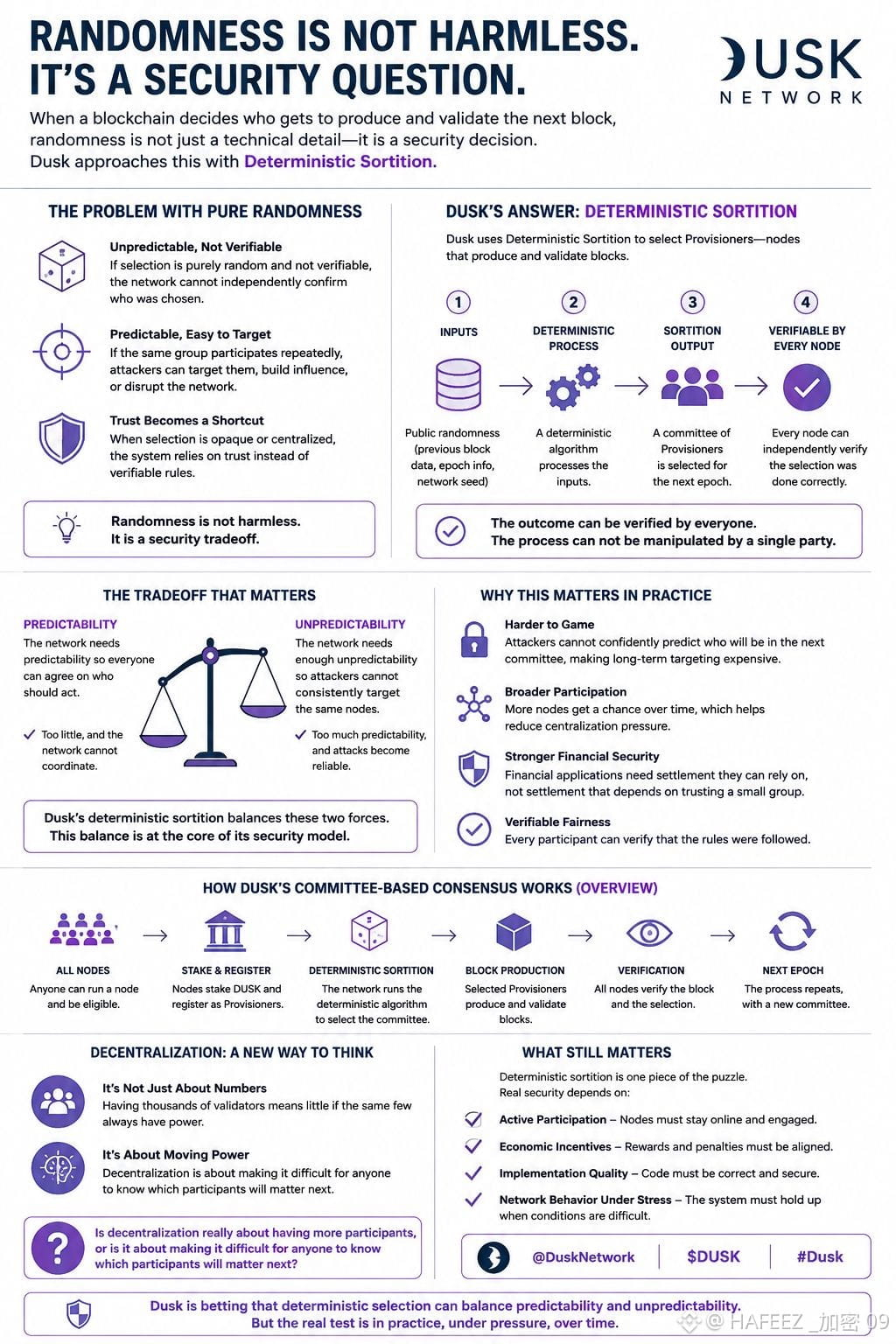
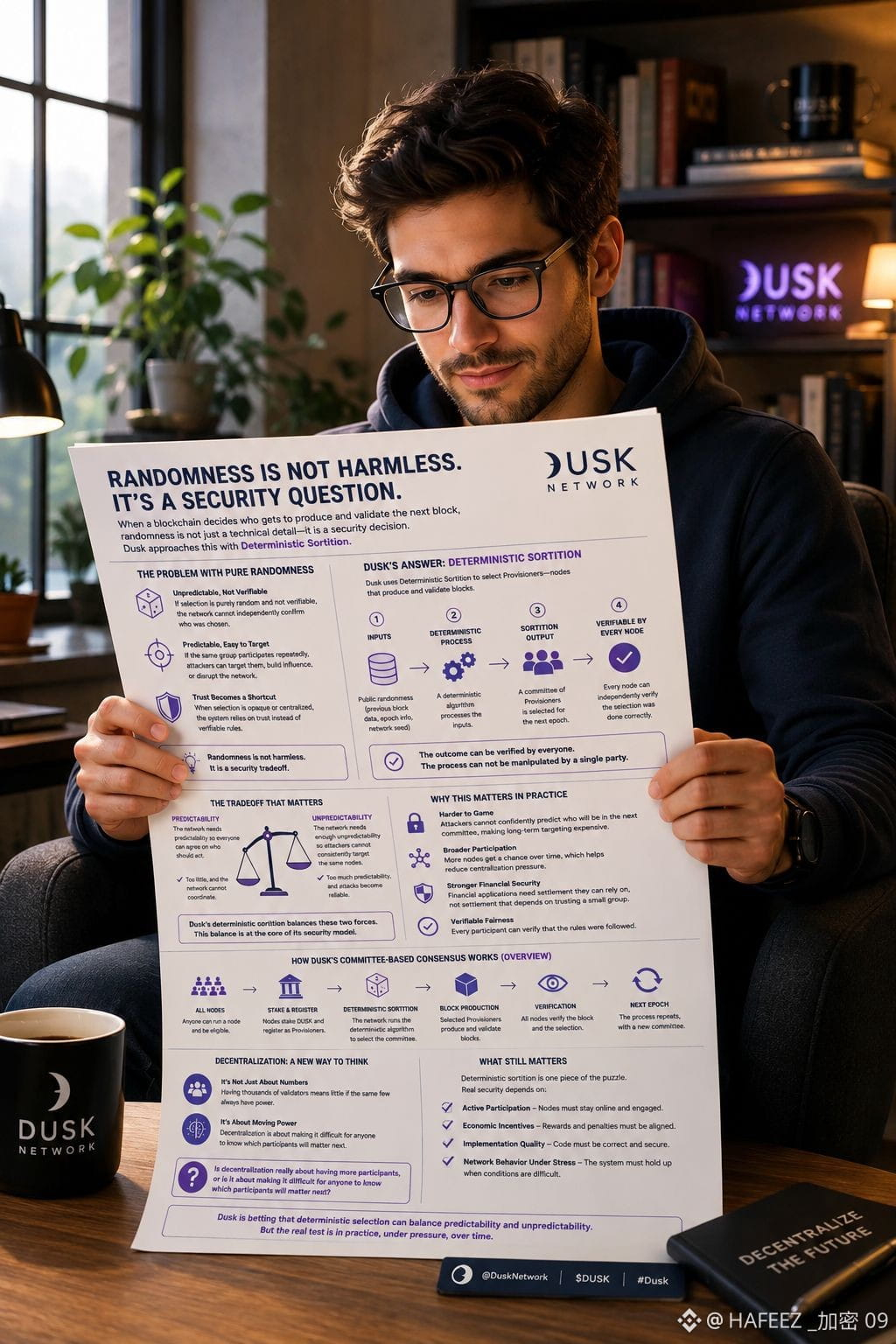
#dusk $DUSK @Dusk Most blockchains make randomness sound harmless.
But when a network has to decide who gets to participate in producing and validating the next block, randomness becomes a security question.
That was the part of Dusk I found more interesting than I expected.
With Deterministic Sortition, Dusk does not simply rely on a fixed committee forever. Provisioners are selected through a deterministic process, so participation can change while still being verifiable by the network. Dusk’s consensus design uses this committee-based approach as part of its security model.
The practical implication is easy to miss.
You want enough predictability for everyone to agree on who is supposed to act, but not so much predictability that an attacker can comfortably target the same participants over and over.
That tradeoff matters even more when the blockchain is trying to support financial activity, where settlement cannot depend on a small group simply being trusted.
What I like about this idea is that it changes how I think about decentralization.
It is not only about how many validators exist.
It is also about how power moves between them.
Dusk is clearly betting that deterministic selection can help balance these two pressures. But that does not make the problem disappear. Real security still depends on participation, incentives, implementation quality, and how the system behaves under stress.
So I keep coming back to one question:
Is decentralization really about having more participants, or is it about making it difficult for anyone to know which participants will matter next?
@DuskNetwork $DUSK
#Dusk
But when a network has to decide who gets to participate in producing and validating the next block, randomness becomes a security question.
That was the part of Dusk I found more interesting than I expected.
With Deterministic Sortition, Dusk does not simply rely on a fixed committee forever. Provisioners are selected through a deterministic process, so participation can change while still being verifiable by the network. Dusk’s consensus design uses this committee-based approach as part of its security model.
The practical implication is easy to miss.
You want enough predictability for everyone to agree on who is supposed to act, but not so much predictability that an attacker can comfortably target the same participants over and over.
That tradeoff matters even more when the blockchain is trying to support financial activity, where settlement cannot depend on a small group simply being trusted.
What I like about this idea is that it changes how I think about decentralization.
It is not only about how many validators exist.
It is also about how power moves between them.
Dusk is clearly betting that deterministic selection can help balance these two pressures. But that does not make the problem disappear. Real security still depends on participation, incentives, implementation quality, and how the system behaves under stress.
So I keep coming back to one question:
Is decentralization really about having more participants, or is it about making it difficult for anyone to know which participants will matter next?
@DuskNetwork $DUSK
#Dusk
$BTC
$ETH
$BNB
Trade setup:
BTC: Watch the support zone for a bounce. TP1 +3%, TP2 +6%, TP3 +10%. SL below support.
HTE: Entry near strong support. TP1 +5%, TP2 +10%, TP3 +15%. SL below support.
BNB: Buy on support confirmation. TP1 +4%, TP2 +8%, TP3 +12%. SL below support.
Wait for volume and confirmation before entering.
$ETH
$BNB
Trade setup:
BTC: Watch the support zone for a bounce. TP1 +3%, TP2 +6%, TP3 +10%. SL below support.
HTE: Entry near strong support. TP1 +5%, TP2 +10%, TP3 +15%. SL below support.
BNB: Buy on support confirmation. TP1 +4%, TP2 +8%, TP3 +12%. SL below support.
Wait for volume and confirmation before entering.
BULLISH
64%
BEARISH
27%
🟢 MARKET BIAS: BULLISH
9%
58 votes • Voting closed
$HYPE
Bias: Bullish above support
Entry: Support zone
TP1: +5% | TP2: +10% | TP3: +15%
SL: Below support
A clean breakout with strong volume can push HYPE toward the next resistance.
Bias: Bullish
Entry: Support zone
TP1: +4% | TP2: +8% | TP3: +12%
SL: Below support
Hold the support and break resistance with volume for continuation.
Bias: Bullish above support
Entry: Support zone
TP1: +6% | TP2: +12% | TP3: +18%
SL: Below support
Volume is key. A strong breakout can start the next move.
$BOME
Bias: Bullish if support holds
Entry: Support zone
TP1: +5% | TP2: +10% | TP3: +15%
SL: Below support
Watch resistance closely. Breakout plus volume confirms strength.
$RE
Bias: Bullish above support
Entry: Support zone
TP1: +5% | TP2: +10% | TP3: +15%
SL: Below support
If buyers defend support and volume increases, upside continuation is possible.
Bias: Bullish above support
Entry: Support zone
TP1: +5% | TP2: +10% | TP3: +15%
SL: Below support
A clean breakout with strong volume can push HYPE toward the next resistance.
Bias: Bullish
Entry: Support zone
TP1: +4% | TP2: +8% | TP3: +12%
SL: Below support
Hold the support and break resistance with volume for continuation.
Bias: Bullish above support
Entry: Support zone
TP1: +6% | TP2: +12% | TP3: +18%
SL: Below support
Volume is key. A strong breakout can start the next move.
$BOME
Bias: Bullish if support holds
Entry: Support zone
TP1: +5% | TP2: +10% | TP3: +15%
SL: Below support
Watch resistance closely. Breakout plus volume confirms strength.
$RE
Bias: Bullish above support
Entry: Support zone
TP1: +5% | TP2: +10% | TP3: +15%
SL: Below support
If buyers defend support and volume increases, upside continuation is possible.
BULLISH
39%
BEARISH
48%
🟢 MARKET BIAS: BULLISH
13%
23 votes • Voting closed
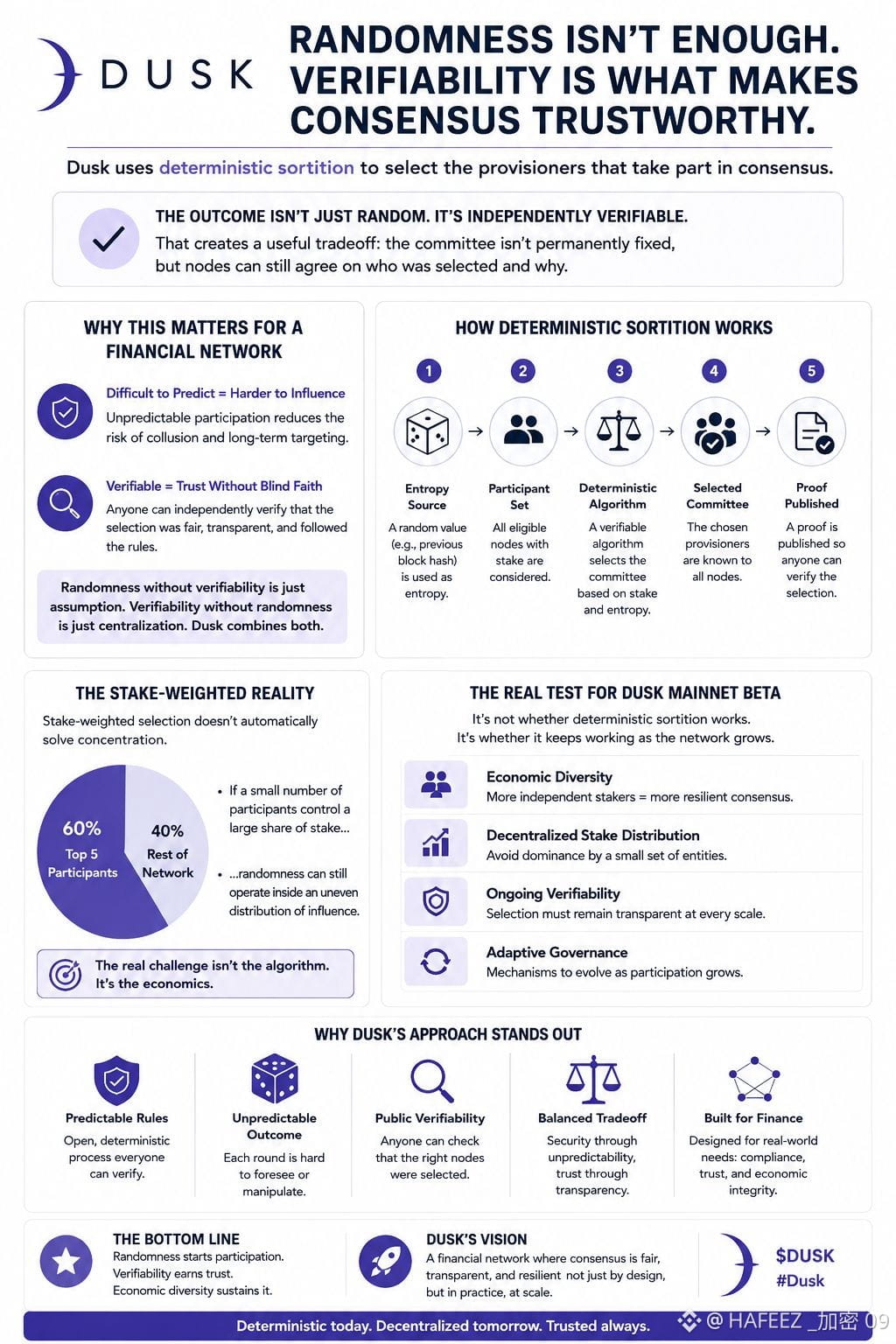
#dusk $DUSK @Dusk I always thought randomness was the part of consensus that made it decentralized.
Then I looked closer at how Dusk handles committee selection, and that assumption started to feel incomplete.
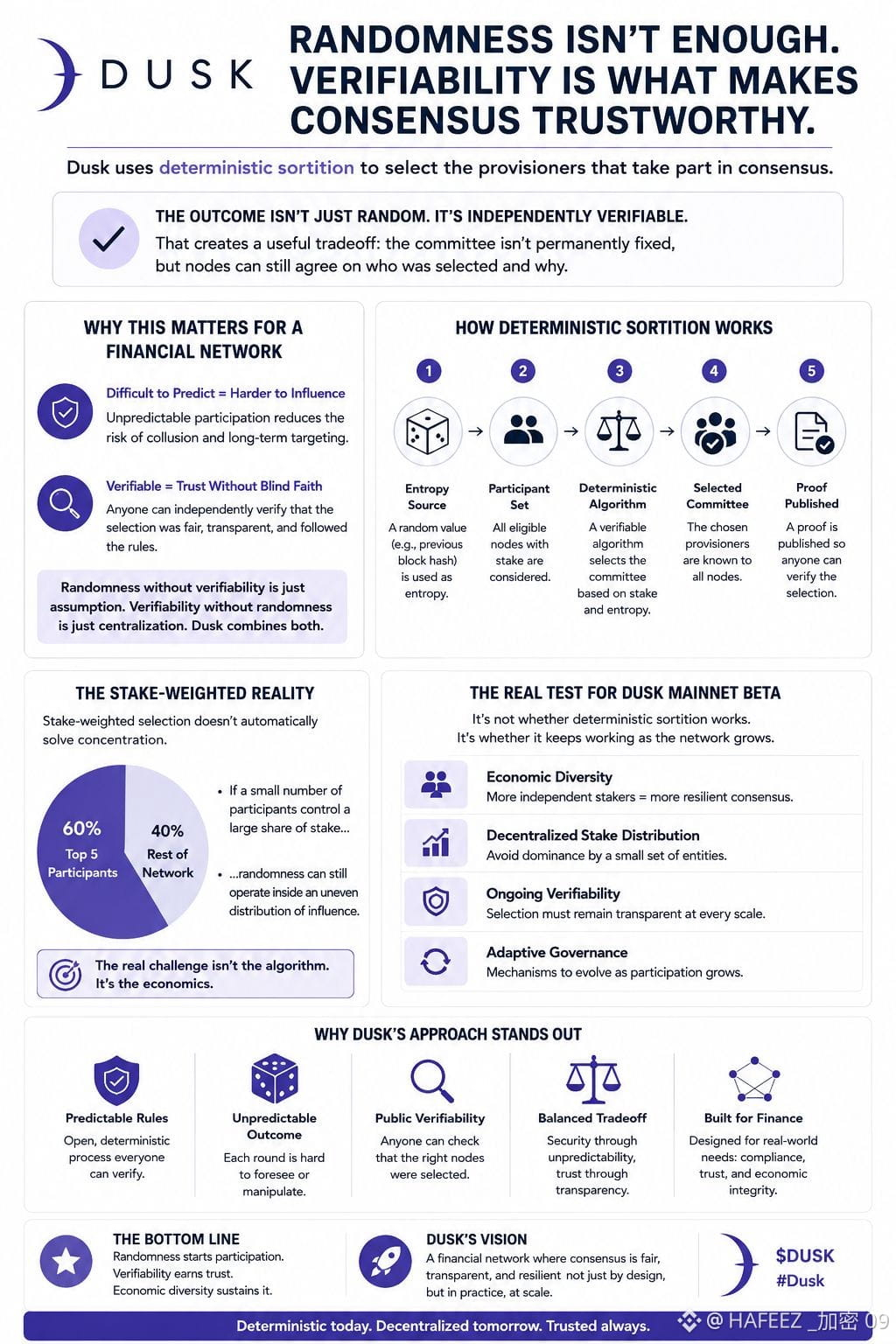
Dusk uses deterministic sortition to select the provisioners that take part in consensus.
The interesting part isn’t simply that the selection is random.
It’s that the outcome can be independently verified.
That creates a useful tradeoff: the committee isn’t permanently fixed, but nodes can still agree on who was selected and why.
For a financial network, that matters more than it first sounds.
You want participation to be difficult to predict, because predictable committees can become easier to influence. But you also need the selection process itself to be verifiable, otherwise “random” becomes something users simply have to trust.
That’s the part of @DuskNetwork I keep coming back to.
Still, there’s a question I can’t ignore: stake-weighted selection doesn’t automatically solve concentration. If a small number of participants control a large share of stake, randomness can still operate inside an uneven distribution of influence.
So maybe the real test for Dusk Mainnet Beta isn’t whether deterministic sortition works.
It’s whether it keeps working as the network becomes more economically diverse.
$DUSK #Dusk #termmax @TermMax $DUSK
Then I looked closer at how Dusk handles committee selection, and that assumption started to feel incomplete.
Dusk uses deterministic sortition to select the provisioners that take part in consensus.
The interesting part isn’t simply that the selection is random.
It’s that the outcome can be independently verified.
That creates a useful tradeoff: the committee isn’t permanently fixed, but nodes can still agree on who was selected and why.
For a financial network, that matters more than it first sounds.
You want participation to be difficult to predict, because predictable committees can become easier to influence. But you also need the selection process itself to be verifiable, otherwise “random” becomes something users simply have to trust.
That’s the part of @DuskNetwork I keep coming back to.
Still, there’s a question I can’t ignore: stake-weighted selection doesn’t automatically solve concentration. If a small number of participants control a large share of stake, randomness can still operate inside an uneven distribution of influence.
So maybe the real test for Dusk Mainnet Beta isn’t whether deterministic sortition works.
It’s whether it keeps working as the network becomes more economically diverse.
$DUSK #Dusk #termmax @TermMax $DUSK
#termmax @TermMaxI always thought randomness was the part of consensus that made it decentralized.
Then I looked closer at how Dusk handles committee selection, and that assumption started to feel incomplete.
Dusk uses deterministic sortition to select the provisioners that take part in consensus.
The interesting part isn’t simply that the selection is random.
It’s that the outcome can be independently verified.
That creates a useful tradeoff: the committee isn’t permanently fixed, but nodes can still agree on who was selected and why.
For a financial network, that matters more than it first sounds.
You want participation to be difficult to predict, because predictable committees can become easier to influence. But you also need the selection process itself to be verifiable, otherwise “random” becomes something users simply have to trust.
That’s the part of @DuskNetwork I keep coming back to.
Still, there’s a question I can’t ignore: stake-weighted selection doesn’t automatically solve concentration. If a small number of participants control a large share of stake, randomness can still operate inside an uneven distribution of influence.
So maybe the real test for Dusk Mainnet Beta isn’t whether deterministic sortition works.
It’s whether it keeps working as the network becomes more economically diverse.
$DUSK #Dusk $DUSK
$DUSK #dusk
Then I looked closer at how Dusk handles committee selection, and that assumption started to feel incomplete.
Dusk uses deterministic sortition to select the provisioners that take part in consensus.
The interesting part isn’t simply that the selection is random.
It’s that the outcome can be independently verified.
That creates a useful tradeoff: the committee isn’t permanently fixed, but nodes can still agree on who was selected and why.
For a financial network, that matters more than it first sounds.
You want participation to be difficult to predict, because predictable committees can become easier to influence. But you also need the selection process itself to be verifiable, otherwise “random” becomes something users simply have to trust.
That’s the part of @DuskNetwork I keep coming back to.
Still, there’s a question I can’t ignore: stake-weighted selection doesn’t automatically solve concentration. If a small number of participants control a large share of stake, randomness can still operate inside an uneven distribution of influence.
So maybe the real test for Dusk Mainnet Beta isn’t whether deterministic sortition works.
It’s whether it keeps working as the network becomes more economically diverse.
$DUSK #Dusk $DUSK
$DUSK #dusk
$SOL
Trade Setup
Bias: Bullish
Entry: Support zone
TP1: +5%
TP2: +10%
TP3: +15%
Stop Loss: Below support
If SOL holds the support zone and breaks resistance with strong volume, the bullish move can continue. If support fails, exit and wait for a better setup.
Trade Setup
Bias: Bullish
Entry: Support zone
TP1: +5%
TP2: +10%
TP3: +15%
Stop Loss: Below support
If SOL holds the support zone and breaks resistance with strong volume, the bullish move can continue. If support fails, exit and wait for a better setup.
BULLISH
100%
BEARISH
0%
🟢 MARKET BIAS: BULLISH
0%
2 votes • Voting closed
Market is showing interesting setups on these three coins.
$HEMI — Watch the support zone for a bounce. A clean breakout with volume can open the way higher.
$BTW — Holding support keeps the bullish setup valid. Breakout confirmation is key before chasing.
$STAR — Buyers need to defend support and push above resistance for continuation.
Trade smart. Always manage risk.
BULLISH
46%
BEARISH
50%
🟢 MARKET BIAS: BULLISH
4%
26 votes • Voting closed
$RICE
— Watching the support zone for a possible bounce. A clean breakout with strong volume could open the way toward the next resistance.
$BTW
— Price needs to hold support before any bullish continuation. Breakout + volume would strengthen the setup.
$VELVET
— Holding support keeps the upside setup active. Watch resistance closely and wait for volume confirmation before entering.
— Watching the support zone for a possible bounce. A clean breakout with strong volume could open the way toward the next resistance.
$BTW
— Price needs to hold support before any bullish continuation. Breakout + volume would strengthen the setup.
$VELVET
— Holding support keeps the upside setup active. Watch resistance closely and wait for volume confirmation before entering.
BULLISH
57%
BEARISH
39%
🟢 MARKET BIAS: BULLISH
4%
46 votes • Voting closed
Verified
#dusk $DUSK @Dusk I used to think consensus was mostly about keeping a blockchain honest.
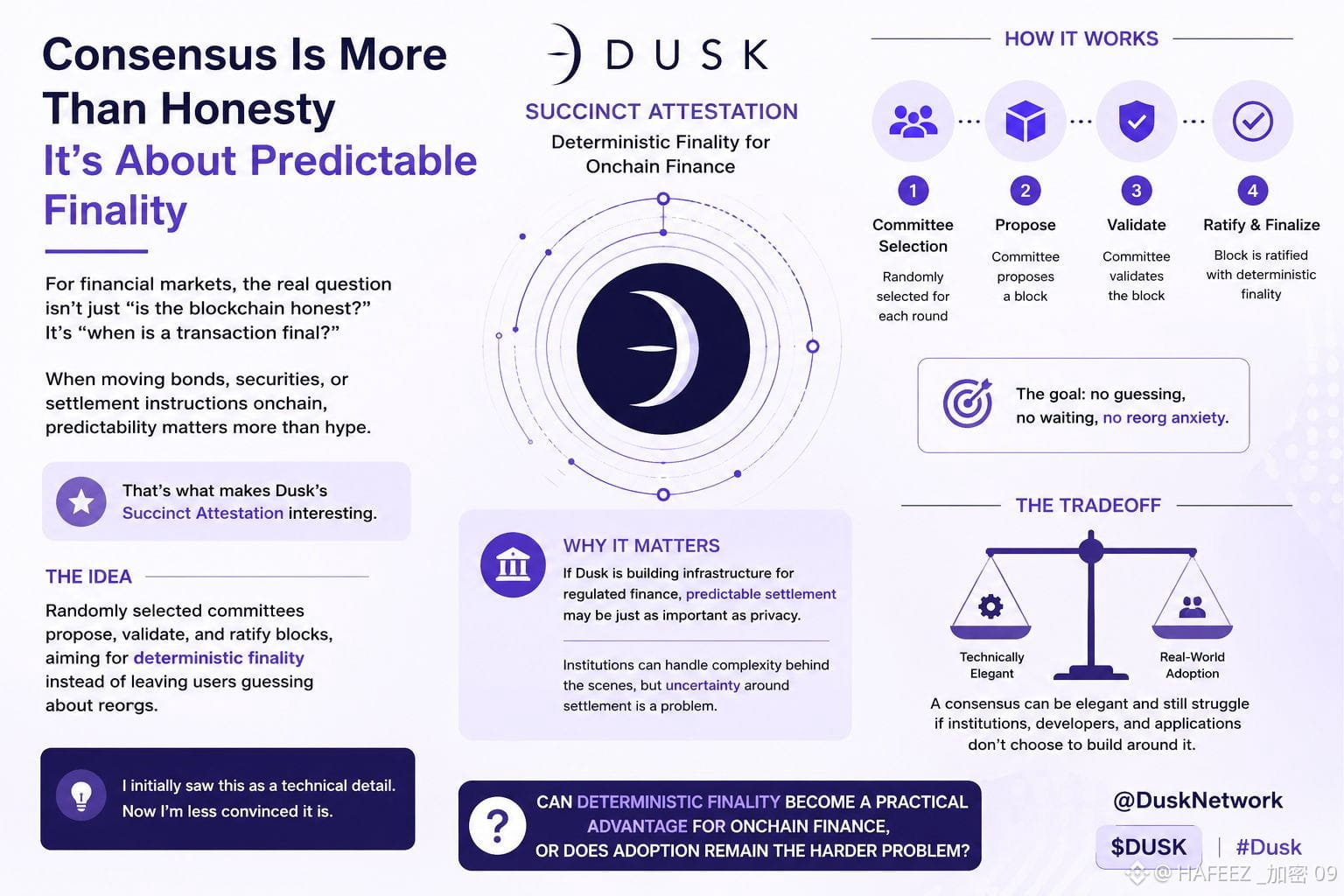
The deeper I looked, the more I realized that for financial markets, there’s another question: how predictable is the moment a transaction actually becomes final?
That matters more when the thing moving onchain isn’t a meme coin, but a bond, security, or settlement instruction.
That’s what made Dusk’s Succinct Attestation interesting to me. It isn’t just another consensus design. The idea is to use randomly selected committees to propose, validate, and ratify blocks, aiming for deterministic finality rather than leaving users wondering whether a transaction might reorganize later.
I initially saw this as a technical detail.
Now I’m less convinced it is.
If Dusk is trying to build infrastructure for regulated finance, predictable settlement may be just as important as privacy. A financial institution can tolerate a lot of complexity behind the scenes, but uncertainty around settlement is harder to ignore.
Still, there’s a real tradeoff here.
A consensus mechanism can be technically elegant and still struggle if institutions, developers, and applications don’t actually choose to build around it.
So I keep coming back to one question:
Can deterministic finality become a practical advantage for onchain finance, or does adoption remain the harder problem?
@DuskNetwork #Dusk @Dusk $DUSK
The deeper I looked, the more I realized that for financial markets, there’s another question: how predictable is the moment a transaction actually becomes final?
That matters more when the thing moving onchain isn’t a meme coin, but a bond, security, or settlement instruction.
That’s what made Dusk’s Succinct Attestation interesting to me. It isn’t just another consensus design. The idea is to use randomly selected committees to propose, validate, and ratify blocks, aiming for deterministic finality rather than leaving users wondering whether a transaction might reorganize later.
I initially saw this as a technical detail.
Now I’m less convinced it is.
If Dusk is trying to build infrastructure for regulated finance, predictable settlement may be just as important as privacy. A financial institution can tolerate a lot of complexity behind the scenes, but uncertainty around settlement is harder to ignore.
Still, there’s a real tradeoff here.
A consensus mechanism can be technically elegant and still struggle if institutions, developers, and applications don’t actually choose to build around it.
So I keep coming back to one question:
Can deterministic finality become a practical advantage for onchain finance, or does adoption remain the harder problem?
@DuskNetwork #Dusk @Dusk $DUSK
#dusk I used to think consensus was mostly about keeping a blockchain honest.
The deeper I looked, the more I realized that for financial markets, there’s another question: how predictable is the moment a transaction actually becomes final?
That matters more when the thing moving onchain isn’t a meme coin, but a bond, security, or settlement instruction.
That’s what made Dusk’s Succinct Attestation interesting to me. It isn’t just another consensus design. The idea is to use randomly selected committees to propose, validate, and ratify blocks, aiming for deterministic finality rather than leaving users wondering whether a transaction might reorganize later.
I initially saw this as a technical detail.
Now I’m less convinced it is.
If Dusk is trying to build infrastructure for regulated finance, predictable settlement may be just as important as privacy. A financial institution can tolerate a lot of complexity behind the scenes, but uncertainty around settlement is harder to ignore.
Still, there’s a real tradeoff here.
A consensus mechanism can be technically elegant and still struggle if institutions, developers, and applications don’t actually choose to build around it.
So I keep coming back to one question:
Can deterministic finality become a practical advantage for onchain finance, or does adoption remain the harder problem?
@DuskNetwork $DUSK #Dusk $DUSK
The deeper I looked, the more I realized that for financial markets, there’s another question: how predictable is the moment a transaction actually becomes final?
That matters more when the thing moving onchain isn’t a meme coin, but a bond, security, or settlement instruction.
That’s what made Dusk’s Succinct Attestation interesting to me. It isn’t just another consensus design. The idea is to use randomly selected committees to propose, validate, and ratify blocks, aiming for deterministic finality rather than leaving users wondering whether a transaction might reorganize later.
I initially saw this as a technical detail.
Now I’m less convinced it is.
If Dusk is trying to build infrastructure for regulated finance, predictable settlement may be just as important as privacy. A financial institution can tolerate a lot of complexity behind the scenes, but uncertainty around settlement is harder to ignore.
Still, there’s a real tradeoff here.
A consensus mechanism can be technically elegant and still struggle if institutions, developers, and applications don’t actually choose to build around it.
So I keep coming back to one question:
Can deterministic finality become a practical advantage for onchain finance, or does adoption remain the harder problem?
@DuskNetwork $DUSK #Dusk $DUSK
$TUT
— Holding support could set up another move higher. Watch for a clean breakout with volume. TP1 +5%, TP2 +10%, TP3 +15%. SL below support.
$RED
— Buyers need to defend the current support zone. A strong breakout can open the way toward higher targets. TP1 +5%, TP2 +10%, TP3 +15%. SL below support.
$EDEN
— Price is testing support. If buyers step in with volume, a recovery move could follow. TP1 +5%, TP2 +10%, TP3 +15%. SL below support.
— Holding support could set up another move higher. Watch for a clean breakout with volume. TP1 +5%, TP2 +10%, TP3 +15%. SL below support.
$RED
— Buyers need to defend the current support zone. A strong breakout can open the way toward higher targets. TP1 +5%, TP2 +10%, TP3 +15%. SL below support.
$EDEN
— Price is testing support. If buyers step in with volume, a recovery move could follow. TP1 +5%, TP2 +10%, TP3 +15%. SL below support.
BULLISH
73%
BEARISH
18%
🟢 MARKET BIAS: BULLISH
9%
11 votes • Voting closed
Log in to explore more content