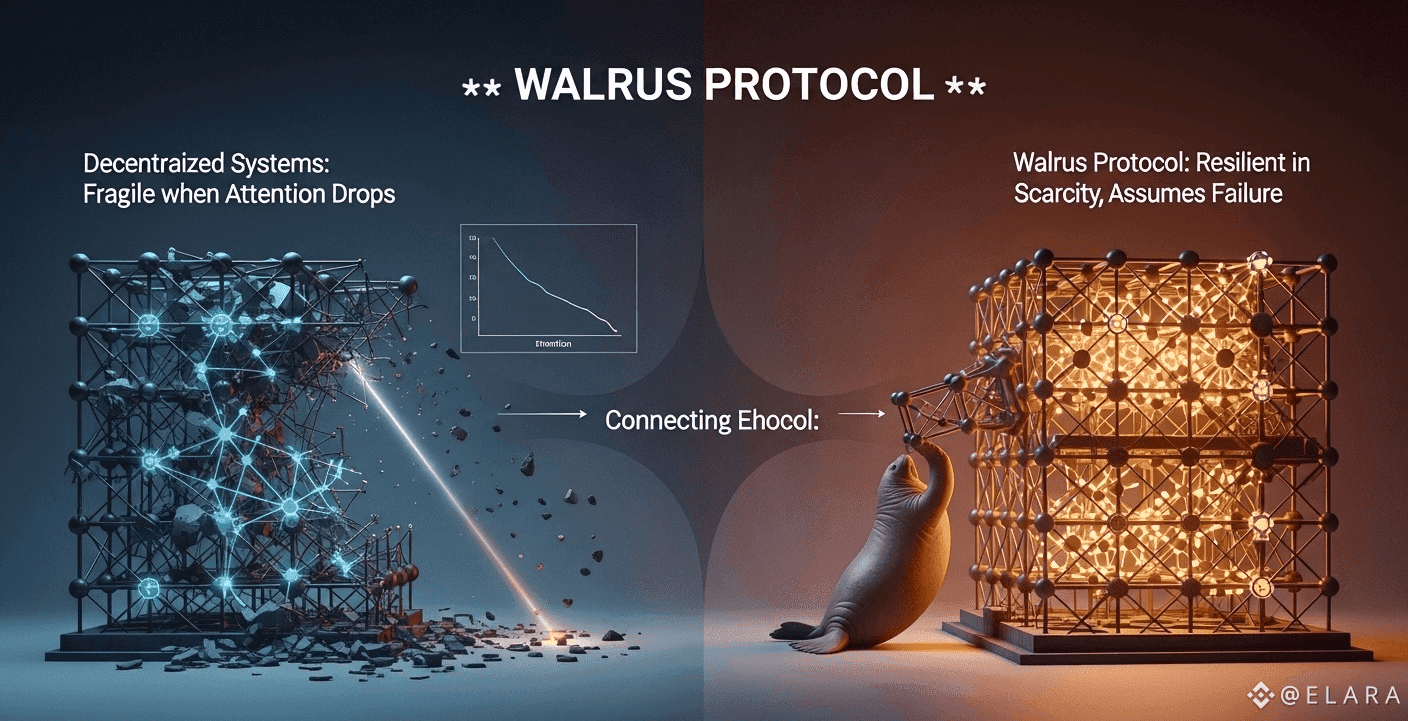
One of the biggest weaknesses of decentralised infrastructure is that it is often invisible. Storage happens somewhere in the background. Availability is assumed. Users only notice when something breaks.
Walrus takes a different approach.
With wal.app, Walrus is not just exposing storage functionality. It is exposing responsibility. The app makes data persistence something users and builders can see, inspect, and reason about instead of trusting blindly.
This matters because decentralized storage is not intuitive. Protocols talk about encoding schemes, fragments, and nodes, but users care about simpler questions. What data is stored? How long will it stay available? What does it cost? What happens if activity drops?
wal.app exists to answer those questions directly.
Instead of treating storage as “upload and forget,” the interface reflects Walrus’ core philosophy: storage is an ongoing state. Data remains available because the protocol continues to enforce it, not because nothing goes wrong.
Through wal.app, users can see stored objects, understand how they are organized, and connect storage actions back to the protocol’s economics. This visibility builds trust. Invisible infrastructure is easy to ignore. Visible infrastructure forces accountability.
For builders, wal.app reduces friction. Instead of relying on custom scripts or centralized dashboards, developers can inspect stored data, reason about availability, and integrate storage logic into applications with more confidence. This is especially important because many Web3 applications fail silently. Smart contracts keep working while their data disappears.
wal.app makes that failure mode harder to ignore.
It also clarifies the role of the $WAL token. Without an interface, infrastructure tokens often feel abstract. With wal.app, the connection becomes concrete. WAL pays for persistence. WAL incentivizes operators. WAL ties cost directly to durability.
This shifts WAL away from speculation and toward responsibility. Its value is tied to how much data people are willing to trust the network with over long periods of time.
The existence of wal.app also signals something deeper about Walrus as a project. It is not optimizing for short-term adoption metrics. It is building tooling for systems expected to still matter years from now, when hype cycles are gone and only infrastructure remains.
Decentralization rarely fails dramatically.
It fails when systems forget what they were built on.
Walrus and wal.app exist to make sure decentralized systems can remember.