
Economic model analysis is actually a translation, translating all the words about "opening blind boxes", "releasing", "trading", "output", and "dropping" into "where the funds flow, who benefits, and where the final value is captured". #BIGTIME#
Regarding Big Time’s current economic model, I have the following views:
For Big Time, there is only one faucet, but there is a lack of rigid demand sinks in the game. Players usually buy NFTs and then earn TIME in the secondary market to make back their investment. TIME actually has no strong consumption scenario and is mainly used for mining and selling on the market.

In addition, the token has no fund flow repurchase mechanism, and the circulating market value is relatively small (US$2 million yesterday and US$30 million today), which is obviously mismatched with the rumored valuation of US$300 million to US$600 million in the primary market. Except for those who traded on MEXC, everyone else is struggling to get their money back.
So, where is the final value capture? It is mainly reflected in OpenLoot, which includes the sales of first-legal currency equivalent soft currency and blind boxes, as well as 5% transaction fees for all future NFT transactions. This will bring a stable cash flow to the team.
However, while cash flow is critical to the team, long-term value capture of the token is also important. Big Time’s design clearly does not pay enough attention to long-term value capture of the token. The In-app Taxation design we proposed previously has many similarities with it, including the separation of levels and functions and the use of randomness, which can increase the transaction frequency of the token and provide opportunities for long-term value capture of the token. Unfortunately, I don’t see Big Time paying enough attention to the latter.
IAT’s design has the potential to replace the traditional dual-token model and NFT, especially for complex and multi-layered game ecosystems. But it also makes me feel that a game with only IAT may become boring.

Finally, Big Time also did not pay enough attention to the consumer layer. The items in the game are mainly for ROI-oriented mining logic, and even the color and level of the skin are related to the character's attributes. The association between appearance and numerical values is unwise. If you want to create an appearance/conspicuous consumption market, you must give up numerical attributes.
In summary, without considering tokens, as the first Web3 native MMO game, Big Time has already lost half. Is this due to the founders' limited game knowledge and eagerness to profit, as well as the mismatch of the third-party operation team, or is it because of the industry's impetuousness and the nature of difficult breakthrough innovation? Should we expect the Web3 version of EVE Online? Or continue to look forward to MMO games supported by digital assets? In the future, what will the gaming industry look like? It is worth mentioning that server problems and asset errors should not appear in games at this stage.
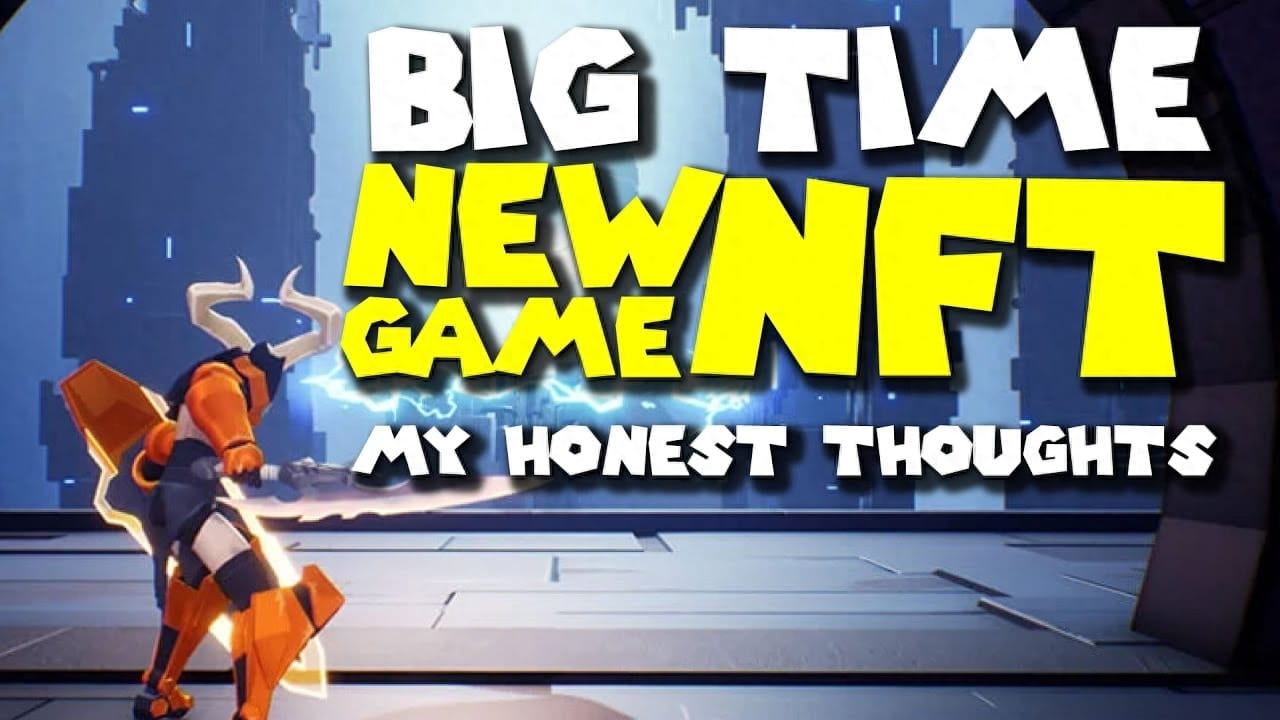
The operation of this token sale has received different evaluations in the market, but the Web3 game team should pay more attention to the Big Time team, which has been conducting NFT sales for the past two years, including promotion and sales, and has gone all out to operate the coin holding community. This may be a precursor to today's incident. This operation may only be applicable to game projects with high visibility, high potential and a large number of assets issued, and it is difficult to replicate, but Big Time played its own cards and took a path that suits it. However, I remind all game teams that they should return to community users, especially to go beyond the stock and achieve growth.