


Bank of America and Fidelity Management recently purchased over $85 million worth of MicroStratefy's MSTR shares.
As per analysts, inflation is still running high, which could worsen the economic conditions resulting in a recession by mid-2023.
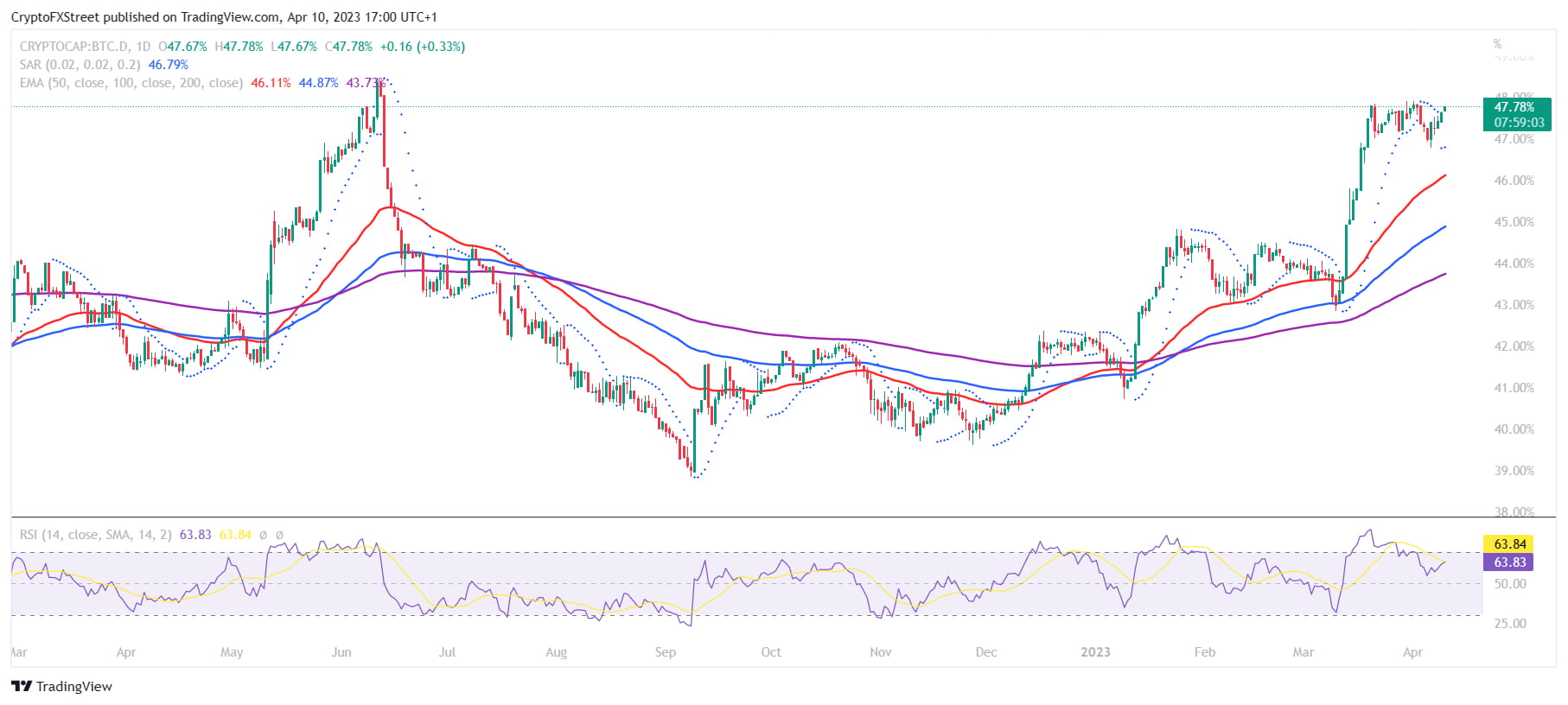
Bitcoin dominance has seen a recovery in the past few days, which could end up being bullish for its price.
Bitcoin has been expected to benefit from the recent bank failures, but this effect is not only visible to the average Joe but to Banks as well. The fall of Silicon Valley Bank, Signature Bank and Silvergate Bank, along with the worsening economic conditions, could act as a potential trigger for a rise in faith in crypto assets.
Banks' reliance on Bitcoin and cryptocurrencies
In an interesting development, the facilitators of the fiat currency have seemingly moved their trust into digital currencies. Banks, by the looks of it, are indirectly stocking up on Bitcoin over the last couple of months as analysts continue to deem the United States' economy doomed.
Recent reports highlighted that the Bank of America (BoA) and Fidelity Management bought more than $85 million worth of MicroStrategy's MSTR shares in Q1 this year. The Michael Saylor tech company has been an avid accumulator of BTC and, over the last two years, has acquired 140,000 BTC worth over $4.1 billion.
The company is basically tied to Bitcoin, and its CEO, Saylor, in the past has indicated that over time the cryptocurrency's rising value will justify the company's recent decisions. However, BoA and Fidelity are not the only ones that seem to believe in these claims. Other banks, including Morgan Stanley and State Street Corporation, are also heavily bullish on BTC. Combined, these banks hold over $93 million worth of shares in MicroStrategy.
While many banks have been critical of cryptocurrencies in the past, the Bank of America has stated that Bitcoin acts similarly to Gold as a safe haven. Calling it an inflation hedge due to its fixed supply, BoA considers it to be a safer investment amidst the uncertain macro environment.
The bank's global research team, in a recent report, also stated,
"Digital currencies appear inevitable. We view distributed ledgers and digital currencies, such as CBDCs and stablecoins, as a natural evolution of today's monetary and payment systems."
Bitcoin investment might work out as economic conditions worsen
Over the last few months, the Consumer Price Index (CPI), aka inflation rate, has been a matter of concern. Despite the inflation rate being set to reduce to 5.2% Year on Year for the month of March 2023, it is still above the Federal Reserve's target rate. With inflation still running high, the spending power could potentially bear a significant impact.
The consequent impact of this on the worsening economy is expected to result in a recession by mid-2023. The Conference Board last month, in its economic forecast, stated,
"We continue to forecast that the US economy will slip into recession in 2023 and expect GDP growth to contract for three consecutive quarters starting in Q2 2023. These changes to the quarterly forecast result in an upgrade to our annual forecast for 2023 and a downgrade to our annual forecast for 2024."
Further, making a case for Bitcoin is the digital asset's increasing dominance in the crypto market. Although BTC dominance was expected to be on a decline, it recovered in the last few days and is holding strong at the moment at 47.78%. This might even end up killing the chances of an alt season, which in return is again good for BTC.
Hence, the banks' inflation hedge might play out in their favor if the aforementioned conditions are met, potentially increasing investors' confidence in the crypto market.