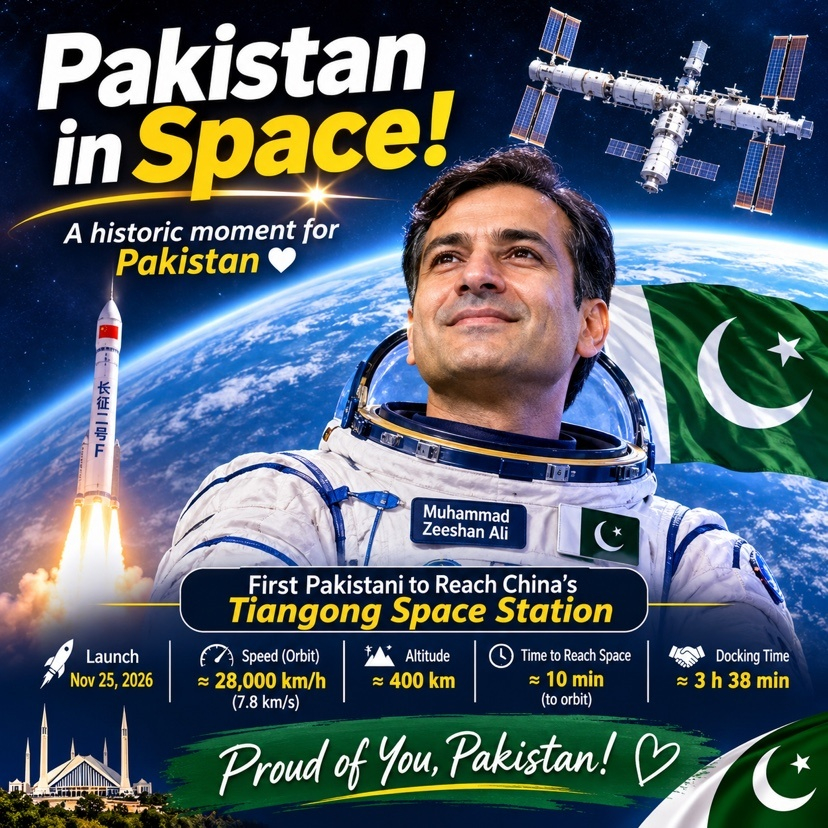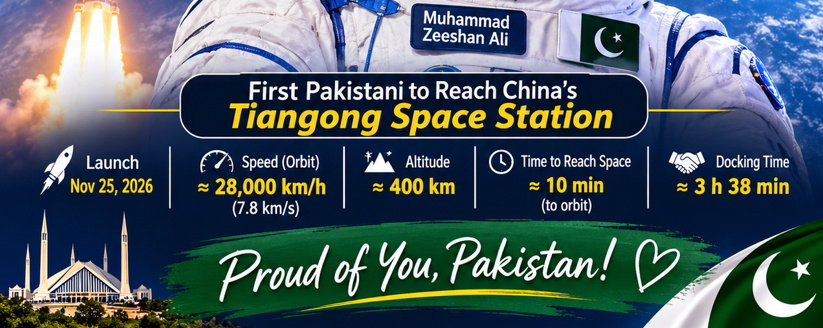

Pakistan has been working with China on sending a Pakistani astronaut into space. The mission is particularly important because it could make a Pakistani the first Pakistani astronaut to travel to China’s Tiangong Space Station.
Let me explain the journey, including speed, altitude, distance, launch, and how long it takes to reach space.
1. Who is the Pakistani astronaut?
Muhammad Zeeshan Ali
Age: 40 years
Background: Pakistan Air Force pilot
Role: Payload specialist
Mission: China’s Shenzhou-24
Destination: Tiangong Space Station
He travelled with two Chinese astronauts:
Tang Hongbo: Mission commander.
Wu Yi: Flight engineer.
Muhammad Zeeshan Ali: Pakistani payload specialist.
He became the first Pakistani to travel into orbital space and the first foreign astronaut to visit China’s Tiangong space station. Dawn +1
2. Has he already reached space?
Mission successfully launched and docked
Yes! As of November 25, 2026, the mission has successfully reached the Chinese space station.
Event
Beijing time
Rocket launch
8:18 AM
Spacecraft entered orbit
Around 8:28 AM
Space station docking
11:56 AM
Docking journey
About 3 hours 38 minutes
The launch took place on November 25, 2026, from Jiuquan Satellite Launch Centre in northwest China. RTHK +1
3. How fast does the spacecraft travel?
This is probably the most interesting part!
Once the spacecraft reaches its orbital speed, it travels approximately:
Approximate orbital speed
28,000 km/h
Approximately 7.8 kilometres per second
467
Kilometres per minute
7.8
Kilometres per second
These are approximate speeds for low Earth orbit, not a published live speed reading for Zeeshan’s spacecraft.
To understand how fast that is:
Riyadh to Islamabad is roughly 2,500 km.
At 28,000 km/h, that distance would take about 5 minutes and 20 seconds.
The spacecraft can circle the Earth approximately every 90 minutes.
This is orbital speed, not the speed maintained throughout the entire launch and docking process.
4. How many kilometres above Earth?
The Tiangong Space Station orbits approximately 400 km above Earth’s surface.
For comparison:
Location
Height above Earth
Commercial passenger aircraft
10–12 km
Edge of space (commonly used 100 km boundary)
100 km
Tiangong Space Station
Around 400 km
So Zeeshan is travelling approximately 400 kilometres above the Earth.
One important point: space doesn’t have a universally agreed physical starting line. The 100 km Kármán line is a commonly used boundary.
5. How long does it take to reach space?
There are two different milestones:
Around 10 minutes: The spacecraft separates from the rocket and enters its planned orbit.
Around 3 hours 38 minutes: It completes its rendezvous and docks with the space station.
So he didn’t need 3.5 hours just to reach space. Most of that time was spent travelling towards and connecting with the station. ecns.cn +1
6. How long will he stay in space?
His visit is expected to last approximately one week, with reports giving a range of 5–10 days.
He is expected to return to Earth aboard China’s Shenzhou-23 spacecraft rather than the Shenzhou-24 that took him there. Dawn +1
7. What will he do in space?
He isn’t going just for sightseeing. He will participate in scientific research.
Some of the experiments include:
Studying microalgae and their potential as a source of food and oxygen.
Testing how spaceflight affects quinoa seeds.
Researching biological processes in microgravity.
Participating in scientific experiments with Chinese astronauts.
The overall mission involves approximately 90 scientific experiments and technology tests. Dawn +1
8. How does he survive in space?
Inside the space station:
Breathing: Oxygen is supplied through the station’s life-support system.
Food: Astronauts eat specially prepared space food.
Water: Water is recycled and purified.
Sleeping: Astronauts sleep in secured sleeping bags.
Walking: They don’t walk normally. They float because of microgravity.
Exercise: They exercise daily to protect their muscles and bones.
9. What rocket carried him?
The rocket was China’s Long March-2F, carrying the Shenzhou-24 spacecraft.
Launch location: Jiuquan, China.
Rocket height: Approximately 58 metres.
Crew: Three astronauts.
Destination: Tiangong Space Station.
The rocket provides the enormous thrust needed to lift the spacecraft out of Earth’s atmosphere and accelerate it into orbit. Shenzhou 24 +1
10. Where is he travelling?
His destination is China’s Tiangong Space Station.
It is not the Moon, and he is not travelling to another planet. He is orbiting Earth.
11. One interesting historical detail
Pakistan’s Namira Salim had already become the first Pakistani citizen to reach the edge of space in October 2023 on a suborbital Virgin Galactic flight.
However, Zeeshan Ali’s achievement is different: he is the first Pakistani to travel into orbital space and visit an operational space station. Dawn +1
12. Watch the mission and read the news
Here are some reports covering the historic flight:
Dawn: Zeeshan Ali becomes first foreigner to board China’s space station
Reuters: Pakistani astronaut boards Tiangong
Al Jazeera: Pakistan’s Zeeshan Ali’s historic flight
Xinhua: Official launch and docking details
My final takeaway: A Pakistani astronaut has now travelled approximately 400 km above Earth, reached orbital speeds of around 28,000 km/h, and joined China’s space station after just 3 hours and 38 minutes of flight.
This is a historic achievement for Pakistan. 🇵🇰🚀