

Published by Cryptic.
Tokenized real-world assets have crossed $31 billion according to rwa.xyz, as of mid-2026, driven by institutional adoption and regulatory clarity across the EU, UAE and Singapore. Choosing a platform is one of the biggest decisions for a project or fund tokenizing assets.
What to check first:
Compliance: does the platform handle KYC and AML natively?
Asset classes: not every platform covers real estate, credit, bonds and equity.
Jurisdictions: MiCA, VARA, SEC and MAS. Cross-border capability matters.
White-label and API access: can you embed it in your own product?
Secondary market: how will investors exit?
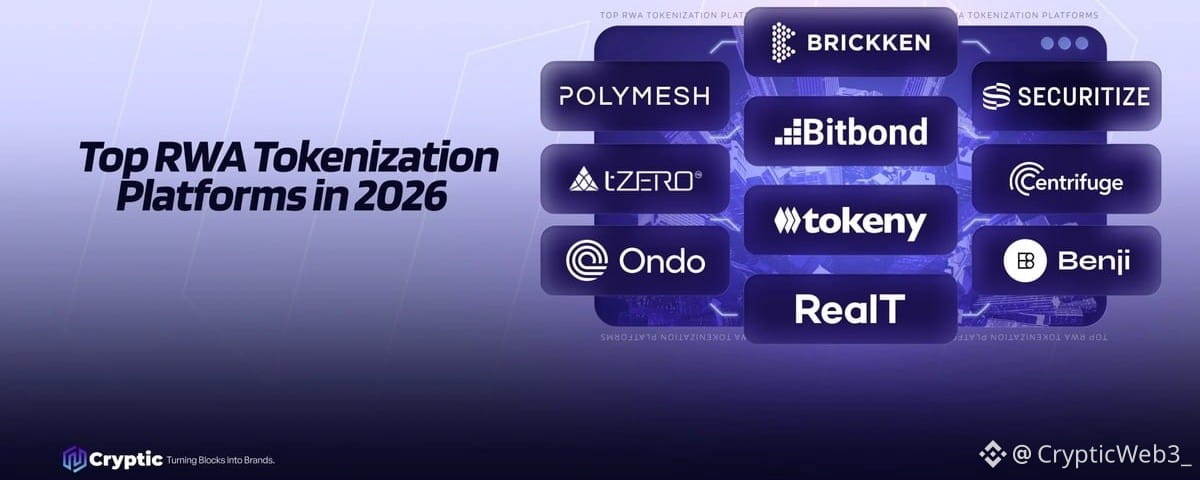
Ten platforms, by use case
Brickken: institutional-grade infrastructure across the full lifecycle of financial instruments. Supports real estate, equity, debt, private credit, commodities, carbon credits and intellectual property. ISO 27001:2022 certified with a DORA-aligned framework. For enterprises, financial institutions and fund managers.
Bitbond: bank-grade tokenization technology and advisory, BaFin-regulated. It ran Europe's first regulated security token offering in 2019. For European companies issuing tokenized debt.
Tokeny: created the ERC-3643 token standard, which has enabled more than $28 billion in tokenized assets across 180+ jurisdictions. Strong EU focus. For EU-based institutions and cross-border regulated issuance.
Polymesh: a blockchain built for regulated assets, with identity verification and compliance enforced at the protocol level. For institutions that need compliance at the infrastructure layer.
Ondo Finance: the dominant platform for tokenized US Treasuries, with over $2.6 billion in TVL as of early 2026. OUSG serves institutions and USDY serves DeFi. For compliant on-chain yield.
Centrifuge: connects real-world private credit to DeFi liquidity pools, with senior and junior tranche structures. For asset originators and DeFi-native capital pools.
tZERO: a regulated Alternative Trading System for digital securities, with over 44 million shares traded since its founding in 2014. It is a trading venue rather than a full tokenization stack. For US private market issuers that need compliant secondary trading.
Securitize: an SEC-registered transfer agent covering issuance, compliance and secondary trading through its own ATS. Closely associated with BlackRock's BUIDL and Hamilton Lane. For institutional asset managers.
Franklin Templeton's Benji: launched in 2021 as the first SEC-registered mutual fund on a public blockchain. The BENJI suite passed $1.98 billion in assets under management across nine blockchain networks as of April 2026, per Franklin Templeton. For institutions seeking regulated on-chain yield.
RealT: fractional ownership of US residential and commercial property, with a separate LLC for each asset. Rental income is paid weekly in stablecoins. For retail investors seeking tokenized real estate yield.
How to choose
The right platform depends on four things: asset class, jurisdiction, investor profile and technical resources. Brickken is the most direct path for enterprises that want to go live fast across several asset classes. In the US, Securitize is the benchmark when regulatory status matters most. When MiCA drives the decision, Tokeny's ERC-3643 architecture is the strongest option.
Secondary market liquidity is still one of the weakest links. Unless you use a platform with a built-in trading venue, such as Securitize or tZERO, plan how investors will exit before you launch.
Full guide with the complete list and FAQs: https://crypticweb3.com/top-rwa-tokenization-platforms/?utm_source=binance_square&utm_medium=article&utm_campaign=bs_republish