
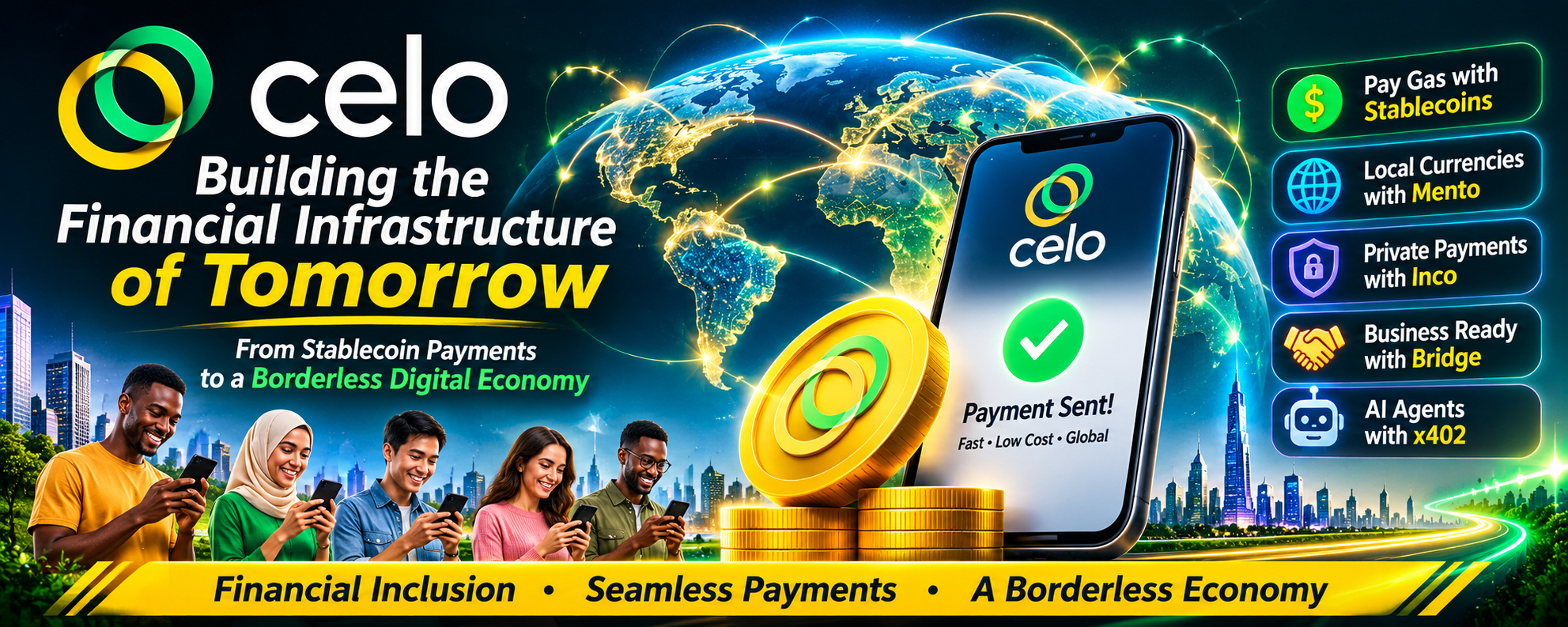

Celo Is Building the Financial Infrastructure of Tomorrow: From Stablecoin Payments to a Borderless Digital Economy
What if sending money across countries became as simple as sending a message?
What if people could pay transaction fees using the same digital dollars they were already holding?
And what if blockchain technology could support payments in local currencies without forcing everyone to understand complicated crypto infrastructure?
These are the problems Celo is trying to solve.
While much of the blockchain industry continues competing around trading, speculation and DeFi incentives, Celo is developing a different vision: making blockchain technology useful for everyday financial activity.
Its evolution into an Ethereum Layer 2 is only one part of that story.
The bigger story is the financial infrastructure being built around it.
1. Celo's Original Vision Was Always About Financial Access
Celo launched its mainnet in April 2020 with a clear mission: make financial tools accessible to people around the world.
Its approach was different from networks primarily designed around institutional finance or speculative trading.
Celo focused on mobile accessibility, affordable transactions, stablecoins and financial inclusion.
That vision influenced several important design decisions.
For example, Celo introduced phone-number-based addressing to make payments more approachable and developed native fee abstraction so users could transact without always needing to hold CELO.
These ideas remain relevant today, even after its transition to Ethereum Layer 2 in March 2025.
Celo did not abandon its original identity. It changed its underlying infrastructure while continuing to pursue the same financial mission.
2. One of Celo's Most Interesting Features: Paying Gas With Stablecoins
Think about a normal blockchain transaction.
You want to send USDC, but you do not have the network's native gas token.
You first need to purchase that token, transfer it to your wallet and then complete your transaction.
For beginners, this creates unnecessary friction.
Celo addresses this through a feature called Fee Abstraction.
It allows supported ERC-20 tokens to be used to pay transaction fees.
For example, users can pay gas using supported assets such as:
- USDC
- USDT
- cUSD
- cEUR
- cREAL
This changes the user experience considerably.
Someone who already holds stablecoins does not necessarily need to purchase a separate token just to complete a transaction.
Ledger also introduced support for Celo's fee abstraction through CIP-64, expanding access to stablecoin-based gas payments for its wallet users.
This is an important lesson for the blockchain industry:
Adoption does not only depend on faster technology. It also depends on removing unnecessary steps.
3. Mento: Bringing Local Currencies Onchain
One of Celo's most interesting ecosystem components is Mento.
Mento focuses on creating and managing digital assets linked to different fiat currencies.
Why does this matter?
Most stablecoin conversations revolve around the US dollar.
But the global economy does not operate using only dollars.
People in Brazil use the Brazilian real. People in Nigeria use the naira. People in Indonesia use the rupiah.
A financial network supporting local-currency stablecoins can create opportunities for payments and onchain foreign exchange without requiring every user to begin with USD.
Celo's Mento ecosystem has expanded to support more than 30 local-currency stable assets, according to its November 18, 2026 community update.
Some examples include:
- BRLm for the Brazilian real.
- cNGN for the Nigerian naira.
- IDRX for the Indonesian rupiah.
- KES-linked assets for the Kenyan shilling.
- EUR-linked assets for the euro.
The bigger opportunity is onchain FX.
Imagine a business receiving payments in one currency and settling obligations in another.
Blockchain-based currency markets could make these financial connections more accessible.
Of course, real-world adoption still depends on liquidity, reliable redemption, regulatory compliance and trustworthy reserve management.
4. A Major Governance Development: Mento Issuance Returns to Celo Governance
An important development happened in 2026.
Following Mento governance proposal MGP-19 and Celo governance proposal CGP-253, authority over the issuance of Mento stable assets returned to Celo Governance.
The November 18 community update explained that the governance structure now covers 15 Mento stable assets and associated protocol infrastructure.
The AP Reserve Foundation was also confirmed as steward of the Mento Reserve's assets and revenue.
Why is this significant?
Stablecoin infrastructure is not just about creating tokens.
It also requires transparent governance, reserve management, risk controls and clear accountability.
Bringing issuance authority under Celo Governance makes this an important development for the network's long-term financial architecture.
It also makes governance decisions worth following closely.
5. Private Payments: Another Important Piece of the Puzzle
Financial transparency is one of blockchain's greatest strengths.
But it can also create challenges.
Imagine a company paying employees or a business settling commercial invoices.
It may not want every transaction amount and financial relationship publicly visible to the entire internet.
This is where privacy-focused infrastructure becomes important.
In August 2026, Inco deployed on Celo, introducing infrastructure for private payments.
The broader opportunity is to combine blockchain settlement with privacy features that make financial applications more practical.
This could be useful for businesses, payment providers and applications that require greater confidentiality.
However, privacy infrastructure must also balance user protection, security and applicable compliance requirements.
The goal is not to remove transparency entirely, but to make financial privacy possible where appropriate.
6. Celo Is Expanding Beyond Retail Payments
Another important development is Celo's growing institutional payment infrastructure.
In May 2026, Bridge added support for Celo.
Bridge is a Stripe-owned stablecoin infrastructure platform designed to help businesses integrate stablecoin payments and financial services.
This is significant because businesses need more than a blockchain.
They need:
- Stablecoin issuance and management.
- Payment processing.
- Onramps and offramps.
- Liquidity infrastructure.
- Developer-friendly integrations.
Celo reported more than $65 billion in stablecoin volume since its March 2025 L2 migration in the announcement.
The same announcement reported more than 1.3 billion lifetime transactions and over 600,000 daily active users.
These are project-reported figures, but they help illustrate the scale of activity Celo is targeting.
The important question is whether this activity continues growing sustainably.
7. AI Agents Could Become the Next Users of Celo
The future of digital payments may involve more than humans.
AI agents are increasingly capable of finding services, processing information and performing digital tasks.
But an autonomous agent also needs a way to pay for those services.
Celo is exploring this through x402.
The protocol allows internet services to request payments through HTTP-based payment flows.
Celo's native facilitator supports stablecoin payments across multiple currencies.
Its October 2026 developments also introduced the buy marketplace, allowing AI agents to access more than 700 services.
This creates an interesting possibility:
An AI agent could purchase digital services and settle payments using supported stablecoins without relying on a traditional checkout process for every interaction.
It is still an emerging market, but it introduces a new potential source of blockchain payment activity.
8. What Is Celo Working Toward Next?
Celo's H2 2026 engineering roadmap identifies several important priorities.
Execution infrastructure: The planned migration from op-geth to op-reth aims to align Celo with the broader Ethereum ecosystem.
Faster confirmations: The roadmap includes an Espresso rollout, intended to reduce confirmation latency through decentralized sequencing infrastructure.
Improved security: Further work on fault proving and reducing trust assumptions remains a major priority.
Better developer infrastructure: Improvements to node operations, public RPC infrastructure and development tools are also part of the plan.
These are roadmap objectives, not all completed upgrades. Their delivery and implementation will be important to watch.
9. The CELO Token and Network Economics
CELO is the native asset of the ecosystem.
It plays an important role in network fees, governance and the broader economic structure.
But an important development is the growing discussion around how network usage can translate into value for the token ecosystem.
Celo's 2026 tokenomics initiatives include directing sequencer revenue toward the Community Fund through governance-approved mechanisms.
A summer 2026 ecosystem update also described programmatic CELO buybacks using non-CELO revenue.
This is worth monitoring because it connects network activity with the token's economic model.
However, investors should distinguish between revenue, token buybacks, circulating supply and actual market demand.
A successful payment network does not automatically guarantee appreciation in its native token.
10. The Bigger Picture: Celo Wants Blockchain to Disappear Into Everyday Finance
The most interesting part of Celo's strategy is that its success does not necessarily require every user to become a crypto expert.
A person should be able to receive money, make payments, access stablecoins and interact with financial applications without understanding every technical detail happening underneath.
That requires more than a fast blockchain.
It requires:
- Affordable transactions.
- Reliable stablecoin liquidity.
- Local-currency support.
- Easy wallet access.
- Financial privacy.
- Business integrations.
- Strong security.
- Sustainable network economics.
Celo is attempting to bring these components together.
There are still challenges around decentralization, liquidity, regulation and long-term adoption.
But its direction is clear.
Final Thoughts
The blockchain industry has spent years trying to convince people to use crypto.
Celo is taking a different approach: building infrastructure that makes using blockchain feel like an ordinary financial activity.
Its Ethereum Layer 2 architecture connects it to a wider ecosystem. Fee abstraction reduces the friction of transactions. Mento expands local-currency possibilities. Inco introduces private payment infrastructure. Bridge strengthens institutional integrations. And x402 opens the door to payments between autonomous AI agents.
These developments represent something bigger than another Layer 2 competition.
They represent an attempt to make blockchain useful across the entire financial experience.
The future of crypto may not be about making everyone understand blockchain. It may be about making blockchain useful enough that people no longer need to think about it.
And Celo is building toward that future.
